Notes of MATH SPECIAL BATCH, Maths Square root and cube 26-Aug-2020 15-36-44.pdf - Study Material
Page 1 :
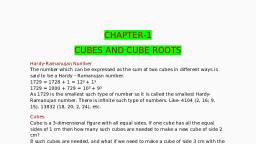
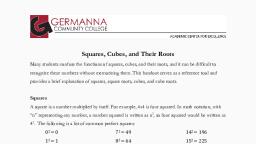
4 CHAPTER 3, , SQUARE-SQUARE, , ROOT AND CUBE-CUBE, , ROOT, , , , After analysing the previous years’ question papers it is found that, in CTET Examination in year 2011, 2 questions; in 2012, 4, questions; in 2013, 4 questions; in 2014, 6 questions; in 2015, 4, questions; in year 2016, 7 questions; have been asked from this, chapter. Mostly questions have been asked from the topics square,, , cube roots and their applications., , , , 3.1 Square, , if a number is multiplied by itself, then the result of this, multiplication is called the square of the number., , eg. Square of 8 is8x8=64, Square of 25 is 25x 25= 625, , &\ The square of an even number is always even and the square of an, , odd number is always odd., 3.1.1 Square Root, , The square root of a number is a value that, when multiplied by, , itself, gives the number. It is denoted by the sign “J”., e.g, Square root of 64 is 8, because 64 is square of 8,, , 3.1.2 Methods of Finding the Square Root, , There are two methods of finding the square root of numbers,, , which are as follow, 1, Prime Factorisation Method, , To find the square root by factorisation method, we can use the, , following steps, , Step1 Express the given number as the product of prime factors., , Step Tl Keep these factors in pairs,, , <, , Step IM Take the product of these prime f., ep taking one out of every pair of ieee, primes. This product gives us the, , , , , , , , , , root of the given number, SdUare, Example 1 Square root of 1089 is, (1) 32 (2933 (3)36 ax, Solution (2) Since, 11| 1089, Tip 99, 3| 9, “3/3, TT 4, , , , . Prime factors of 1089 = 11x 11x 3x3, , Now, taking one number from each pair and multiplying, together then, we get ¥1089 = 11x 3 = 33, , Z\ By prime factorisation method, we can find the, square root of only perfect square number. if we, don’t get complete pairs of factors, then given, number is not a perfect square number, This, number may be converted to a perfect number by, multiplying or dividing it by a required number., , Example 2 What least number should be, multiplied to 245 to make it a perfect square?, , , , , , , , (1) 2 2) 3 @).5 47, Solution (3) 5 | 245, “7/49, “77, —~T 4, 245=5x7x7, , Here, pair of factor 5 is not complete. So, if we muttiply it by, 5, we get a perfect square number., , Hence, required number is 5., 2. Division Method, , ‘The steps of this method can be easily understood, with the help of following examples., , , , Example 3 Find the square root of 18769., (1) 135 (2) 149 (3) 137 is, Solution (3), , ‘Step | In the given number, mark off the digits in pars, Starting from the unit digit. Each pair and, Temaining one digit (if any), is called a pe"?, , 137, , 1{ 18769, spent cn, 23) 87, ~~} 89 __, , 267| 1869, nf 1869,, x
Page 2 :
2 ", step | Now, 1" =10n subtracting, we get 0 (zero) as remainder., , step IIl_ Bring down the next period, i.e. 87. Now, the trial divisor is, 1x2 =2 and trial dividend is 87. So, we take 23 as divisor, and put 3 as quotient. The remainder is 18 now., , step 'V Bring down the next periad, which is 69. Now, the trial, divisor is 13 x 2 = 26 and trial dividend is 1869. So, we take, 267 is dividend and 7 is quotient. The remainder Is 0 now., , Step V_ The process (processes like Ill and IV) goes on till all the, periods (pairs) come to an end and we get remainder as 0, (zero). Hence, the required square root = 137., , Example 4 What is the square root of 151321?, ; (1) 389 (2) 441 (3) 361 (4) 344, ' Solution (1) 389, 151324, 9, 613, 544, 6921, 6921, x, , , , | 2| |, , , , x, 2, o, , |, , , , . Required square root = 389, , » AX We should apply division method when the number is so, large that it is very difficult to find its square root by prime, factorisation method., , | 3.13 Square Root of a Fraction, , t To find square root of a fraction, we have to find the square, roots of numerators and denominators, separately., , , , | Examples ,|2704 9, 81, 52 58 42 48, 1) 2S (2) = (3) —— 4, me az @ 3, F solutt, : ‘olution (1) D, 5| 2704, 25, 702| 204, __| 204, x*, , , , , , 461, ; Gample 6 Find the square root of a, , , , (1) 8.161 (2) 15:14 (3) 7.5911 (4) 9.32, Solution gy [@B1 _ (HOH? _ [922 022 90.6444, 8 er Yexe Vie Je 4, ' = 7.5911 {approx.], , are not a complete, , A Someti denominato' rs, : times, numerator and ert the given fraction, , Square. In such cases, it is better to conv, into decimal fraction to find the square root., , 3.1.4 Square Root of Decimal, Numbers, , If in a given decimal number, the number of digits after, decimal are not even, then we puta 0 (zero) at the, extreme right, so that these are even number of digits, after the decimal point. Now, numbers are paired, starting from right hand side before the decimal point, and from the left hand after the decimal digit., eg. 156.694, There are odd number of digits after decimal. So, we put, a zero after the digit, so that there are even digits after, the decimal 156.6940., Now, pairs are marked as, , Direction of making, , 156 * 69 40, After the pairs are marked, division method is used to, find the square root., Example 7 Find the square root of 147.1369., (1) 12.14 (2) 12.13 (3) 13.26 (4) 13.13, , Solution (2) Here, 147,1369 contains even digits after decimal,, so there is no need to add zero after the last digit, now period are, marked as 147.1369., , 12.13, 147.1369, 1, , 22) 47, , 44, , ail 313, 241, 7269, 7269, So Se, , 2423, , , , . Required square root = 12.13, , To Find the Square Root of Decimal, , Fraction, , To find the square root of any decimal number, firstly, we find the square root of numerator and denominator, separately of given decimal number., , PB, 1.€. i, Seem, , q V4, eg. a4 [lad _ v144, ee 421 12, , 1x11 11 11
Page 3 :
Important facts related to square and square roots, , () Ifthe square of any number ends with 1, then its square, root will end with 1 or 9., , (ii) Ifthe square of any number ends with 4, then its square, root will end with 2 or 8., , (iii) If the square of any number ends with 5, then its square, root will end with 5., , (iv) Ifthe square of any number ends with 6, then its square, root will end with 6., , (v) If the square of any number ends with 9, then its square, root will end with 3 or 7., , (vi) The square of any number always ends with 0, 1, 4, 5, 6, or 9 but will never ends with 2, 3, 7 or 8., , (vii) Square root of negative number is imaginary., , Example 8 The square root of ee is, , 24, a), , 25, 25 a5., OF, , 25, (4) 2, (4) 7, Solution (2) Given, decimal fraction = 8:25 _ 625, 676 676, eB _ I, Vere, , 676, _ _fSx5x5x5, y2x2x 13x13, , Now,, , , , 3.2 Cube, , If a number is multiplied twice by itself, then the result of, this multiplication is called the cube of that number., , eg. Cube of 6 is6 x6 x6=216, Cube of 8 is8 x8 x8 =512, , 3.3 Cube Root, , The cube root of a given number is the number whose cube, is the given number. The cube root is denoted by the sign, eyf, , eg. ()¥8 =Y2x2x2=2, (ii) ¥512 = 98 x8 x8 =8, , Method of Finding the Cube Root, , There is only one method to finding the cube root, which ig, given below, , Prime Factorisation Method, , To find the cube root by factorisation method, we can use, the following steps, Step I Express the given number as the product of prime, factors. ,, StepIl Make these factors in pairs of three each,, , Step III Take the product of these prime factors taking one, out of every pair of the same primes., , This product gives us the cube root of the given, number., , Important facts related to cube and cube roots, , (i) If the cube of a number is of 2 or 3 digits, then its cube, root will be 1 digit., , (ii) If the cube of a number of 4, 5 or 6 digits, then its cube, root will be of 2 digits., , (iii) If the cube of a number have 0, 1, 2, 3, 4,5, 6,7, 8, 9 in its, unit’s place, then its cube root will have 0, 1, 8, 7, 4,5,6,, 3, 2 or 9 in their unit’s place, respectively., , (iv) There are only three numbers whose cube is equal to, the number, , ie, (0)? =0, (1)? =1, (-1)? =-1, i, (v) if 2 is a fraction then fe = XP, q q Va, integers., (vi) If p is an integer, then Y— p.=— ¥p., , Example 9 Cube root of 19683 is, , (1) 19 2) 23 (3) 27 (4) 29, Solution (3) 19683 = 3x 3x3x3x3x3x3x3x3, , 19683 = 3x 3x 3=27, , Example 10 Find the value of ‘ S000728, 0.085184, , 9 7, (1) a (2) a 3) 3, , where p and q are, , 6, (4) 2., a (4) 44, Solution (1) {0900729 _ | 729 _ [_9x9x9 _ 9, 0asie4 Vasiea Vaaxagxad 4d, Example 11 Find cube foot of — 5832,, , (6 (2)-18 (3)16 (4)18, Solution (2) 9(- 8632) =~ yeags . PlOxS IS = 18
Page 5 :
4 CHAPTER EXERCISE, , ¥. If J18 x 14x x = 168, then xis, equal to, , 2 3 2 7, aS (2) = = be, M5 Qe @s @5, , 112 _ J576., 2. The value of ———, Cor vise “a2 **, , (1) 8 (2)12 (3) 16 (4) 18, 3. Which of the following is false?, (1) ¥5184 =72 (2) V15625 = 125, (8) ¥1444 = 38 (4) ¥1296 = 35, 4. (V8 - V4 — /2) is equal to, ()2-v2 (2) v2 -2, (3) 2 (4) -2, ¥8+1 4 ,-28-1, We-1 eer, ate y is equal to, (1) 14 (2) 13. (3) 15 (4) 10, 6. What is the least number to be, multiplied with 294 to make it a, perfect square?, (1) 2 (2)3 (3) 6 (4) 24, 7. What is the least number to be, added to 8200 to make it a perfect, square?, (1) 81 (2) 100 (3) 264, , 8. The value of, , ¥400 + ,/0.04 — {0.000004 is, , (1) 20.22 (2) 20.198, (3) 20.188 (4) 20.022, 9. ¥9/0.004096 is equal to, (1)4 (204 (3)0.04 (4) 0.004, 10. If 4096 = 64, then the value of, , {40.96 + {0.4096 + ,/0.004096, + {0.00004096 is, (1) 7.09, , (3) 7.1104, , 11. Find the square root of 05-5., , , , 5. Ifx=, , , , then, , (4) 154, , (2) 7.1014, (4) 7.12, , 1 12 1 2, (155 @)15 @)105 (4) 65, , 12. If x=2+2 and y=2-2, then, the value of (x* — y*) is, (112 (2)14 (3) BV, , 13. Ifa? =1+7,4 =14+5+5,, 5? <1+ 8+, then the value of, , (4) 18, , at+b+cis, (1) 130 (2) 128, (3) 120 (4) 126, , 14. Given that /3 = 1.732, then the, value of 3+ V6 is, BY — 2Vi2 — /32 + V0, equal to, (1) 4.899 (2) 2.551 (3) 1.414 (4) 1.732, , If a, bare rationals and, , a2 + by3 = 98 + V108 - /48, - V2, , then the values of a, b are, , respectively, , (1,2 21,3 821 (4)23, , fa = 23-2 V3 +2, V3 + V2 v3- 2’, , 2 22, then the value of = + e is, , a, (1)930 (2)970 (3) 1025 (4) 1030, If the expression, , x + 809436 x 809438 be a perfect, square, then the value of xis, , 15., , 16. and b=, , , , , , 17., , (1) 0 @)1, , (3) 809436 (4) 809438, 18. 9/2744+7 is equal to, , (1)14 (2)2 (3) 15 (4) 8, 19. 1331 x ¥216 + 9729 + Y64 is, , equal to, , (1)78 = =(2)79 = (8) 15 (4) 91, 20. 1f(2000)"° = 1.024x10*, then the, , value of k is, , (1/30 (2)31— (3) 33 (4) 34, 21. 1f(125)7° x (625)-!* = 5, then the, , value of xis, , (0 =@1 = =@)2 (4) 3, 22. The value of question mark (?) in, , 612 +16 + 576 =? is, , (1)26 (2)31— (8) 22 (4) 18, 23. What least number should be, , subtracted from 6860, so that 19 be, , the cube root of the result from this, , subtraction?, , (1) 4 (22 (3)3 (4)5, 24, The value of ¥/441 + /16 + V4 is, , equal to, , (3 @5 @)7 (49, 25. The value of ? in, , 90.064 = Y0.027 + 97 is, , (1) 0.027 (2) 0.008, , (3) 0.001 (4) 0.421875, , , , , , 26., , 31., , 32., , The value of 0.09 x 0.000064 is, , (1) 0.036 (2) 0.00036, , (3) 0.36 (4) None of these, If (16)® + (16)* x (16)° = 16*, then x, is equal to, , a)9 28 (@)7 (4) 10, , tf,/5+ Yx =3, then the value of x, , 18, (1)64 = (2) 125 (3) 9 (4) 27, If (10 + ¥x = 4, then what is the, , value of x?, (1) 150 (2)216 (3) 316 = (4) 450, , If m and n are natural numbers,, , then Y/n is, , (1) always irrational, , (2) irrational number unless n is the, mith power of an integer, , (8) irrational number unless m is the, nth power of an integer, , (4) irrational number unless m andn, are coprime, , 3a, (3) = 0.008, then the value of, , (0.25) is *, (1) 20.5 (2)225 (3)0.25 (4)625, , If 2*-1 + 2**1 = 9560, then find, the value of x., , (1) 10 (2) 12, (3)9 (4)8, , (42 x 229) + (9261)" is equal to, (1) 448 (2) 452, , (3).456 - (4) 458, , If 4003250 = 4x 10* + 3x10”, +2x10* +5x10”, then, , x+ y+2z+ wis equal to, , (1) 16 (2) 14, , (3) 12 ~ (4) 10, , Ifa = (2016)? + (2016) + 2017,, , then the value of a is, , (1) 2017 (2) 2016, , (3) 2018 (4) 2019, , n-1 n-3, , (2) * (:) , then the value, q P, , of nis, 1, , Ms, , (3)1, , 7, >, (42., , ia



 Learn better on this topic