Page 1 :
MATHEMATICS, ix PEDAGOGY
Page 2 :
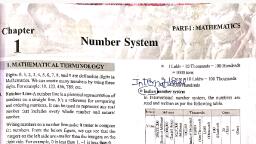
A CHAPTER 1, , NUMBER, SYSTEM, , , , ‘epics operations on decimal numbers, fractions etc., , fer analysing the previous years’ question papers it is found, , nat in CTET Examination in year 2011, 6 questions; in 2012,, , questions; in 2013, 4 questions; in 2014, 12 questions; in 2015,, i questions and in year 2016, 3 questions have been asked,, , som this chapter. Mostly questions have been asked from the, , , , 11 Number, , 4 mathematical symbol represented by a set of digits is, sumber., , 141 Digits, , , , 4 dled digits., 4.2 Numeration System, , ‘sternational system, which are as follow, , “Indian (Hindu-Arabic) System, , called a, , To represent a number, we use ten different basic symbols of, Mathematics Le. 0, 1, 2, 3, 4, 5, 6, 7, 8 and 9. These symbols are, , There are mainly two systems of numeration, Indian system and, , , , , , , , , , , , , , , , os, — In words In figures, oss =o eee y, Ten crore 100000000 0, Crore i ‘, Crore yooov000 | 10, Ten lakh soonova =| 10% 3, oa id 0, Lakh 100000 10, 4, Tho, Ten thousand 10000 10° 0, ‘usand 7, Thousand 1000 | 10 2, Hundred — J00 10* 3, Ones Ten 10 10! id, One 1 10" 6, , On the basis of Indian system, number 43002576 will, be read as four crore thirty lakh two thousand five, hundred seventy six., , 2, International System, , , , , , sa feces secre eg, = | Inwords _| In figures In powers Number, Hundred million | 100000000; i908 | 8, Million Ten million 10000000, 1g? | 4, Million 1000000 10° 3, Hundred thousand] 100000| 40° | 0, Thousand| Ten thousand 10000 | wt | 0, Thousand 1000 | 10? | 2, Hundred 100; 40? | 5, Ones Ten 10| 10! | 7, One 1 io | 6, , , , On the basis of International system, number, 43002576 will be read as forty three million two, , - thousand five hundred seventy six., , Example1 Convert the following numbers into, figures, (i) Eight crore forty seven lakh ninety., (ii) Five million eight thousand ninety four., Solution ()) (8x 10" )+ (4x10°)+ 7 x 10°)+ (9x10), = 84700090, (ii) (6x 10⁸) + (8x10°)+ (9x10')+ (4x 10°), = 5008094, , Example 2 Convert the following numbers into, , words in both Indian and International systems., , (i) 973276 (ii) 1000567, , Solution ()) Indian system Nine lakh seventy three, thousand two hundred seventy six, , International system Nine hundred seventy, three thousand two hundred seventy six, , (i) Indian system Ten lakh five hundred sixty, seven, International system One million five hundred, sixty seven., , Value of the Digits, , There are two values of the digits of any number, which are as follows, , Face value The face value of a digit in a number is, the value of the digit itself. It is known as real value, also., , c.g. In the number 92347, the face value of 9 is 9, face, value of 2 is 2, face value of 3 ts 3 and so on., , Place value ‘The place value of a digit in a number, changes according to its place. Ina number,
Page 3 :
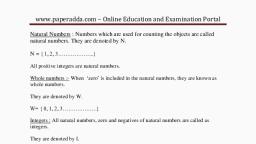
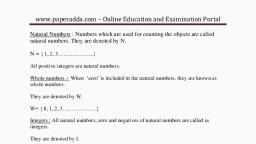
Place value of units digit = (Digit at units place) x10°, Place value of tens digit = (Digit at tens place) x10!, Place value of hundreds digit, , = (Digit at hundreds place) x10? and so on., , The place value of number is called the local value of the, number also. e.g. In the number 28397, the place value of 8, , = Place value of thousands digit, = (Digit at thousands place) x 107, , =8x10> =g000, , Example 3 What is the difference between the piace, vaiue and the face value of 5 in the number 865432?, , (1) 4995 (2) 4990, {3) 4980 (4) 5000, , Solution /1) .- Piace value of 5 = 5000, and face value of 5 = 5 :, . Required difference = 5000-5 = 4995, , Example 4 in the number 98739246, find the sum of, , Place values of both the 9's., (1) 89991000 (2) 90009000, (3) 9009000 (4) 899100, Solution (2) Place value of first, , 9=9x 107 = 90000000, Place value of second 9 = 9 x 10° = 9000, ~. Required sum = 90000000 + 9000 = 90009000, , * Example 5 Find the sum of face values of all the 8's in, the number 87388243., (1) 8 (2) 24 (3) 80088000 (4) 888, , Solution (2) We know that the face value of a digit is the digit itself, Hence, required sum = 8 + 8+ 8=24, , 1.1.3 Types of Numbers, There are various types of numbers which are as follow, , 1. Natural numbers All counting numbers are called, natural numbers and they start from 1. They are, denoted by N., , e.g. 1, 2, 3, 4,... ete., , 4 is nota natural number., , 2. Whole numbers All natural numbers including, zero are called whole numbers. These are denoted by W., e.g. 0, 1, 2, 3,.,. ete., , Operations of addition, subtraction, multiplication and, division with whole numbers are as follow, (i) For any two whole numbers a and b,, atb=bta, e.g. 1030+89 = 1119 =89 +1030, , (ii) For any two whole numbers a and 5., a-—bzb-a, e.g. 25-5 =20, 5-25=-20, be 20 # -20, (iii) For any two whole numbers a and 6, @xb=bx,, e.g. 21125 =5275=25x211 |, b, , (iv) For any two whole numbers a and 6, 4 2?, a, , eg. 18 = 1 2% =010, 10 100, 104010, 3. Integers All positive and negative whole numbers _, are called integers. e.g. ...—3.-—2-1.0,1,2,3,. ete, A\ 0 izero) is neither positive nor negative., Operations of addition, subtraction, multiplication and, division with integers, (i) For any two integers a and b,a+b=b+a |, eg. 5+(-7)=-2=(-7)+5 |, (ii) For any two integers a and b,a—b#b-a, eg. 6—(-5)=11(-5)-6=-11, ll#-l1, (iii) For any two integers a and b, axb=bxa, e.g. (—5) x6 =—30 =6x(-5), , (iv) For any two integers a and b, ; # p, a, cg ee, fg, 4. Positive numbers The digits which are situated on, the right side of zero (0) on the number line, are called, positive numbers., Going to the right side, value of the numbers is, increased., , ONf 23°34, 5. Negative numbers The digits which are situated, on the left side of zero(0) on the number line, are called, negative numbers., , 4-32-10, Going to the left side, value of the numbers is decreased., Following are some properties of negative numbers, * Multiplications of two negative numbers is positive., eg. (-3)x(-5)=15, * Sum of two negative numbers is equal to the sum of, numbers with negative sign., eg. (-12)+(-7)=-19, Difference of two equal negative numbers is zeroeg. (-7)-(-7)=0
Page 4 :
+ Division of two negative numbers is positive,, , eg. (—28)+(-4)=7, , If a positive number and a negative numb., , then they are actually subtracted., , eg 5+(-3)=5-3=2,-5+(3)=-543=-9,, , and -5-(3)=-5-3=-8, , Multiplication of a positive and a negative numbers is, , always negative., , eg. (-3)x(9)=-27, , Negative numbers are commutative with respect to, , addition and multiplication., , eg. (—3)+(-10)=—13=(— 10) +(-3),, (-7)x(-2)=14 =(-2)x(-7), , AX Remember that = (-)x(-) = +, , :, , er are added,, , ., , xWe- (4) x()=()x(Hst (H+ (a+, ()+(-)=- (4) -(@)=+0r, 6, Even numbers The numbers which are divisible by 2,, are called even numbers., , eg. 2,4, 6,8, 10,... etc., , 7. Oddnumbers The numbers which are not divisible by 2,, are called odd numbers., , eg. 1,3,5, 7,9, ... ete., , 8 Rational numbers The numbers which can be, expressed in the form of p/q, where p,q are integers and, , q #0, are called rational numbers., 342, , ££. —,—5—,... ete,, 59°79, , A All integers and frat ans are rationals., 9. Irrational numbers The numbers which cannot be, expressed in the form of 2 are called irrational numbers., q, eg. v2, v3, 45,...ete., , 10. Prime numbers The numbers other than ‘1’ which, have exactly two factors ‘1’ and ‘itself’, are called prime, - Bumbers or equivalently cannot be divided by any number, except 1. ‘, €g. 2,3, 5,7, 11, 13, 17, ... etc., , A (i) 2"is the least and only even prime number., (ii) ‘1’ is not a prime number., , Test of Prime Numbers, , wee we are to test whether the number P is prime or not,, es can check it by using the following steps, , ; ep Find a whole square number just greater than Psay x}., , i Find the square root of x? ice. x,, , hk Take all the prime numbers less than or equal to x., , PIV Check whether P is exactly divisi, ble b:, taken in Step III or not, ean etna, , Step V_ If yes, then P is not prime and if not, then Pis, prime. e.g. Let P =193, Now, 196 is the whole square number just, greater than 193. 196>193; 14> V193 ., , Prime numbers upto 14 are 2, 3, 5, 7, 11 and 13., Since, none of these numbers divides 193, exactly, thus 193 is a prime number., , 11. Composite numbers All non-prime numbers, are called composite numbers., , e.g. 4, 6, 8,9, 10, 12,... ete., A 'Visnota composite number., , 12. Real numbers Rational and irration of numbers, are combine to form the set of real numbers. e.g. 2/7,, x, V2,.... ete., , 1.1.4 Digits of a Number, , 1. Two-digit numbers If ten’s place digit of a, number is x and unit place digit is y, then two-digit, number would be (10x + y)., , 2. n-digit greatest numbers In n-digit greatest, numbers, 9 is written as many time as the value of n, , e.g. 5-digit greatest number = 99999, , 3. n-digit lowest numbers In n-digit lowest, number, first of all 1 is written and after that (n —1), times written zero., , e.g. 5-digit lowest number = 10000, , Example 6 Whatis the sum of greatest 4-digit, number and lowest 5-digit number?, (1) 19999 (2) 10999 (3) 99991 (4) 90099, Solution (1) Greatest 4-digit number = 9999, Lowest 5-digit number = 10000, Sum = 9999 + 10000 = 19999, , 1.1.5 To Verify the Commutative, Property, , There are some rules or identities related to verification, of commutative properties, which are as given below, 1, Additive identity When 0 (zero) is added to, , any real number, we get the same number ie., a+0=0+a=aforany realnumbera = *, , +. Ois called additive identity of a., , 2. Additive inverse The number which, when, added to the given number gives the result as zero is, called additive inverse of the gtven-number i., at(a’)=a’+a=0,, ©. a’ is called additive inverse of a., , 4\ Additive inverse for a real number ‘a’ is -a.
Page 5 :
3. Multiplicative identity When 1 (one) is multiplied, to any real number, we get the same number i.e., axl=1xa=a, , + is called multiplicative identity of ‘a’., , 4. Multiplicative inverse The number which, when, multiplied to the given number gives the result as 1 is, called the multiplicative inverse of the given number., , ie.axa’=a’xa=a, -. a’ is called multiplicative inverse of a., , A Multiplicative inverse is same as reciprocal of a, number., Thus, multiplicative inverse for a real number ‘a’, , is—., a, , 5. Associative rule For any three integers a, b and c, the rule is defined as, (a+b)+c=a+(b+c)(axb)xc =ax(bxc), 6. Distributive rule For any three integers a, b and c, , the rule is defined as, ax(b+c)=(axb)+(axc), , 1.2 Operations on Numbers, , There are various operations on number, which are given, , below., , 1. Addition When two or more numbers are combined, together, it is called addition. It is denoted by the sign, , a., eg. 32+29+78=139, 193 +275 = 468, , Important formulae for addition of natural numbers are, given below, , (i) Sum of first n natural numbers (Zn), 14243+.4n= 204), (i) Sum of squares of first n natural numbers (En” ), Z n(n +1)(2n+1), , 6, , (iii) Sum of cubes of first n natural numbers (En3 ), , 2, 19427 +39 +..4n? -(), 2, , P42? 43? 4...4n?, , tiv) Sum of first n even natural numbers = n(n + 1), (v) Sum of first 2 odd natural numbers = n?, , 2. Subtraction When one or more numbers are taken, out from a larger number, it is called subtraction, It is, denoted by the sign ~’., eg. 182 - 13-56 =113, , 176.3 + 12~ 132.8= 55.5, , 3. Multiplication When two numbers, say x andy are, multiplied together, then x is added y times or Vis addeg, x times. It is denoted by the sign ‘x’., , eg. 3X4=343434+3=44+44+4=12, , 4, Division Division is the method of finding how, many times a given number called the divisor 4, contained in another given number called the dividend, The number expressing this, is called the quotient anq, the excess of the dividend over the product of the, divisor and the quotient is called the remainder., , eB: 265748 Dividend, , Divisor— 48)265(5 — Quotient, 25— Remainder, These quantities are inter-related by the following relations, , Dividend = (Divisor x Quotient) + Remainder, , Example 7 _ ina sum of division the quotient is 110, the, remainder is 250, the divisor is equal to the sum of the, quotient and remainder. What is the dividend?, , (1) 3940 (2)39850 (3) 40000 (4) 3890, Solution (2) Divisor = 110 + 250 = 360, Dividend = (360 x 110) + 250 = 39850, Hence, the dividend is 39850., , 1.3 Playing with Numbers, , The meaning of playing with numbers is to increase the, mathematical knowledge of numbers to keep in mind with, calculating relation. e.g. We know that, the number which, is divisible is called composite number and which is not, divisible is called prime numbers but when we check a, special number is divisible by 3, then first we sum of the, digits of the number and after that divide by 3. If sum is, divided by 3, we know that number is fully divisible by 3, and that number is a composite number., , 41.3.1 Test of Divisibility of Numbers, , A number is, , Divisible by 2. if unit digit of the given number is either, even or 0 (zero)., ¢.g. 12, 246 are divisible by 2., , Divisible by 3. if the sum of all the digits of yhe given, number is divisible by 3, Ea er, , e.g, 153, since the sum of all digits is 1+5+3= 9,\Wwhich is, divisible by 3. Hence, 153 is divisible by 3., , Divisible by 4. if the number made by last two digits of the, given number is divisible by 4., ¢.g. 348, since the last two digits 48, which is divisible, by 4. Henge, 348 is divisible y 4,