Page 2 :
Programme Objective:- It demonstrates basics of Print, media., , Programme Outcome:- Through this topic the students, know about the basics., , Learning Outcome :- The students get immense, fundamentals of print media., , Course Objective:- This paper has been introduced for the, , basic concept of the print journalism. The students have to know, about print media., , Course Outcome:- The students can apply their knowledge, in writings.
Page 3 :
What is Print Media?, Print media - a medium that disseminates printed matter, Medium - a means or instrumentality for storing or, communicating information, Public press, Press - the print media responsible for, gathering and publishing news in the form of newspapers, or magazines, Journalism, News media - newspapers and magazines, collectively, Saizdat , Underground Press - a system of clandestine, printing and distribution of dissident or banned literature
Page 4 :
Definition, The industry associated with the printing, & distribution of, news through newspapers and magazines., Print media is one of the oldest and, basic forms of mass communication. It includes, newspapers, weeklies,, magazines, monthlies and other forms of printed, journals
Page 5 :
Brief History of Printed Media, 59 BC Caesar orders the publication of events in Rome, 748 First hand written newspapers - China, 1440 Guttenberg develops wooden printing press, , 1502 First mass produced news report – Zeitung, 1653 First double column paper – Oxford Gazette, 1702 First daily newspaper – Daily Courant, , 1731 First magazine published – Gentlemen’s Magazine - Scotland, 1833 The Penny Press - $.01 newspapers, 1845 Paperbacks appear in America, 1880 First photographs in newspapers, 1909 Conde Nast buys Vogue, and transforms it into a photo-fashion, monthly for upmarket women
Page 6 :
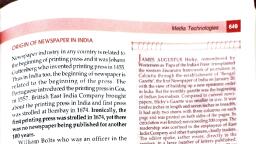
Print Media in, India, Printing technology came to India in, 1556. By-Jesuit priests, The first newspaper in India was, published in 1780, The first book printed in India was in, Portugese language in Old Goa. It was, Doctrina Christa by St. Francis Xavier.
Page 7 :
Sample of first book….
Page 8 :
Cont…., ❖, , The first printing press was established in Mumbai, in 1674, second in Madras and third in Calcutta in, 1779., It was a Britisher who started the first newspaper in, our country. On January29, 1780 James Augustus, Hickey launched the “Bengal Gazette”., It has another title “Calcutta Advertiser”. It was, popularly known as “Hickey’s Gazette”. The first issue, of the paper had two pages and later it was increased, to four pages. It’s size was 35 cms x 24 cms.
Page 9 :
Current scenario in india, At present over 62,000 newspapers and periodicals, are published in India, Daily circulation of newspapers, are over 180 million., PricewaterhouseCoopers in its “Indian entertainment, and media outlook 2009" report has estimated that, the Indian Entertainment & Media industry will return, to double digit growth in 2010 ., Print media industry is projected to grow by 5.6%, over the period 2009-13, reaching to Rs.213 billion in, 2013 from the present Rs. 162 billion in 2008., The relative shares of newspaper publishing and, magazine publishing are not expected to change, significantly and are expected to remain the same at, around 87% in favour of newspaper publishing.
Page 10 :
Cont…., Magazine publishing is expected to grow at a higher, rate of 6.5% as compared with newspaper publishing, which is expected to grow at 5.6% for the next 5, years., The Indian Media and Entertainment (M&E) industry is, on a growth surge and is expected to cross US$ 200, billion by 2015.
Page 11 :
Threats to the NEWSPAPER INDUSTRY, Radio, ◼ Talk radio allows consumers to listen to views on political, social, or, sports topics, ◼ Consumers can interact and voice their opinions on issues, Broadcast and Cable Television, ◼ 24 hour news channels cover stories in depth and break news, instantly, ◼ Video presentation is more entertaining to the mass society, Internet, ◼ News consumers can seek out the stories that interest them, ◼ Consumers can interact and voice their opinions on issues, All “new media” formats deliver the news faster than printed, newspapers
Page 12 :
Newspaper Response to TECHNOLOGY, Newspapers have used their brand strength to successfully, establish their own web sites., This is becoming an important source of ad revenue., Newspapers have also partnered with their new media rivals to, share resources and coverage on stories.
Page 13 :
GRAPHIC Trends in Newspapers, Modern Newspaper Layout, ◼, , Two popular formats, Broadsheet – large 23 ½ x 15. 6 column (serious), Tabloid small 15 x 11 ¾ 5 column (sensational), , ◼, , Use design principles based on visual perception, research and desktop publishing technology, Fewer fonts and sizes, Use of white space to separate columns, Articles are shaped into long rectangles to fit as a balanced, , whole
Page 14 :
COLOR, Today’s Newspapers incorporate full-color ink, Color grabs attention and, presents a more finished, valuable product, , Dedicated to the front, pages of sections and sold, as advertisements on the, back, Single colors are found on, inside pages
Page 15 :
Pictures and Machine Produced Art, Technology enables newspapers to add timely, dramatic pictures to stories, Computer graphic programs allow pictures to be, enhanced and manipulated – easily incorporating them, into the layout
Page 16 :
INFOGRAPHICS, Infographics are a type of art that, visually and graphically presents, data or statistics, Readers can easily understand, Infographics, , Examples of Infographics include, ◼, ◼, ◼, , ◼, , bar charts, pie charts, data maps with geographical, information, pictographs
Page 17 :
MAGAZINES, A type of periodical that is financed by, advertising, subscriptions and newsstand sales, Bound publications with a soft cover, , Higher quality and longevity than newspapers, Usually printed in full color on coated paper, Segmented into two categories – business/trade, publications and consumer magazines
Page 18 :
THREATS to the Magazine Industry, The increase in media choices draw consumers away, from magazine purchases, Specialized cable channels (Food Network, CNBC, Golf, Channel) compete for viewers attention of special, interests, The internet provides free content vs. paying for it at, the newsstand
Page 19 :
PAPER, The many characteristics of paper, greatly affect the readers perception of, the magazine, ◼, ◼, ◼, ◼, , Paper Size, Paper Weight and Bulk, Whiteness of paper, Paper Gloss
Page 20 :
COVER, Magazines use their covers to attract readers and, induce purchase, Good covers quickly communicate their message to, the consumer, ◼ What stories are found in this issue, ◼ What the magazine is about, , Bold pictures alone will not communicate the message, effectively. Copy should be placed on the cover to, further explain the magazine
Page 21 :
The Importance of COVERS, Quickly, analyze this, cover, What is the, attitude of, the cover, model, What do you, feel is the, content of, this magazine
Page 22 :
The Importance of COVERS, Quickly, analyze this, cover, What is the, attitude of, the cover, model, What do you, feel is the, content of, this magazine
Page 23 :
The Importance of COVERS, , The body language of Arnold and the use of type help, communicate the content and attitude of each publication.
Page 24 :
Various TRENDS in Magazines, Artwork is playing an increasing role in magazine, design and layout, ◼ Photos are used as backgrounds, ◼ Photos are computer enhanced and altered, Type setting – unusual text alignment and sizes create, dissonance but engage the reader, Non traditional fonts and reverse type, The more progressive your magazine the more design, rules you can break
Page 25 :
MORE Trends in Magazines, Advertising drives many of the industry’s innovative, trends, ◼ Advertisers want to create interesting ways for, their message to rise above the noise, ◼ Magazines will always find ways to squeeze more, revenue from their product, Magazines tie online content to their print editions, , Easier to start up a new magazine but difficult to make, a profit, ◼, ◼, , 745 magazines were launched in 2002, up from 702 in 2001, 60% of new titles never celebrate their first anniversary
Page 26 :
FUTURE IMPACT of print media
Page 28 :
THANK, YOU