Page 1 :
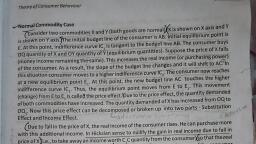
induces the consumer to buy more of it under the income effect. But with fall in the price 0, a good, it becomes relatively cheaper. This induces the consumer to buy more to substitute it <n, in place of the costlier good. This is called substitution effect., , Thus, a change in price has both income as well as substitution effects., , _/ (Hicksian Decomposition of Price Effect into Income Effect and Substitution Effect Jor Separatio,, or Break up of Substitution and Income Effects from the Price Effect) Y hed, , (as price falls, demand for normal goods increases as a result of substitution effect. Whe,, price falls, real income increases. Asa result, demand for normal goods increases. This is due, to Income effect. Thus, as pricé falls, demand for normal goods increases as a result of both, substitution effect and income effect.), , The price effect comprises the income effect and the su bstitution effect (or price effect income effect + substitution effect). But how ? When the price of a good falls (price of other, good and money income remaining constant), the quantity demanded of the good (whose, price has fallen) increases. This is the price effect. The price effect has two effects. First, the, consumer (he has a constant money income) substitutes this commodity for the other. This is, the substitution effect. The substitution effect relates to the increase in the quantity, demanded of X when its price falls while keeping the real income of the consumer constant., He substitutes the cheaper good (X) for relatively costlier good (Y). This means that he will, buy more of X instead of buying Y. Second, when the price of the commodity falls, the real, income of the consumer increases (the price of Y is constant). With this increased real income, (surplus money), the consumer can buy more of X or both the goods. This is the income effect, (if the price of a good increases, the reverse happens). In both cases, the quantity demanded, of the good (s) increases as a result of fall in the price of one good. This is the price effect. The, total increase in demand happens in two ways - due to substitution effect and due to income, , effect. Thus, price effect is the result of substitution effect and income effect. In other words, :, (price effect = substitution effect + income effect. ) |, , Now the question arises, if PE = SE + IE, then how these should be separated or decomposed., There are two methods for decomposing or splitting the price effect into substitution effect and, income effectfOne method was given by J.R. Hicks The other was suggested by E. Slutsky. Here, we discuss only the method proposed by Hicks (Hicksian approach)., , : Hicks has separated the substitution effect and income effect from the price effect through, , compensating variation in income” Joy chahging the relative price of a good while keeping, the real income of the consumer constant. ccording to Hicks, “when the relative prices of the, goods change, the money income of the consumer is altered in such a manner that his real, purchasing power remains constant and he is n ither better off nor worse off than before,, , i.e., he conti 5 aes, ier eS to remain on the same indifference curve”. Let us now discuss Hicksian