Page 1 :
UNIT –I, , 1|Page, , AN INTRODUCTION TO MANAGEMENT, , BBA – I NOTES
Page 2 :
UNIT –I, , 2|Page, , AN INTRODUCTION TO MANAGEMENT, , BBA – I NOTES
Page 3 :
UNIT –I, , 3|Page, , AN INTRODUCTION TO MANAGEMENT, , BBA – I NOTES
Page 4 :
UNIT –I, , 4|Page, , AN INTRODUCTION TO MANAGEMENT, , BBA – I NOTES
Page 5 :
UNIT –I, , 5|Page, , AN INTRODUCTION TO MANAGEMENT, , BBA – I NOTES
Page 6 :
UNIT –I, , 6|Page, , AN INTRODUCTION TO MANAGEMENT, , BBA – I NOTES
Page 7 :
UNIT –I, , 7|Page, , AN INTRODUCTION TO MANAGEMENT, , BBA – I NOTES
Page 8 :
UNIT –I, , 8|Page, , AN INTRODUCTION TO MANAGEMENT, , BBA – I NOTES
Page 9 :
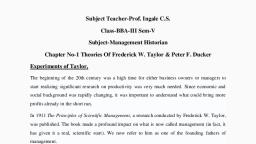
UNIT –I, , AN INTRODUCTION TO MANAGEMENT, , BBA – I NOTES, , Fredrick W. Taylor (1856-1915): He is known as ‘father of scientific, management’. His ideas about management grew out of his wide-ranging, experience in three companies: Midvale Steel Works, Simonds Rolling Mills and, Bethlehem Steel Co. As an engineer and consultant, Taylor observed and reported, on what he found to be inexcusably inefficient work practices, especially in the, steel industry. Taylor believed that workers output was only about one-third of, what was possible. Therefore, he set out to correct the situation by applying, scientific methods. Taylor’s philosophy and ideas are given in his book, ‘Principles, of Scientific Management’ published in 1911. Taylor gave the following principles, of scientific management. Taylor concluded that scientific management involves a, completer mental revolution on the part of both workers and management, without, this mental revolution scientific management does not exist., Scientific Management Approach The impetus for the scientific management, approach came from the first industrial revolution. Because it brought about such, an extraordinary mechanization of industry, this revolution necessitated the, development of new management principles and practices. The concept of, scientific management was introduced by Frederick Winslow Taylor in USA in the, beginning of 20th century. He defined scientific management as,” Scientific, management is concerned with knowing exactly what you want men to do and then, see in that they do it in the best and cheapest way”. Elements and Tools of, Scientific Management: The features of various experiments conducted by Taylor, are as follows:, • Separation of Planning and doing: Taylor emphasized the separation of, planning aspects from actual doing of the work. The planning should be left to the, supervisor and the workers should emphasize on operational work., • Functional Foremanship: Separation of planning from doing resulted into, development of supervision system that could take planning work adequately, besides keeping supervision on workers. Thus, Taylor evolved the concept of, functional foremanship based on specialization of functions. Job Analysis: It is, undertaken to find out the best way of doing things. The best way of doing a job is, one which requires the least movement consequently less time and cost., • Standardization: Standardization should be maintained in respect of, instruments and tools, period of work, amount of work, working conditions, cost of, production etc., 9|Page
Page 10 :
UNIT –I, , AN INTRODUCTION TO MANAGEMENT, , BBA – I NOTES, , • Scientific Selection and Training of Workers: Taylor has suggested that the, workers should be selected on scientific basis taking into account their education,, work experience, aptitudes, physical strength etc., • Financial Incentives: Financial incentives can motivate workers to put in their, maximum efforts. Thus, monetary (bonus, compensation) incentives and nonmonetary (promotion, upgradation) incentives should be provided to employees., A body of principles of management has been developed by Henri Fayol, the father, of modern management. Fayol wrote perceptibly on the basis of his practical, experience as a manager. Although, he did not develop an integrated theory of, management, his principles are surprisingly in tune with contemporary thinking in, management theory. Fayol held that there is a single "administrative science",, whose principles can be used in all management situations no matter what kind of, organization was being managed. This earned him the title of "Universality". He,, however, emphasized that his principles were not immutable laws but rules of, thumb to be used as occasion demanded. Fayol held that activities of an industrial, enterprise can be grouped in six categories : (i) technical (production), (ii), commercial (buying, selling and exchange), (iii) financial (search for and optimum, use of capital), (iv) security (protection of property and persons), (v) accounting, (including statistics); and (vi) managerial. However, he devoted most of his, attention to managerial activity. He developed the following principles underlying, management of all kinds of organizations :, 1. Authority and Responsibility are Related : Fayol held that authority, flows from responsibility. Managers who exercise authority over others, should assume responsibility for decisions as well as for results. He, regarded authority as a corollary to responsibility. Authority is official as, well as personal. Official authority is derived from the manager's position, in organizational hierarchy and personal authority is compounded of, intelligence, experience, moral worth, past services, etc., 2. Unity of Command : This principle holds that one employee should, have only one boss and receive instructions from him only. Fayol, observed that if this principle is violated authority will be undermined,, discipline will be jeopardy, order will be disturbed and stability will be, threatened. Dual command is a permanent source of conflict. Therefore,, in every organization, each subordinate should have one superior whose, command he has to obey., 10 | P a g e
Page 11 :
UNIT –I, , AN INTRODUCTION TO MANAGEMENT, , BBA – I NOTES, , 3. Unity of Direction : This means that all managerial and operational, activities which relate a distinct group with the same objective should be, directed by "one head and one plan. According to Fayol, there should be,, "one head and one plan for a group of activities having the same, objective". It, however, does not mean that all decisions should be made, at the top. It only means that all related activities should be directed by, one person. For example, all marketing activities like product strategy, and policy, advertising and sales promotion, distribution channel policy,, product pricing policy, marketing research, etc., should be under the, control of one manager and directed by an integrated plan. This is, essential for the "unity of action, coordination of strength and focusing of, effort". Violation of this principle will cause fragmentation of action and, effort, and wastage of resources, 4. Scalar Chain of Command : According to Fayol scalar chain is the, chain of superiors ranging from the ultimate authority to the lowest ranks., The line of authority is the route followed via every link in the chain by, all communication which start from or go to the ultimate authority., 5. Division of Work : This is the principle of specialization which,, according to Fayol, applies to all kinds of work, managerial as well as, technical. It helps a person to acquire an ability and accuracy with which, he can do more and better work with the same effort. Therefore, the work, of every person in the organization should be limited as far as possible to, the performance of a single leading function., 6. Discipline : Discipline is a sine qua non for the proper functioning of an, organization. Members of an organization are required to perform their, functions and conduct themselves in relation to others according to rules,, norms and customs. According to Fayol, discipline can best be, maintained by : (i) having good superiors at all levels; (ii) agreements, (made either with the individual employees or with a union as the case, may be) that are as clear and fair as possible; and (iii) penalties, judiciously imposed., 7. Subordination of Individual Interest to General Interest : The interest, of the organization is above the interests of the individual and the group., It can be achieved only when managers in high positions in the, organization set an example of honesty, integrity, fairness and justice. It, will involve an attitude and a spirit of sacrificing their own personal, interests whenever it becomes apparent that such personal interests are in, 11 | P a g e
Page 12 :
UNIT –I, , AN INTRODUCTION TO MANAGEMENT, , BBA – I NOTES, , conflict with organizational interests. It may, however, be emphasized, that social and national interests should have precedence over, organizational interests whenever the two run counter to each other., 8. Remuneration : Employees should be paid fairly and equitably., Differentials in remuneration should be based on job differentials, in, terms of qualities of the employee, application, responsibility, working, conditions and difficulty of the job. It should also take into account, factors like cost of living, general economic conditions, demand for, labour and economic state of the business., 9. Centralisation : Fayol believed in centralisation. He, however, did not, contemplate concentration of all decision making authority in the top, management. He, however, held that centralisation and decentralisation is, a question of proportion. In a small firm with a limited number of, employees, the owner-manager can give orders directly to everyone. In, large organizations, however, where the worker is separated from the, chief executive through a long scalar chain, the decision making, authority has to be distributed among various managers in varying, degrees. Here one generally comes across a situation of decentralisation, with centralised control. The degree of centralisation and decentralisation, also depends on the quality of managers., 10.Order : Order, in the conception of Fayol, means right person on the, right job and everything in its proper place. This kind of order, depends, on precise knowledge of human requirements and resources of the, concern and a constant balance between these requirements and, resources., 11.Equity : It means that subordinates should be treated with justice and, kindliness. This is essential for eliciting their devotion and loyalty to the, enterprise. It is, therefore the duty of the chief executive to instill a sense, of equity throughout all levels of scalar chain., 12.Stability of Tenure of Personnel : The managerial policies should, provide a sense of reasonable job security. The hiring and firing of, personnel should depend not on the whims of the superiors but on the, well-conceived personnel policies. He points out that it takes time for an, employee to learn his job; if they quit or are discharged within a short, time, the learning time has been wasted. At the same time those found, unsuitable should be removed and those who are found to be competent, 12 | P a g e
Page 13 :
UNIT –I, , AN INTRODUCTION TO MANAGEMENT, , BBA – I NOTES, , should be promoted. However, "a mediorce manager who stays is, infinitely preferable to outstanding managers who come and go"., 13.Initiative : It focuses on the ability, attitude and resourcefulness to act, without prompting from others. Managers must create an environment, which encourages their subordinates to take initiative and responsibility., Since it provides a sense of great satisfaction to intelligent employees,, managers should sacrifice their personal vanity in order to encourage, their subordinates to show initiative. It should, however, be limited,, according to Fayol, by respect for authority and discipline., 14.Esprit de Corps : Cohesiveness and team spirit should be encouraged, among employees. It is one of the chief characteristics of organized, activity that a number of people work together in close coopearation for, the achievement of common goals. An environment should be created in, the organization which will induce people to contribute to each other's, efforts in such a way that the combined effort of all together promotes the, achievement of the overall objectives of enterprise. Fayol warns against, two enemies of esprit de corps, viz. (i) divide and rule, and (ii) abuse of, written communication. It may work to the benefit of the enterprise to, divide its enemy but it will surely be dangerous to divide one's own, workers. They should rather be welded in cohesive and highly interacting, work-groups. Overreliance on written communication also tends to, disrupt team spirit. Written communication, where necessary, should, always be supplemented by oral communication because face-to-face, contacts tend to promote speed, clarity and harmony., Frank (1868-1924) and Lillian (1878-1972) Gilbreth: Frank Gilbreth, a, construction contractor by back ground, gave up his contracting career in, 1912 to study scientific management after hearing Taylor’s speak at a, professional meeting. Along with his wife Lillian, a psychologist, he studied, work arrangements to eliminate wasteful hand-body-motion. Frank, specialized in research that had a dramatic impact on medical surgery and,, through his time and motion findings, surgeons saved many lives. Lillian is, known as ‘first lady of management’ and devoted most of her research to the, human side of management. Frank Gilbreth is probably best known for his, experiments in reducing the number of motions in bricklaying., , 13 | P a g e
Page 14 :
UNIT –I, , AN INTRODUCTION TO MANAGEMENT, , BBA – I NOTES, , Henry Gantt (1861-1919): He was a consulting engineer who specialized in, control system for shop scheduling. He sought to increase workers efficiency, through scientific investigation. He developed the Gantt Chart (Figure-2.2), that provides a graphic representation of the flow of the work required to, complete a given task. The chart represents each planned stage of work,, showing both scheduled times and actual times. Gantt Charts were used by, managers as a scheduling device for planning and controlling work. Gantt, devised an incentive system that gave workers a bonus for completing their, job in less time than the allowed standards. His bonus systems were similar, to the modern gain sharing techniques whereby employees are motivated to, higher levels of performance by the potential of sharing in the profit, generated. In doing so, Gantt expanded the scope of scientific management, to encompass the work of managers as well as that of operatives, , 14 | P a g e