Page 1 :
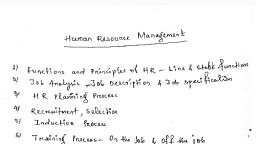
UNIT- SECOND, Nature of job Analysis, "Job analysis deals with the anatomy of the job.....This is the complete study of the job embodying every known and determinable factor, including the duties and responsibilities involved in its performance; the conditions under which performance is carried on; the nature of the task; the qualifications required in the worker; and the conditions of employment such as pay, hours, opportunities and privileges", "Job analysis is the methodical compilation and study of work data in order to define and characterise each occupation in such a manner as to distinguish it from all others.", Job analysis, contains a simple term called "analysis", which means detailed study or examination of something (job) in order to understand more about it (job). therefore job analysis is to understand more about a specific job in order to optimise it. Job analysis is a systematic process of collecting complete information pertaining to a job. Job analysis is done by job analyst who is an officer have been trained for it., , Job analysis is a procedure through which you determine the duties and responsibilities, nature of the jobs and finally to decide qualifications, skills and knowledge to be required for an employee to perform particular job. Job analysis helps to understand what tasks are important and how they are carried on. Job analysis forms basis for later HR activities such as developing effective training program, selection of employees, setting up of performance standards and assessment of employees ( performance appraisal)and employee remuneration system or compensation plan., Job analysis is a detailed examination of, tasks that make up a job (employee role),, conditions under which an employee performing his/her job, and, what exactly a job requires in terms of aptitudes (potential for achievement), attitudes (behavior characteristics), knowledge, skills, educational qualifications and the physical working condition of the employee., In simple words Job analysis is a formal programme which examines the tasks, duties and responsibilities contained in an individual unit of work., Job analysis takes place before the recruitment process., Job design, Job design involves the conscious efforts to organize tasks, duties and responsibilities into a unit of work to achieve certain objectives., An HR manager should have a keen interest in the design and specification of individual jobs within the organization., Job design is about the way that tasks are combined to form complete jobs in the workplace, whilst job redesign has its focus on how existing jobs are changed- for example, by redesigning jobs management may able to increase motivation around, say, the introduction of self-managed work teams., “Job design is the process of deciding on the contents of a job in terms of its duties and responsibilities, on the methods to be used in carrying out the job, in term of techniques, systems and procedures and on the relationships that should exist between the jobholder and his superiors, subordinates and colleagues”, The main goal of designing a job are as follows:, i. Facilitating the interest of employees towards the job and enhancing their satisfaction, ii. Increasing employee motivation and productivity, iii. Enhancing employees’ skills by identifying their training needs, iv. Covering the modern needs of employee participation, v. Ensuring safer working environment, vi. Making the communication process clear and effective in the organization, vii. Improving the quality of working life of employees, viii. Eliminating the unnecessary levels of supervision, checking, and control, ix. Establishing high-level standards for customer service, x. Minimizing cost by reducing wastage., Human Resource Planning, Human resource planning (HRP) is the continuous process of systematic planning ahead to achieve optimum use of an organization's most valuable asset—quality employees. planning ensures the best fit between employees and jobs while avoiding manpower shortages or surpluses., There are four key steps of the HRP process. They include analyzing present labor supply, labor demand, balancing projected labor demand with supply, and supporting organizational goals., HRP helps companies is an important investment for any business as it allows companies to remain both productive and profitable., HR managers have to make plans to do the following:, Find and attract skilled employees., Select, train, and reward the best candidates., Cope with absences and deal with conflicts., Promote employees or let some of them go., Investing in HRP is one of the most important decisions a company can make. After all, a company is only as good as its employees. If it has the best employees and the best practices in place, it can mean the difference between sluggishness and productivity and can lead to profitability., Demand forecasting for manpower planning, Manpower Forecasting is the first step of the entire manpower planning activity. The HR manager foresees the demand and supply of different types of manpower resources in the firm. The basic idea is to look into in which department; unit or level there is a shortage or surplus of human requirements. Forecasting is the process of making judgments about accrued events whose actual outcomes have not been seen. Successful manpower planning involves only two critical steps .First one is estimating the Demand Forecast for manpower accurately and the second one is ensuring the Supply Forecast for manpower to meet the Demand Forecast. Demand forecasting and Supply Forecasting go hand in hand. The job of the manpower planner is to take suitable steps to bridge the gap between Demand and Supply by understanding the trends that occurs due to dynamic business environment and estimating intensively the future needs of an enterprise. In the absence of any systematic work in this direction, there is a high probability that an organisation may face many surprises in terms of human resource requirements and therefore be unable to cope up with the future challenges. The absence of the right persons at the right time may prohibit the fullest accomplishment of corporate plans. It may also lead to incur losses because of the organisations’ inability to cash in the opportunities which necessitate both Demand Forecasting as well as Supply Forecasting., CONCEPT OF MANPOWER FORECASTS, In the context of manpower forecasting, there is a need to understand the distinction between the different concepts like ‘projections’, ‘estimates’ and ‘forecasts’. ‘Projections’ are predictions of outcome at the responses of spontaneous forces. The outcome which is expected to happen in the normal course of events with the absence of external stimulus is projection. They are mathematical extensions of existing manpower data into the future. On the other hand Estimates’ are educated guesses. Estimates are calculated approximately based on experiences and opinion of experts., Forecasts refer to predictions of outcome when normal course of events are influenced and altered by extraneous factors. Forecasts usually take into account both projections and the estimates. There could be different types of Forecasts depending upon the purpose for which forecasts are made. Some of the major types of forecasts are described below. HR plans depend heavily on forecasts, expectations, and anticipation of future events, to which manpower requirements in terms of quality and quantity are directly linked. Moreover, uncertainty adds complexity to forecasting., Manpower Forecasting is defined as, "the prediction of future levels of demand for and supply of workers and skills at organizational level, at regional level, or could be at national level. A variety of techniques are used in manpower forecasting. It includes the statistical analysis of current trends and the use of mathematical models. At national level, analysis of census statistics is included. At organizational level, sales and production figures is the base line upon which projections of future manpower requirements are made"., NEED FOR MANPOWER FORECASTS, The basic rationality of manpower forecasts is the long gestation lags in the production of skilled professional people. Manpower forecasts well in advance facilitate planning of education and training. It is an effort to ensure that manpower required both in terms of quality and quantities are available at the time when they are needed., The second major reason of manpower forecast is the imperfections in the labour market. Markets for manpower with long lead time for production are characterised by long lags in the supply side and short lags, on the demand side. Therefore supply is to be planned in order to meet the demand. If that does not happen, there is a high probability that the labour market may lead to distortions in occupation-education correspondence. As a result of which there could be a huge educated unemployment or with people taking up occupations for which they are not adequately trained or both. Manpower Forecasts are expected to facilitate correction of labour market distortions., The third major reason of man power forecast is that, in the short-run, elasticities of substitution among various skills have been observed to be either zero or near zero. Therefore, production of goods and services requires different categories of skilled manpower in fixed proportion. In such a situation shortages of any skilled category of manpower, would adversely affect the production of goods and services within the economy. Manpower Forecasts would help in avoiding such types of situation by facilitating anticipation of skill shortages and planning skill supplies accordingly., HR supply forecasting, Human Resource supply forecasting is the process of estimating availability of human resource followed after demand for testing of human resource. For forecasting supply of human resource we need to consider internal and external supply. Internal supply of human resource available by way of transfers, promotions, retired employees & recall of laid-off employees, etc. Source of external supply of human resource is availability of labour force in the market and new recruitment., , External supply of human resource depends on some factors mentioned below., Supply and demand of jobs., literacy rate of nation., rate of population, industry and expected growth rate and levels, technological development., compensation system based on education, experience, skill and age., T, Once a company has forecast the demand for labour, it needs an indication of the firm's labour supply. Determining the internal labour supply calls for a detailed analysis of how many people are currently in various job categories or have specific skills within the organization. The planner then modifies this analysis to reflect changes expected in the near future as a result of retirements, promotions, transfers, voluntary turnover, and terminations., , Demand forecasting helps in determining the number and type of personnel/human resources required in future. The next step in human resource planning is forecasting supply of human resources. The purpose of supply forecasting is to determine the size and quality of present and potential human resources available from within and outside the organisation to meet the future demand of human resources. Supply forecast is the estimate of the number and kind of potential personnel that could be available to the organisation., Estimating Internal Labor Supply for a Given Unit, Employee hiring, Employee Hiring, Hiring employees is a process crucial to the success of a business, and as most successful small business owners know, the hiring process does not begin with the interview and end with the job offer. Rather, it involves planning and considering the job prior to an interview, recruiting and interviewing wisely to bring in the right person, and providing new workers with an orientation that enables them to get off to a strong start with the company., RECRUITMENT, Recruitment is a process of identifying, screening, shortlisting and hiring potential resource for filling up the vacant positions in an organization. It is a core function of Human Resource Management., Recruitment is the process of choosing the right person for the right position and at the right time. Recruitment also refers to the process of attracting, selecting, and appointing potential candidates to meet the organization’s resource requirements., Nature of Recruitment, Determine the present and future requirements of the organization on conjunction with its personnel planning and job analysis activities., Increase the pool of job candidates at minimum cost., Help increase the success rate of the selection process by reducing the number of visibly under qualified or overqualified job applicants., Help reduce the probability that job applicants, once recruited and selected, will leave the organization only after a short period of time., Meet the organization’s legal and social obligations regarding the composition of its work force., Begin identifying and preparing potential job applicants who will be appropriate candidates., Increase organizational and individual effectiveness in the short term and long term., Evaluate the effectiveness of various recruiting techniques and sources for all types of job applicants., Sources of Recruitment, The eligible and suitable candidates required for a particular job are available through various sources. These sources can be divided into two categories,, Internal Sources of Recruitment, (a) Promotions, The promotion policy is followed as a motivational technique for the employees who work hard and show good performance. Promotion results in enhancements in pay, position, responsibility and authority. The important requirement for implementation of the promotion policy is that the terms, conditions, rules and regulations should be well-defined., (b) Retirements, The retired employees may be given the extension in their service in case of non-availability of suitable candidates for the post., (c) Former employees, Former employees who had performed well during their tenure may be called back, and higher wages and incentives can be paid to them., (d) Transfer, Employees may be transferred from one department to another wherever the post becomes vacant., (e) Internal advertisement, The existing employees may be interested in taking up the vacant jobs. As they are working in the company since long time, they know about the specification, and description of the vacant job. For their benefit, the advertisement within the company is circulated so that the employees will be intimated., Benefits of Internal Sources of Recruitment, (i) The existing employees get motivated., (ii) Cost is saved as there is no need to give advertisements about the vacancy., (iii) It builds loyalty among employees towards the organization., (iv) Training cost is saved as the employees already know about the nature of job to be performed., (v) It is a reliable and easy process., External Sources of Recruitment, (a) Press advertisement, A wide choice for selecting the appropriate candidate for the post is available through this source. It gives publicity to the vacant posts and the details about the job in the form of job description and job specification are made available to public in general., (b) Campus interviews, It is the best possible method for companies to select students from various educational institutions. It is easy and economical. The company officials personally visit various institutes and select students eligible for a particular post through interviews. Students get a good opportunity to prove themselves and get selected for a good job., (c) Placement agencies, A databank of candidates is sent to organizations for their selection purpose and agencies get commission in return., (d) Employment exchange, People register themselves with government employment exchanges with their personal details. According to the needs and request of the organization, the candidates are sent for interviews., (e) Walk in interviews, These interviews are declared by companies on the specific day and time and conducted for selection., (f) E-recruitment, Various sites such as jobs.com, naukri.com, and monster.com are the available electronic sites on which candidates upload their resume and seek the jobs., (g) Competitors, By offering better terms and conditions of service, the human resource managers try to get the employees working in the competitor’s organization., Benefits of External Sources of Recruitment, (i) New talents get the opportunity., (ii) The best selection is possible as a large number of candidates apply for the job., (iii) In case of unavailability of suitable candidates within the organization, it is better to select them from outside sources., Employee selection, process of employee selection, recent trends in recruitment., CANDIDATE SELECTION, Once a bank of potential candidates is established, the manager must select candidates and begin the interview process., CHECKING REFERENCES Checking references, though time consuming, is an important step in the hiring process. Prospective employees will often provide professional references, if not on the resume itself, then at least on request. A manager may choose to check references before the interview with a candidate if they are provided, or may opt to check references between a first and second interview. In any event, a manager should always request references and make the calls., Chances are good that a previous employer will not provide more information about the employee than their name, the dates of employment and the positions the person held. This is because a company, or any person within a company, which provides false information can be held legally liable for that misinformation. This potential liability does not, however, prevent a hiring manager from asking about the employee's work habits, performance or attitude. It is possible that someone may comment further on the employee, especially if the person is not a member of the Human Resources Department, but is a former manager. If this kind of additional information about the employee is made available, never discuss it with the employee directly. Rather, use it as a guide for probing questions about the person's previous work experience with that company., EMPLOYMENT TESTING Thousands of companies use employment testing of some kind to evaluate candidates prior to employment. Employment testing is an area fraught with legal pitfalls, however, so it is best to seek the advice of a professional employment testing service or an attorney experienced in labor law before implementing such requirements., MAKING A DECISION AND AN OFFER, After the interviewing process has taken place, it is not always easy to come to a final hiring decision. Sometimes a business may be forced to choose among a number of highly qualified, attractive applicants. This is obviously a nice problem to have. Conversely, on other occasions a business may undertake a time-consuming search, only to find themselves with candidates who are notably flawed in one respect or another. In such instances, the company leadership needs to determine whether the business can afford to extend the search, or whether business realities require that they fill the position with the best of the candidates before them., THE OFFER The hiring manager should personally extend an offer of employment to the selected candidate as soon as possible after the interview. This begins the employee/manager relationship. Define the amount of time the candidate has to consider the offer—a few days to one week is usually enough. The offer can be extended in person or over the phone. It is important to note that an offer, even verbal, may be construed as a contract between the employee and the company. Therefore, construct the offer carefully., An offer should include the following:, Confirmation that you are speaking with the right person., Offer of the position, including title and reporting relationship., Starting salary for the position., A suggested date for the candidate's response, Proposed starting date for the position., Indicate necessary follow through by you and/or the candidate, A manager should note that the position itself may dictate how to offer the starting salary. If the person is being offered an exempt (salaried) position, consider offering the salary in terms of bi-weekly earnings, or the smallest possible increment in which they are paid. If you are offering a person a non-exempt (hourly) position, you might offer the salary as an hourly wage. This could be important because the offer may be construed as a contractual agreement. If a yearly salary is offered, this may imply employment for one year. If the person is employed for a shorter period of time they could conceivably sue for the full, offered salary. By offering the salary in smaller increments, you avoid the possibility of any misunderstanding., NEGOTIATING TERMS Every candidate offered a position has the option to either accept or reject the job offer and may want to negotiate terms, usually salary or benefits. Though the company may not be able to consider alternate terms of employment, it is often wise to hear a candidate's proposal. If the candidate is truly the best qualified person for the job, there may be some room for compromise on both the part of the candidate and on the part of the company. Listening to a proposal also establishes the manager's willingness to hear out other suggestions, a practice which is well received by any employee., LAWS IMPACTING THE HIRING PROCESS, The hiring process is subject to legal guidelines set out by both federal and state government defining the boundaries for discriminatory hiring practices. Companies may not discriminate in hiring on the basis of sex, age, race, national origin, religion, physical disability, or veteran status. These are called protected classes. A hiring manager may not screen out any applicant because of membership in a protected class, nor may any interview questions address topics pertaining to the protected class. The main acts and laws which define these classes and the hiring practices based on them are:, I. The Civil Rights Act of 1964 (Title VII), II. Age Discrimination in Employment Act of 1967 (ADEA), III. Americans With Disabilities Act of 1990 (ADA), IV. The Uniformed Services Employment Reemployment Rights Act of 1994 (USERRA), V. Immigration Reform and Control Act, Anti-discrimination laws do not require any company to hire an applicant because of membership in a protected class. A manager is not required to hire applicants from any protected class in proportion to their numbers in the community. A manager is required to select the best qualified applicant for the position, based on the critical skills of the job, and is required to make that selection irrespective of whether or not that applicant belongs to a protected class. To be sure that hiring practices do not violate any of these laws, focus on the candidate's capabilities based on the critical skills of the job. Any questions about the legal aspects of hiring should be directed to a capable employment lawyer., NEW EMPLOYEE ORIENTATION, Once the hiring decision is made and the offer is accepted, a manager needs to prepare to welcome a new employee. An employee orientation program should produce good will and provide education about the company; a poorly planned program can increase confusion and even hasten turnover. Employee orientation is more than a paperwork session—it is the new employee's first impression of the company., One of the first things the manager should review is the job description, along with the specifics of the position, its goals, and the critical skills. After this has been accomplished, the new employee can be introduced to the company at large., REQUIRED FORMS All new employees are required to fill out specific forms on the first day of employment. These include federal and state forms such as:, VI. Federal Tax Withholding Form (W-4), VII. State and/or Local Tax Withholding Forms, VIII. Employment Eligibility Verification Form (I-9), The company may also have specific forms for emergency notification and other critical information. Be sure each form and its purpose is explained to the employee and that the employee is given sufficient time to complete them., COMPANY SPECIFICS New employees need to know more than where their desk is. They need to know the way to operate on a daily basis within the company. An orientation session should address any of the following topics pertinent to the workplace:, IX. Areas for public information (bulletin boards, etc.) and private information (mailboxes, etc.), X. Entrance and exit for the building, XI. Introduction to managers and co-workers, XII. Location of departments, XIII. Location of restrooms and breakroom, XIV. Location of secured area for personal belongings, XV. Operation of the phone system, XVI. Parking, XVII. Training schedule, COMPANY POLICIES Specific company policies should be thoroughly reviewed with every new employee, so that all employees understand the guidelines under which they work. Though these might be discussed during the interview, they should be reiterated in an employee's orientation. Policies to review can include the following:, XVIII. Company Mission Statement, history and future, XIX. Company benefits and payroll policies, XX. Company dress code, office hours, XXI. Company communications and open door policies, XXII. Company policies against harassment and discrimination, Employee manuals containing this information are typically distributed during the orientation process. Employers should make sure that they receive written documentation from the new employee when they receive their manual, for this paperwork conveys significant legal protections in the event of future employer-employee difficulties.