Page 1 :
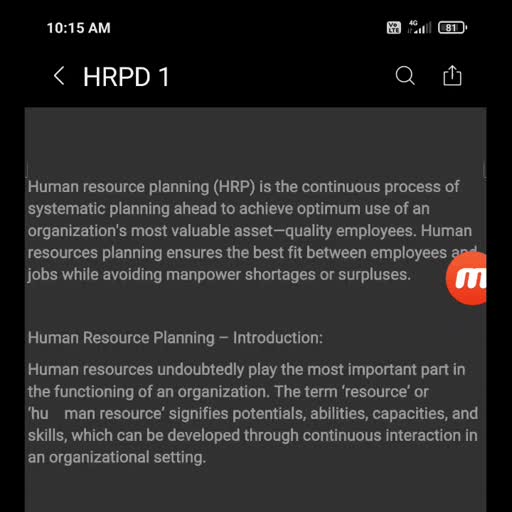
Concept of Human Resource Planning, Human resource planning has been defined as "the process by which, management determines how an organization should move from its current, manpower position to its desired manpower position. Through it management, strives to have the right number and the right kind of people at the right place, at, the right time, doing things which result in both the organisation, and the, individual receiving, maximum long, range benefit." In the words of Stainer,, "Manpower planning is the strategy for the acquisition utilisation, improvement, and preservation of an organisation's human resources. It is aimed at, coordinating the requirements for and the availability of different types of, employees., According to Beach, "Human resource planing is a process of determining and, assuming that the organisation will have an adequate number of qualified, persons, available at the proper times, performing jobs which meet the needs of, the enterprise and which provide satisfaction for the individuals involved., Thus, human resource planning involves estimating manpower needs and, formulating plans to meet these needs., Vetter defines HRP as, “The process by which management determines how the organization should, move from its current manpower position to its desired manpower position”, According to Stainer, “Human Resource Planning is the strategy for acquisition,, movement and preservation of human resources in an organization” It is basically, the process of getting the right number of qualified people into the right job, at, the right time so that organizational objectives can be met., , Characteristics of human resource planning, An analysis of the above definitions reveals the following characteristics of human, resource planning:
Page 2 :
(i) Human resource planning like all planning is forward looking or future, oriented. It involves forecasts of the manpower needs in a future time period, so that adequate and timely provision may be made to meet the needs., (ii) Human resource planning is an on-going or continuous process because the, demand for and the supply of human resources undergo frequent changes., (iii) Human resource planning is an integral part of corporate planning. Without, a corporate plan, there can be no manpower plan., (iv) The basic purpose of human resource planning is to make optimum, utilisation of an organisation's current and future human resources., (v) Human resource planning has both quantitative and qualitative aspects., The former implies the right number of employees while the later means the, right talent required in the organisation., (vi) Human resource planning is the primary responsibility of management so, as to ensure effective utilisation of the organisation's human resources., (vii) Human resource planning is a systems approach to human resources. In it,, the information about the demand and supply of human resources, constitutes the input. Comparison and evaluation of demand and supply so, as to identify the gap between the two is the transformation process. The, outputs of human resource planning are the strategy and programme, formulated to bridge the gap., (viii) Human resource plans can be long-term or short-term. Long-range plans, are prepared for a period of five years or more on the basis of trends in the, economy, labour market and production. These reflect management thinking, on the organisation structure, business environment and human resource, policies. Short-term manpower plans cover time periods ranging from one, year to less than five years. These are concerned with filling existing jobs.
Page 3 :
Long-range and short-range plans are complementary to each other., (ix) Human resource planning is a two-phased process involving calculation, about the demand for and supply of human resources, so as to secure an, equilibrium between the two. A manpower plan consists of two sub-plans:, (a) a manpower demand plan, and (b) a manpower supply plan., (x) Human resource planning involves study of the manpower environment, which influences the demand for manpower and its supply. It also involves, study of manpower utilisation., , Objectives of Human Resource Planning, The main objectives of human resource planning are as follows:, 1. To ensure optimum use of existing human resources., 2. To forecast future requirements for human resources., 3. To provide control measures to ensure that necessary human resources are, available as and when required., 4. To link human resource planning with organisational planning., 5. To assess the surplus and shortage of human resources., 6. To anticipate the impact of technology on jobs and human resources., 7. To determine levels of recruitment and training., 8. To estimate the cost of human resources and housing needs of employees., 9. To provide a basis for management development programmes., 10. To facilitate productivity bargaining., 11. To meet the needs of expansion and diversification programmes., The ultimate purpose of manpower planning is to relate future human resources, to future enterprise needs so as to maximise the future return on investment in, human resources."
Page 4 :
Need, scope and Importance of Human Resource, Planning, Effectivbe human resource planning offers the folloeing benefits, 1. To carry on its work and to achieve its objectives, every organisation, requires, employees with adequate lonowledge, experience and aptitudes. Human, resource planning is helpful in selection and training activities. It ensures, that adequate number of persons are selected and trained well in advance, to nil future Job vacancies in the organisation, 2. Human resource planning Identifies gaps in existing manpower in terms of, their quantity and talent. Suitable training and other steps can be taken in, time to fill these gaps., 3. There is need to replace employees who retire, die, resign and become, incapacitated due to injury. Provision for replacement of personnel can be, made through human resource planning, 4. Human resource planning facilitates the expansion and diversification of an, organisation. In the absence of human resource plans, the required human, resources will not be available to execute expansion and diversification plans, at the right time., 5. Human resource planning creates awareness about the effective utilisation, of human resources throughout the organisation. It helps to reduce wastage, of manpower, 6. Human resource planning is helpful in effective utilisation of technological, progress. To meet the challenge of new technology existing employees need, to be retrained and new employees may be recruited., 7. With the help of human resource planning, areas of surplus manpower can, be anticipated and timely action can be taken (e.g., redeployment)., 8. Human resource planning is useful in anticipating the cost of human, resources which facilitates the budgeting process. It also helps in controlling
Page 5 :
human resource costs through effective utilisation., 9. Human resource planning facilitates career and succession planning in the, organisation. It provides enough lead time for internal succession of, employees to higher positions through promotions. It also contributes to, management succession and development., 10. Human resource planning helps in planning for physical facilities like, canteen, staff quarters, dispensary and school for the staff and their children., 11. At the national level, human resource planning facilitates educational, reforms, geographical mobility of talent and employment generation., In recent years, focus on human resource planning has increased due to the, following reasons:, 1. Employment Situation. On the one hand, the number of educated unemployed, is increasing. On the other hand, there is acute shortage for a variety of skills., Under-developed countries find that shortage of talented and skilled manpower is, a major obstacle to their industrial progress and they have to import certain skills,, 2. Technological changes. The widespread and rapid changes in production, technology, marketing methods and management techniques are having, profound effects on the contents and contexts of jobs. These changes create, problems concerning redundancies, retraining and redeployment of personnel., Systematic human resource planning can help to solve these problems., 3. Organisational Change. Size of firms is increasing the environment of, business has become turbulent. Rapid changes in environment require changes in, organisation structure and activities which affect requirements for human, resources New human resource strategies are needed to meet these new, requirements., 4. Demographic Changes. The profile of the work force in terms of age, sex,, education, technical skills and social background is changing Such changes have, significant implications for human resource planning., 5. Shortage of Skills. Organisations have become increasingly complex and, require a wide-range of specialised skills. These skills are scarce and problems, arise when employees with these skills leave an organisation.
Page 6 :
6. Legislative Controls. Law with regard to working conditions, working hours., weaker sections, women and child labour, casual and contract labour. etc. does, not permit management to hire and fire at free will. Therefore, managers, must, look ahead and forsee manpower problems with the help of systematic human, resource planning, 7. Pressure Groups. Trade unions, politicians and displaced persons create, pressures on management for internal recruitment, promotions, preference to, sons of the soil/displaced persons/employees' children, etc., 8. Systems Concept. Systems thinking and information technology stress, planning and new ways of handling voluminous records concerning human, resources., 9. Lead Time. Longer lead time is required for selection and training of, employees to handle new jobs and technology successfully. This requires longterm human resource planning, 10. Hiring Costs. Recruitment and training costs are increasing. Increase in, hiring costs encourages upgrading from within the organisation, and planned, retention through manpower planning., 11. Increased Mobility. Investment in human resources belongs to the employee, who takes his skills wherever he goes. With increasing mobility, organisations find, it difficult to retain talented personnel. Effective manpower planning helps to, reduce employee turnover., , Factors affecting Human resource planning, 1. Company Specific Factors / Internal Environmental factor, a) Strategy, b) b) Human Resource Inventory, c) Human Resource Mobility, d) Time Horizon, 2. External environmental factor, Micro Environmental Factors, a) Industry Growth, b) Industry Attractiveness
Page 7 :
c) Technology, d) Competition Climate, Macro Environmental Factors, a) Economy, b) Labour Market, c) Demographic Factors, d) Regulatory Framework, , Human Resource Management Tools and Techniques, , , , , , , , , , , , Organizational Charts, Responsibility Assignments Matrix, Text, Networking, Organizational Theory, Expert Judgment, SWOT Analysis, Programmatic Job Advertising Tools, Talent Management Systems, Pre-employment Assessment Tools