Page 1 :
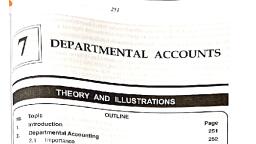
DEPARTMENTAL ACCOUNTS, 251, 7, THEORY AND ILLUSTRATIONS, No. Topic, Introduction, OUTLINE, Page, 1., Departmental Accounting, 251, 2., 2.1, Importance, 252, 2.2, Manner, Inter-Departmental Transfers, 3., 254, 3.1, Transfer Value, 3.2, Entries For Transfer, 3.3, Closing Stock at Transfer Value, 3.4, Stock Reserve, Many Departments, Entry For Stock Reserve, 3.5, 3.6, 3.7, Balance Sheet, 4., Illustrations : Allocation of Expenses, 257, 4.1, Departmental P & L A/c, 4.2, Departmental & General P & L A/c, 4.3, Final Accounts, Inter Departmental Transfers at Cost, Departmental P & L A/c, Departmental & General P &L A/c, 5., 275, 5.1, 5.2, 5.3, Final Accounts, Inter Departmental Transfers at Selling Price, Departmental & General P &L A/c, 287, 6., 6.1, 6.2, Final Accounts, 290, 7., Quantitative, 291, 8., Latest F.Y.B.A.F. University Exam Questions, 1., INTRODUCTION, a, Scanned By Scanner Go
Page 2 :
department. Many expenses are incurred for the organisation as a whole and not for any particular, and so on. According to Accounting Standard 17 of the Institute of C.A. of India, such division is, be divided into many departments based on number of processes involved e.g. process A, process B, departmental stores, on the other hand, may be divided into different departments on the basis of, different products or services e.g. grocery, medicines, cosmetics and so on. A chemical factory may, Accountancy and Financial Management (F. Y.B.Com.: SEM-I), 252, places. (In modern technical terms, a departument is known as a 'segment.), The division into departments is based on various factors such as functions, products or, processes. A, made based on two main factors - business and geographical area., 2., DEPARTMENTAL ACCOUNTING, 2.1, IMPORTANCE, When there are a number of departments, it is necessary to ascertain the profit or loss from each, department, separately. If only a single profit and loss account is prepared for the entire business, losses in some departments may be set-off against profits in other departments. In Departmental, accounting, each department is treated as a separate entity for the purpose of recording and reporting., The profit and loss account is prepared in columnar form to ascertain the profits of each department, separately (see Worksheet 2). This helps in finding out which department is contributing how much, profits. The owners can decide whether any department is making losses or too little profits and, hence should be closed down or re-organised. The commission of Departmental manager can be, decided on the basis of the profit of each department. Thus, departmentwise accounting reports are, useful for the management in (i) planning (ii) control and (iii) evaluation of performance. Departmental, reports are only for the internal use of management., 2.2, MANNER, The details in such P & LAccount relating to Sales, Purchases, Stocks, Expenses etc. are ascertained, in the following manner :, (1) Sales/Purchases/Returns, The books of accounts, day-books, ledgers etc. are kept department-wise. The day-books (sales, journal, purchase journal, return books etc.) are so designed as to show the transactions of each, department, separately. Alternatively, in some cases, each department may keep its own day-books, such as its own Sales Journal etc. Such day-books help in finding out the total sales and purchases of, each department, separately, at the year-end., (2) Stocks, Department-wise stocks can be ascertained by preparing stock sheets separately for each department, while counting the closing stock at the year-end., (3) Expenses, Each department is treated as a distinct profit centre or cost centre. The manager of each department, is responsible for controlling the expenses of his department. The expenses of a concern are of two, types: direct and indirect., (a) Direct Expenses, Direct expenses are the expenses which can be directly identified with a particular department, e.g. the direct expenses of a production department would be the raw materials consumed, uhe, wages of the workers and factory expenses such as rent, power etc. Department-wise dne, salaries/wages can be ascertained by preparing separate pay-sheets for each department., (b) Indirect Expenses, Indirect expenses are the expenses which cannot be so directly identified with a, particular, department. However, these expenses e.g. expgcannednByn$canaer enses o
Page 3 :
sales, expenses on common building and so on, benefit a numbet of departments These common., penses, also known as overheads, can be charged (allocated) to each department on some, ntable hasis. The following Worksheet shows the different ways in which the common expenses, sinh as frcight, rent etc. are allocated (divided and charged) to different departments:, ppartmental Acmunts, 253, NORKSHEET 1: ALLOCATION OF INDIRECT EXPENSES, Expenses to be allocated, No., Freight inward, octroi etc., Basis of Allocation, 1., Rent, taxes, repairs of building, Purchases of each department, Floor area of each department, 3., Lighting, Power, No. of points in each department, 4., Horse power of equipments installed, in each department, Depreciation, repairs, 5., Insurance, Value of asset in each department, 6., (a) Assets, (b) Stocks, (c) Workmens compensation, (a) Value of asset in each department, (b) Value of stock in each department, (c) No. of Workers/Wages of each dept,, No. of workers in each department, 7., Staff welfare, 8., Contribution to P.F./ESIS, Wages of each department, Material consumed by each department, No. of employees in each department, Hours worked at each department, 9., Costs of Stores department, 10., Costs of Personnel department, 11., Costs of Repairs workshop, 12., Costs of Canteen, Wages/No. of workers in each, department, 13., Production/Factory expenses, (1) Material consumed by each, department, (2) Wages of each department, (3) Machine Hours of each department, (4) Labour Hours of each department, (5) Quantity produced by each, department, (1) Sales of each department, (2) Units/Kg. sold by each department, (3) Units/Kg. sent by each department, (4) Units/Kg. stored by each, department, Selling & Distribution expenses, 14., (1) Sales of each department, (2) Salaries of each department, 15., Administrative/Office expenses, (c) Other Common Expenses or Losses, Other common expenses which cannot be so allocated to each department, e.g. Audit fees Legat, fees, Interest on loans etc., are charged to the General Profit & Loss Account. Other abnormal, Joss of goods by fire, damaged stock sold at a loss are also charged to the General, losses, Profit & Loss Account, so that the departmental pront & loss account shows only the normal, profits earned by a department. The profits of all the departments are transferred to the crmai, the General Profit & Loss Account. (The departmental loes are transferred to the debit of the, general profit & loss account)., (d) Departmental Profit, e.g., Scanned By Scanner Go
Page 4 :
Accountancy and l'inancial Managemient (r.Y.13. Com.: SEN, 10. OBJECTIVE QUESTIONS, 10.1 MULTIPLE CHOICE QUESTIONS, A., Conceptual, 1. Lighting is allocated on the basis of, (a) No. of points, (c) Floor Area, 2. Power is allocated on the basis of, of each department., (b) No. of employees, (d) Wages, each department., (b) No. of employees in, (d) Horse power of equipments installed in, (a) No. of points in, (c) Floor Area of, 3. Value of asset in each department is used as a basis for allocation of, (a) Depreciation, (c) both (a) and (b) above, 4. No. of workers in each department is not used as a basis of allocation of, (a) Staff welfare, (c) Costs of Canteen, 5. Sales of each department may be used as a basis of allocation to different departments for, (a) Selling and Distribution Expenses, (c) Both (a) and (b), 6. Rent and rates are apportioned to different departments on the basis of, (a) Floor area occupied, (c) sales of each department, 7. The turnover ratio is used in Departmental accounts for the allocation of, (a) Income tax, (b) Repairs, (d) neither (a) and (b) above, (b) Carriage Outward, (d) Costs of Personnel department, (b) Advertising Expenses, (d) Neither (a) nor (b), (b) number of workers, (d) Value of the assets kept, (b) bad debts, (c) depreciation, 8. Provision for unrealised profit with respect to stocks when transfers are effected at transfer pric, is to be charged to, (a) departmental trading account, (c) either (a) or (b), 9. Which of the following is not debited to General Profit and Loss account ?, (a) Audit fees, (c) Power and Fuel, 10. Which of the following is not allocated in the sales ratio ?, (a) Advertisement, (c) Commission on sales, 11. Which of the following is not debited to Departmental Profit and Loss account ?, (b) departmental profit and loss account, (d) general profit and loss account, (b) Interest on loan, (d) None of the above, (b) Bad debts, (d) Carriage inward, ni nisipa, (a) Carriage outward, (c) Rent and Rates, 12. Which of the following is not debited to Departmental Profit and Loss account ?, (b) Salaries, (d) Commission received, (a) Carriage inward, (c) Rent and Rates, 13. Following entry passed in Departmental Trading account means, Department A, To Department B, (a) Department A sent goods and Department B receives goods, (b) Department A receives goods and Department B sends goods, (b) Salaries, (d) Electricity, HOM AN AGT, Dr., (c) Both (a) and (b), (d) None of the above, 14. Which of the following is not divided in the ratio of number of employees ?, na etch forn2 o, (a) Salaries, (c) Rent and Rates, (b) Bonus, (d) All of the above, beribnl jo noo, Scanned By Scanner Go
Page 5 :
() Direct expenses are the expenses which can be directly identified with a particular department, 15 Which of the following statements is false regarding departmental accounting ?, 18. Which of the following expenses is a direct expense in departmental accounting?, (a) A department-wise balance sheet is always prepared, (d) Abnormal losses are not charged to departmental profit and loss account, • Which is the best way to allocate an indirect expense such as Advertising Expense?, (c) Each department may keep its own day-books, Which of the following expenses is an indirect expense in departmental accounting?, 297, (a) Rent, (c) Sales, (b) Carriage inward, (d) Purchases, (a) Department sales, Average cost of equipment used in each department, (c) Square feet, (d) None of the above, (a) Purchases Expense, (c) Advertising expenses, . The difference between a department's net sales and cost of goods sold is, (a) Departmental gross profit, (c) Departmental closing stock, 0 The difference between a department's gross profit and its expenses is, (a) Departmental gross profit, (c) Departmental cost of goods sold, 21. All of the following are used to compute departmental profit EXCEPT, (b) Administrative expenses, (d) Depreciation, (b) Departmental net profit, (d) Net profit taken to balance sheet, (b) Departmental net profit, (d) Net profit taken to balance sheet, (a) Sales, (c) Debtors, 22. Indirect expenses are allocated to departments based on, (b) Sales returns and allowances, (d) Purchases, (a) income-tax laws, (c) instructions from the board of directors, 23. Indirect expenses are normally, (a) allocated to each department on some reasonable basis, (b) allocated to each department by arbitrary methods, (c) actual expenses determined from departmental day books, (d) ignored when preparing departmental profit and loss account, 24. Direct expenses are assigned to departments based on, (a) estimated expenses, (b) actual expenses, (b) some reasonable basis, (d) decisions of the shareholders, (c) the percentage of total net sales by each department, (d) the percentage of gross sales by each department, 25. Which of the following would not be used as the basis for allocating expenses to departments?, (b) E-mail messages, (d) All of these would be used, (a) Sales, (c) Cost of goods sold, 26. Which of the following expenses is not likely to be allocated to departments by the company?, (a) Advertising expenses, (c) Bad debt expenses Gm, (b) Delivery expenses, (d) Depreciation expenses, (e) All of these are likely to be allocated, B., Numerical, onn oi coulbnt, (b) 16,500, ToD OL9 erttnot iloug aecip s (d) 6,000, 00t,04TS (b), (a) 7,500, (c) 18,000, Scanned By Scanner Go