Page 1 :
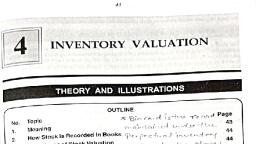
43, 4, INVENTORY VALUATION, THEORY AND ILLUSTRATIONS, OUTLINE, No. Topic, Meaning, * Bin card isthe record Page, 43, majitlained under the, 44, 1., How Stock is Recorded in Books perpecfual in uenteny, 2., 44, 3., Importance of Stock Valuation, 5ystem by the stores, 44, Systems, Periodic System of Inventory departniont and shows tue, 4., 4.1, Perpetual System of Inventory quanditicsaymatexial, 4.2, receiued, issued and, 45, in hand arter each, Distinction, balalice, 4.3, 5., First In First Out (FIFO) Method, 46, 6., Weighted Average Cost Method, oeceipt and issue., Illustrations, dt is also lenown as, 48, 7., Simple (Date-wise Transactions), Simple (Group-wise Transactions), bintag, 7.1, S4ock, caid er, 7.2, 7.3, Adjustments, 8., Verification of Stocks, 66, 8.1, Procedure for Stock Taking, 8.2, Adjustments in Physical Stock, 9., Illustrations, 68, Physical Stock on Year- End, Physical Stock After Year-End, 9.1, 9.2, 9.3, Physical Stock Before Year-End, 10., Latest F.Y.B.A.F. University Exam Questions, 74, 1., MEANING, A trading concern purchases goods for resale. It is possible that on the last day of the accounting year, some of the goods remain unsold, i.e. are in stock. A manufacturing concern purchases raw materials, to be converted into finished goods. The finished goods are then sold. It is possible that on the last, day of the accounting year some raw materials remain unused, some raw materials are still in process., and even some finished goods remain unsold. Thus, stock includes the goods purchased for resale, not yet sold, raw materials purchased but not yet consumed, raw materials only partly processed, Šcanned By Scanner Go
Page 2 :
(work-in-process) and finished goods manufactured but not sold. In short, Stock (or inventory) means, the stock of goods which a concern deals in, consumes or manufactures., 44, Accountancy and Financial Management (F.V.B. Com.: SEM-, 2., HOW STOCK IS RECORDED IN BOOKS, The closing stock is brought in the books at the end of the year through an adjusiment entry by, vear g the Closing Stock A/c and crediting the Trading or Manufacturing A/c. In order to bring the, year-end closing stock in the books it is necessary to: (a) lirst physically verify the quantity of items, stock as at year-end and (b) then compute the rate at which stocks are to be valued because the, Value of Stocks = Quantity x Rate., 3. IMPORTANCE OF STOCK VALUATION, Verification and valuation of inventory is important because of the followng :, (1) To Show Proper Value of Assets: A balance sheet is prepared at the end of every year, so that, the owner of business knows the assets and liabilities of the business. The goods lying in stock at, the end of the year are assets of business and hence must be shown in the balance sheet., (2) To Show Proper Profits: Profits for a year are equal to Income during the year Less Costs, during the year. This is known as the concept of periodical matching of costs and revenue. Gross, profits are equal to Income from goods sold Less Cost of goods sold. The income is from goods, *sold'. Hence, the cost includes only the cost of goods 'sold' and not the cost of goods unsold or, in stock. The income from goods in stock will be received when these goods are sold in future., Hence the cost of closing stock is carried forward to be deducted from such future sales. For this, purpose, the value of closing stock is credited to the Manu facturing or Trading Account. Thus,, closing stock is brought into the books in order to compute the correct amount of profits in the, current year as well as in the future., 4. SYSTEMS, 4.1, PERIODIC SYSTEM OF INVENTORY, (1) Meaning : Under the Periodic Inventory System, closing stock is ascertained by taking an actual, physical count of all the inventory items on hand on a particular date. Alternatively, the quantity, may be ascertained from the Bin-Card showing quantity details of stock items. The value of, stock on such date is equal to : Quantity of stock so ascertained x Rate., (2) Formula : Under the periodic system of inventory, cost of inventory (at the year-end) is ascertained, first, as above and then cost of goods sold (during the year) is found by the following formula:, Cost of goods sold during the year = Opening stock + Purchases during the year - Closing stock., (3) Steps : There are two steps involved in this method :, (a) Count the items physically. Certain items can be weighted in kilos or tonnes or in litres, (b) The items counted are listed, priced and added so as to get the value of in ventory, For this, purpose, a stock sheet is prepared., (4) Advantages :, (a) Stock valuation is done accurately., %3D, (b) It is less expensive., (5) Disadvantages :, (a) It affects normal business operations at the end of the accounting period., (b) It becomes more expensive if the income statements are required more frequently., (c) Discrepancies will never come to light., (d) Inventory control is not possible under thiScarmed By Scanner Go
Page 3 :
Inventory Viluation, 45, 4.2 PERPETUAL SYSTEM OF INVENTORY, Under the Perpetual Inventory System, closing stock is ascertained, not by taking physical count, but, tiom the stock ledger itself, after each receipt and issue. The value of stock is also calculated alter, cach transaction ofreceipt or issue. Perpetual system thus helps to keep constant track of high-valuc, items., Under the perpetual system of inventory, cost of goods sold upto a day is ascertained first, as above, and then cost of inventory (on that day) is found by the following formula:, Closing stock on that day = Opening stock + Purchases to-date - Cost of goods sold to-date., %3D, 4.3 DISTINCTION, Periodic Inventory System, Sr., No., 1 This system is based on physical, verification., Perpetual Inventory System, It is based on book records., 2 This system provides information about, stock and cost of goods sold at a, particular date., 3. This system determines first, inventory, and, computes cost of goods sold as, balancing figure., 4. Cost of goods sold includes loss of, goods as goods not in stock are, assumed to be sold., It provides continuous information about, about stock and cost of sales., It determines first, cost of goods sold, and, computes stock as balancing figure., Closing inventory includes loss of goods, as all unsold goods are assumed to be in, inventory., Inventory control is possible under this, system., 5. Under this method, inventory control is, not possible., This system is simple and less expensive. It is complex and costlier method., 7. It requires closure of business for, counting of stock., 6., Inventory can be determined without, stopping the operations of the business., 5., FIRST IN FIRST OUT (FIFO) METHOD, This method assumes that the items received first are issued (sold or consumed) first, so that the, latest items are in stock. In this method, an issue is valued at the oldest rate, while the closing stock, is valued at the latest rate. The FIFO formula assumes that the items of inventory which were purchased, or produced first are consumed or sold first. Consequently, the items, remaining in the inventory are, those most recently purchased or produced. This method gives the same results whether the stock is, ascertained at the year end under periodic system or every day under the perpetual system of inventory., Advantages, 1. Simple to Compute: This is a simple formula to compute. It is necessary only to check the purchase, bills backwards to the extent the goods are in stock., 2. Stock Valued at Current Cost: The closing stock under this formula gets valued at the latest rate., Thus the balance sheet shows the current cost of the stock., 3. Perishable Goods: This is the most suitable method in case of perishable goods which are issued, on FIFO basis. It is also suitable in cases where, in actual practice, the goods received first are in, fact issued first., Disadvantages, 1. Higher Profits in Inflation: At times of rising prices (inflation), the value of closing stock under, this method is high. Thus, this method leads togtarmaBVScanner Go, during deflation (falling prices)., igher, during inflation and lower profits
Page 4 :
Thus, the issue of 10 units on 3-1-2014 is assumed to be out of the first purchase on 1-1-2014. The, assumed to be out of items purchased on 2-1-2014. Hence the closing stock is valued at the rate of, next issue on 4-1-2014 is assumed to be from the next purchase on 2-1-2014. The closing stock is, items purchased on that date. The Closing Stock under this basis gets valued at the latest rate., M-1), Accountancr and Financial Management, material, Illustration 1: (FIFO), Issue, Units, TDate, Purchase, Rate, 2014, 1.00, 1.20, Units, 1-1, 10, 10, 2-1, 15, 3-1, 4-1, Solution :, Closing Stock, Value, Date, Purchases, Issue, Units, Rate, Value, Units, Rate, Units, Rate, 10, 1.00, 10.00, 1-1-2014, Value, 10, 1.00, 10.00, 18.00, 2-1-2014, 1.00, 10.00, 10, 15, 1.20, 18.00, + 15, 1.20, 3-1-2014, 15, 1.20, 18.00, 10.00, 4-1-2014, 10, 1.00, 10, 1.20, 12.00, 6.00, 1.20, Total, 25, 16.00, 28.00, 15, 6., WEIGHTED AVERAGE COST METHOD, onder the Weighted Average Cost formula, the cost of each item is determined from the weighted, average of the cost of similar items purchased or produced during the period. The averagé may be, calculated on a periodic basis, or as each additional shipment is received (i.e. on perpetual basis),, depending upon the circumstances (i.e. accounting policy - periodic or perpetual) of the enterprise, [AS 2)., Weighted Average Cost method can be used under both the systems of inventory periodic and, регpetual., Under the periodic system, the Weighted average cost of inventory at the end of a particular, period (e.g. at the year-end) is calculated by the following formula:, Opening Stock + Purchases (In Amounts), Opening Stock + Purchases (In Units), Weighted Average Cost Per Unit =, The above rate is applied to the units in stock to ascertain the value of stock. The value of Closing, stock is ascertained by the formula:, Value of closing stock = Weighted Average Cost Per Unit x Units in Stock., Under the perpetual system, the weighted average cost is ascertained after each purchase by the, following formula:, Total cost of inventory on hand (after latest purchase), Weighted Average Cost Per Unit =, Total units of inventory on hand (after latest purchase), The above rate is applied to the units issued in order to ascertain the cost of goods sold The cost of, goods sold upto any day is ascertained by the formula:, Cost of goods sold upto that day = Weighted Average Cost, Per, Scanned By Stahner Go, bodom zi
Page 5 :
Inventory Valuation, 47, (Note for students: If an examination problem does not specifically mention about the system of, ny entory, students should solve the problem assuming that the perpetual system of inventory is in, use)., Advantages, 1. Lower Profits in Inflation: At times of rising prices (inflation), the value of closing stock under, this method is lower than that under FIFO. Thus, this method leads to lower profits during inflation, and higher profits during deflation (falling prices), as compared to FIFO., Disadvantages, 1. Difficult to Compute: This is not a simple formula to compute. It is necessary to check the details, of all the purchases during the year., > Stock Valued at Average Cost: The closing stock under this formula gets valued at the average, rate. Thus the balance sheet may not show the current cost of the stock., 3. Unsuitable: This method is not suitable in many cases e.g. in case of perishable goods where, FIFO is more suitable., Illustration 2 : (Weighted Average), Refer Illustration 1. Work out the value of the closing stock, if cost is computed at Weighted Average, Rate., Solution :, Weighted Average (Perpetual Inventory System), Issues, Closing Stock, Receipts, Rate Amount, Date JOpening Stock, Units | Rate | Amount, Units, Value, 2014 Units Value Units, (3), (7), (8), (9), (10), (11)., (6), = 4 x 5, (1), (2), (4), (5), = 7 x 8, = 2 + 4 - 7, = 3 + 6 - 9, Nil, Nil, 10, 1.00, 10, Nil, Nil, Nil, 10, 10.00, 1-1, 10 10.00, 15, 1.20, 18, Nil, Nil, Nil, 25, 28.00, 2-1, 25 28.00, Nil, Nil, 10, 1.12, 11.20, 15, 16.80, 3-1, Nil, 15 16.80, Nil, Nil, Nil, 1.12, 5.60, 10, 11.20, 4-1, Steps :, (1) 1-1-2014 : Enter Purchase Units [10] in column (4) and Purchase Rate [R 1.00] in column (5)., Calculate amount as (4) x (5). Since Issues are Nil, enter same Quantity & Amount in closing, stock columns (10) & (11)., (2) 2-1-2014 : Enter closing stock on 1-1-2014 as opening stock on 2-1-2014. Enter purchases as, explained above. Closing stock units (10) will be equal to (2) + (4), closing stock value =, (6)., (3) +, (3) 3-1-2014 : Enter opening stock as explained above. Enter units [10] issued in column (7). These, issues will be valued at the Weighted Average Rate (WAR)., 28.00, Total cost of Inventory on hand (after latest purchase), Total units of Inventory on hand (after latest purchase), = 1.12, %3D, WAR =, 25, Hence Issue Amount = 10 units x 1.12 = 11.20. The closing stock on 3-1-2014 is the balancing, figure. Closing stock units = 25 - 10 = 15: Closing stock value = { 28 less { 11.20 = 16.80., Thus, under the Weighted Average Cost Method (Perpetual Inventory System), the closing, stock value is the balancing figure. The Weighted Average Rate is used for calculating, Amount of Issue., (4) 4-1-2014: The entries are made in the same manner as explained above., Scanned By Scanner Go, A1OS-T-40