Page 1 :
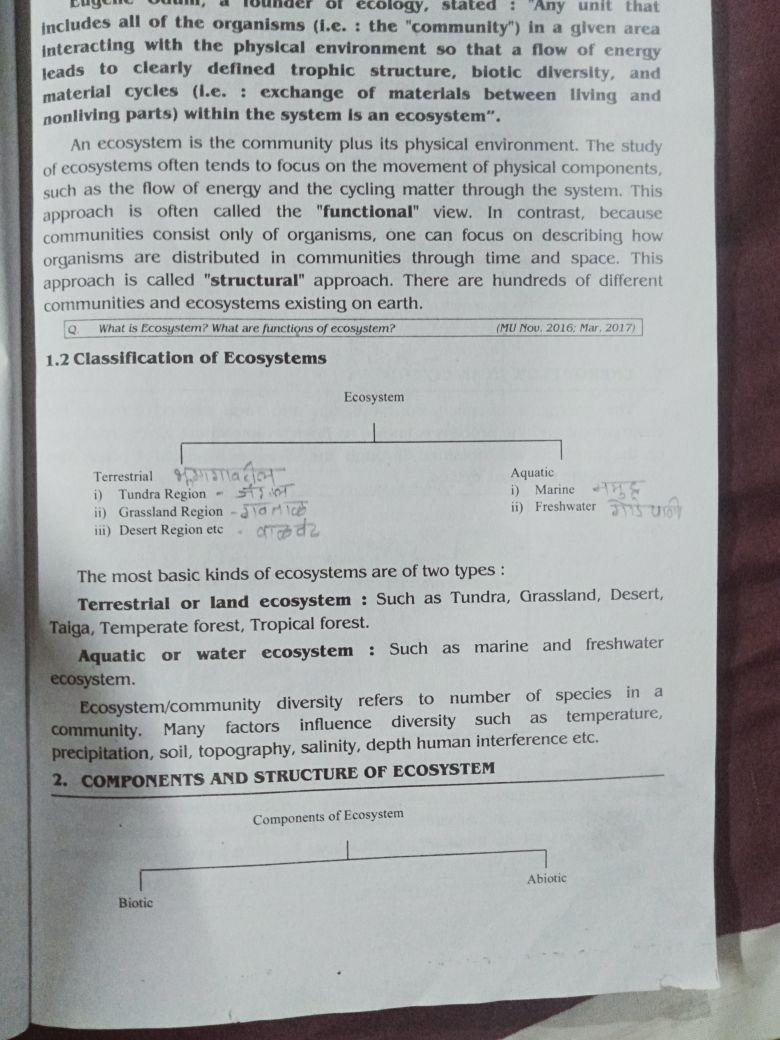
er ee, , , , , , , , , , , , , , , , , , , , , , , , , , , , a i Ay, Saree + My unit Chat, includes all of the organisms (i.e. : the "community") in a given area, interacting with the physical environment so that a flow of energy, jeads to clearly defined trophic structure, biotic diversity, and, material cycles (Ie. : exchange of materials between living and, nonliving parts) within the system Is an ecosystem”., , n ecosystem is the community plus its physical environment. The study, of ecosystems often tends to focus on the movement of physical components,, such as the flow of energy and the cycling matter through the system. Th, approach is often called the "functional" view. In contrast, because, communities consist only of organisms, one can focus on describing how, organisms are distributed in communities through time and space. This, approach is called "structural" approach. There are hundreds of different, communities and ecosystems existing on earth,, , What & Ecosystem? What, , , , , , , , fU How, 2016; Mar, 2017, , , , 1.2 Classification of Ecosystems, , Ecosystem, , Terrestrial YESVET\AC IO Aquatic, , i) Tundra Region = i) Marine, ii) Freshwater, , ii) Grassland Region, lil) Desert Region ete, , , , The most basic kinds of ecosystems are of two types :, Terrestrial or land ecosystem : Such as Tundra, Grassland, Desert,, , Temperate forest, Tropical forest., tic or water ecosystem : Such as marine and freshwater, , tem/community diversity refers to number of species in a, Many factors influence diversity such as _ temperature, , soil, topography, salinity, depth human interference etc., IONENTS AND STRUCTURE OF ECOSYSTEM, , ‘Components of Ecosystem