Page 1 :
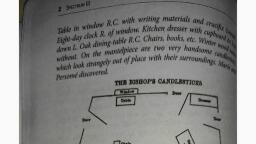
THE BISHOP'S CANDLESTICKS 19, Convict. You mean me-you want me to take them?, Bishop. Please; they may help you. (The Convict takes the candlesticks, in absolute amazement.] And my son. There is a path through the, woods at the back of this cottage which leads to Paris, it is a very, lonely path, and I have noticed that my good friends the gendarmes, do not like lonely paths at night. It is curious., Convict. Ah, thanks, thanks, Monseigneur. I-I-[He sobs.] Ah! I'm, a fool, a child to cry, but somehow you have made me feel that-that, it is just as if something had come into me-as if I were a man again, and not a wild beast., The door at back is open and the Convict is standing in it., Bishop. [Putting his hand on his shoulder.] Always remember, my, son, that this poor body is the Temple of the Living God., Convict. [With great awe.] The Temple of the Living God. I'll, remember. [Exit L. C.], The Bishop closes the door and goes quietly to the prie-dieu in the, window R., he sinks on his knees, and bows his head in prayer., Slow curtain., ABOUT THE PLAY, The story of this play has been adapted from a few chapters in, the first volume of Les Misérables (1862), Victor Hugo's celebrated, novel, which depicts the deplorable social realities of nineteenth-, century France and the hardships suffered by its poor. Les., Misérables is also an extended reflection on crime, punishment, and redemption. The protagonist of the novel is the former convict, Jean Valjean, who turns his life around after an encounter with a, kind and generous bishop. McKinneľ's play dramatises this life-, changing incident., curious: (here) strange, prie-dieu: a low bench for a person to kneel on while praying; usually fitted with, a raised shelf on which the elbows or a book may be rested
Page 2 :
THE BISHOP'S CANDLESTICKS 21, 5. Why was the bishop kind towards the convict? What did the, convict think was the reason for the bishop's kindness? Did the, convict turn out to be right in some regard?, 6. This play is based on the novel Les Misérables, in which the, convict has a name-Jean Valjean. Why do you think McKinnel, left the convict unnamed? Elaborate on how the playwright's, choice expands on the theme of the play., 7. (a) Write a character sketch of Persomé. (b) The character of, Persomé does not exist in Les Misérables. Why do, McKinnel added her to his play version of the story?, you, think, Answer the following questions with reference to context., I'm a fool, a child to cry, but somehow you have made me feel that-, that it is just as if something had come into me-as if I were a man, again ..., 1. What play is this line taken from? Who is the playwright? Who, says this to whom?, 2. What do you think the speaker means by 'as if something had, come into me? What is the speaker trying to convey? Why do, you think the speaker is unable to name the 'something?, 3. Very briefly, explain who or what caused this change in the, speaker. (Avoid summarising the story.), One must do a great deal for the devil, in order to do a little for God., 1. What play is this line taken from? Who is the playwright? Who, says this to whom?, 2. What made the speaker say this? What is the meaning of the line?, 3. In not more than two sentences, say what the speaker did 'for the, devil, in order to do a little for God, Persomé: You are incorrigible. You'll sell, your, Bishop: No, no, sister, not my candlesticks., candlesticks next., 1. In what way is the bishop 'incorrigible?, 2. What is Persomés tone in this dialogue? What does she think, about the bishop's behaviour?, 3. Why does the Bishop not want to sell his candlesticks?
Page 3 :
Candlesticks. The play offers an antidote in the form of, play, as revealed through their actions and words. Wha,, Describe the character of the convict who broke into the b, cottage. What changed in the man at the end of the play, transform the convict, inspiring the latter to begin pullinglim, 2. Compare and contrast the characters of the two sibling, Answer the following questions in about 600-750 words ea, dehumanisation of the convicted-leads to the hardening, criminals and a continuous cycle of crime. We see this situn, play out in the character of the unnamed convict in The Bih, and compassion. The trust and kindness shown by the bi, SPECTRUM Im, 20, the, out of a hate-filled existence., COMPREHENSION, 1., caused this change?, play, as revealed through their actions and words te, opinion, might these two personalities represent?, Discuss the themes of this play., Answer the following questions in about 300–350 worde, Why does Persomé call the bishop 'the dupe of everyide, or lying old woman in the Parish? Do you think ths i, assessment?, . What did the convict mean when he said Tm not a many, a number'? What is the significance of this line with ag, themes of this play?, Why did the convict steal from his benefactor? Whl, tell us about his nature? What did the convict intend, the stolen goods?, (a) Why did the gendarmes arrest the convic? ()
Page 4 :
good and, and it's a queer thing to ask but-but could you, wo, Persomé. Well, if I must go, at least I'll take the candlesticks with, Bishop. [Loudly and with great severity.] I, your Bishop, comman, Bishop. [More severely.] Persomé, place the candlesticks on that, doesn't when one has been in Hell, but somehow I–I–know you, Convict. I-I didn't believe there was any good in the world-, can be lost there, they won't find me there. And I must travel at ni, daren't-besides I must go on, I must get to Paris, it is big, and, Convict. No! [Looking at the candlesticks.] No! no! I daret, Bishop. Now won't you sleep here, see your bed is ready., Convict. [Shamefacedly.] Monseigneur, I'm glad I didn't g, Bishop. /With slight severity.] Persomé, leave us. I wish it., 18 SPECTRUM II, She looks hard at him, then turns towards her door, on, and leave us., Persomé. [Defiantly.] I will not!, Persomé does so with great reluctance and exits R, get aw, with them, curse me, I am. I'm glad., I, do you understand?, Bishop. I see-you must travel by night., bless me before I go-I-I think it would help me., you, head very shamefacedly.], Bishop. [Makes sign of the cross and murmurs blessing.], Convict. [Tries to speak, but a sob almost chokes him.] Goodngt, He hurries towards the door., Bishop. Stay, my son, you have forgotten your property. (imng, the candlesticks.], queer. strange; odd, stay: (here) to wait a moment
Page 5 :
18 SPECTRUM IIl, Bishop. [With slight severity.] Persomé, leave us. I wish it., She looks hard at him, then turns towards her door., Persomé. Well, if I must go, at least I'll take the candlesticks with me, Bishop. [More severely.] Persomé, place the candlesticks on that table, and leave us., Persomé. [Defiantly.] I will not!, Bishop. [Loudly and with great severity.] I, your Bishop, command it., Persomé does so with great reluctance and exits R., Convict. [Shamefacedly.] Monseigneur, I'm glad I didn't get away, with them, curse me, I am. I'm glad., Bishop. Now won't you sleep here, see your bed is ready., Convict. No! [Looking at the candlesticks.] No! no! I daren't, I, daren't-besides I must go on, I must get to Paris, it is big, and I–I, can be lost there, they won't find me there. And I must travel at night,, do you understand?, Bishop. I see-you must travel by night., Convict. I-I didn't believe there was any good in the world-one, doesn't when one has been in Hell, but somehow I-I-know you're, good and, and it's a queer thing to ask but-but could you, would, you bless me before I go-I-I think it would help me. I-[Hangs his, head very shamefacedly.], Bishop. [Makes sign of the cross and murmurs blessing.], Convict. [Tries to s, t a sob almost chokes him 1e