Page 1 :
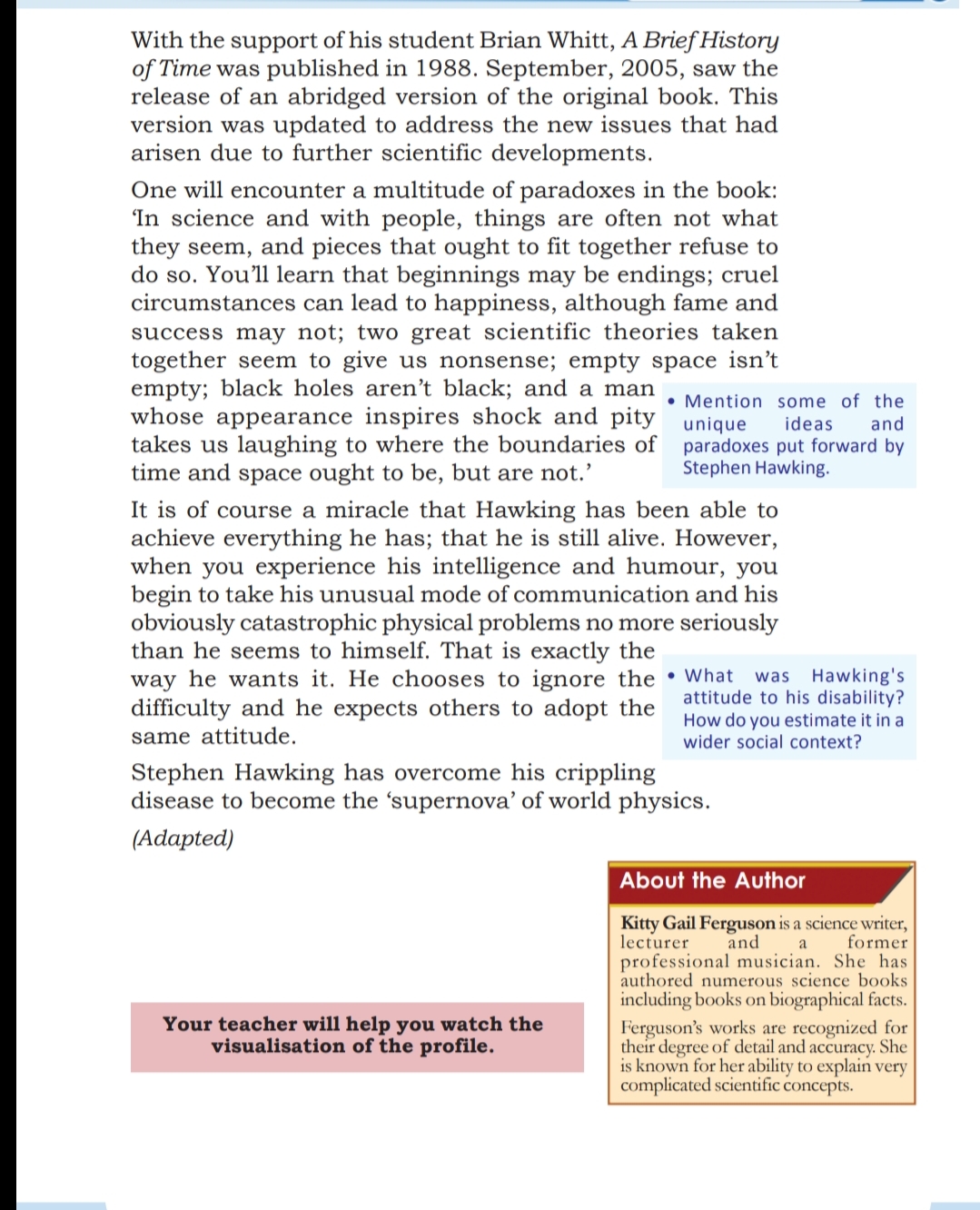
With the support of his student Brian Whitt, A Brief History, of Time was published in 1988. September, 2005, saw the, release of an abridged version of the original book. This, version was updated to address the new issues that had, arisen due to further scientific developments., , One will encounter a multitude of paradoxes in the book:, ‘In science and with people, things are often not what, they seem, and pieces that ought to fit together refuse to, do so. You'll learn that beginnings may be endings; cruel, circumstances can lead to happiness, although fame and, success may not; two great scientific theories taken, together seem to give us nonsense; empty space isn’t, empty; black holes aren’t black; and a man ., , 7 : :, * Mention some of the, whose appearance inspires shock and pity nique ideas and, takes us laughing to where the boundaries of _ paradoxes put forward by, time and space ought to be, but are not.’ Stephen Hawking., , It is of course a miracle that Hawking has been able to, , achieve everything he has; that he is still alive. However,, , when you experience his intelligence and humour, you, , begin to take his unusual mode of communication and his, , obviously catastrophic physical problems no more seriously, , than he seems to himself. That is exactly the, , way he wants it. He chooses to ignore the * What was Hawking's, difficulty and he expects others to adopt the pa Lea ar, same attitude. wider social context?, Stephen Hawking has overcome his crippling, , disease to become the ‘supernova’ of world physics., , (Adapted), PNT Mw ated s, , Kitty Gail Ferguson is a science writer,, lecturer and a former, professional musician. She has, authored numerous science books, including books on biographical facts., , Your teacher will help you watch the Ferguson’s works are recognized for, visualisation of the profile. their degree of detail and accuracy. She, , is known for her ability to explain very, complicated scientific concepts.