Notes of Second Bcom A 2022, English A sunny morning.pdf - Study Material
Page 1 :
1, A Sunny Morning, A Comedy of Madrid, SERAFÍN AND JOAQUÍN ÁLVAREZ QUINTERO, ABOUT THE AUTHORS, Serafin (1871-1938) and Joaquín (1873-1944) Álvarez Quintero, were celebrated Spanish playwrights of the early twentieth century., Together, the two brothers wrote about 200 plays depicting the, life, manners and speech of the people of Andalusia in southern, Spain. The popularity of their comedies contributed to the revival, of Spanish theatre, and the Quintero brothers were dubbed the, "Golden Boys of Madrid Theatre Some of their most well-known, plays include The Galley Slaves, The Love that Passes, Las de Cain,, Doña Clarines and Malvaloca. Their plays are characterised by, light themes, witty language and simple staging., THE PLAY, Characters, Doña Laura, Petra, a maid, Don Gonzalo, Juanito, an attendant, Scene: A sunny morning in a retired corner of a park in Madrid., Autumn. A bench at the right., DOÑA LAURA, a handsome, white-haired old lady of about seventy,, refined in appearance, her bright eyes and entire manner giving evidence, that despite her age her mental faculties are unimpaired, enters leaning, Madrid: the capital city of Spain, Doña: a Spanish courtesy title or form of address for a woman, unimpaired: not weakened; undamaged
Page 2 :
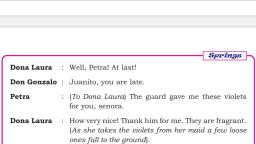
upon the arm of her maid, PETRA. In her free hand she carries a po, Doña Laura. I am so glad to be here. I feared my seat would, Doña Laura. Yes, you are only twenty. [She sits down on the bendch, 2 ARTICULATION II, which serves also as a cane., occupied. What a beautiful morning!, Petra. The sun is hot., on, Oh, I feel more tired today than usual. [Noticing PETRA, who, impatient.] Go, if you wish to chat with your guard., Seems, Petra. He is not mine, señora; he belongs to the park., Doña Laura. He belongs more to you than he does to the park Go, find him, but remain within calling distance., Petra. I see him over there waiting for me., Doña Laura. Do not remain more than ten minutes., Petra. Very well, señora. [Walks toward the right.], Doña Laura. Wait a moment., Petra. What does the señora wish?, Doña Laura. Give me the bread crumbs., Petra. I don't know what is the matter with me., Doña Laura. [Smiling.] I do. Your head is where your heart is-with, the guard., Petra. Here, señora., She hands DOÑA LAURA a small bag. Exit PETRA by the right., Doña Laura. Adiós. [Glances toward the trees at the right.] Here they, come! They know just when to expect me. [She rises, walks toward, the right, and throws three handfuls of bread crumbs.] These are for, parasol: a light umbrella used to give shade from the sun, señora: (Spanish) madam, adiós: (Spanish) farewell; goodbye
Page 3 :
A SUNNY MORNING 3, the spryest, these for the gluttons, and these for the little ones which, are the most persistent. [Laughs. She returns to her seat and watches,, with a pleased expression, the pigeons feeding.] There, that big one is, always first! I know him by his big head. Now one, now another, now, two, now three-that little fellow is the least timid. I believe he would, eat from my hand. That one takes his piece and flies up to that branch, alone. He is a philosopher. But where do they all come from? It seems, as if the news had spread. Ha, ha! Don't quarrel. There is enough for, all. I'll bring more tomorrow., Enter DON GONZALO and JUANITO from the left center. DoN GONZALO, is an old gentleman of seventy, gouty and impatient. He leans upon, JUANITO's arm and drags his feet somewhat as he walks., Don Gonzalo. Idling their time away! They should be saying Mass., Juanito. You can sit here, señor. There is only a lady., DOÑA LAURA turns her head and listens., Don Gonzalo. I won't, Juanito. I, a bench to myself., Juanito. But there is none., Don Gonzalo. That one over there is mine., Juanito. There are three priests sitting there., Don Gonzalo. Rout them out. Have they gone?, Juanito. No, indeed. They are talking., Don Gonzalo. Just as if they were glued to the seat. No hope of their, leaving. Come this way, Juanito., spryest: most active and energetic, glutton: someone who eats excessively, persistent: determined, timid: shy; not confident, Don: a Spanish courtesy title or form of address for men that is prefixed to the, forename, gouty: suffering from gout (painful inflammation of the joints of the foot), rout: to cause to flee; to drive (someone) away
Page 4 :
4 ARTICULATION II, They walk toward the birds, right., Doña Laura. [Indignantly.] Look out!, Don Gonzalo. Are you speaking to me, señora?, Doña Laura. Yes, to you., Don Gonzalo. What do, you, wish?, feeding on, Doña Laura. You have scared away the birds who were, my crumbs., Don Gonzalo. What do I care about the birds?, Doña Laura. But I do., Don Gonzalo. This is a public park., Doña Laura. Then why do you complain that the priests have taken, your bench?, Don Gonzalo. Señora, we have not met. I cannot imagine why you, take the liberty of addressing me. Come, Juanito., Both go out by the right., Doña Laura. What an ill-natured old man! Why must people get so, fussy and cross when they reach a certain age? [Looking toward the, right.] I am glad. He lost that bench, too. Serves him right for scaring, the birds. He is furious. Yes, yes, find a seat if you, is wiping the perspiration from his face. Here he comes. A carriage, would not raise more dust than his feet., can. Poor man! He, Enter DON GONZALO and JUANITO by the right, and walk towara me, left., Juanito. No indeed, señor. They are still there., I, unfair
Page 5 :
A SUNNY MORNING 5, extreme end of DOÑA LAURA'S bench and looks at her indignantly. He, touches his hat as he greets her.] Good morning., Doña Laura. What, you here again?, Don Gonzalo. I repeat that we have not met., Doña Laura. I was responding to your salute., Don Gonzalo. 'Good morning should be answered by 'Good, morning, and that is all you should have said., Doña Laura. You should have asked permission to sit on this bench,, which is mine., Don Gonzalo. The benches here are public property., Doña Laura. Why, you said the one the priests have was yours., Don Gonzalo. Very well, very well. I have nothing more to say., [Between his teeth.] Senile old lady! She ought to be at home knitting, and counting her beads., Doña Laura. Don't grumble any more. I'm not going to leave just to, please you., Don Gonzalo. [Brushing the dust from his shoes with his handkerchief.], If the ground were sprinkled a little it would be an improvement., Doña Laura. Do you use your handkerchief as a shoe-brush?, Don Gonzalo. Why not?, Doña Laura. Do you use a shoe-brush as a handkerchief?, Don Gonzalo. What right have you to criticise my actions?, Doña Laura. A neighbour's right., Don Gonzalo. Juanito, my book. I do not care to listen to nonsense., Doña Laura. You are very polite., touches his hat: Touching the brim of one's hat lightly was a way of showing, respect. This informal salute was common etiquette among gentlemen., senile: mentally or physically weak with age



 Learn better on this topic