Page 1 :
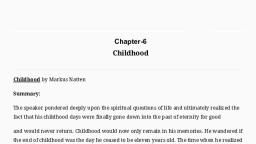
CHILDHOOD, By Markus Natten, Introduction, In the poem Childhood, the poet ponders deeply over the question of his lost, childhood. He recalls a number of stages when his thoughts and perceptions about, the world and people changed. He tries to identify that one particular stage or time, when he lost his childhood and stepped into adulthood. He feels a sense of nostalgia, for the lost childhood and finally settles down with an idea that his childhood has gone, to some forgotten place and that place could only be found in an infant’s innocent, face., Summary, The speaker pondered deeply upon the spiritual questions of life and ultimately, realized the fact that his childhood days were finally gone down into the past of, eternity for good and would never return. Childhood would now only remain in his, memories. He wandered if the end of childhood was the day he ceased to be eleven, years old. The time when he realized that heaven and hell are not real places because, they could not be located in geography and never could be. Where did his childhood, go? Was it the time he realized that adults were not all they seemed to be? They talked, of love and they preached of love, but did not act so lovingly nor practiced what they, preached. Was that the day. Where did his childhood go? Was it when he found out, that his mind was really his? To use it whichever way he chose? To produce thoughts, that was not those of other people but his and his alone. Was that the day? Where did, his childhood go? It went to some forgotten place that is hidden in a baby’s face. That, was all that he knew and that was all that he remembered., In the poem ‘Childhood’, the poet is trying to realise the age when he lost his, childhood, when he became mature enough to understand the worldly things. So he, keeps saying, “When did my childhood go?” He finally realizes that his childhood is, gone to “some forgotten place”, “that is hidden in an infant’s face.”, , Detailed Explanation, Stanza 1, Childhood has for centuries been considered by poets as a blissful period of one’s life., In this poem, the poet exhibits his curiosity to know, when an individual ceases to be, a child. The process of growing up from a child to an adolescent and an adult is an, inevitable one. There is no line of demarcation between the various stages of life. The, poet begins the poem by putting forth this question to himself. He wonders when did, his childhood leave him and where could it be found now? He wonders if it was the, day he ceased to be eleven, or was it the time he realized that Heaven and Hell could, not be located on the maps he was familiar with. As he matures he realizes that they, do not exist in this world. They are only imaginary places., Stanza 2, In the second stanza, the poet reiterates the same question and wonders if it is the day, when a child develops a new perception with which he is able to see through the, hypocrisy of the adults. They talk of love and preached of love but in actuality they are, double faced. Was that the day? Stanza 3
Page 2 :
In the third stanza, the poet pondering over the same question wonders if it was the, day when his perso nality acquired certain individuality. When he realized that his, mind was his own and he was capable of producing thoughts that were his own,, devoid of any form of bias or influence. Now he is conscious of his own separate, identity and feels himself different from others., Stanza 4, The poet concludes the poem by expressing his regret at the loss of his childhood, which was a beautiful period of his life. He comes to the conclusion that it has gone to, some forgotten place. The recollection of it has faded away with the passage of time., Perhaps it has gone to the innocent face of a child. Here the poet creates a lovely, image of an infant’s face. He conveys the idea that innocence of the childhood remains, only as long as one is infant. There is a tinge of optimism in this thought. At least, innocence and purity of mind prevails in some form or the other on this earth., , When did my childhood go?, Was it the day I ceased to be eleven., Was it the time I realised that Hell and Heaven,, Could not be found in Geography,, And therefore could not be, Was, that the day!, Q1. When does poet realise that his childhood has gone?, Ans. Poet realises at the age of eleven., Q2. Why is the age of eleven so important for the poet?, Ans. Because at the age of eleven, he can differentiate between fact and fiction., Q3. What is the quality acquired by the poet at this stage of his life?, Ans. The poet has become rational at this stage., Q4. When did the poet know that ‘hell’ and ‘heaven’ are imaginary concepts?, Ans. When he could not locate these places in geography books., Q5. Why is the poet worried?, Ans. The poet is worried because he has lost his purity of thoughts and innocence., Q6. Where has the poet’s childhood gone?, Ans. His childhood has gone to some forgotten place., Q7. What is a child’s perception of an adult?, Ans. As the childhood goes, the child can differentiate between fact and fiction., , When did my childhood go?, Was it the time I realised that adults were not, All they seemed to be,, They talked of love and preached of love,, But did not act so lovingly, Was that the, day!, Q1. Why does the poet not talk great of grown up people?, Ans. Poet feels that grown up people do not act on what they preach., Q2.Why is the poet confused?, Ans. Poet cannot understand whether he is a child or an adult., Q3.How does the poet find the people in this world?, Ans. Poet finds the people as hypocrites., Q4.Choose word from the passage which means ‘sermonized’. Ans., Preached
Page 3 :
When did my childhood go?, Was it when I found my mind was really mine,, To use whichever way I choose,, Producing thoughts that were not those of other people, But my own and mine alone Was that the day!, Q1. Explain ‘My mind was really mine’?, Ans. It means that poet was completely in control of himself., Q2. ‘Producing thoughts that were not these of other people’s means:, Ans. The poet has gained confidence to express his views independently., Q3. Which stage of life has been under consideration above?, Ans. Poet is passing through adulthood., Q4. What thoughts of the poet are revealed in these lines? Ans., His individuality is expressed here., , Where did my childhood go?, It went to some forgotten place,, That is hidden in an infant’s face, That’s, all I know., , Q1. Why is the poet eager to know the lost place of his childhood?, Ans. (i) The poet cherishes childhood the most., (ii) The poet once again wishes to lead the innocent life of a child., (iii) The poet is eager to know where his childhood is hidden., Q2.Where is poet able to find his lost childhood?, Ans. In the innocent face of the infant., Q3. Choose a word from the passage which is synonymous to ‘concealed., Ans. Hidden, Q4. What is the rhyming scheme of the above lines? Ans., a b b a., Short Answer Type Questions, Q1. How does the poem expose man and presents him in true colours?, Ans. Childhood symbolizes innocence, purity, softness and love. As a child grows,, these qualities start receding. Man becomes impure, cunning, shrewd and hypocrite., Grown-ups become blatant liars. They talk of love but practice hatred. They preach, brotherhood of mankind but perpetuate hatred and killing. Simplicity and honesty, evaporate into thin air, the moment man crosses the threshold of innocent childhood., Q2. What is the poet’s feeling towards the childhood?, Ans. The poet regards childhood as a period of heavenly innocence. A child sincerely, feels that there is god above. He is free from all earthly evils. He believes that there is, really a Heaven and a Hell. He is truly religious in his soul. A child knows no, hypocrisy. He always means what he says. There is no difference between his thoughts, and actions. A child is free from any sense of ego. He does not think himself to be, different from or superior to others. In short, childhood is a state of heavenly, innocence and purity of heart.
Page 4 :
Q3. What according to the poem, is involved in the process of growing up? Ans., As a person grows up, he becomes a rationalist, an egoist and a hypocrite. He accepts, nothing that is not logical. He loses faith in God. He does not believe in Hell or, Heaven. He becomes very conscious of his self. He wants to follow his own desires and, ideas. He becomes an egoist. He talks of love and preaches of love, but is not so loving, in his actions. In short, he loses all his innocence of his childhood., Q4. How does the poet describe the process of being grown up?, Ans. The process of being grown up develops the critical thinking and analytical point, of view in the person. It makes the person rationalized and abled to take his decision, by virtue of his seat of reasoning., Q5. How does the poet repent on his loss of childhood?, Ans. He expresses concern over his childhood’s disappearance. Childhood cannot be, regained. It keeps our life aloof from the world of hypocrisy, bitter reality and, materialism., Q6. The poet has asked two questions one is about the time and other is about, the place. Why has he used these questions?, Ans. He has used these two questions to interpret the time and place of way of going, his childhood away. “When” points out the process of being rational at a particular, time and “where” states the place where the innocent world of childhood resides., Q7. What does the Hell and heaven stand for?, Ans. It stands for the world of imagination that fascinates only small children. These are nothing but the, product of our imaginative mind that helps the person to escape from reality., Q8. What contrast did he find in adult’s behaviour?, Ans. They talked of human values but did not practise in their day to day life., , Childhood, EXTRACTS:, Where did my childhood go?, It went to some forgotten place,, That’s hidden in an infant’s face,, That’s all I know., (a) Whom does “my” refer to?, (b) What is “it” in the second line?, (c) Where has “it” gone to?, (d) Where is that forgotten place hidden?, (e) Explain the phrase “hidden in an infant’s face”., (f) What does the poet long for?, (g) Can the poet go back to infancy?, (h) What has the poet gained after entering adolescence?, When did my childhood go?, Was it the day I ceased to be eleven,, Was it the time I realized that Hell and Heaven, Could not be found in Geography, And therefore could not be,, Was that the day!
Page 5 :
(a) Name the poem and the poet., (b) What do you know about the poet’s age?, (c) What has the poet come to realize?, (d) What change has the poet observed in him?, (e) What has the poet lost?, (f) Which word in the extract can be replaced with “stopped”?, Answer any four of the following questions in not more than 30-40, words., 1. How does the poet realise he has grown up?, 2. What do the phrase ‘my mind was really mine’ mean?, 3. The first three stanzas of the poem end in exclamation marks. Why do you, think the poet does so?, 4. What is the poet’s attitude trowards childhood in the poem of the same, name?, 5. What different questions does the poet ask in the poem?, 6. Why does the poet take 11 years as the age of demarcation?