Page 1 :
UNIT 13, LEVERAGES, Structure, , 13.0, , Objectives, , 13.1, , Introduction, , 13.2, , Concept and Types of Leverage, , 13.3, , Operating Leverage, , 13.3.1 Meaning, 13.3.2 Computation of OL, 13.3.3 Behaviour of Operating Leverage, 13.3.4 Applications, 13.4, , Financial Leverage, , 13.4.1 Meaning, 13.4.2 Computation of Financial Leverage, 13.4.3 Behaviour, 13.4.4 Applications, 13.5, , Composite Leverage, , 13.6, , EBIT-EPS Analysis, , 13.7, , Importance of Leverage, , 13.8, , Practical Problems, , 13.9, , Let us sum up, , 13.10 Key words, 13.11 Answers to check your progress, 13.12 Terminal Questions, 13.13 Selected References, , 1
Page 2 :
13.0, , OBJECTIVES, , After studying this unit, you should be able to, • understand the concepts of financial leverage, operating leverage and total, leverage, • explain the computation process of leverages, • assess the behaviour and applications of leverages, • analysis the relationship between EBIT and EPS, • discuss the importance of leverages, • Illustrate various practical problems of leverage, , 13.1, , INTRODUCTION, , In the arena of financing decisions, the capital structure decision assumes, greater significance. As it deals with debt equity composition of the organization,, the resultant risk and return for shareholders is of utmost concern for finance, managers. If the borrowed funds are more than owners’ funds, it results in increase, in shareholders’ earnings. At the same time, it also increases the risk of the, organization. In a situation where the proportion of the equity funds is more than, the proportion of the borrowed funds, the return as well as risk of the shareholders, will be very low. This underlines the importance of having an optimal capital, structure where risk and return to shareholders be matched. The effect of capital, structure where risk and return to shareholders may judiciously help the finance, managers to decide their short term and long term strategies. The behaviour and, application of leverage helps in examining the whole issue in right perspective., , 2
Page 3 :
13.2, , CONCEPT AND TYPES OF LEVERAGES, , The dictionary meaning of the term leverage refers to : an increased means, for accomplishing some purpose”. It helps us in lifting heavy objects by the, magnification of force when a lever is applied to a f unction., , James Horne has defined leverage as the employment of an asset or funds for, which the firm pays a fixed cost or fixed return., , Christy and Roder defines leverage as the tendency for profits to change at a faster, rate than sales., , A few essential characteristics of leverage are as follows :, , (a) Leverage is applied to the employment of an asset or funds., (b) Profits tend to change at a faster rate than sales., (c) There is risk return relationship which is basically found in the same, direction., (d) If higher is the leverage, higher will be the risk and higher will be the, expected returns., , A brief review of various types of leverage is as follows :, , Return on Investment Leverage is an index of operational efficiency. It is, calculated as follows :, EBIT, --------------Total Assets, , 3
Page 4 :
Asset Leverage is the part of ROI leverage. It is like assets turnover. It is, calculated as follows :, , Sales, --------------Total Assets, A firm with a relatively high tur nover is said to have a high degree of asset, leverage., , Operating Leverage is related to fixed cost. It indicates the impact of changes in, sales on operating income. It is calculated as follows :, Contribution, --------------EBIT, Financial Leverage depends upon the ratio of debt and preferred stock together to, common shares. It is calculated with the help of EBIT and EBT as below :, , EBIT, --------------EBT, Combined Leverage is the multiplication of operating leverage and financial, leverage., , 4
Page 5 :
Activity 1, , 1. Explain the following :, (i) Combined Leverage, , (ii) Asset Leverage, , (iii) ROI Leverage, , 2. Explain the concept of leverage. State its essentials., , 13.3, , OPERATING LEVERAGE, , It takes place when a change in revenue produces a greater change in EBIT., It is related to fixed costs. A firm with relatively high fixed costs uses much of its, marginal contribution to cover fixed costs., , 5
Page 6 :
13.3.1 Meaning, , It refers to heavy usage of fixed assets. A few definitions are as follows :, , “The use of fixed operating costs to magnify a change in profits relative to a given, change in Sales”, Walker & Petty, , “If a high percentage of a firm’s total costs are fixed costs, then the firm is said to, have a high degree of operating leverage., , E F Brigham, It is a function of three factors :, § Fixed costs, § Contribution, § Volume of Sales, , A few specific characteristics of operating leverage are as follows :, § It affects assets side of Balance sheet, § It is related to composition of fixed assets, § It is related in fluctuations in business risk, § It affects capital structure and return on total assets., , 6
Page 7 :
13.3.2 COMPUTATION OF OL, , The operating leverage can be calculated by the following formula, , OL =, , Contribution, ------------------ or, EBIT, , C, --------EBIT, , where contribution means sales minus variables costs, EBIT means contribution minus fixed costs ., , If contribution is more than fixed cost, it is favourable financial leverage. In, case of vice-versa, it is unfavourable financial leverage., , Illustration No. 13.1, , The following are the details, , Selling price per unit, , Rs. 20, , Variable cost per unit, , Rs. 12, , Actual sales, , 200 units, , Installed capacity, , 300 units, , Calculated operating leverage in each of the following two situations., , (i), , when fixed costs are Rs. 1000, , (ii), , when fixed costs are Rs. 800., , 7
Page 8 :
Solution :, , Statement showing computation of operating leverage, , Sales, Less Variables Costs, Contribution, Less – Fixed Costs, Earning Before Tax, Operating Leverage, , Rs. 4,000, Rs. 2,400, -----------Rs. 1,600, Rs. 1,000, -----------Rs. 600, Rs. 1,600, -----------Rs. 600, = 2.67, , Rs. 4,000, Rs. 2,400, -----------Rs. 1,600, Rs. 800, -----------Rs. 800, Rs. 1,600, -----------Rs. 800, 2.0, , 13.3.3.BEHAVIOUR OF OPERATING LEVERAGE, , The behaviour of operating leverage may be measured by the degree of, operating leverage., , The degree of operating leverage is the percentage change in the profits resulting, from a percentage change in the sales. It may be put in the form of the following, formula :, , Percentage change in EBIT, Degree of Operating Leverage = -------------------------------------Percentage change in Sales, , 8
Page 9 :
Illustration No. 13.2, , The following are the details, , Selling Price Per Unit, , Rs. 20, , Variable Cost per unit, , Rs. 12, , Actual Sales, , 200 units, , Fixed cost, , 1000, , Calculate degree of operating leverage when sales will be, (a) 150 units, (b) 250 units, (c) 300 units, , Solution :, Computation of degree of operating leverage, Items, Sales in units, Sales in Rs., Less Variable, Costs in Rs., Contribution, Less Fixed, Costs in Rs., EBIT in Rs., , Present, Position, , (i), , (ii), , (iii), , 200, 4000, 2400, ------1600, 1000, ------600, , 150, 3000, 1800, ------1200, 1000, ------200, , 250, 5000, 3000, ------2000, 1000, ------1000, , 300, 6000, 3600, ------2400, 1000, ------1400, , 200, ------25, -8, , 67, ------25, + 2.67, , 133, ------50, + 2.67, , Degree of Operating, Leverage, , 9
Page 10 :
If a firm has a high degree of operating leverage, small change in sales will have, large effect on operating income. Similarly, the operating profits of such a firm, will suffer loss as compared to decrease in its sales., , There will not be any operating leverage, if there are no fixed costs., , 13.3.4., , APPLICATIONS, , The operating leverage indicates the impact of change in sales on operating, income. If a firm has a high degree of operating leverage, small change in sales, will have large effect on operating income. A few areas of application are as, follows :, , (1) Operating leverage has an important role in capital budgeting decisions., Infact, this concept was originally developed for use in capital budgeting., (2) Long term profit planning is also possible by looking at quantam of fixed, cost investment and its possible effects., (3) Generally, a high degree of operating leverage increases the risk of a firm., For deciding capital structure in favour of debt, the impact of further, increase in risk will influence capital structure decision., , Activity II, , 1. Illustrate the concept of operating leverage., , 10
Page 11 :
2. State the applications of operating leverage in the changed socio-economic, Indian scenario., __________________________________________________________________, __________________________________________________________________, __________________________________________________________________, , 13.4, , FINANCIAL LEVERAGE, , It refers to usage of debt in capital structure. It is the use of fixed cost, capital (debt) in the total capitalization of the firm. Fixed cost capital includes, loans, debentures and preferences share capital., , 13.4.1 MEANING, , Financial leverage is expressed as the firm’s ability to use fixed financial, cost in such a manner so as to have magnifying impact on the EPS due to any, change in EBIT (Earning Before Interest and Taxes). In other words, financial, leverage is a process of using debt capital to increase the return on equity., , According to Guthman “Financial leverage is the ability of the firm to use fixed, financial changes to magnify the effect of changes in EBIT on the firms EPS., , The following are the essentials of financial leverage :, , (1) It relates to liabilities side of balance sheet, (2) It is related to capital structure, (3) It is related to financial risk, (4) It affects earning after tax and earnings per share, , 11
Page 12 :
(5) It may be favourable or unfavourable. Unfavourable leverage occurs when, the firm does not earn as much as the funds cost., , 13.4.2 COMPUTATION OF FINANCIAL LEVERAGE, , The financial leverage can be calculated by the following formula :, , Financial Leverage =, , EBIT, -----------EBT, , where EBIT refers to earnings before interest and tax and EBT refers to earnings, before tax but after interest, , Some authorities have used the term financial leverage in the context of, establishing relationship between EBIT and EPS. The financial leverage shows the, percentage change in EPS in relation to percentage change in EBIT., , 13.4.3 BEHAVIOUR, , The behaviour of financial leverage may be measured by the degree of, financial leverage. The degree of financial leverage may be in the form of the, following equation :, Degree of Financial leverage, , =, , Percentage change in EBT, -----------------------------------Percentage change in EBIT, , Alternatively, this may be calculated in terms of EPS., , Degree of Financial leverage, , =, , Percentage change in EPS, -----------------------------------Percentage change in EBT, , 12
Page 13 :
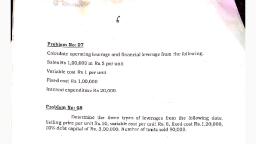
Illustration No. 13.3., , A Ltd. has the following capital structure :, Rs., Equity share capital (of Rs. 100 each), , 1,00,000, , 10% Preference share capital (of Rs. 100 each), , 2,00,000, , 10% debentures (of Rs. 100 each), , 2,00,000, , If EBIT is (i) Rs. 1,00,000 (ii) Rs. 80,000 and (iii) Rs. 1,20,000,, Calculate financial leverage under three situations. Assume 50% tax rate., Solution :, Computation of Financial Leverage, Items, , (i), , EBIT, Less Interest on Debentures, EBT, Less Income Tax, PAT, Less Preference Dividend, Earnings for Equity Shareholders, No. of Shares, EPS, , Financial Leverage, , EBIT, -------EBT, , Rs. 1,00,000, Rs. 20,000, ---------------Rs. 80,000, Rs. 40,000, ---------------Rs. 40,000, Rs. 20,000, ---------------Rs. 20,000, Rs. 10,000, 2, , (ii), , (iii), , Rs, 80,000, Rs. 20,000, ------------Rs. 60,000, Rs. 30,000, ------------Rs. 30,000, Rs. 20,000, ------------Rs. 10,000, Rs. 10,000, 1, , Rs. 1,20,000, Rs. 20,000, ---------------Rs. 1,00,000, Rs. 50,000, ---------------Rs. 50,000, Rs. 20,000, ---------------Rs. 30,000, Rs. 10,000, 3, , Rs. 1,00,000 Rs. 80,000 Rs. 1,20,000, --------------- ------------- --------------Rs. 20,000, Rs. 10,000 Rs. 30,000, 5, , 13, , 8, , 4
Page 14 :
13.4.4 APPLICATIONS, , Financial leverage is useful in, (i), , Capital structure planning, , (ii), , Profit Planning, , Financial leverage helps the finance managers while devising the capital structure, of the company. A high financial leverage means high fixed financial costs and, high financial risk. Increase in fixed financial costs may force the company into, liquidation., , 13.5, , COMPOSITE LEVERAGE, , Both operating and financial leverage magnify the returns. There is, combined effect of these leverages on income. Both the leverages are closely, concerned with the firm's capacity to meet its fixed costs (both operating and, financial). In case both the leverages are combined, the result obtained will, disclose the effect of change in sales over change taxable profit., , Composite Leverage, , = Operating Leverage * Financial Leverage, , Contribution, It may be expressed as, = ------------------EBT, The degree of combined leverage is computed in the following manner :, , Degree of Combined leverage, , =, , Percentage change in EPS, ---------------------------------------------Percentage change in Sales Volume, , 14
Page 15 :
Illustration No. 13.4, , The following particulars are available :, , Sales, , Rs. 1,00,000, , Variable Cost, , Rs., , 70,000, , Fixed Cost, , Rs., , 20,000, , Long term loans, , Rs., , 50,000, , At 10 percent, , Compute the combined leverage., , Solution :, Operating Leverage =, , 30,000, ------------ = 3, 10,000, , Financial Leverage =, , 10,000, ------------ = 2, 5,000, , Combined Leverage =, , 30,000, ------------ = 6 (or 3* 2 = 6), 5,000, , Activity 3, 1., , What is degree of financial leverage ? How is it computed ?., , __________________________________________________________________, , __________________________________________________________________, , __________________________________________________________________, , 15
Page 16 :
2., , State the applications of financial leverage., , __________________________________________________________________, , __________________________________________________________________, , __________________________________________________________________, , 3., , Illustrate with an example the process of computing financial leverage., , __________________________________________________________________, , __________________________________________________________________, , __________________________________________________________________, , 13.6, , EBIT - EPS ANALYSIS, , This is a method to study the effect of leverage. It involves the comparisons of, alternative methods of financing under various alternative financing proposals. A, firm may raise funds in either of the following alternatives :, (i), , Exclusive use of equity capital, , (ii), , Exclusive use of debt, , (iii), , Various combinations of debt and equity, , (iv), , Various combinations of debt, equity and preferences capital, , Illustration No. 13.5, , A company is contemplating to raise additional fund of Rs. 20,00,000 for setting, up a project. The company expects, EBIT of Rs. 8,00,000 from the project., Following alternative plans are available :, , 16
Page 17 :
(a), , To raise Rs. 20,00,000 by way of equity share of Rs. 10 each, , (b), , To raise Rs. 10,00,000 by way of equity shares and Rs. 10,00,000 by way, of debt @ 10%., , (c), , To raise Rs. 6,00,000 by way of equity and rest Rs. 14,00,000 by way of, preferences shares @ 14%., , (d), , To raise Rs. 6,00,000 by equity shares, Rs. 6,00,000 by 10% equity, Rs. 8,00,000 by 14% Preference shares, , The company is in 60% tax bracket which option is best ?, Solution :, , EBIT - EPS Analysis, in Rs., Particulars, , EBIT, Less Interest, EBT, Less Tax, EAT, Less Dividend for, Preference shares, Earnings for equity, Shareholders, Number of Equity, shares, EPS, , Options, A, , B, , C, , D, , 8,00,000, 8,00,000, 4,80,000, 3,20,000, -, , 8,00,000, 1,00,000, 7,00,000, 4,20,000, 2,80,000, -, , 8,00,000, 8,00,000, 4,80,000, 3,20,000, 1,96,000, , 8,00,000, 60,000, 7,40,000, 4,44,000, 2,96,000, 1,12,000, , 3,20,000, , 2,80,000, , 1,24,000, , 1,84,000, , 2,00,000, , 1,00,000, , 60,000, , 60,000, , 2.07, , 3.07, , 1.6, , 2.8, , Option D is the best as EPS is the maximum in this case., , 17
Page 18 :
13.7, , IMPORTANCE OF LEVERAGES, , Leverages have the magnifying effect. Operating leverage magnifies EBIT, with respect to contribution while financial leverage magnifies EPS with respect to, EBIT. Financial leverage enhances the EPS without an additional investment. By, having judicious assets mix and financing mix, EPS may be increased. A few, areas identified in this regard are as follows :, , Investment in fixed assets, , (Operating leverage), , Capital structure planning, , (Financial leverage), , Profit planning, , (Combined leverage), , Monitoring business and financial risk, Maximising the value of share, Improving EPS, Judicious mixture of operating leverage and financial leverage., , A firm with high operating leverage should not have a high financial leverage., Similarly, a firm having low operating leverage will stand to gain by having a high, financial leverage. If both leverages are increased, the possibility of bearing more, risk will increase., , Activity 4, 1., , How does EBIT-EPS analysis help in choosing the best financing mix ?, , __________________________________________________________________, , __________________________________________________________________, , __________________________________________________________________, , 18
Page 19 :
2., , Collect information for a company regarding financing mix. Also compute, leverages for the same., , __________________________________________________________________, , __________________________________________________________________, , __________________________________________________________________, , 3., , Write a brief mote on importance of leverages in profit planning., , __________________________________________________________________, , __________________________________________________________________, , __________________________________________________________________, , 13.8, , PRACTICAL PROBLEMS, , In this subsection, an attempt has been made to arrange a few practical, problems of leverages alongwith solution :, , Illustration No. 13.6, , A company has three alternative plans :, , Equity Capital, Debt @ 10%, , A, , B, , C, , Rs., 30,000, 30,000, , Rs., 15,000, 45,000, , Rs., 45,000, 15,000, , EBIT Rs. 6,000, Calculate financial leverage., , 19
Page 20 :
Solution :, Computation of Financial Leverage, Particulars, , A, , B, , C, , EBIT, Less - Interest, , 6,000, 3,000, ------3,000, 2, , 6,000, 4,500, ------1,500, 4, , 6,000, 1,500, ------4,500, 1.33, , Profit Before Tax, Financial Leverage, Illustration No. 13.7, , in Rs., , Given below the following data of two companies :, Particulars, , A Ltd., , B. Ltd., , Sales, , 4,00,000, , 3,50,000, , Variable Cost, , 40% of Sales, , 40% of Sales, , Fixed Cost, , 25,000, , 30,000, , Interest, , 1,40,000, , 80,000, , Calculate degree of operating leverage and degree of financial leverage., Solution :, Statement showing computation of OL and FL, in Rs., Particulars, , A Ltd., , B Ltd., , Sales, Less - Variable Cost, Contribution, Less - Fixed Cost, EBIT, Degree of Operating, Leverage, Interest, EBT, Degree of Financial, Leverage, , 4,00,000, 1,60,000, 2,40,000, 25,000, 2,15,000, 1.12, , 3,50,000, 1,40,000, 2,10,000, 30,000, 1,80,000, 1.17, , 1,40,000, 2,75,000, 2.87, , 80,000, 1,00,000, 1.80, , 20
Page 21 :
Illustration No. 13.8, , The following data is available for ABC Ltd., Rs., Sales, , 7,50,000, , Variable Cost, , 4,20,000, , Fixed Cost, , 60,000, , Debt, , 4,50,000, , Interest on Debt @, , 9%, , Equity Capital, , 5,50,000, , Calculate ROI, Operating, financial and combined leverage. Also ascertain the, level at which EBIT will be zero., , Solution :, , Return on Investment, , Sales - Variable Cost - Fixed Cost, EBIT = Rs. 7,50,000 - Rs. 4,20,000 - Rs. 60,000 = Rs. 2,70,000, Rs. 2,70,000, ROI = ------------------ * 100 = 27%, Rs. 10,00,000, Operating Leverage, C, ------EBIT, , =, , Rs. 3,30,000, ------------------ = 1.22, Rs. 2,70,000, , 21
Page 22 :
Financial Leverage, EBIT, ------- =, EBT, , Rs. 2,70,000, ------------------ = 1.17, Rs. 2,29,500, , Combined Leverage = 1.17 * 1.22 = 1.43, Sales when EBIT will be zero, Rs. 3,30,000, P/V Ratio = ------------------ * 100 = 44%, Rs. 7,50,000, Fixed Cost = 60,000 + 40,500 = 1,00,500, Rs. 1,00,500, BEP, , = ------------------ = Rs. 228409, 44%, , Illustration No. 13.9, The following details are available :, , Existing equity capital, , 10,000 shares of Rs. 10 each, , Proposals to Raise, , Rs. 1,00,000 with following alternatives, , (a) Debt at 10%, (b) Equity capital @ Rs. 10 per share, (c) Preference shares of Rs. 10 each @ 12% dividend, EBIT, , Rs. 80,000, , Tax Rate, , 50%, , Advise which of the method of financing would be most suitable., , 22
Page 23 :
Which is the most optimum proposal of financing ?, Solution :, Optimum proposal of financing, in Rs., Particulars, , I, , II, , III, , EBIT, Less - Interest, EBT, Tax, EAT, Less – Dividend for, Preferences shares, Earnings per shareholders, No. of shares, EPS, , 80,000, 10,000, 70,000, 35,000, 35,000, -, , 80,000, 80,000, 40,000, 40,000, -, , 80,000, 80,000, 40,000, 40,000, 12,000, , 35,000, 11,000, 3.18, , 40,000, 10,000, 4.00, , 28,000, 10,000, 2.80, , Activity 5, , 1., , Calculate degree of (i) operating leverage (ii) financial leverage and (iii), combined leverage from the following data :, Sales 50,000 units @ Rs. 4 per unit, Variable cost per unit 40%, Fixed costs – Rs. 1,00,000, Interest charges Rs. 3668, , __________________________________________________________________, , __________________________________________________________________, , __________________________________________________________________, , 23
Page 24 :
2., , The installed capacity of a factory is 700 units. The actual exploited, capacity is 500 units. Selling price per unit Rs. 100 and variable cost is Rs., 60 per unit., Calculate operating leverage when, (a) fixed costs are Rs. 5000, (b) fixed costs are Rs. 11,000, (c) fixed costs are Rs. 15,000, , __________________________________________________________________, , __________________________________________________________________, , __________________________________________________________________, , 13.9, , LET US SUM UP, , Leverage refers to the use of an asset or source of funds which involves, fixed costs or fixed returns. Leverages can be operating, financial and combined., Operating leverage uses fixed operating costs to magnify the effects of changes in, sales on the operating profits. Operating leverage may be favourable or, unfavourable. High operating leverage is good when sales increase. Financial, leverage affects financial risk of the firm. In financial leverage, the source of fund, which wants fixed refund so that more than proportionate change in EPS may be, reflected. Combined leverage is the multiplication of financial and operating, leverage. In order to keep the risk under control, low financial leverage be kept, alongwith high degree of operating leverage. EBIT – EPS analysis may help the, financial managers to choose the optimum capital structure., , 24
Page 25 :
13.10 KEY WORDS, , Leverage is the employment of an asset or funds for which the firm pays a fixed, cost or fixed return., Operating Leverage is the use of fixed operating costs to magnify a change in, profits relative to a given change in sales., Financial Leverage is the tendency of residual income to vary disproportionately, with operating profit., Combined Leverage expresses the relationship between revenue on account of, sales and the taxable income., ROI Leverage is the ratio of EBIT and total assets., Trading on Equity – Financial leverage is also sometimes called on trading on, equity., EPS – Earnings per share is calculated by dividing earnings available to equity, share holders with number of equity shares., , 13.11 ANSWERS, , Activity 5, , 1., , Operating leverage 4.33, Financial leverage 1.14, Combined leverage 4.9, , 2., , Operating leverage 1.33, Financial leverage 2.22, Combined leverage 4.0 times, , 25
Page 26 :
13.12 TERMINAL QUESTIONS, , 1. What is leverage ? What are the different types of leverages ?, 2. What is operating leverage ? How is it different from financial leverage ?, Illustrate., 3. What is combined leverage ? Explain its significance., 4. Illustrate EBIT – EPS Analysis., 5. State the applications of operating and financial leverage., 6. Explain the significance of operating leverage ? Discuss its effect on risk., 7. When does financial leverage become favourable ? Discuss its impact on, risk., 8. The following are the details :, A Company, , B Company, , Sales, , 10,00,000, , 6,00,000, , Variable cost, , 4,00,000, , 2,40,000, , Fixed cost, , 2,40,000, , 1,80,000, , Interest, , 1,00,000, , 1,00,000, , Calculate the following :, a) Degree of operating leverage and financial leverage of both the firms., b) Comment on the risk position., [ Ans :, , A Comp. 1.66 and 1.38, B Comp. 2, , and 2.25 ], , 9. A textile company has EBIT of Rs. 3,20,000. Its capital structure consists, of the following securities :, Rs., 10% Debentures, , 10,00,000, , 12% Preference shares, , 2,00,000, , Equity shares of Rs. 100 each, , 8,00,000, , 26
Page 27 :
The company is in the 35 percent tax bracket., a) Determine the EPS, b) Determine the degree of financial leverage, [ Ans. a) Rs. 14.875 b) 1.75 ], 10. Calculate operating, financial and combined leverage under situations when, fixed costs are, a) Rs. 50,000, b) Rs. 1,00,000, For financial plans 1 and 2 respectively from the following information, pertaining to the operation and capital structure of XYZ co., , Total Assets, , Rs. 3,00,000, , Asset Turnover, , 2, , Variable cost as, Percentage of sales, , 60%, , Financial plan, A., , B., , Debt 10%, , Rs. 10,00,000, , Equity, , Rs. 3,00,000, , Debt 10%, , Rs. 3,00,000, , Equity, , Rs. 1,00,000, , [ Ans. a) 1.26 FPA 1.05 / 1.08 FPB 1.19 / 1.27, b) 1.71 FPA 1.33 / 1.84 FPB 1.5 / 2.18 ], , 27
Page 28 :
13.13 SELECTED REFERENCES, , Singh J.K. "Financial Management" Dhanpat Rai & Co. Pvt. Ltd.; Delhi - 110006, Van Horne, J.C. " Financial Management and Policy, Prentice Hall of India, New, Delhi., Khan, M Y & Jain P.K., "Financial Management - Text and Problems" Tata, Mcgraw Hill, Mumbai., Kulkarni, P.V. & Satya Prasad "Financial Management”, Himalaya Publishing, House, Mumbai., Upadhaya, K.M. " Financial Management" Kalyani Publishers, Ludhiana., Maheshwari, S.N. "Financial Management - Principles and Practice", Sultan, Chand & Sons, Delhi., , 28




 Learn better on this topic