Notes of TYBCOM ECONOMICS, Economics chapter 1- international trade ricardian theory of comparative cost.pdf - Study Material
Page 1 :
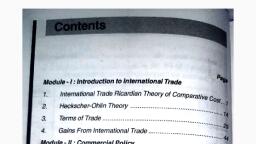
a.2, Q.2, Q.3, , Fuil Length Question OR, Full Length Question, Full Length Question OR, Full Length Question, , Q.3, Q.4, , Fuil Length Question, , Q.4, , Full Length Question, , Q.5, Q.5, , Full Length Question, , Q.6, , OR, , 15, 15, OR, , Full Length Question, , 15, 15, , (A) Theory Questions, (B) Theory Questions, , 10, 10, , OR, Short Notes To be asked 06, to be answered 04, , Q.6, , 20, , Note:Full length question of 15 marks may be divided into, two Sub questionN, of 7/8 and 10/5 marks., , Contentss, Page, , Module - I: Introduction to International Trade, , 1., , International Trade Ricardian Theory of Comparative Cost, , 2, , Heckscher-Ohlin Theory, , 3., , Terms of Trade., , 4., , Gains From International Trade., , Module, , Il:, , *sanh*******s*************eek*ase6ene*e*saosnnemerasernaree, , 14, , *****"****A***anae***************s*******e***4**oe, , 29, , Commercial Policy, , 5., , Commercial Trade Policy, , 60, , 6., , Tariff and Non-Tariff Barriers., , 74, , 7., , International Economic Integration, , 96, , Module - Il: Balance of Payments and, , International Economic Organisation, 8., , Balance of Payments, , 9., , Causes of Disequilibrium and Measures to Correct, Disequilibrium in BOP, , 134, , World Trade Organisation., , 749, , 119, , *****, , ******, , 10, , ***, , Module -IV: Foreign Exchange Market, 11., , Foreign Exchange Market.., , 12, , Determination of Equilibrium Rate of Exchange., , *, , *, , 784, , 13 Purchasing Power Parity Theory, 14., , 170, , 201, , Role of Central Bank in Foreign Exchange, , Rate Management, , ****, , University Paper Solutions: April 2019., IV, , 212, , 231
Page 2 :
INTERNATIONALTRADE, , 1, , RICARDIAN THEORY, OF COMPARATIVE, , COST, 1.1, , Introduction, , 1.2, , Ricardian Theory, , 1.3, , Evaluation, , 1.4, , Practical Applicability, , 1.1, , INTRODUCTION, , International trade, involves export and, , deals with trade between the, import of goods and services., , Why do countries trade with each, was, , raised, , by, , countries., , other? This fundamental, , classical economists., , It, , question, , They provided the answer too, , the production of, by stating that, each country specialises in, , -, , some, , commodities which it can produce at a lower cost and exports them,, but at a, and imports other goods which can be produced at home,, to specialise in the, higher cost. What, however, makes a country, production, , of, , a, , commodity, , ? The, , answer, , provided by theclassical, , economist was - the international division of labour. In other words,, it is the ability of labour that enables a, given the natural resources,, Thus,, country to specialise in the production of a commodity., nternational trade is the result of advantages a country possesses, h producing a particular commodity ata lower cost.
Page 3 :
Business Economics, , -, , VI (1. Y.B. Com., , :, , SEM-, , VI), , Adam Smith explained this in the form of "Absolute Differencos, , Cost". Subsequently, David Ricardo improved the explanation iin, in, the form of "Comparative Difference in Cost"., , Adam Smith' in his book "Wealth of nations" (1776) argued that, international trade is advantageous for all the participating countries, only if they enjoy absolute difference in the cost of production of, the commodity which they specialise in. As in the case of individuals, where each person specialises in the production of that commodity, , in which he has an absolute superiority in terms of cost, so also each, , country specialises in the production of goods based on absolute, , advantage., For international trade to be beneficial, according to Adam Smith, countries must enjoy absolute difference in cost., , 1.2 RICARDIAN THEORY OF COMPARATIVE, COST, David Ricardo agreed that absolute difference in cost gives a clear, , reason for trade to take place. He, however, went further to argue, that even when a country has absolute advantage in the production, , of both commodities it is beneficial for that country to specialise in, the production of that commodity in which it has a greater, , comparative advantage. The other country can be left to specialise, in the production of that commodity in which the first country has, less comparative advantage. According to Ricardo the essence for, , international trade is not the absolute difference in cost but, comparative difference in cost. Ricardian theory is based on the, , following assumptions., , Assumptions, 1., , There are two countries and two commodities., , 1. Adam Smith: British (Scottish), Classical Economist, 1723-1790, considered, as 'The Father of Economics'., , 2. David Ricardo : British Classical Economist, 1772-1823.
Page 4 :
3, , International Trade Ricardian 1Theory of Comparative Cost, There is, , 2, , in, , perfect competition both, , commodity, , and factor, , markets., , 3., , of labour i.e. value of, a commodity is measured in terms of labour hours/days, , Cost of, , production is expressed in, , required, , to, , produce it,, , terms, , Commodities, , are, , also exchanged, , on, , the, , basis of labour content of each good. For example in England, one unit of wine produced by 120 labour days is exchanged, 1.2 units of, with cloth produced by 120 labour days, that is,, , cloth., 4., , than natural, Labour is the only factor of production other, resources., , 5., , Labour is homogeneous i.e. identical in efficiency, in a particular, , country., 6., , Labour is, , perfectly, , mobile within, , a, , country but perfectly, , immobile between countries., , 7., , between countries, There is free trade i.e. the movement of goods, is not hindered, , by, , any, , restrictions., , subject to constant returns, , 8., , Production is, , 9., , There is no technological change., , to scale., , takes place on barter system., 10. Trade between two countries, , 11, , Full employment exists in both, , 12, , There is, , no, , countries., , transport cost., , David Ricardo explained, On the basis of the above assumptions,, and Portugal, his comparative cost difference theory, taking England, as two countries, , As, , and wine and cloth, , as two commodities., , the cost is measured in terms of, the, in, out, assumptions,, pointed, , labour hours. Table 1.1, , explains, , the, , advantage expressed in labour hours, , principle, , of, , comparative
Page 5 :
Business Economics- VI (T. Y.B.Com. :, , berefar oes, Country, , Table 1.1, , og, , SEM-VI, , 1 Unit of Wine1 Unit of Cloth, , England, , 120 L, 80 L, , Portugal1, , 100 L, 90 L, , Fortugal requires less hours of labour for both wine and cloth. One, unit of wine in Portugal is produced with the help of 80 labour hours, as against 120 labour hours required in England. In the case of cloth, , too, Portugal requires less labour hours than England. From this it, , could be argued that there is no need for trade as Portugal produces, both commodities at a lower cost. Ricardo however tried to prove, that Portugal stands to gain by specialising in the commodity in, , which it has a greater comparative advantage. Comparative cost, advantage of Portugal can be expressed in terms of cost ratio., Cost ratios of producing wine and cloth can be expressed as:, , Table 1.2, , England, , Portugal, Wine, , Cloth, , Wine, , Cloth, , 80, , 90, , 120, , 100, , 120, , 100, , 80, , 90, , 0.9, , 1.5, , 1.11, , 0.66, , <, , Portugal has advantage of lower cost of production both in wine, and cloth. However the difference in cost, that is the comparative, advantage is greater in the production of wine (1.5 - 0.66 = 0.84), , than in cloth, , (1.11-0.9= .21). y, , fns antwr bas onioeoo, , Evenin terms of absolute number of days of labour Portugal hasa, , larger comparative advantage in wine, that is, 40 labourers less than, , England ascompared to cloth where the difference is only 10, (40, 10). Accordingly Portugal specialises in the production of wine, where its comparative advantage is larger. England specialises in, , the production of cloth where its comparative disadvantage is lesser, than in wine.
Page 6 :
International Trade Ricardian Theory of Comparative Cost, , 5, , Comparative advantage in production is explained in Fig. 1.1., , ---, , - - mado, , X, , G, Wine, , Fig.1.1:Comparative Advantage, In the above, , diagram,, , PL and EG, , are, , the, , production possibility, , curves of Portugal and England respectively. Portugal has absolute, advantage in the production of both the commodities as OP > OE, , and OL, , OG. ET line which is parallel to PL tells us that, Portugal, has greater comparative advantage in the production of wine, as it, can produce OT of wine which is greater than OG, which England, >, , can produce (OT > OG). England will specialise in cloth where its, , comparative disadvantage is less than what it is in the production, of wine., , Comparative Cost Benefits Both: Let us explain Ricardian, contention that comparative cost benefits both the participants,, though one of them had clear cost advantage in both commodities., To prove it, let us work out the internal exchange ratio., Table 1.3, , Country, , Wine, , Cloth, , Domestic Exchange Rate, , W, , England, , Portugal, , 120, , 100, , 80, , 90, , og, , C, iutd1.2, e0.89
Page 7 :
Business Economics VI (T., , 6, , -, , B.Com.:SEM-VI, , Let us assume these two countries enter into trade at ., an, , international exchange rate (Terms of Trade) 1:1., At this rate,, , England specialising in cloth and exporting one unit of, , cloth gets in turn one unit ofwine. At home it is required to givel2, units of cloth for one unit of wine., England thus gains 0.2 of cloth, 1.e. wine is cheaper from Portugal by 0.2 unit of cloth., , Similarly Portugal gets one unit of cloth from England for its one, unit of wine as against 0.89 of cloth at home thus gaining extra cloth, , 0.1. Here both England and, Portugal gain from the trade ie, England gives 0.2 less of cloth to get one unit of wine and Portugal, , of, , gets 0.11 more of cloth for one unit of wine., In this, , example, Portugal specialises in wine where it has greater, comparative advantage leaving cloth for England in which it has, less comparative, disadvantage. The example also validates Ricardian, argument that the base for international trade is the comparative, difference, , in cost and not the absolute, , difference in, , cost., , 1.3 EVALUATION, David Ricardo is credited with the, , explanation of international trade, in terms of, cost, comparative advantage. He successfully, proved the, principle which guides the international, trade., He could,, his celebrated, through, of two countries, example, and, (England, two commodities, Portugal) and, (wine and, , cloth) demonstrate the, superiority of, comparative, over, advantage Smith's absolute advantage., in its, As theory, logic, clarity and lucidity it is, highly appreciated. Such, admiration is evident in Paul, Samuelson's, -, , like, girls could win, , a, , observation, , beauty contests, comparative, , certainly rate high in that it is an, , -, , "if, , theories, , elegantly logicaladvantage, structure". Even, would, , though different explanations of, put forward subsequently, the comparative advantage have been, has remained as, principle of comparative advantage, the foundation, of, international trade., its, Notwithstanding, contribution,, the, limitations. Let us point out the, theory however, has its, major, drawbacks of the theory.
Page 8 :
International Trade Ricardian Theory of Comparative Cost, The, , 1., , theory,, , it is, , argued,, , is based, , Theyare:, (a), , on, , unrealistic, , 7, , assumptions., , Pertect Competition: The real world is full of, , imperfections both in commodity and factor markets., (b) Two Countries and Two Commodities The theory is, confined to a limited case of two countries and two, commodities, where as trade takes place between many, countries and in a large number of commodities., (c), , Labour Theory of Value: Value of goods is expressed in, terms of labour content. Labour, theory of value developed, by classical economists has too many limitations and thus, is not applicable to the reality. Labour was expected to be, the Ricardian invariant measuring rod. However, in the, real world, , value of, , goods, , and services is, , expressed, , money i.e. the prices are the values expressed in units of, , money., (d) Full Employment: The assumption of full employment, helps the theory to explain trade on the basis of, , comparative advantage. The reality is far from full, employment. Cost of production, even in terms of labour,, may change as the countries, at different levels of, employment move towards full employment., , (e) Mobility of Factors of Production: As against the, assumption of perfect immobility between the countries,, we witness difficulties in the, mobility of labour and capital, within a country itself. At the same time their mobility, between nations was never totally absent., , (6) Absence of Transport Cost: Exclusion of transport cost, makes the comparative advantages, theory meaningless., Goods do not move tree of charge and when cost is, included the comparative advantage of the countries, may, change. Countries may gain or lose comparative, , depending on the transport cost involved., , 2., , advantage, , Static Theory: The comparative advantage theory is based on, constant returns to scale. Further the cost remains the, , same as
Page 9 :
8, , Business Economics- VI (T.Y.B.Com, , om.: SEM-V, , there is no change in, technology. In other words, the the, based on certain given conditions which do not, undero ory is, , change. However the real world is never static. undergc, Techn hy, , quality of inputs specially labour and availability of factoolog, , production do undergo a change over a period of time.rs of, dynamic world, comparative advantage does not remain In#a, same. Quantitative and, qualitative changes in inputs make thone, Comparative advantage a dynamic one. Accordingly, over, a, of time as in the, , period, , direction of trade, , advantage., 3., , case of, , -, , change, , India, , due to, , the, , composition and, dynamic comparative, -, , Demand is lgnored: The Ricardian theory concentrates on the, , supply of goods. Each country specialises in the production of, , a commodity based on its comparative advantage., explains international trade in terms of supply, demand for granted., , 4., , Ihe theory, and takes, , Complete Specialisation:The comparative advantage theory, comes to an implicit conclusion of, complete specialisation. In, , the Ricardian example, England is specialising fully in cloth, and Portugal in wine. Such complete, specialisation is unrealistic, even in the two countries and two commodities, model. It is, , possible only if two countries happen to be almost identical in, size and demand. Again, a complete, specialisation in the, , production of a less important commodity is not possible due, to insufficient demand for it., , 5., , No Free Trade : Ricardian theory assumes free trade i.e. no, restriction on the movement of goods between the countries. It, , is unrealistic to assume not to have any restriction on trade., , The real world witnesses a lot of tariff and non-tariff barriers, on international trade. Poor countries find it difficult to, enjoy, , the comparative advantage in the production of labour intensive, commodities due to the protectionist policies followed by the, , developed countries., 6., , Ricardian theory is not applicable to the developing countries, as these countries are nowhere near full employment. Their, markets are full of imperfections but they are in the process of, change in the quality of their labour force, quantity of capital,
Page 10 :
International Trade Ricardian Theory of Comparative Cost, , technology, tapping of new resources etc. In other words the, , developing countries exhibit all the characteristics of dynamic, economies. This is evident from the fact that the composition, of foreign trade of developing countries has undergone a lot, of change in the recent decades., , 1.4PRACTICAL APPLICABILITY, Not withstanding the limitations of Ricardian theory, his supporters, mainly Profs. Haberler, Taussig and others attempted to prove the, practical importance and applicability of the theory. It is argued, that:, 1, , The two commodities two countries model can be extended to, , all the commodities and all the countries. Each country then, will specialise in the production of those commodities in which, others and, it enjoys Comparative advantage and export them to, , import the required goods from others where they are, at, , 2., , a, , lower, , price, , than at home., , The theory which, , expressed, , available, , explained in terms of labour can also be, of money as it is possible to express the, , was, , in terms, , total cost in terms of money. Specialisation would take place, on, , 3., , the basis of comparative, , advantage in, , terms of, , money cost., , scale and no change in, The assumption of constant returns to, in, technology can also be relaxed. With changes technology, , and production being subject to laws of returns, specialisation, both under, will still take place on the basis of cost advantage, increasing and decreasing, 4., , cost., , cost" makes the comparative, Assumption of "no transport, unrealistic. It is pointed, advantage theory, it is argued, very, cost to the cost of production,, out that after adding transport, in which it will have, each country will produce those goods, cost, for example, India, , cost advantage. After adding transport, Mexico in, cost advantage against USA or, may not enjoy the, the advantage for, commodities but it certainly will have, some, , selling them in some neighbouring, , countries.
Page 11 :
10, , Business Economics- VI (T. Y.B.Com. : SEM-Vn, , 5., , It is suggested that cost would not undergo a change as the, , countries operate with assumptions like full employment,, perfect competition, static nature of the economy, free trade, and many other restrictive assumptions. The supporters of, Kicardian theory argued that all the restrictive assumptions, , of the comparative cost theory could be relaxed and make, , the theory practical to the real world situation where each, country specialises in the production of those goods and, , services in which it has comparative cost advantage under, the changing conditions., Ihe doctrine of comparative advantage inspite of its Iimitations,, , has remained as the basic principle of international trade. One, , cannot disagree with Prof. Paul Samuelson when he says "yet for, , all its over simplification, the theory of comparative advantage, the world, has in it a most important glimpse of truth." Today when, 1S moving towards greater liberalisation and globalisation, each, services on the, country specialises in the production of goods and, into international, basis of comparative cost advantage and enters, of, , trade. Each country attempts to lower its cost of production, internationally traded goods to get an advantage in the global, , market. Therefore, it could be argued that Ricardian explanation, of the basis of international trade (comparative difference in cost), is valid and, , applicable, , to the real world., , REVIEW QUESTIONS, 1., , 2., , Examine Ricardian theory of comparative difference in cost., , "Though a country can produce both the commodities at a lower cost, thanthe other, yet it is advantageous to that country to specialise in, the production of that commodity in which it has larger comparative, , advantage." Discuss., , 3., , Examine the practical applicability of Ricardian theory of comparative, Cost., , 4., , Write short notes on:, , (a), , Assumptions of comparative cost theory, , (6), , Limitations of Ricardian theory, , (c), , Applicability of Ricardian theory to the real world
Page 12 :
International Trade Ricardian Theory of Comparative Cost, , 11, , OBJECTIVE QUESTIONS, Choose the correct option and, rewrite the statement:, According to classical economists, international trade takes place due, , A, , to., , (a), , Factor endowments, , (b) Technological differences between countries, (c), , International division of labour, , (d) Currency value differences, 2., , 3., , The theory of Absolute Cost Difference is associated with, (a) David Ricardo, (b) Adam Smith, (c) Alfred Marshall1, (d) Bertil Ohlin, According to David Ricardo, the essence of international trade is, , (a) Absolute cost difference between countries, (b) Equal cost difference betweencountries, 4., , (c) Zero cost difference between countries, (d) Comparative cost difference between countries, Assume that there are two countries, A and B, and that they can both, produce two goods, X and Y. The theory of comparative advantage, states that, , (a), (b), , o(d), , Trade between the two countries is beneficial if both countries, have equal cost advantage in the production of both X and Y, , Trade between the, , two countries is, , beneficial if both countries, , have cost advantage in the production of both X and Y, , Trade between the two countries is beneficial only if A has a cost, advantage and B has cost disadvantage in any one of the goods, even if A has, Trade between the two countries can be beneficial, and B has cost disadvantage in, in both, , goods, advantage, both goods, of the Ricardian theory trade?, Which of the following is an assumption, cost, , 5., , (a), (b), (c), , (d), , 6., , countries, Labour is perfectly mobile between, a, Labour is heterogeneous within country, between countries, Labour is perfectly immobile, factors of production considered, Labour and capital are the two, , cost theory of trade,, to Ricardo's comparative, difference between countries is, fundamental cause of cost, labour between countries, , According, , (a), , Homogeneity of, , (b), , Heterogeneity of, , labour between countries, , the
Page 13 :
Business Economics- VI, , 12, (), , Availability of stock of capital, , (d), , Availability of money capital, , (T., , .B.Com.:SESEM-VI, , is used as the only measurement of cost of producti, , duction in, , Ricardo's theory of comparative cost., (b) Capital stock, (a) Labour hours, , (c), 8., , Raw material cost, , (d), , Both, , abour and capital, , costs, , The Ricardian theory of comparative cost advantage is considered, , static theory because, (a), , it is based on increasing returns to scale, , (bit is based on constant returns to scale, , (c), (d), 9., , The, , it is based on decreasing returns to scale, it assumes that the state of technology changes, , comparative, , cost, , conclusion of, , advantage theory, , comes, , to, , an, , implicit, , (a) Incomplete international specialization, (b Partial international specialization, c) Complete specialization, (d) Competitive specialization, 10., , The Ricardian theory is a, (a) demand side theory, (b) supply side theory, (c) both demand and supply side theory, , (d) dynamic theory, , Ans.: (1) - (c), (2) - b), (3) - (d), (4) - (d), (5) - (c), (6) - (b), (7) - (a), (8) - (b),, , 9)-(c), (10) - (b), B., , State with reasons whether the, false:, , following, , statements, , 1. Though Portugal can produce both wine and clothes at a, , are, , true, , or, , lower cost, , than England, yet it is advantageous to Protugal to specialise in the, , 2, , production of wine in which it has higher comparative advantage., , Comparative cost theory cannot be extended to more than two, countries., , 3., , Ricardian theory can be explained in terms of labour, only but not, , terms of money., , 4, 5., 6., , in, , Comparative cost theory is based on cost of supply and, ignores, demand., Ricardian theory of, comparative cost can be explained in terms or, money., The comparative cost, the ory is not applicable to the real world.
Page 14 :
International Trade Ricardian Theory of, Comparative Cost, Ans.:, 1., 2, B., , 4., 5., , True; For Reasons :Refer Section 1.2., , False; For Reas ons : Refer Section 1.4., False; For Reasons : Refer Section 1.4., , True; For Reasons : Refer Section 1.3 (3)., True; For Reasons : Refer Section 1.4 (2)., , 6., , False; For Reasons :Refer Section 1.4 (5)., , C, , Match the columns:, Group A, 2., , 3, , Group B, , Adam Smith, , (a), , David Ricardo0, , (b) Assumption of comparative cost, theory, Limitation of the Ricardian theory, , Value is based on, labour content, , Static theory, , Comparative cost difference, , (d) Absolute difference in cost, (e) Mobility of labour, , Ans.: (1)-(d), (2) - (a), (3)- (b), (4)- (c), , axortet, , 13



 Learn better on this topic