Page 1 :
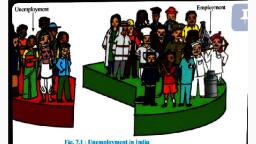
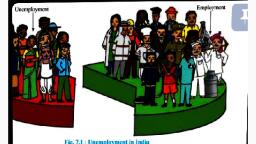
UNEMPLOYMENT IN INDI, ,, , , , 41 Nature of Unemployment in India, , 4,2 Extent of Unemployment in India, , 4,3 Causes of Unemployment, , 4.4 Policy Strategy for Employment Generatio', 45 Government Policies to Generate Employment, , n in India, , The employment scenario of India is quite disappointing. There is acute unemploymey, and underemployment in India. The problem of unemployment, as the problem of poverty, js considered to be a biggest challenge to development planning in India. Increase i;, unemployment is considered to worsen the conditions of the poor. A high rate q, unemployment in rural areas is expected to accelerate migration to urban areas and iti, likely to increase the pressure on limited infrastructure. At the same time, the capability ¢, the state to create jobs for people in general or even for certain vulnerable sections ¢, population is limited in the present climate of economic liberalisation. The nature ani, extent of unemployment in India and the policy measures to correct unemployment ar, , explained in this chapter., , , , , , India being a developing economy the nature of unemplo i, devs \ yment sharply differs from the, one that prevails in developed countries. In the developed countries the unemployment is, due to deficiency of effective demand and it is mostly cyclical in nature. In India the, — = a evional phenomenon. It is not restricted to any one sector ot, up of alt i i, ee : : population. It is a widespread problem affecting almost every segment of the, , The nature of unemployment in the country i ifyi, 1 y is analysed by classif, into 1) Rural employment and 2) Urban eeciplorinent maria. +, , 1. RURAL UNEMPLOYMENT:, , ince large percentage o ian population reside le rural sector with the maif, Since la: itage f India: lat: reside in th ith, , ; 4 i i eon, , occupation as agriculture and allied activities, it gives rise to the problem _ rural, , unemployment. The rural unempl i ivi i, es oe ployment is generally divided into Disguised, Seasonal, , (a) Disguis i, jet etn edhe There is considerable disguised unemployment in the, f state of unemployment in which more people are engage?
Page 2 :
Unemployment in India 33, in agricultural operations than required. The marginal productivity of such workers, is zero. It means that all the workers are not needed to maintain the existing level of, production. Even if some workers are withdrawn, the same work can be done by, fewer people., , (b) Seasonal Unemployment: Another dimension of rural unemployment is the problem, of seasonal unemployment among the farmers. Agriculture by its very nature Is a, seasonal activity. For a significant part of the year the Indian farmers are out of work., In the absence of supplementary sources of employment, they remain unemployed, during the slack agricultural season., , () Open Unemployment: Those who do not have any work come under this category., They are able and willing to work, but there is no work for them. Such an, unemployment is in the nature of involuntary idleness. There is considerable open, unemployment among the landless agricultural workers. With the decline of cottage, industries and handicrafts, many rural people have no alternative means of livelihood., They have to depend upon the agricultural sector which is already overcrowded., , Open unemployment in rural sector includes educated unemployment also as more, and more rural youth get educated during the recent times., , The main causes responsible for rural unemployment are high growth rate of population,, illiteracy, dependency on monsoon, lack of rural development and infrastructural facilities,, lack of mobility of people, and so on., , 2. URBAN UNEMPLOYMENT:, , In Urban areas, the main occupations are related to secondary and tertiary sectors in which, generally semi skilled and skilled labourers are engaged. The main two types of, unemployment in the urban sector are industrial and educated unemployment., , (a) Industrial Unemployment: Industrial unemployment is the result of slow growth of, industrial development vis-a-vis growth of labour force. There has been a tendency, for the rural people to migrate to urban areas in search of employment. Further,, unemployment in the industrial sector has increased. This is due to a number of factors, like slow industrial growth, decay of small scale and cottage industries, deceleration, in the public sector employment including government employment and so on., , (b) Educated Unemployment: An important aspect of urban unemployment is the lack, of job opportunities for the educated people. With increasing literacy level, the problem, of educated unemployment is becoming severe. University degree holders and even, professionally trained peopleare finding it difficult to getjobs. Unemployment among, the educated is mainly due to over emphasis on theoretical aspects of various subjects., The education system is cut-off from ground realities of the Indian economy., , , , In India the National Sample Survey Organisation (NSSO) provides information about, , Unemployment and employment, on the basis of its quinquennial surveys. The 61th round, , of the NSSO was conducted during July 2004 to June 2005, The NSSO uses three different, , concepts:, , @ Usual Principal Status (UPS) unemployment: It is measured in number of persons., It shows number of persons who remained unemployed for the major part of the
Page 3 :
Indian Economy (T.Y.B.A.E.: SEM. Vi, 34, , The UPS unemployment rate is regarded as the measure of chronic, year., , Pen, unemployment during the reference year., , t: It is also measured in number, ii nt Weekly Status (CWS) unemploymen 3 ‘ of, @) Sa. It Shave the number of persons who did not find even an hour of Wor, , during the survey week. It is also a measure of chronic unemployment, but With, reduced reference period of a week,, , (iii) Current Daily Status (CDS) unemployment: It is measured in person days. Itshows, the number of persons who did not find work ona day or some days during the, survey week. The CDS captures the unemployed days of the chronically unemployed,, the unemployed days of the usually employed who become intermittently unemployeq, during the reference week and unemployed days of those classified as employed, according to the current weekly status criterion. It is considered to be a comprehensive, , measure of unemployment, including both chronic unemployment as well as unde;, employment, on weekly basis., , The extent of unemployment in India is explained below :, , 1. Magnitude of Unemployment: The ma;, , various rounds of NSSO Surve, unemployment for years is sho, of unemployment is the highes:, CDS approach compared to the, intermittent unemployment., , unemployment rates in rural an, , gnitude of unemployment as brought out by, ys. A comparison between different estimates of, wn in Table 4.1. It indicates that the CDS estimate, t. The higher unemployment rates according to the, usual status approaches indicates a high degree of, It can also observed from Table 4.1 that overall, id urban sectors as well as total unemployment., , Table 4.1: Unemployment Rates in India (2015-16), , (percent), , , , , , Rural 3.4, Urban 44, , , , , , Total 3.7, , , , , , , , Source : Economic Survey, 2016-17, A. 156., , Unemployment rates in rural and urban ar, higher in urban areas t, , icantly higher among females than males, both in rural and, ployment rates (UPS) among the females in the rural areas has, 1993-94 to 3.1% in 2004-05. Similarly the females unemployment, ed from 8.3% to 9.1% during the same period., , Unemployment Across a; 21, , es oe on bi Sroups: Unemployment, shows that the un:, in 1999, urban areas. The unem, increased from 1.4% in, , rates in the urban areas has increas, , tates are Significantly higher in, le unemployment rates on CDS basis for different age group, , employment rate for the 15-29 age erou was as high, n tae it, 2000 against 7.3 percent for the population L a iste. ai “ae
Page 4 :
Unemployment in India =, , Te, , According to Planning Commission, higher unemployment rates in the younger age, group reflect the phenomenon that new entrants into the labour force, except those, from the lowest income groups, may be more likely to wait until they find a job which, matches their aspirations., , Unemployment by the level of Education: According to NSSO, compared to 199394, unemployment rates for persons of higher education level has declined in rural, areas both for males and females in 1999-2000, and it has further declined in 2004-05, compared to 1999-2000. Unemployment rate of graduate and above female population, is much higher in rural areas than in urban areas. This indicates lack of opportunities, in rural India and lack of mobility of this population segment.’, , Unemployment among Educate Youth: The unemployment rate for the educated, (secondary and above) persons in the age group 15-29 in 1993-94 was as high as 18.5, percent. The unemployment rate on the persons in the age group 15-29 who have any, form of technical education was even higher at 27.3 percent in 1993-94. However,, according to the NSS, the incidence of unemployment among the educated youth,, both for general and technical education, declined sharply between 1993-94 and 19992000. Unemployment rates for educated youth in 1999-2000 are still higher at 14.8, percent for secondary education and above and 23.7 percent for all types of technical, education, but they are significantly lower than in earlier years., , The high rate of unemployment among the educated youth is the core of the problem because it, creates a sense of despair across a wide section of the population including not only the educated, youth but their parents and families. The problem of unemployment in this category can, only be solved if high quality employment is created., , Wide variations in unemployment across states: The rate of unemployment varies, sharply across states. The unemployment rate (per 1000) according to usual status, (adjusted) as per the NSS 66th Round 2009-10 is lowest in Rajasthan (4) followed by, Karnataka (5) and highest in Kerala (75) followed by Assam (39) in rural areas. In the, urban areas the unemployment rate is lowest in Gujarat (18) followed by Rajasthan, (22) and highest in Kerala (73) and Bihar (73) followed by Assam (52)., , Extent of Underemployment: Under employment arises due to two kinds of factors., First, the labour time of a person classified as employed over the reference period, may not be utilised fully. This kind of under-employment among the employed persons, is visible and hence, it is called visible underemployment. Second, the income from, work, over the reference period, is not adequate and, hence, it causes underemployment. Such underemployment is referred to as invisible under-employment., In 1993-94, 6.1 percent of the usually employed persons were seeking additional work., On the basis of CWS we can observe the following trends in under-employment., , () Theunder-employment rate declined gradually during the period 1983 to 1993-94, and witha faster rate between the period 1987-88 and 1993-94 in general, and for, females in particular., , (ii) The problem of under-employment is seen to be more serious among usually, employed females than among employed males and more in rural than in urban, areas., , ", , 1. See Economic Survey 2007-08, p. 248.
Page 5 :
7, , 36 Indian Economy (T.Y.B.A.E.; SEM-y)), , Table 4.2 shows the percentage of labour force actively looking for, , a job, Yearwigg, from 2010 to 2017., , , , , , Table 4.2, Year Unemployment Rate, 2010 3.54, 2011 3.54, 2012 3.62, 2013 3.53, 2014 3.41, 2015 3.49, 2016 3.51, 2017 3.52, , , , , , , , , , Source : data.gov.in, , , , The important causes of unemployment are the following :, , 1, Population Growth and Increase in Labour force: The most important cause of, unemployment is of course the population explosion, which in turn causes an increase, in labour force. The labour force has increased from 363.3 million in 1999-2000 to, 428.9 million in 2009-10 and further to 440.4 million in 2011-12 (see Table 4.3), This, increase is not only due to increase in population but also due to some sociological, changes such as, higher labour force participation rate particularly of women,, weakening joint family system especially in urban areas encouraging more family, members to seek employment and so on. In rural areas agriculture is becoming more, crowded without the corresponding increase in productivity. Indian agriculture has, thus become a reservoir of ever increasing underemployed and surplus population., , Table 4.3 : Labour Force in India (by CDS basis), , (in million), , , , , , Year Labour Force, 1999-2000 363.3, 2004-05 417.2, 2009-10 428.9, 2011-12 440.4, , , , , , , , , , Source: Economic Survey, 2014-15, p. 135., , 2. Inappropriate Technology: The increasing population and labour force against, inadequate supplies of capital inputs has made Indian economy labour abundant and, capital scarce. If the forces of demand and supply of labour and capital were operating, freely, the relative prices of labour would be lower than capital, thus inducing, entrepreneurs to use labour intensive technologies in order to maximise profits., However, the technologies used in many sectors are capital intensive. The main pee, is distortion of factor prices away from true equilibrium prices. This is due to factor: