Page 1 :
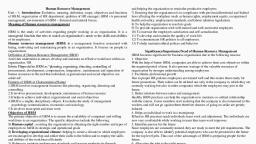
Human Resource Management, Unit – 1: Introduction: Evolution, meaning, definition, scope, objectives and functions, of HRM; organization of HR department; qualities of HR manager; HRM v/s personnel, management; environment of HRM – External and internal forces;, Meaning of Human resources management, HRM is the study of activities regarding people working in an organization. It is a, managerial function that tries to match an organization‘s needs to the skills and abilities, of its employees., Human resources management (HRM) is a management function concerned with, hiring, motivating and maintaining people in an organization. It focuses on people in, organizations, Definition of Human Resource Management (HRM), Activities undertaken to attract, develop and maintain an effective workforce within an, organization. OR, Edwin Flippo defies HRM as ―planning, organizing, directing, controlling of, procurement, development, compensation, integration , maintenance and separation of, human resources to the end that individual, organizational and social objectives are, achieved"., Features of HRM or Characteristics/Nature, 1.HRM involves management functions like planning, organizing, directing and, controlling., 2.It involves procurement, development, maintenance of human resource, 3.It helps to achieve individual, organizational and social objectives, 4.HRM is a mighty disciplinary subject. It includes the study of management, psychology communication, economics and sociology., 5.It involves team spirit and team work., Objectives of HRM, The primary objective of HRM is to ensure the availability of competent and willing, workforce to an organization. The specific objectives include the following:, 1) Human capital : assisting the organization in obtaining the right number and types of, employees to fulfill its strategic and operational goals, 2) Developing organizational climate: helping to create a climate in which employees, are encouraged to develop and utilize their skills to the fullest and to employ the skills, and abilities of the workforce efficiently, 3) Helping to maintain performance standards and increase productivity through, effective job design; providing adequate orientation, training and development;, providing performance-related feedback; and ensuring effective two-way, communication., 4) Helping to establish and maintain a harmonious employer/employee relationship, 5) Helping to create and maintain a safe and healthy work environment, 6) Developing programs to meet the economic, psychological, and social needs of the, employees, , and helping the organization to retain the productive employees, 7) Ensuring that the organization is in compliance with provincial/territorial and federal, laws affecting the workplace (such as human rights, employment equity, occupational, health and safety, employment standards, and labour relations legislation)., 8) To help the organization to reach its goals, 9) To provide organization with well-trained and well-motivated employees, 10) To increase the employees satisfaction and self-actualization, 11) To develop and maintain the quality of work life, 12) To communicate HR policies to all employees., 13) To help maintain ethical polices and behavior, Significance/Importance/Need of Human Resource Management, HRM becomes significant for business organization due to the following reasons:, 1. Objective, With the help of better HRM, companies are able to achieve their core objectives within, the required period of time. It also prevent wastage of the valuable resources of, organization by stronger understanding among employees., 2. Facilitates professional growth, Due to proper HR policies employees are trained well and this makes them ready for, future promotions. Their talent can be utilized not only in the company in which they are, currently working but also in other companies which the employees may join in the, future., 3. Better relations between union and management, Healthy HRM practices can help the organization to maintain co-ordinal relationship, with the unions. Union members start realizing that the company is also interested in the, workers and will not go against them therefore chances of going on strike are greatly, reduced., 4. Helps an individual to work in a team/group, Effective HR practices teach individuals team work and adjustment. The individuals are, now very comfortable while working in team thus team work improves., 5. Identifies person for the future, Since employees are constantly trained, they are ready to meet the job requirements. The, company is also able to identify potential employees who can be promoted in the future, for the top level jobs. Thus one of the advantages of HRM is preparing people for the, future., 6. Allocating the jobs to the right person, If proper recruitment and selection methods are followed, the company will be able to, select the right people for the right job. When this happens the number of people leaving, the job will reduce as the will be satisfied with their job leading to decrease in labour, turnover., 7. Improves the economy
Page 2 :
Effective HR practices lead to higher profits and better performance by companies due, to this the company achieves a chance to enter into new business and start new ventured, thus industrial development increases and the economy improves., Scope of HRM/Functions of HRM, The scope of HRM refers to all the activities that come under the banner of HRM. These, activities are as follows:, 1. Human Resources Planning, Human resource planning or HRP refers to a process by which the company to identify, the number of jobs vacant, whether the company has excess staff or shortage of staff and, to deal with this excess or shortage., 2. Job Analysis Design, Another important area of HRM is job analysis. Job analysis gives a detailed, explanation about each and every job in the company. Based on this job analysis the, company prepares advertisements., 3. Recruitment and Selection, Based on information collected from job analysis the company prepares advertisements, and publishes them in the news papers. This is recruitment. A number of applications, are received after the advertisement is published, interviews are conducted and the right, employee is selected thus recruitment and selection are yet another important area of, HRM., 4. Orientation and Induction, Once the employees have been selected an induction or orientation program is, conducted. This is another important area of HRM. The employees are informed about, the background of the company, explain about the organizational culture and values and, work ethics and introduce to the other employees., 5. Training and Development, Every employee goes under training program which helps him to put up a better, performance on the job. Training program is also conducted for existing staff that have a, lot of experience. This is called refresher training. Training and development is one area, were the company spends a huge amount., 6. Performance Appraisal, Once the employee has put in around 1 year of service, performance appraisal is, conducted that is the HR department checks the performance of the employee. Based on, these appraisal future promotions, incentives, increments in salary are decided., 7. Compensation Planning and Remuneration, There are various rules regarding compensation and other benefits. It is the job of the, HR department to look into remuneration and compensation planning., 8. Motivation, Welfare, Health and Safety, Motivation becomes important to sustain the number of employees in the company. It is, the job of the HR department to look into the different methods of motivation. Apart, , from this certain health and safety regulations have to be followed for the benefits of the, employees. This is also handled by the HR department., 9. Industrial Relations, Another important area of HRM is maintaining co-ordinal relations with the union, members. This will help the organization to prevent strikes lockouts and ensure smooth, working in the company., HRM Environment :- Environment of HRM refers to the aggregate of conditions,, events and influences that surround and affect it. following are the external and internal, environment in which the HRM has to function.External Environment :- Economic, political, technological and demographic factors, include the external environment., , Internal environment :- Internal environment comprises of the factors which affect an, organization‘s human resources from inside the organization‘s boundaries. mission, hr, policies, organization culture, hr system etc. are the variable of hr internal environment., , Qualities of HR Managers : The qualifications and qualities which will be applicable, in general can be summarized as follows., 1) Clarity of Thoughts – In most of the situations and circumstances, we come across, two options; either we want to do or we don‘t want to do; either we agree to it or we, don‘t agree to it; either it is acceptable or it is not acceptable; either you want or you, don‘t want. It has been seen that many HR Professionals are confused. They are not, clear, where they want to take their company. They don‘t know what role they like to, play in the organization. They don‘t have clarity of role. They don‘t have clear, expectations, neither from themselves, or from their team or from their internal
Page 3 :
customers (employees). With this confusion, they fail to take decisions. They fail to take, stand., , unique position where we can develop people. We can develop their career. We can, develop their life. We can help them in changing their perception and behavior.., , 2) Efficiency in Time Management - HR professionals is expected to be efficient in, time management. They are expected to set time-frame and meet those expectations., Most of the time, I have seen that they don‘t give any time limit. You approach them for, any work and they respond by saying, ―Ok, it will be done‖. But when? I agree that, ―Good HR Professionals‖ have many things to do. Recruitments, Employee Relations,, Talent Management, Career Development, Benchmarking, etc are the things, which, takes lots of time. But, all goals, all dreams, all activities, all commitments looks good, and are achievable, if there is a closing date for that.., , 8) Self Discipline – This again is a common quality that everyone should have,, irrespective of their respective professions, but it is more appreciable in HR, Professionals and is like a must have. They need to set standards for others to follow;, they need to benchmark their own behavior and if they start flowing with water,, everything else will go for a toss and things will go out of control. I have heard, people, saying that I am doing this or that because others are also doing it but that is not, expected from HR Professionals. Discipline in life is a must to grow, prosper and being, successful. So, set standards and don‘t just flow., , 3) Compare Performances / Compare Situations & Circumstances but do not, compare individuals / People -Knowingly or unknowingly but quite often, instead of, Circumstances and Situations, we tend to compare two different people. Instead of, analyzing the behavior of a person we tend to analyze them as an individual and take, this as our right. The very basic principle of science and management says that no two, individuals are same., , 9) Trust Worthy – This is very important quality and must have for all HR, Professionals. Candidates, at the time of interview share important information with HR;, Employees share lots information, personal, professional, ideas, suggestions, future, related, dreams etc. Imagine, if the, , 4) Knowledge about the Business and Industry – Everybody should be aware of their, strengths and weaknesses. They should be aware as what they want in their life and, career. It is a well known fact and has been proved in various surveys that HR, professionals don‘t care to understand the business of the company and the industry that, they are working in., 5) Vision and Goal for the Department, Team and Organization –HR professionals, and HR heads don‘t have that vision. They want to do something in HR but don‘t know, what they can do or should do. They should have vision for the organization for HR, perspective and goals for their department and team. It‘s a must have. Until and unless, you are sure about your destination, you cannot take the path., 6) Love for Number / Data / Figures / Calculations / Analysis / Projections – You, talk to any person in any other profession and tell them that you are in HR; two things, will automatically flash in their mind – Theory and Politics. One reason why HR, professionals in India have not been able to enter into the Board Room and make their, presence felt in the organization is because though they have ideas, they have strategies, and policies but they are not able to support those strategies with data. (It is because, there is no mathematics and calculations involved in this subject that many people, [mostly females] love to join this profession)., 7) Enthusiasm to Share / Develop / Coach and Mentor – We have heard and read in, our schools and colleges that ―Knowledge is a wealth; the more you distribute/share the, more you gain‖. In this profession of HRM & D; we are privileged and are in a very, , 10) Creativity: Creativity is what separates competence from excellence. Creativity is, the spark that propels projects forward and that captures peoples' attention. Creativity is, the ingredient that pulls the different pieces together into a cohesive whole, adding zest, and appeal in the process., 11) Structure: The context and structure we work within always have a set of, parameters, limitations and guidelines. A stellar manager knows how to work within the, structure and not let the structure impinge upon the process or the project. Know the, structure intimately, so as to guide others to effectively work within the given, parameters. Do this to expand beyond the boundaries., 12)Intuition: Intuition is the capacity of knowing without the use of rational processes;, it's the cornerstone of emotional intelligence. People with keen insight are often able to, sense what others are feeling and thinking; consequently, they're able to respond, perfectly to another through their *deeper understanding. * The stronger one's intuition,, the stronger manager one will be., 13) Commitment: A manager is committed to the success of the project and of all team, members. S/he holds the vision for the collective team and moves the team closer to the, end result. It's the manager's commitment that pulls the team forward during trying, times., 14). Being Human: Employees value leaders who are human and who don't hide behind, their authority. The best leaders are those who aren't afraid to be themselves. Managers, who respect and connect with others on a human level inspire great loyalty.
Page 4 :
15.) Versatility: Flexibility and versatility are valuable qualities in a manager. Beneath, the flexibility and versatility is an ability to be both non-reactive and not attached to how, things have to be. Versatility implies an openness this openness allows the leader to, quickly *change on a dime* when necessary. Flexibility and versatility are the pathways, to speedy responsiveness., , Organization Structure:- It is generally shown on an organization chart which shows, the authority relationships between various functions in the organization by showing, who reports to whom., Types of organization structure, , 16) Big Picture, Small Actions: Excellent managers see the big picture concurrent with 1. Line organisation : Line structure is a type of structure in which authority flows in, managing the details. Small actions lead to the big picture; the excellent manager is, direct line from a superior to a subordinate. Each employee knows who is his superior, skillful at doing both: think big while also paying attention to the details., and who has authority to issue order to whom. Managers has full authority in their area, of operations and are responsible for final results. Chief Executive HR Manager, 17) Be Decisive, The Right Timing: Excellent managers must know when to make, Recruitment Training Compensation Industrial Welfare Officer manager manager, decisions mostly for the benefit of the group as a whole; sometimes hard decisions must, manager Relations, be made without personal consideration. Know why, how but most importantly when to, 2. Staff organization : provide advice and service to line, act. In all decisions, the wrong timing can lead to waste or disasters, especially when, 3.Functional organisation : In any functional organization, all activities of an organization, strategical decisions must be made., is divided into different functions such as production, marketing, finance etc. each, functional area is headed by a specialist who directs the activities of that area for the, Differences between PM & HRM, entire organization. Every employee is required to report to his respective functional, Dimension, Personnel Management, Human Resources Management, head. The functional head has line authority over activities of his functional area., 1. Employment, Careful delineation of written contracts Aim to go beyond contract, 4.Line and staff organization : the line and staff structure combines the benefits of both, Contract, line organization and functional organization. Staff positions are created to assist line, 2. Rules, Importance of guiding clear rules, Can do outlook, impatience, with rule, managers., Thus the personnel department offers help and advices on personnel issues to, all, departments, without violating the unity of command principle., 3. Behaviour referent Norms/customs/practices, Values/mission, 5. A Divisional structure : The role of a personnel manager attached to the divisional, 4. Managerial task, Monitoring, Nurturing, office/branch office or factory of a decentralized organization is particularly a different, one. The personnel managers at divisional/branch level is responsible to the local, 5. Management Role Transactional, Transformational leadership, divisional/branch manager. personnel manager at divisional/branch assist branch, manager in devising personnel programs and in the management of personnel at the, 6. Communication, Indirect, Direct, branch/division., 6., Matrix, structure : In a matrix organizational structure, employees have two superiors,, 7. Conflict handling, Reach temporary truce, Manage climate & culture, in that they are under dual authority. One chain of command is functional and the other, 8. T&D, Controlled access to courses, Learning organization is a project team. Hence matrix structure is referred to as a multi-command system., Thus, the team of employees which comprise the personnel department have two, 9. Focus of attention, Personnel procedures, Wide ranging cultural, structural &, superiors, i.e personnel manager{vertical dimension} and project manager{horizontal, for interventions, personnel strategies, dimension}. Both dimensions of structure are permanent and balanced, with power held, 10.Shared interests, Interests of the org. are uppermost, Mutuality of interests equally by both the functional head and a project manager., Organization of HR department, Organization :- Organization is a process of identifying and grouping the work to be, performed, defining and delegating responsibility and authority and establishing the, relationships for the purpose of enabling the people to work most effectively., , Evolution of HRM, The evolution of HRM can be traced back to Kautilya Artha Shastra where he, recommends that government must take active interest in public and private enterprise., He says that government must provide a proper procedure for regulating employee and, employee relation.
Page 5 :
The international institute of personnel management and national institute of labour, management were set up to look into problems faced by workers to provide solutions to, them. The Second World War created awareness regarding workers rights and 1940‘s to, 1960‘s saw the introduction of new technology to help workers., The 1960‘s extended the scope of human resource beyond welfare. Now it was a, combination of welfare, industrial relation, administration together it was called, personnel management., With the second 5 year plan, heavy industries started and professional management, became important. In the 70‘s the focus was on efficiency of labour wile in the 80‘s the, focus was on new technology, making it necessary for new rules and regulations. In the, 90‘s the emphasis was on human values and development of people and with, liberalization and changing type of working people became more and more important, there by leading to HRM which is an advancement of personnel management., Kathryn McKee, cited in Brewster (2000) has identified four periods in the evolution of, HRM, 1) Mechanistic period – This is the period from the 1900‘s – 1950‘s when, manufacturing was the driving force in industry. The main focus was on, administrative functions such as r e c r u i t i n g , d i s m i s s i n g , p a y i n g , d e a l i n g, w i t h l a b o u r u n i o n s a n d k e e p i n g r e c o r d s . Management of people was, guided by the principles and ideas of scientific management advocated by Fredrick, Taylor and Henri Fayol. As such efficiency was more important than human, relations, 2) Legalistic period – This is the 1960‘s – 1970‘s which was characterized by legislation in, the civil, social, political and employment areas. This involved, r e g u l a t i o n o f t h e employment and labour markets through laws and, policies such as Africanization and K e n y a n i z a t i o n i n K e n y a , E q u a l, Opportunities Acts in th e USA and many others R e g u l a t e l a b o u r, unions and employment contracts. This period also ushered, t h e computerization of HR information., 3) Organist Period– T h i s i s t h e p e r i o d o f organizational change associated, with the1980‘s. Globalization as a result of t echnological change led to, mergers, acquisitions, downsizing and rightsizing of organizations. Workforce, became more diverse as a result o f i m m i g r a t i o n , e x p a n s i o n o f c r o s s - b o r d e r, b u s i n e s s e s , m o r e e d u c a t e d w o r k e r s w i t h increased awareness. These changes, required specialist personnel systems., 4) Strategic period – 1990‘s– This is a period of more complicated organizations, with complex structures and networks. The hallmarks of this period are increased, competition d u e t o g l o b a l i z a t i o n h e n c e t h e n e e d f o r s u r v i v a l ., O r g a n i z a t i o n s a d o p t e d s t r a t e g i c planning. The role of HR was elevated to the, highest level in the organization reporting to the CEO and the Board of Directors. The, future in the 21st century is predicted to be catalytic (a catalyst for change and the key, for competitive advantage due to:-Cross border employment -Cultural mix, Welfare (1920s-1930s), , , , , , , Administration (1930s- 1940s), Employee relations (1940-1960s), Functional expertise (1970s-1980s), Business partner / player (1990s)
Page 6 :
Unit-No-2 Human Resource Planning:, [Meaning, importance & benefits of HRP; characteristics of HRP; need for planning;, HRP Process-job analysis, job design, Job description and job specification; meaning, of recruitment and selection; recruitment and selection process;], 1.1Meaning of HRP: Human Resource Planning is concerned with the planning the, future manpower requirements is the organization. HR manager ensures that the, company has the right type of people in the right number at the right time and place,, who are trained and motivated to do the right kind of work at the right time, It is the process by which an organization ensures that it has the right number &, kind of people at the right place and at the right time, capable of effectively and, efficiently completing those tasks that help the organization achieve its overall, objectives., 1.2 Definitions of Human Resource Planning - HRP ↓, 1.Colemn has defined human resource planning as "the process of determining, manpower requirements and the means for meeting those requirements in order to, carry an integrated plan at the organization"., 2.Stainer defines manpower planning as "strategy for the acquisition, utilization,, improvement and preservation of an enterprise's human resources. It relates to, establishing job specifications or the quantitative requirements of jobs determining the, number of personnel required and developing resources of manpower"., 2.Objectives of Manpower / HR Planning there is a greater need for planning in order, to keep the organization dynamic in a changing situation of uncertainty. More, specifically, HRP is required to meet following objectives:, 1. To ensure optimum utilization of human resources currently employed in the Organ., 2. To determine the future manpower requirements of the Organization as per the need, for renovations, modernisation, expansion and growth programmes., 3.To determine the recruitment level., 4.To ensure that necessary human resources are available as and when required., 5.To assess future accommodation requirements., 6.To design the basis for management development programmes so as to develop, the required talents among the employees selected., 7.To determine levels of recruitment and training, 8.To estimate the cost of human resources and housing needs of employees, 9.To meet the needs of programme of expansion,diversification, 10. Use existing HR productivity, 3.Need for HRP in Organizations Major reasons for the emphasis on HRP are, 1) Employment-Unemployment Situation: Though in general the number of educated, unemployment is on the rise, there is acute shortage for a variety of skills. This, emphasizes on theneed for more effective recruitment and employee retention., 2) Technological Change: The changes in production technologies, marketing methods, and management techniques have been extensive and rapid. Their effect has been, profound on the job contents and job contexts. These changes have caused problems, , relating to redundancies, retention and redeployment. All these suggest the need to, plan manpower needs intensively and systematically., 3) Demographic Change: The changing profile of the work force in terms of age, sex,, literacy, technical inputs and social background has implications for HRP., 4) Skill Shortage: Unemployment does not mean that the labour market is a buyer‘s, market. Organizations generally become more complex and require a wide range of, specialist skills that are rare and scare. A problem arises in an organization when, employees with such specialized skills leave., 5) Governmental Influences: Government control and changes in legislation with, regard to affirmative action for disadvantages groups, working conditions and hours of, work, restrictions on women and child employment, causal and contract labour, etc., have stimulated the organizations to be become involved in systematic HRP., 6) Legislative Control: The policies of ―hire and fire‖ have gone. Now the legislation, makes it difficult to reduce the size of an organization quickly and cheaply. It is easy, to increase but difficult to shed the fat in terms of the numbers employed because of, recent changes in labour law relating to lay-offs and closures. Those responsible for, managing manpower must look far ahead and thus attempt to foresee manpower, problems., 7) Impact of the Pressure Group: Pressure groups such as unions, politicians and, persons displaced from land by location of giant enterprises have been raising, contradictory pressure on enterprise management such as internal recruitment and, promotion, preference to employees‘ children, displace person, sons of soil etc., 8) Systems Approach: The spread of system thinking and advent of the macro, computer as the part of the on-going revolution in information technology which, emphasis planning and newer ways of handling voluminous personnel records., 4.Advantages / Importance of HRP ↓, 1.Meeting manpower needs : Every Organization needs adequate and properly, qualified staff for the conduct of regular business activities. Imaginative HRP is, needed in order to meet the growing and changing human resource needs of an, organization., 2.Replacement of manpower : The existing manpower in an Organisation is affected, due to various reasons such as retirement and removal of employees and labour, turnover. HRP is needed to estimate the shortfall in the manpower requirement and, also for making suitable arrangements for the recruitment and appointment of new, staff., 3.Meeting growing manpower needs : The expansion or modernisation programme, may be undertaken by the enterprise. Manpower planning is needed in order to, forecast and meet additional manpower requirement due to expansion and growth, needs through recruitment and suitable training programmes., 4.Meeting challenges of technological environment : HRP is helpful in effective use, of technological progress. To meet the challenge of new technology existing, employees need to be retrained and new employees may be recruited.
Page 7 :
5.Coping with change : HRP enables an enterprise to cope with changes in competitive, forces, markets, products, and technology and government regulations. Such changes, generate changes in job content, skill, number and type of personals., 6.Increasing investment in HR : An employee who picks up skills and abilities, becomes a valuable resource because an organisation makes investments in its, manpower either through direct training or job assignments., 7.Adjusting manpower requirements : A situation may develop in; an organisation, when there will be surplus staff in one department and shortage of staff in some other, department. Transfers and promotions are made for meeting such situations., 8.Recruitment and selection of employees : HRP suggests the type of manpower, required in an organisation with necessary details. This facilitates recruitment and, selection of suitable personnel for jobs in the Organisation. Introduction of appropriate, selection tests and procedures is also possible as per the manpower requirements., 9.Placement of manpower : HRP is needed as it facilitates placement of newly selected, persons in different departments as per the qualifications and also as per the need of, different departments. Surplus or shortage of manpower is avoided and this ensures, optimum utilisation of available manpower., 10.Training of manpower : HRP is helpful in selection and training activities. It, ensures that adequate number of persons are trained to fill up the future vacancies in, the Organisation., 11.It reduces the manpower cost, 12.It helps for preparing budget, 13. It helps for performance appraisals, 14.Selection of the right men, 5.Characterstics of HR Planning :, 1.It is a continuous process 2.It is used to create balance betwn demand and supply of, HR, 3.It provides a basis for recruitment and selection process, 4.It provide a right employee at right time and at right cost to an org., 5.It requires quantitative methods for forecasting, 6.It co-ordinates individuals goal with organization goal, 7.It identifies and fulfils the surplus and shortage gap, 8.It provides advantages to both organization and emploiyees, 6.Process of HRP The planning process is influenced by overall organizational, objectives and the environment of business. HRP essentially involved forecasting, human resource needs, assessing human resource supply and matching demand supply, factors through human resource related programmes. Process of HR Planning are, 1.Estimation of vacancy 2.Job requirements & Job Descriptions 3.Skill Analysis, 4.Selecting sources of recruitment, Process of HRP, , 1.Environmental Scanning:, It refers to the systematic monitoring of the external forces influencing the, organization. The following forces are essential for pertinent HRP. 1.Economic, factors, including general and regional conditions., 2.Technological changes, 3.Demographic changes including age, composition and literacy, 4.Political and, legislative issues, including laws and administrative rulings 5.Social concerns,, including child care, educational facilities and priorities. By scanning the environment, for changes that will affect an organization, managers can anticipate their impact and, make adjustments early., 2.Organizational Objectives and Policies: HR plan is usually derived from the, organizational objectives. Specific requirements in terms of number and, characteristics of employees should be derived from organizational objectives Once, the organizational objectives are specified, communicated and understood by all, concerned, the HR, department must specify its objective with regard to HR utilization in the organization, 3.HR Demand Forecast:Demand forecasting is the process of estimating the future, quantity and quality of people required to meet the future needs of the organization., Annual budget and long-term corporate plan when translated into activity into activity, form the basis for HR forecast. Demand forecasting is essential because it helps the, organization to 1.Quantify the jobs, necessary for producing a given number of goods,, 2.To determine the nature of staff mix required in the future, 3.To assess appropriate, levels in different parts of organization so as to avoid unnecessary costs to the, organization, 4.To prevent shortages of personnel where and when, they are needed by, the organization. 5.To monitor compliances with legal requirements with regard to, reservation of jobs. Techniques like managerial judgment, ratio- trend analysis,, regression analysis, work study techniques, Delphi techniques are some of the major, methods used by the organization for demand forecasting.
Page 8 :
4.HR Supply Forecast: Supply forecast determines whether the HR department will be, able to procure the required number of workers. Supply forecast measures the number, of people likely to be available from within and outside an organization, after making, allowance for absenteeism, internal movements and promotions, wastage and changes, in hours, and other conditions of work. Supply forecast is required because it is needed, as it 1. Helps to quantify the number of people and positions expected to be available, in future to help the organization realize its plans and meet its objectives 2. Helps to, clarify the staff mixes that will arise in future 3. It assesses existing staffing in, different parts of the organization. 4. It will enable the organization to prevent, shortage of people where and when they are most needed. 5. It also helps to monitor, future compliance with legal requirements of job reservations. Supply analysis covers, the existing human resources, internal sources of supply and external sources of, supply., 5.HR Programming: Once an organization‘s personnel demand and supply are, forecasted the demand and supply need to be balanced in order that the vacancies can, be filled by the right employees at the right time., 6.HR Plan Implementation: HR implementation requires converting an HR plan into, action. A series of action are initiated as a part of HR plan implementation. Programmes, such as recruitment, selection and placement, training and development, retraining and, redeployment, retention plan, succession plan etc when clubbed together form the, implementation part of the HR plan., 7.Control and Evaluation: Control and evaluation represent the final phase of the HRP, process. All HR plan include budgets, targets and standards. The achievement of the, organization will be evaluated and monitored against the plan.During this final phase, organization will be evaluating on the number of people employed against the, established (both those who are in the post and those who are in pipe line)and on the, number recruited against the recruitment targets. Evaluation is also done with respect, to employment cost against the budget and wastage accrued so that corrective action, can be taken in future, 2.1.JOB ANALYSIS(, )Meaning:It is a method of obtaining all, information relating to the specific jeob i.e., it is a detailed and systematic study of, information relating to the operation and responsibilities of a specific job., Defiantion:1.E.B.Flippo defines‖Job analysis is the process of studying and, collecting information relating to the operations and responsibilities of a specific job., 2.Michael J.Jucius defines ―Job analysis refers to the process of studying the, operations,duties and organizational aspects of jobs in order to derive specifications or, as they are called by some job descriptions‖., 2.Methods of Job Analysis Four methods or approaches are utilized in analyzing jobs., These are :, 1.Personal Observation : The materials and equipment used, the working conditions, and probable hazards, and an understanding of what the work involves are the facts, which should be known by an analyst., , 2.Sending out of Questionnaires : This method is usually employed by engineering, consultants. Properly drafted questionnaires are sent out to job-holders for completion, and are returned to supervisors. However, the information received is often, unorganised and incoherent. The idea in issuing questionnaire is to elicit the necessary, information from job-holders so that any error may first be discussed with the, employee and, after due corrections, may be submitted to the job analyst., 3.Maintenance of Long Records : The employee maintains a daily record of duties, he performs, marking the time at which each task is started and finished. But this, system is incomplete, for it does not give us any desirable data on supervisor, relationship, the equipment used, and working conditions. Moreover, it is timeconsuming., 4.Personal Interviews may be held by the analyst with the employees, and answers to, relevant questions may be recorded. But the method is time-consuming and costly., 3.Purposes/importance/Benefits /Role/ Uses of Job Analysis A comprehensive job, analysis programme is an essential ingredient of sound personnel management. It is, fundamental to manpower management programmes because the results of job, analysis are widely used throughout the programmes. The information provided by job, analysis is useful, if not essential, in almost every phase of employee relations., 1.Organisation and Manpower Planning : It is helpful in organisational planning for it, defines labour needs in concrete terms and coordinates the activities of the work force,, and clearly divides duties and responsibilities., 2.Recruitment and Selection : By indicating the specific requirements of each job (i.e.,, the skills and knowledge), it provides a realistic basis for hiring, training, placement,, transfer and promotion of personnel., 3.Useful for fixing Wage and Salary Administration : By indicating the qualifications, required for doing specified jobs and the risks and hazards involved in its, performance, it helps in salary and wage administration. Job, 4.Job Re-engineering (Facilitates redesigning of jobs) : Job analysis provides, information which enables us to change jobs in order to permit their being manned by, personnel with specific characteristics and qualifications. This takes two forms : (a), Industrial Engineering Activity, which is concerned with operational analysis,, motion study, work simplification methods and improvements in the place of work, and its measurement, and aims at improving efficiency, reducing unit labour costs, and, establishing the production standard which the employee is expected to meet; and (b), Human Engineering Activity, which takes into consideration human capabilities,, both physical and psychological, and prepares the ground for complex operations of, industrial administration, increased efficiency and better productivity., 5. Useful for Employee Training and Management Development : Job analysis, provides the necessary information to the management of training and development, programmes. It helps it to determine the content and subject-matter of in-training, courses. It also helps in checking application information, interviewing, weighing test, results, and in checking references.
Page 9 :
6.Performance Appraisal : It helps in establishing clear-cut standards which may be, compared with the actual contribution of each individual., 7.Health and Safety : It provides an opportunity for indentifying hazardous conditions, and unhealthy environmental factors so that corrective measures may be taken to, minimize and avoid the possibility of accidents., 8.Job Designing. 9. Job Evaluation, 3.JOB DESIGN (, ): 1.Meaning It means determing the specific duties, and responsibilities to be performed and carried out by the employees., It is a deliberate and systematic attempt to structure the technical and social aspects, of work so as to improve technical efficiency and job satisfaction., Job design is an attempt to create a match between job requirements and human, attributes. It involves both organizing the components of the job and the interaction, patterns among the members of a work group., The main objective of job design is to integrate the needs of the individual and the, requirements of the organisation. Needs of employees include job satisfaction in terms, of interest, challenge and achievement. Organisational requirements refer to high, productivity, technical efficiency and quality of work. Today, educated and creative, employees demand well-designed jobs. Therefore, increasing attempts are being made, to redesign jobs so as to improve the quality of working life. A systematic body of, knowledge on the designing of jobs has been developed after the Industrial Revolution, and the large scale enterprises., Defination:1.According to Armstrong ‖Job design is the process of deciding on the, contents of a job in terms of its duties and responsibilities, on the methods to be used, in carrying out the job, in terms of techniques, systems and procedures and on the, relationships that should exist between the job holder and his superiors, subordinates, and colleagues‖, 2.According to Jon Werner and DeSimone, ―Job design is the development &, alteration of the components of a job (such as the tasks one performs, and the scope of, one‘s responsibilities) to improve productivity and the quality of the employees‘ work, life.‖, 3.Job design has been defined by Davis (1966) as: ―The specification of the contents,, methods, and relationships of jobs in order to satisfy technological and organizational, requirements as well as the social and personal requirements of the job-holder.‖, 2.Objectivies of Job Design:1.To Integrate the needs of employees 2.To meet the, requirements of organ. 3.To satisfy the needs of employees., 3.Approaches to Job Design : The main approaches to job design are described below :, 1. Classical Approach : Also known as Engineering approach, it was developed by, F.W. Taylor and his associates. The principles of scientific management formed the, basis for designing jobs in most Organizations. These principles focus on planning,, standardizing and improving human effort at the operative level in order to maximize, productivity. In the words of Taylor, ―the work of every workman is fully planned out, by the management at least one day in advance and each man receives in most cases, complete written instructions, describing in detail the task which he is to accomplish., , This task specifies not only what is to be done but how it is to be done and the exact, time allowed for doing it. Jobs designed on the basis of classical approach are not, appropriate in the modern environment characterized by increased awareness, improved, education and rising expectations of workforce., 2.Behavioural Approach(Job Characteristic Approach) : The findings of Elton, Mayo, Frederick Herzberg and other human relations experts led to search for, alternative ways of designing jobs so as to avoid the dysfunctional consequences of, standardization and simplification. Job redesign, work structuring, job enrichment,, participative system and other similar strategies were developed to improve the quality, of work life. The aim of all these attempts is to design jobs which will not only ensure, technical efficiency but will satisfy social and psychological needs of workers., The most popular behavioural approach to job redesign is the Job characteristics, model of Hackman and Oldham. This model is based on the assumption that three key, psychological stats of a jobholder determine his motivation, satisfaction and, performance on the job. Behavioural approach to job design is a socio-technical, approach as it deals with both the technical and social aspects of a job. It is, therefore, an, improvement over the classical approach which considered only the technical side of, jobs. Tavistock Institute of Human Relations, London has carried out several, experiments in the application of the socio-technical approach to job design. The job, characteristics model, however, suffers from some limitations. It is probabilistic and has, an intuitive appeal. But there is little empirical evidence to support it. In one study of, bank employees in India growth need has not been found coaching, counselling etc., are, examples of corrective actions that help to improve performance., 4.Methods /Techniques /Option of Job Design:, The various techniques of job design and redesign are discussed below:, 1.Job Simplification, : In job simplification, the complete job is broken down, into small subparts; this is done so that employee can do these jobs without much, specialized training. Moreover, small operations of the job can also be performed, simultaneously so that the complete operation can be done more quickly. For job, simplification, generally time and motion studies are used., 2.Job Rotation: Another technique designed to enhance employee motivation is job, rotation, or periodically assigning employees to alternating jobs or tasks. For example,, an employee may spend two weeks attaching bumpers to vehicles and the following two, weeks making final checks of the chassis. During the next month, the same employee, may be assigned to two different jobs., It involves transfer of executives from one job to another. The aim of job rotation is, to broaden the knowledge, skills and outlook of executives. This method can be used in, the case of management trainee and also in the case of an existing manager due for, promotion. It is also useful for providing variety of job experience to managers., Advantage of Job Rotation Technique:, 1.The employee experiences variety of work, workplace and peer group., 2.Job rotation helps to broaden the knowledge and skills of an employee., 3.It relieves the employee from the boredom and monotony of doing the same job.
Page 10 :
4.It helps to people become more flexible. They are prepared to assume responsibility, specially at other positions., 5.It broadens the work experience of employees & turns specialists into generalists., 6.It is beneficial for the management also as the management gets employees who can, perform a variety of tasks to meet the contingencies., 7.This method improves the self image and personal worth of the employee., 8.It brings all departments on the same footing as executives move from one dept to, other., 9..Job rotation facilitates inter-departmental cooperation., 10.There is absence of monotony in the training process due to job rotation, Disadvantage of Job Rotation Technique:, 1.It creates disruptions. Members of the work group have to adjust to the new employee., 2.Productivity is reduced by moving a worker into new position just when his efficiency, at the prior job was creating organizational economies., 3.Training costs are increased., 4.The supervisor may also have to spend more time answering question and monitoring, the work of the recently rotated employee., 5.It can demotivate intelligent and ambitious trainees who seek specific responsibilities, in their chosen specialty, 6. The trainee manager finds it difficult to adjust himself to his new bosses, 7. Even the executives are not in a position to have specialized knowledge and training, in one particular branch of work, 8. Frequent changes of position of executives may also affect their morale, 3.Job Enlargement: Another means of increasing employee‘s satisfaction with routine, jobs is job enlargement, or increasing the number of tasks performed (i.e. increasing, the scope of the job). Job enlargement, like job rotation, tries to eliminate short job, cycles that create boredom. Unlike job rotation, job enlargement actually increases the, job cycle. When a job is enlarged, either the tasks being performed are enlarged or, several short tasks are given to one worker. Thus, the scope of the job is increased, because there are many tasks to be performed by the same worker. Job enlargement, programs change, many methods of operation- in contrast to job rotation, in which the same work, procedures are used by workers who rotate through work stations. Although job, enlargement actually changes the pace of the work and the operation by reallocating, tasks and responsibilities, it does not increase the depth of a job. The focus of, designing work for job enlargement is the exact opposite of that for job specialization., Instead of designing jobs to be divided up into the fewest of tasks per employee, a job, is designed to have many tasks for the employee to perform. An enlarged job requires, a longer training period because there, are more tasks to be learned. Worker satisfaction should increase because is reduced as, the job scope is expanded. However, job enlargement programs are successful with, jobs what have increased scope; such workers are less prone to resort to absenteeism,, , grievances, slowdowns and other means of displaying job dissatisfaction. Enlargement, is done only on the horizontal level. Thus, the job remains the same, but becomes of, a larger scale than before. In the words of Geroge Strauss and L.R. Sayles ―Job, enlargement implies that instead of assigning one man to each job, a group of men can, be assigned to a group of jobs and then allowed to decide for themselves how to, organize the work. Such changes permit more social contacts and control over the, work process.‖, Job enlargement has the following advantages:, 1.Increase in diversity of jobs, 2.Provides variety of skills., 3.Job, satisfaction, 4.Trains and develops more versatile employees., 5.Reduces tension and, boredom., 6.Provides wholeness and identity with the task and increases the knowledge necessary, to perform it. Despite these advantages this is not a completely satisfactory method of, job design as it does not increase the depth of a job. Enlarged jobs require longer, training period as there are more tasks to be learned., 4. Job Enrichment:, The concept of job enrichment has been derived from, Herzberg‘s two-factor theory of motivation in which he has suggested that job content, is one of the basic factors of motivation. If the job is designed in such a manner that it, becomes more interesting and challenging to the job performer and provides him, opportunities for achievement, recognition, responsibility, advancement and growth,, the job itself becomes a source of motivation to the individual., According to Richard W. Beatty and Graig Eric. Schneider, ―Job enrichment is a, motivational technique which emphasizes the need for challenging and interesting, work. It suggests that jobs be redesigned so that intrinsic satisfaction is derived from, doing the job. In its best applications it leads to a vertically enhanced job by adding, function from other organizational levels, making it contain more variety and, challenge and offer autonomy and pride to the employee.‖, According to P. Robbins, ―Job enrichment refers to the vertical expansion of the jobs. It, increases the degree to which the worker controls the planning, execution and, evaluation of his work.‖, According to Mondy. Holmes, and Flippo, ―Job enrichment refers to basic changes in, the content and level of responsibility of a job so to provide for the satisfaction of the, motivation needs of personnel., Techniques of Job Enrichment: In order to enrich the jobs. The management should, adopt the following measures:, Freedom in decisions, Allow the employee to set his own standards of, performance., Assign a natural work unit to an employee., Encouraging participation, Minimize the controls to provide freedom to the employees Expand job vertically, Make an employee directly responsible for his performance. Sense of achievement., Encourage participation of employees in deciding organizational goals and policies., Introducing new, difficult and creative tasks to the employees.
Page 11 :
Advantages of Job Enrichment: The advantages of job enrichment are as follows:, It makes the work interesting and employee get motivated., It enriches the role., Job enrichment is the most widely used of job design as it provides a meaningful, learning to employees., It increases skills of the employees., It helps in reducing the rate of labor turnover and absenteeism., It increases morale and performance., Reduce Boredom and, dissatisfaction., Increase in output both qualitative and quantitative., Disadvantages of Job Enrichment, Increase cost, Not applicable to all jobs., Need more employee counseling, training, and guidance. Imposed on people., Negative impact on personnel., Objected by unions Pay dissatisfaction, 4.Job Description: Job description is the immediate product of job analysis process; the, data collected through job analysis provides a basis for job description and job, specification., Meaning: is a written record of the duties, responsibilities and requirements of a, particular job. It is concerned with the job itself and not with the job holders. It is a, statement describing the job in such terms as its title, location, duties, working, conditions and hazards., Definition: 1.Flippo has Defined Job Description as, ―A job description is an, organized, factual statement of duties and responsibilities of a specific job. In brief, it, should tell what is to be done. How it is done why. It is a standard of function, in that, defines the appropriate and authorized content of a job., 2.According to Pigors and Myres, ―Job description is a pertinent picture (in writing), of the organizational relationships, responsibilities and specific duties that constitutes, a given job or position. It defines a scope of responsibility and continuing work, assignments that are sufficiently different form that of other jobs to warrant a specific, title.‖, Contents of Job Description : 1.Job Tile 2. Job Summary 3.Job Location 4.Duties and, Responsibilities 5.Nature of Supervisors 6.Machines,Tools and Materials 7.Relation to, Other job 8.Working conditions 9.Amendments.10.Policies., 5.Job Specification: Meaning: These are the minimum acceptable qualifications like, knowledge and necessary skill to perform the job successfully., Based on the information acquired through job analysis, the job specification, identifies the knowledge, skills, and abilities needed to do the job effectively The job, specification, therefore, is a important tool in the selection process, for it keeps the, selector‘s attention on the list of qualifications necessary for an incumbent to perform, the job and assists in determining whether candidates are qualified., Definition 1.According to Dale Yoder, ―The job specification, as such a summary, properly described is thus a specialized job description, emphasizing personnel, requirement and designed especially to facilitate selection and placement.‖, 2.Flippo has defined job specification as, ―Job specification is a statement of the, minimum acceptable human qualities necessary to perform a job properly ………….., , It performance.‖ is a standard of personnel and designates the qualities required for, acceptable, In is clear from the above definitions that job specification is a statement of, summary of personnel requirements for a job. It may also be called ―standard of, personal for the selection‖, A Job Specification should include:, (i) Physical characteristics, which include health, strength, endurance, age, height,, weight, vision, voice, eye, hand and foot co-ordination, motor co-ordination, and, colour discrimination., (ii) Psychological and social characteristics such as emotional stability, flexibility,, decision making ability, analytical view, mental ability, pleasing manners, initiative,, conversational ability etc., (iii) Mental Characteristics such as general intelligence, memory, judgement, ability to, concentrate, foresight etc., (iv) Personal Characteristics such as sex, education, family background, job, experience, hobbies, extracurricular activities etc, 6.Recruitment:1.Meaning: Recruiting is the discovering of potential candidates for, actual or anticipated organizational vacancies. Or, from another perspective, it is a, linking activity-bringing together those with jobs to fill and those seeking jobs., In other words Recruitment means to estimate the available vacancies and to make, suitable arrangements for their selection and appointment. In the recruitment process,, the available vacancies are given wide publicity and suitable candidates are encouraged, to submit applications so as to have a pool of eligible candidates for scientific selection., 2.Definition:1.According to Edwin B. Flippo, ―Recruitment is the process of searching, for prospective employees and stimulating them to apply for jobs in the organization.‖, 2.According to Werther and Davis, ―Recruitment is the process of finding and, attracting capable applicants for employment. The process begins when new recruits, are sought and ends when their applications are submitted. The result is a pool of, applicants form which new employees are selected.‖, 3.Process of Recruitment: Recruitment process passes through the following stages:, 1.Recruitment process begins when the personnel department receives requisitions for, recruitment from any department of the company, The personnel requisitions contain, details about the position to be filled, number of persons to be recruited, the duties to be, performed, qualifications expected from the candidates, terms and conditions of, employment and the time by which the persons should be available for appointment etc., 2.Locating and developing the sources of required number and type of employees., 3. Identifying the prospective employees with required characteristics., 4.Developing the techniques to attract the desired candidates. The goodwill of an, organisation in the market may be one technique. The publicity about the company, being a good employer may also help in stimulating candidates to apply. There may be, others of attractive salaries, proper facilities for development etc., 5.Evaluating the effectiveness of recruitment process.
Page 12 :
According to Famularo, personnel recruitment process involves five elements, viz., a, recruitment policy, a recruitment organisation, a forecast of manpower, the development, of sources of recruitment, and different techniques used for utilising these sources, and a, method of assessing the recruitment programme. The explanation of these is described, below:, 1.Recruitment Policy: It specifies the objectives of recruitment and provides a, framework for the implementation of the recruitment programme. It also involves the, employer‘s commitment to some principles as to find and employ the best qualified, persons for each job, to retain the most promising of those hired, etc. It should be based, on the goals, needs and environment of the organization., 2.Recruitment Organisation:The recruitment may be centralized like public sector, banks or decentralised. Both practices have their own merits. The choice between the, two will depend on the managerial philosophy and the particular needs of the, organisation., 3.Sources of Recruitment: Various sources of recruitment may be classified as internal, and external. These have their own merits and demerits., 4.Methods of Recruitment: Recruitment techniques are the means to make contact, with potential candidates, to provide them necessary information and to encourage them, to apply for jobs., 5.Evaluation of Recruitment Programme: The recruitment process must be evaluated, periodically. The criteria for evaluation may consist of cost per applicant, the hiring, ratio, performance appraisal, tenure of stay, etc. After evaluation, necessary, improvements should be made in the recruitment programme., 4.Sources of Recruitment: The different sources of recruitment are classified into two, categories,, 1.Internal : sources of recruitment are from within the organization., 2.External : sources of recruitment are from outside the organization., , 1. Internal Sources of Recruitment: The internal sources of recruitment are:1.Promotions : Promotion means to give a higher position, status, salary and, responsibility to the employee. So, the vacancy can be filled by promoting a suitable, candidate from the same organization., 2.Transfers : Transfer means a change in the place of employment without any change, in the position, status, salary and responsibility of the employee. So, the vacancy can be, filled by transferring a suitable candidate from the same organization., , 3.Internal Advertisements : Here, the vacancy is advertised within the organization., The existing employees are asked to apply for the vacancy. So, recruitment is done from, within the organization., 4.Retired Managers : Sometimes, retired managers may be recalled for a short period., This is done when the organization cannot find a suitable candidate., 5.Recall from Long Leave : The organization may recall a manager who has gone on a, long leave. This is done when the organization faces a problem which can only be, solved by that particular manager. After he solves the problem, his leave is extended., Merits of Internal Sources: The benefits / advantages / merits of using internal sources, 1.It is time saving, economical, simple and reliable., 2.There is no need of induction training because the candidate already knows everything, about the organization, the work, the employee, the rules and regulations, etc., 3.It motivates the employees of work hard in order to get higher jobs in the same Organ., 4.It increases the morale of the employees and it improves the relations in the organ., 5.It reduce executive turnover. 6.It develops loyalty and a sense of responsibility., Demerits of Internal Sources:, 1.It prevents new blood from entering the organization. New blood brings innovative, ideas, fresh thinking and dynamism into the organization., 2.It has limited scope because it is not possible to fill up all types of vacancies from, within the organ., 3.The position of the person who is promoted or transferred will be vacant., 4.There may be bias or partiality in promoting or transferring persons from within the, organization., 5.Those who are not promoted will be unhappy., 6.The right person may be promoted or transferred only if proper confidential reports of, all employees are maintained. This involves a lot of time, money and energy., External Sources of Recruitment: The external sources of recruitment are:1.Management Consultants : Management consultants are used for selecting higherlevel staff. They act as a representative of the employer. They make all the necessary, arrangements for recruitment and selection. In return for their services, they take a, service charge or commission., 2.Public Advertisements : The Personnel department of a company advertises the, vacancy in newspapers, the internet, etc. This advertisement gives information about the, company, the job and the required qualities of the candidate. It invites applications from, suitable candidates. This source is the most popular source of recruitment. This is, because it gives a very wide choice. However, it is very costly and time consuming., 3.Campus Recruitment : The organization conducts interviews in the campuses of, Management institutes and Engineering Colleges. Final year students, who're soon to get, graduate, are interviewed. Suitable candidates are selected by the organization based on, their academic record, communication skills, intelligence, etc. This source is used for, recruiting qualified, trained but inexperienced candidates., 4.Recommendations :The organization may also recruit candidates based on the, recommendations received from existing managers or from sister companies.
Page 13 :
5.Deputation Personnel : The organisation may also recruit candidates who are sent on, deputation by the Government or Financial institutions or by holding or subsidiary, companies., Advantages of External Sources:, 1.It encourages young blood with new ideas to enter the organisation., 2.It offers wide scope for selection. This is because a large number of suitable, candidates will come for the selection process., 3.There are less chances of bias or partiality., 4.Here there is no need to maintain confidential records., Limitations of External Sources:The demerits/limitations of using external sources, 1.It is very costly. This is because advertisements, test, medical examination etc., has to, be conducted., 2.It is very time consuming. This is because the selection process is very lengthy., 3.It may not develop loyalty among the existing managers., 4.The existing managers may leave the organisation if outsiders are given higher post., Factors affecting Recruitment, 1.Internal Factors: 1.Working conditions 2.Image of organization 3.Promotional, opportunities, 4.Ability & Skill of management to stimulate candidates 5.Salary levels, Type & Extent, of business 6.Wage and salary policies; 7.The age composition of existing working, force;, 8.Promotion and retirement policies; 9.Turnover rates;10.The nature of operations, nvolved the kind of personnel required; 11. The level and seasonality of operations in, question;, 12.Future expansion and reduction programmes; 13. Recruiting policy of the, organisation;14. Human resource planning strategy of the company;15.Size of the, organisation and the number of employees employed; 16.Cost involved in recruiting, employees, and finally; 17.Growth and expansion plans of the organisation., 2.External Factors: 1.Govt. Regulations 2.Trade Unions 3.Local candidates, 4.Recommendations, Nepotism 5.Career opportunities in other organisations, 7.1.Meaning of Selection ↓Selection is next to recruitment. It is the process of choosing, the most suitable candidates (Properly qualified and competent) out of many interested, candidates. It is a process of selecting the best and rejecting the rest. In this selection, process, interested applicants are differentiated in order to identify those with a greater, likelihood of success in a job. Such candidates are selected and appointed., Definition : According to Thomas Stone, ―Selection is the process of differentiating, between applicants in order to identify (and hire) those with a greater likelihood of, success in a job‖, According to Keith Davis, ―Selection is the process by which an organisation chooses, from a list of screened applicants,the person or persons who best meet the selection, criteria for the position available.‖, Selection is a negative function as it relates to elimination of unsuitable, candidates. 'Right man for the right job' is the basic principle in selection. Selection of, , suitable candidates is a responsible type of work as selection of unsuitable persons for, jobs creates new problems before the business unit., 2.Selection Procedure: The selection procedure is concerned with securing relevant, information about an applicant. This information is secured in a number of steps or, stages. The objective of selection process is to determine whether an applicant meets the, qualification for a specific job and to choose the applicant who is most likely to perform, well in that job. Selection is a long process, commencing from the preliminary interview, of the applicants and ending with the contract of employment (sometimes)., The selection procedure consists of a series of steps. Each step must be, successfully cleared before the applicant proceeds to the next. The selection process is a, series of successive hurdles or barriers which an applicant must cross. These hurdles are, designed to eliminate an unqualified candidate at any point in the selection process., Thus, this technique is called ―Successive Hurdles Technique A comprehensive, selection process involves the various steps as shown in Figure, Application pool from recruitment process, , Primary screening & interview, , Eliminate those who does not fulfil job, Requirement., , Application Blank, , Unfavourable personnel data, , Selection tests, , Eliminate those who obtain, unfavourable test score, , Interviews, , Eliminate those not meeting job, and organisational requirements, , Background investigations, , Eliminate those with adverse remarks, , Physical examination, , Eliminate those not meeting physical, standards, , Approval by appropriate authority, , Final Employment decision, , Adopt objectivity, , Congratulate
Page 14 :
Evaluation, , Check the reliability and validity, , 1. Application Pool: Application pool built-up through recruitment process is the base, for selection process. The basic objective at the recruitment level is to attract as much, worthwhile applications as possible so that there are more options available at the, selection stage., 2. Preliminary Screening and Interview: It is highly noneconomic to administer and, handle all the applicants. It is advantageous to sort out unsuitable applicants before, using the further selection steps. For this purpose, usually, preliminary interviews,, application blank lists and short test can be used. All applications received are, scrutinised by the personnel department in order to eliminate those applicants who do, not fulfil required qualifications or work experience or technical skill, his application, will not be entertained., Such candidate will be informed of his rejection.Preliminary interview is a sorting, process in which the prospective candidates are given the necessary information about, the nature of the job and the organisation. Necessary information is obtained from the, candidates about their education, skills, experience, expected salary etc. If the candidate, is found suitable, he is elected for further screening. This courtesy interview; as it is, often called helps the department screen out obvious misfits. Preliminary interview, saves time and efforts of both the company and the candidate. It avoids unnecessary, waiting for the rejected candidates and waste of money on further processing of an, unsuitable candidate. Since rejection rate is high at preliminary interview, the, interviewer should be kind,courteous, receptive and informal., 3. Application Blank or Application Form: An application blank is a traditional, widely accepted device for getting information from a prospective applicant which will, enable the management to make a proper selection. The blank provides preliminary, information as well as aid in the interview by indicating areas of interest and discussion., It is a good means of quickly collecting verifiable (and therefore fairly accurate) basic, historical data from the candidate. It also serves as a convenient device for circulating, information about the applicant to appropriate members of management and as a useful, device for storing information for, later reference. Many types of application forms,, sometimes very long and comprehensive and sometimes brief, are used. Information is, generally taken on the following items:, (a) Biographical Data: Name, father‘s name, data and place of birth, age, sex,, nationality,height, weight, identification marks, physical disability, if any, marital status,, and number of dependants., (b) Educational Attainment: Education (subjects offered and grades secured), training, acquired in special fields and knowledge gained from professional/technical institutes or, through correspondence courses., (c) Work Experience: Previous experience, the number of jobs held with the same or, other employers, including the nature of duties, and responsibilities and the duration of, , various assignments, salary received, grades, and reasons for leaving the present, employer., (d) Salary and Benefits: Present and expected., (e) Other Items: Names and addresses of previous employers, references, etc. An, application blank is a brief history sheet of an employee‘s background and can be used, for future reference, in case needed.The application blank must be designed from the, viewpoint of the applicant as well as with the company‘s purpose in mind. It should be, relatively easy to handle in the employment office. Application form helps to serve, many functions like:, Its main usefulness is to provide information for reference checking, good, interviewing, and correlation with testing data., It helps to weed out candidates who are lacking in education, experience or some, other eligibility traits., It helps in formulating questions to be asked in the interview., Data contained in application form can be stored for future reference., It also tests the candidate‘s ability to write, to organize his thoughts, and to present, facts clearly and succinctly., It indicates further whether the applicant has consistently progressed to better jobs. It, provides factual information., Weighted Application Blanks, Some organisations assign numeric values or weights to the responses provided by the, applicants. This makes the application form more job related. Generally, the items that, have a strong relationship to job performance are given higher scores. For example, for a, sales representative‘s position, items such as previous selling experience, area of, specialisation, commission earned, religion, language etc. The total score of each, applicant is then obtained by adding the weights of the individual item responses. The, resulting scores are then used in the final selection. WAB is best suited for jobs where, there are many employees especially for sales and technical jobs. It can help in reducing, the employee turnover later on.However, there are several problems associated with, WAB e.g., It takes time to develop such a form., The WAB would have to be updated every few years to ensure that the factors, previously identified are still valid products of job success., The organisation should be careful not to depend on weights of a few items while, finally selecting the employee., 4. Selection Tests: Many organisations hold different kinds of selection tests to know, more about the candidates or to reject the candidates who cannot be called for interview, etc. Selection tests normally supplement the information provided in the application, forms. Such forms may contain factual information about candidates. Selection tests, may give information about their aptitude, interest, personality, which cannot be known, by application forms. Types of tests and rules of good of testing have been discussed in, brief below:
Page 15 :
A. Aptitude Tests: These measure whether an individual has the capacity or talent, ability to learn a given job if given adequate training. These are more useful for clerical, and trade positions., B. Personality Tests: At times, personality affects job performance. These determine, personality traits of the candidate such as cooperativeness, emotional balance etc. These, seek to assess an individual‘s motivation, adjustment to the stresses of everyday life,, capacity for interpersonal relations and self-image., C. Interest Tests: These determine the applicant‘s interests. The applicant is asked, whether he likes, dislikes, or is indifferent to many examples of school subjects,, occupations, amusements, peculiarities of people, and particular activities., D. Performance Tests: In this test the applicant is asked to demonstrate his ability to do, the job. For example, prospective typists are asked to type several pages with speed and, accuracy., E. Intelligence Tests: This aim at testing the mental capacity of a person with respect to, reasoning,word fluency, numbers, memory, comprehension, picture arrangement, etc. It, measures the ability to grasp, understand and to make judgement., F. Knowledge Tests: These are devised to measure the depth of the knowledge and, proficiency in certain skills already achieved by the applicants such as engineering,, accounting etc., G. Achievement Tests: Whereas aptitude is a capacity to learn in the future,, achievement is concerned with what one has accomplished. When applicants claim to, know something, an achievement test is given to measure how well they know it., H. Projective Tests: In these tests the applicant projects his personality into free, responses about pictures shown to him which are ambiguous., Rules of Good Testing, Norms should be developed for each test. Their validity and reliability for a given, purpose should be established before they are used., Adequate time and resources must be provided to design, validate, and check tests., Tests should be designed and administered only by trained and competent persons., The user of tests must be extremely sensitive to the feelings of people about tests., Tests are to be uses as a screening device., Reliance should not be placed solely upon tests in reaching decisions., Tests should minimize the probabilities of getting distorted results. They must be, ‗race-free‘., Tests scores are not precise measures. They must be assigned a proper weightage., 5. Interview: An interview is a procedure designed to get information from a person and, to assess his potential for the job he is being considered on the basis of oral responses by, the applicant to oral inquiries by the interviewer. Interviewer does a formal in-depth, conversation with the applicant, to evaluate his suitability. It is one of the most, important tools in the selection process. This tool is used when interviewing skilled,, technical, professional and even managerial employees. It involves two-way exchange, of information. The interviewer learns about the applicant and the candidate learns about, the employer., , Objectives of Interviews: Interview helps:, To obtain additional information from the candidate., Facilitates giving to the candidate information about the job, company, its policies,, products etc., To assess the basic suitability of the candidate.The selection interview can be:, One to one between the candidate and the interviewer:, Two or more interviewers by employers representatives-sequential;, By a panel of selections, i.e., by more than representative of the employer., The sequential interview involves a series of interviews; each interviewer meeting the, candidate separately.The panel interview consists of two or more interviews meeting the, candidate together., Types of interviews: Interviews can be classified in various ways according to:, (A) Degree of Structure, (B) Purpose of Interview, (C) Content of Interview, (A) Degree of Structure:, (1) Unstructured or non directive: in which you ask questions as they come to mind., There is no set format to follow., (2) Structured or directive: in which the questions and acceptable responses are, specified in advance. The responses are rated for appropriateness of content. Structured, and non-structured interviews have their pros and cons. In structured interviews all, applicants are generally asked all required questions by all interviewers. Structured, interviews are generally more valid. However structured interviews do not allow the, flexibility to pursue points of interests as they develop., (A)Purpose of Interview: A selection interview is a type of interview designed to, predict future job performance, on the basis of applicant‘s responses to the oral, questions asked to him., (B) Stress interview is a special type of selection interview in which the applicant is, made, Uncomfortable by series of awkward and rude questions. The aim of stress interview is, supposedly to identify applicant‘s low or high stress tolerance. In such an interview the, applicant is made uncomfortable by throwing him on the defensive by series of frank, and often discourteous questions by the interviewer., (C) Content of Interview: The content of interview can be of a type in which, individual‘s ability to project a situation is tested. This is a situation type interview., In job-related interview, interviewer attempts to assess the applicant‘s past behaviours, for job related information, but most questions are not considered situational., In a behaviour interview a situation in described and candidates are asked how they, behaved in the past in such a situation. While in situational interviews candidates are, asked to describe how they would react to situation today or tomorrow. In the, behavioural interview they are asked to describe how they did react to the situation in, the past., Principles of Interviewing:To make it effective, an interview should be properly, planned and conducted on certain principles; Edwin, B. Flippo has described certain rules and principles of good interviewing to this end:
Page 16 :
Provide proper surroundings. The physical setting for the interview should be both, private and comfortable., The mental setting should be one of rapport. The interviewer must be aware of nonverbal behaviour., Plan for the interview by thoroughly reviewing job specifications and job, descriptions., Determine the specific objectives and the method of the interviewing., Inform yourself as much as possible concerning the known information about the, interviewee., The interviewer should possess and demonstrate a basic liking and respect for people., Questions should be asked in a manner that encourages the interviewee to talk. Put, the applicant at ease., Make a decision only when all the data and information are available. Avoid, decisions that are based on first impressions., Conclude the interview tactfully, making sure that the candidate leaves feeling neither, too elated nor frustrated., Maintain some written record of the interview during or immediately after it., Listen attentively and, if possible, protectively., Questions must be stated clearly to avoid confusion and ambiguity. Maintain a, balance between open and overtly structured questions., ‗Body language‘ must not be ignored., The interviewer should make some overt sign to indicate the end of the interview., Interviewing is largely an art, the application of which can be improved through, practice., 6. Background Investigation: The next step in the selection process is to undertake an, investigation of those applicants who appear to offer potential as employees. This may, include contacting former employers to confirm the candidate‘s work record and to, obtain their appraisal of his or her performance/ contacting other job-related and, personal references, and verifying the educational accomplishments shown on the, application. The background investigation has major implications., 7. Physical Examination: After the selection decision and before the job offer is made,, the candidate is required to undergo physical fitness test. Candidates are sent for, physical examination either to the company‘s physician or to a medical officer approved, for the purpose. Such physical examination provides the following information., Whether the candidate‘s physical measurements are in accordance with job, requirements or not?, Whether the candidate suffers from bad health which should be corrected?, Whether the candidate has health problems or psychological attitudes likely to, interfere with work efficiency or future attendance?, Whether the candidate is physically fit for the specific job or not? Policy on these, physical exams has changed today. Dale Yoder writes, ―Modem policy used the, physical, , examination not to eliminate applicants, but to discover what jobs they are qualified to, fill. The examination should disclose the physical characteristics of the individual that, are significant from the standpoint of his efficient performance of the job he may enter, or of those jobs to which he may reasonably expect to be transferred or promoted. It, should note deficiencies, not as a basis for rejection, but as indicating restrictions on, his transfer to various positions also.‖, 8. Approval by Appropriate Authority: On the basis of the above steps, suitable, candidates are recommended for selection by the selection committee or personnel, department. Though such a committee or personnel department may have authority to, select the candidates finally, often it has staff authority to recommend the candidates for, selection to the appropriate authority. Organizations may designate the various, authorities for approval of final selection of candidates for different categories of, candidates. Thus,, for top level managers, board of directors may be approving authority; for lower levels,, even functional heads concerned may be approving authority., 9. Final Employment Decision: After a candidate is finally selected, the human, resource department recommends his name for employment. The management or board, of the company offers employment in the form of an appointment letter mentioning the, post, the rank, the salary grade, the date by which the candidate should join and other, terms and conditions of employment. Some firms make a contract of service on judicial, paper. Usually an appointment is made on probation in the beginning. The probation, period may range from three months to two years. When the work and conduct of the, employee is found satisfactory, he may be confirmed. The personnel department, prepares a waiting list and informs the candidates. In case a person does not join after, being selected, the company calls next person on the waiting list., 10. Evaluation: The selection process, if properly performed, will ensure availability of, competent and committed personnel. A period audit, conducted by people who work, independently of the human resource department, will evaluate the effectiveness of the, selection process. The auditors will do a thorough and the intensive analysis and, evaluate the employment programme.
Page 17 :
Unit No- 3 TRAINING AND INDUCTION, A)Training: Meaning of training , objectives, benefits and methods of training ;, identification of training needs; criteria of effective training methods, B) Induction : Meaning of induction; objectives and methods of induction, C) Promotion and demotion – meaning and criteria;, D) Transfers and separation : concepts of transfers and separation., A) TRAINING :[ Meaning of training , objectives, benefits and methods of training ;, identification of training needs; criteria of effective training methods], 1.Meaning of Training, Training is the process of planned programs and procedures undertaken for the, improvement of employee's performance in terms of his attitude, skills, knowledge and, behavior., Definition of Training : Training can be define as a process of planned programs and, procedures undertaken for the improvement of employee's overall performance like his, attitude, behavior, skills and knowledge etc. This can be useful for organizations to, achieve their targets efficiently., These training and development programs can significantly improve the overall, performance of organization. Training is normally viewed as a short process. It is, applied to technical staff, lower, middle, senior level management. When applied to, lower and middle management staff it is called as training and for senior level it is called, managerial development program/executive development program/development, program., 2.Objectives/Purpose/Goals of Training and Development, The purpose of training and development can be explained as follows:, 1. Improving quality of workforce :Training and development programs can help in, improving the quality of work produced by the workforce of organization. Mostly,, training is given in a specific area like finance, marketing or HR, which helps in, improving the quality of work in that particular area., 2. Enhance employee growth :By attending these training and development programs,, employees are able master the work of their jobs and that's how they develop and, grow themselves in a professional way., 3. Prevents obsolescence: These programs help employees to keep themselves up to, date with the new trends in latest technology, which reduces the chances of, termination of the job., 4. Assisting new comer :These programs help new employees to adjust themselves in a, new working environment, culture and technology. They feel themselves as regular, employees of that organization., 5. Bridging the gap between planning and implementation :It helps organizations to, easily achieve their targets and goals what they actually planned for. Employees, know their job better and they deliver the quality performance according to needs of, top management. That's why organizations can easily implement their plans., , 6. Health and safety measures :Training and development program clearly identifies, and teaches employees about the different risk involved in their job, the different, problems that can arise and how to prevent such problems. This helps to improve the, health and safety measures in the company., 3.Advantages & Disadvantages of Training in HRM, Advantages of Training Programs, The following are the advantages of training program to the company:, 1. Increase in efficiency of worker :Training programs can help workers to increase, their efficiency levels, improve quality and thereby increase sales for the company., 2. Reduced supervision :When workers have been formally trained they need not be, supervised constantly. This reduces the work load on the supervisor and allows him, to concentrate on other activities in the factory., 3. Reduction in wastage :The amount of material wasted by a trained worker is, negligible as compared to the amount of material wasted by an untrained worker., Due to this the company is able to reduce its cost its cost of production., 4. Less turnover of labour :One of the advantages of the training program is that it, increases the confidence of employees and provides them with better career, opportunities. Due to this employee generally do not leave the company. There by, reducing labour turnover., 5. Training helps new employees:A person, who is totally new to the company, has no, idea about its working. Training helps him to understand what is required from him, and helps him to adjust to the new environment., 6. Union management relations :When employees are trained and get better career, opportunities. The union starts having a possible attitude about the management., They feel that the management is genuinely interested in workers development. This, improves union management relations., Advantages of Training Programs to the Employees of Organization, Following are the advantages of training program to the employee:, 1. Better career opportunities:Training programs provide the latest information,, develops talent and due to this the employee is in a position to get better jobs in the, same company or other companies., 2. High rewards:Effective training programs result in improved performance. When, performance appraisal is done excellent performance from the employee is rewarded, by giving him incentives and bonus, 3. Increased motivation :Employees who have been trained are generally more, confident as compared to others. Since their efforts will be rewarded in future they, are very much interested in improving their performance. Therefore we can say that, their motivation levels are very high., 4. Group efforts:Training programs are not only technical programs but are also, conducted in areas like conflict management, group dynamics (formal and informal, groups), behavioral skills, stress management etc. This enables employees to put in, group effort without facing problems that groups normally face. In other words, training teaches people to work in a group.
Page 18 :
5. Promotion:People who attend training programs learn from them and improve, themselves are generally considered for promotion. Thus training increases chances, of promotion., 4.Methods of Training Operating Personnel/Factory Workers – HRM, There are different methods of training for operating personnel (factory workers)., Training these workers becomes important because they handle equipment worth crores, of rupees. The different methods can be explained with the help of following diagram:, , 1. On the job training method:In this method workers who have to be trained are taken, to the factory, divided into groups and one superior is allotted to every group. This, superior or supervisor first demonstrates how the equipment must be handled, and, then the worker is asked to repeat whatever he has observed in the presence of the, supervisor. This method makes it easy for the employee to learn the details about, specific equipment. Once the worker studies the first equipment thoroughly the, supervisor moves on to the next equipment and so on., 2. Apprenticeship training :In this method both theory and practical session are, conducted. The employee is paid a stipend until he completes training. The theory, sessions give theoretical information about the plant layout, the different machines,, their parts and safety measures etc. The practical sessions give practical training in, handling the equipment. The apprentice may or may not be continued on the job after, training., 3. Vestibule training :In this method of training an atmosphere which is very similar to, the real job atmosphere is created. The surroundings, equipment, noise level will be, similar to the real situation. When an employee is trained under such conditions he, gets an idea about what the real job situation will be like. Similarly when he actually, starts doing the job he will not feel out of place. This method is used to train pilots, and astronauts. In some places graphics are also used to create the artificial, surroundings. This method involves heavy investment., 4. Job rotation:In this method the person is transferred from one equipment to the other, for a fixed amount of time until he is comfortable with all the equipments. At the end, of the training the employee becomes comfortable with all the equipment. He is then, assigned a specific task., 5. Classroom method:In this method the training is given in the classroom. Video,, clippings, slides, charts, diagrams and artificial modules etc are used to give training., Methods of Training, Various methods are used to train personnel for managerial level jobs in the company., These methods can be explained with the help of following diagram:, , 1.On the Job Training Methods in HRM :On the job method refers to training given to, personnel inside the company. There are different methods of on the job training:, 1.Job rotation:This method enables the company to train managerial personnel in, departmental work. They are taught everything about the department. Starting from, the lowest level job in the department to the highest level job. This helps when the, person takes over as a manager and is required to check whether his juniors are doing, the job properly or not. Every minute detail is studied., 2. Planned progression:In this method juniors are assigned a certain job of their senior, in addition to their own job. The method allows the employee to slowly learn the job, of his senior so that when he is promoted to his senior job it becomes very easy for, him to adjust to the new situation. It also provides a chance to learn higher level jobs., 3. Coaching and counseling :Coaching refers to actually teaching a job to a junior. The, senior person who is the coach actually teaches his junior regarding how the work, must be handled and how decisions must be taken, the different techniques that can, be used on the job, how to handle pressure., There is active participation from the senior. Counseling refers to advising the junior, employee as and when he faces problems. The counselor superior plays an advisory, role and does not actively teach employees., 4. Under study :In this method of training a junior is deputed to work under a senior., He takes orders from the senior, observes the senior, attends meetings with him,, learns about decision making and handling of day to day problems. The method is, used when the senior is on the verge of retirement and the job will be taken over by, the junior., 5. Junior board :In this method a group of junior level managers are identified and they, work together in a group called junior board. They function just like the board of, directors., 2.Off the Job Training Methods in HRM, Off the Job Training Methods:Off the job training refers to method of training given, outside the company. The different methods adopted in off the job training are the, following:
Page 19 :
1. Classroom method:The classroom method is used when a group of managers have to, be trained in theoretical aspects. The training involves using lectures, audio visuals,, case study, role play method, group discussions etc. The method is interactive and, provides very good results., 2. Simulation :Simulation involves creating atmosphere which is very similar to the, original work environment. The method helps to train manager handling stress,, taking immediate decisions, handling pressure on the jobs etc. An actual feel of the, real job environment is given here., 3. Business games :This method involves providing a market situation to the trainee, manager and asking him to provide solutions. If there are many people to be trained, they can be divided into groups and each group becomes a separate team and play, against each other., 4. Committee :A committee refers to a group of people who are officially appointed to, look into a problem and provide solution. Trainee managers are put in the committee, to identify how they study a problem and what they learn from it., 5. Readings :This method involves encouraging the trainee manager to increase his, reading related to his subject and then ask him to make a presentation on what he has, learned. Information can be collected by trainee manager from books, magazines and, internet etc., 5Training Procedure/Process of Training for Employees in HRM, Every company has a specific training procedure, depending upon its requirements. A, general training procedure is explained below along with diagram:, , 1. Determining training needs of employee:In the very 1st step of training procedure,, the HR department, identifies the number of people required training, specific area in, which they need training, the age group of employee, the level in organization etc. in, some cases the employee may be totally new to the organization. Here the general, introduction training is required. Some employees may have problems in specific, areas; here the training must be specific. This entire information is collected by HR, department., , 2. Selecting target group: Based on information collected in step 1 the HR department, divides employee into groups based on the following:, i. The area of training, ii. Level in the organization, iii. The intensity of training, Preparing trainers: Once the employees have been divided into groups, the HR, department arranges for trainers. Trainers can be in house trainers or specialized, trainers from outside. The trainers are given details by HR department, like number, of people in group, their age, their level in organization, the result desired at the end, of training, the area of training, the number of days of training, the training budget,, facilities available etc., 4. Preparing training packages :Based on the information provided by trainers, he, prepares entire training schedule i.e. number of days, number of sessions each day,, topics to be handled each day, depth of which the subject should be covered, the, methodology for each session, the test to be given for each session, handout/printed, material to be given in each session., 5. Presentation:On the first day of training program the trainer introduces himself and, specifies the need and objective of the program and then actually stars the program., The performance of each employee is tracked by the trained and necessary feedback, is provided., 6. Performance:At the end of training program the participants reports back to their, office or branches. They prepare report on the entire training program and what they, have learned. They the start using whatever they have learned during their training., Their progress and performance is constantly tracked and suitable incentives are, given if the participant is able to use whatever he has learned in training., 7. Follow up:At the end of training program the participants reports back to their office, or branches. They prepare report on the entire training program and what they have, learned. They the start using whatever they have learned during their training. Their, progress and performance is constantly tracked and suitable incentives are given if, the participant is able to use whatever he has learned in training., 6.Evaluation of Training Program in HRM, Effectiveness of training programs are constantly evaluated by the company to find if, the money, they have invested has been spend properly or not. Training programs can, be evaluated by asking following questions., i. Has change occurred after training?, ii. Is the change due to training?, iii. Is the change positive or negative?, iv. Will the change continue with every training program?, A training program should give following resulting changes:, 1. Reaction:Reaction refers to attitude of employee about the training, whether the, employee considers training to be positive or negative one. If reaction is positive then, people have accepted the program and changes will be possible.
Page 20 :
2. Learning :Another method of judging effectiveness is to identify levels of learning, i.e. how much the people have learnt during the training. This can be found out by, trainers mark sheet, the report submitted by the employee, and actual performance., 3. Behavior :The HR department needs to understand behavior of the employees, to, understand the effectiveness of training. The behavioral change can be seen in how, the person interacts with juniors, peer groups and seniors. They mark change in, behavior and inform the HR department of the success of training program., 4. Result:Results provided by employee in monetary terms also determines, effectiveness of training program i.e. employee success in handling the project, the, group performance before and after training etc., , B) INDUCTION[Meaning of induction; objectives and methods of induction ], Induction = Orientation, Definition of Induction in HRM : Induction can be defined as a process of introducing, the employee who is newly elected to the organization. When an employee is given a, letter of appointment he joins the company on duty. The very first thing that the, company does is, introduces the new employee to the organization and people working, there. An induction program may be conducted at a particular center for all employees, or at different places (branches of the company) for different employees. Normally the, new employee is called together to the staff training college for the induction program., Define Placement, Induction Process in HRM, Induction Process, The induction starts with an introduction secession about the company, number of, branches, a brief history of the company, number of products, number of countries, operating in, organizational structure, culture, values, beliefs, the names of top, management personnel etc. Apart from this introductory secession there will be other, secessions also like secessions on behavioral science, soft skill training, secessions on, giving details about the job, salary, bonus, information about different leaves that can be, taken by the employee about upward mobility in the organization etc. There are different, ways in which secessions can be conducted i.e. using lecture method, power point, presentation, group discussion, psychological test, roll play secessions etc., The induction program concludes with the employee reporting for duty at his respective, branch after induction. When he reports for duty the senior most people in the branch, takes the new employee around the office and introduces to all other employees and, gives information about the working of the branch. The senior people regularly stay in, touch with the new employee in the first week so that he can make the new employee, comfortable and help him to adjust to the company. After this the company may start a, training program for the new employee., Define Placement, Companies conduct recruitment and selection and finally select employees. The, employees undergo an induction program. After the induction program is over the, employee is given a specific job in the company. This is called placement., , C) Promotion and Demotion, 1.Promotion:, Definitions : Some definitions given by authorities on the subject are listed below:, 1. According to Scott and Clothier, ―A promotion is the transfer of an employee to a job, which pays more money or one that carries some preferred status.‖, 2.According to Prof Mamoria, ―Promotion is a term which covers a change and calls for, greater responsibilities, and usually involves higher pay and better terms and conditions, of service and, therefore, a higher status or rank.‖, 3.According to Arun Monappa and Saiyadain, ―Promotion is the upward reassignment, of an individual in an organization‘s hierarchy, accompanied by increased, responsibilities, enhanced status, and usually with increased income, though not always, so.‖, From the above definitions, we can say that promotion usually implies several, things to the person concerned—higher status, both at work and in the community, outside, more pay and fringe benefits, perhaps greater job security and a more senior, position from which a person renders better service to his organization. Employees, expect to be informed about ladders of promotion, how they can prepare themselves for, advancement and what will be expected of them from the higher rated jobs., 2.Types of Promotion:The different types of promotions are:, (a) Limited Promotion:Limited promotion is also known as upgrading. It is the, movement of an employee to a more responsible job within the same occupational, unit and with a corresponding increase in pay. Thus, upgrading means an increase of, pay on the same job or moving to a higher scale without changing the job., (b) Dry Promotion:Dry promotion is a promotion as a result of which there is no, increase in the employee‘s pay. Dry promotions are those which are given in lieu of, increases in compensation. It is usually made decorative by giving a new and longer, title to the employee., (c) Multiple Chain Promotion:Multiple chain promotion provide for a systematic, linking of each position to several other positions. Such promotions identify multipromotional opportunities through clearly defined avenues of approach to and exist, from each position in the organization., (d) Up and Out Promotion:Up and Out Promotion often leads to termination of, services. In this type of promotion, a person must either earn a promotion or seek, employment elsewhere., 5.2.3 Basis of Promotion:Different promotion systems are used in different, organizations. Of them the following are considered the most important:, (a) Promotion Based on Seniority, (b) Promotion Based on, Merit, (c) Merit Cum Seniority Promotion, (d) Promotion by Selection, (e) Time Bound Promotion, (f) Temporary Promotion, (a) Promotion Based on Seniority:Seniority based promotion systems are based on the, length of service of an employee in an organization. Seniority systems put a premium on, length of service and job experience. In the case of promotion based on seniority, the, employees are promoted to higher positions purely based on their length of service, irrespective of their qualifications, experience, performance and track record. Trade, unions prefer seniority as a basis of promotion because by-offs, recalls and discharges, are usually based on seniority. The seniority promotion plan is as old as civilization, itself. In business, however, it is not always dependable as a promotional policy. It, survives simply because no better system has been evolved. If the seniority principle is
Page 21 :
adopted, capable young men will look for better prospects elsewhere. Normally, this, method of promotion policy is seen in Government services and in services of quasi, Governmental organizations. Unless the official has a very poor and bad work record, he, is automatically promoted to higher position based on his service seniority., Arguments for Promotion by Seniority, All employees are assured of promotion which will come automatically when it is due ., Seniority is a factor which can be measured quantitatively; it is easily explained and, understood and therefore, escapes charges of favouritism and discrimination., The management will have a known man. This reduces the risk associated with, bringing an unknown person from outside., Seniority as a criterion for promotion makes its impact on reduction in employee, turnover., Seniority is considered to contribute to the employees‘ ability on the assumption that, the longer a person does a job, the more he learns about it., Promotion by seniority satisfies the personal aspirations of the employees. This, results in better morale of the employees., Arguments against Promotion by Seniority, If the seniority principle is adopted, capable young men are likely to become, impatient and will look for better prospects elsewhere., The internal sources may be inadequate to meet the growing requirements of the, organizations., If the worth of an employee is not appreciated and given due recognition, it results in, frustration and low morale of the employees., Promotions by seniority leads to capable young men looking for better prospects, elsewhere. Consequently, the organization comes to be run by second-grade, people,who have stayed because they do not have sufficient calibre to move elsewhere., With the fast changing world of technology it is necessary to infuse new blood into, the organization. This is denied when the policy of promotion is by seniority., (b) Promotion Based on Merit, Under promotion based on merit, employees are promoted to higher positions purely on, their performance and work record. Here, the management will look into the, qualifications, experience, previous work record, performance capability etc. The, service seniority of the employee would not be considered for promotion. In principle, it, is felt that promotion should be based on merit. However, the use of merit as a basis for, promotion can cause problems because what management regards as merit, trade unions, may see as favouritism. Therefore, as far as possible, merit rating should be based on, operating facts., Arguments for Promotion by Merit:, Promotion by merit brings rewards for meritorious work. This encourages an, employee to work hard and advance in the organization., Promotion by merit enhances organizational efficiency and maximizes utilization of, talent., Promotion by merit acts as a motivator. This leads to increased productivity., Arguments against Promotion by Merit:, 1.When management adopts merit as a basis for promotion, it must evolve controls to, recognize, merit objectively which will refute the allegations of favouritism.This is, very difficult to chieve, Trade unions regard merit as favouritism. They distrust the sincereity of management, when it claims the right to promote solely on merit., , Efficiency in the present job does not necessarily predict ability to do well in a job, with greater responsibility., The devices used for judging ability such as performance appraisal ratings and, confidential reports are not above subjectivity. It is this problem of bias in judging merit, that makes employees oppose merit as a base for promotion., (c) Merit cum Seniority Promotion :Promotion based on ―Merit cum Seniority‖ would, have a blend of the advantages of both the systems discussed above. Both the service, seniority and work efficiency will be taken into account in promoting an employee., These two possibly conflicting factors – seniority and merit - frequently pose problems, in considering employees for promotion. From the point of view of organizational, efficiency, merit seems to be the logical basis of promotion and therefore, management, would like it to be the only factor. Trade unions want seniority to be considered as the, basis for promotion since it is an objective and impartial method of judging employees, for promotion. A sound management will pursue a policy of properly balancing these, two factors i.e., seniority and merit. An employee who has service seniority with the, desired level of merit and efficiency would be given priority in promotion to the next, cadre as compared to others having only one of them. Merit cum seniority method has, been considered as the best method of promotion as it gives due weightage to the skill, efficiency and better service record of the employee., (d) Promotion by Selection:Promotion by selection is a process through which, employees are promoted after undergoing rigorous test and screening. The service, records of all the employees due for promotion are screened and scrutinised by a, committee appointed for that purpose. The Committee will scrutinise the past records,, merit, qualification and experience of the employees due for promotion to a cadre., Under this system employees with service seniority or better qualifications and, experience need not be promoted automatically. The employees are put to various tests, and interviews before a final selection is made and some employees are promoted., (e) Time Bound Promotion Scheme:Under this method, employees would be promoted, according to standards of time set for promotions to higher cadre subject to the condition, that they possess the minimum qualifications required for entry into a higher position., Neither seniority nor merit will be considered here. The employees may have to pass, some departmental examinations or tests for being considered for such a promotion., (f) Temporary Promotion Scheme :Also known as officiating promotion scheme,, under the temporary promotion scheme, officials are promoted temporarily to higher, positions in case there are vacancies and if they are due for promotion. Such temporary, promotion is no guarantee for a permanent promotion, though normally temporary, promotions are automatically made permanent if the service of the employee during the, officiating period is satisfactory. It is like keeping the employee under some sort of, probation at the higher position before he is confirmed., 5.2.4 Promotion Policy:Whatever may be the type of promotion followed by the, management, there should be a definite promotion policy which should be effective and, protect the interests of the employees due for promotion. A concrete, comprehensive and, realistic promotion policy should be evolved covering the following points:, (a) Promotion Policy Statement:A corporate policy on promotion helps to state, formally the organization‘s broad objectives, and to formulate both the organization‘s, manpower and individual career plans., (b) Ratio of Internal Promotion Vs External Recruitment :A promotion policy, statement must state the ratio of internal promotions to external recruitment at each, level. Such a statement will help manpower planners to project numbers of internally, available candidates for vacancies.
Page 22 :
(c) Decide the Basis for Promotion :A promotion policy statement must decide the, basis on which promotions are to be given. Usually promotions are decided on the basis, of performance appraisals., (d) Decide the Routes for Promotion:We have to identify the network of related jobs., Such an exercise will help in succession planning and also help aspirants to acquire the, necessary formal qualifications or on-the-job training. This process would help in, identifying promotion channels. Once it is finalised, it should be made known to the, employees concerned., (e) Communicate the Promotion Policy:The organization should communicate its, promotion policy to its employees. Such an exercise will help aspirants to acquire the, necessary formal qualifications, encourage them to attend suitable external development, programmes etc., (f) Lack of Promotional Avenues:There may be some deserving candidates who will, not get promoted due to lack of available positions. In such cases where employees, perform adequately in their present jobs, wage increments should be forthcoming., (g) Determination of Seniority:A ticklish area in the formation of a promotional policy, is the determination of an employee‘s seniority. Should the seniority be plant-wise, unitwise or occupation-wise? Generally, seniority is unit wise., (h) Relationship of Disciplinary Action to Promotion:Another area to look into while, formulating a promotional policy is whether there is a relationship between any, disciplinary action taken against an employee and promotion. Does a disciplinary action, cause a loss in employee seniority? If yes, then to what extent?, Advantages of a Promotion Policy, The following are the benefits of a good promotional policy:, (i) A good promotion policy provides an incentive to work more effectively as it, recognizes an employee who comes out with better work. It must however tell, employees in advance what avenues exist for advancement., (ii) It develops employee loyalty by rewarding him and placing him in a higher position, in the organization for his efficiency., (iii) It facilitates and increases job satisfaction., (iv) It increases work effectiveness in the organization., (v) It also attracts efficient employees to the organization., (vi) It increases employee interest in training and self-development., (vii) A promotion policy makes employees believe that their turn too will come and so, they remain with the company. This reduces labour turnover., 2.DEMOTION:Demotion is a process by which the employee is downgraded and sent, to a lower position from the one he is holding at present. When an employee is moved to, a job with less responsibility, status or compensation he is said to be demoted. Demotion, is the reverse of, promotion. It is more a punishment for inefficiency or incompetence., Defination: 1. According to D.S Beach, Demotion is ―the assignment of an individual to, a job of lower rank and pay usually involving lower level of difficulty and, responsibility‖., 2. According to Arun Monappa and Saiyadain Demotion ―is a downward assignment in, the organization‘s hierarchy to a lower level job which has less responsibility, pay and, status. Because of this hierarchical repositioning it has a negative connotation and may, lead to employee dissatisfaction‖. Demotions, being a serious penalty, must be handled, tactfully. The usefulness of demotion as a punitive measure is questioned on many, grounds. A demoted employee will be disgruntled and his dissatisfaction may spread to, , co-workers which will adversely affect morale, productivity and discipline of the, workforce., Causes of Demotion, 1.Demotion may be used as a disciplinary weapon., 2.Demotion may be resorted to when employees, because of ill health or personal, reasons, cannot do their job properly., 3. If a company curtails some of its activities, employees are often required to accept, lower- level position until normally is restored., 4.If an employee finds it difficult to meet job requirement standards, following his, promotion he may be reverted to his old position., Conditions for Demotion, Demotions serve a useful purpose in the sense that they keep the employees alert and, alive to their responsibilities and duties. Demotion will serve its purpose if it satisfies the, following, conditions:, Violations of rules and regulations of the organization would subject an employee to, demotion. Here it should be noted that serious violations if rules and regulations, would only warrant such a drastic action. Demotion should never be made as penalty, for violation of the rules of conduct, poor attendance record or insubordination., There should be a proper and detailed investigation of any alleged violation of rules, and regulation., If any violations occur, there should be a consistent and equitable application of the, penalty. A hasty decision should be avoided., There must be a provision for review., Demotions have a serious impact on the employees. Therefore, demotions are made, infrequently., D)TRANSFER AND SEPARATION, 1.TRANSFER:A transfer is a change in job assignment. It does not involve a change in, responsibility and status. A movement of an employee between equivalent positions at, periodical, intervals is called ―transfer‖. A transfer therefore does not involve a change of, responsibility or compensation. Transfers are normally made to place employees in, positions where they are likely to be more effective or where they are likely to get, greater job satisfaction. Transfers may be either organization-initiated or, employeeinitiated. An organization may initiate a transfer to place employees in, positions where they are likely to be more effective or where they are better able to meet, work schedules of the organization. Employee initiated transfers also known as, ―personnel transfers‖ may be initiated for several reasons. These could range from, wanting a change of boss or a change of location or to avoid interpersonal conflicts with, their present colleagues or to join their friends and relatives., Defination: 1 Yoder has defined transfer as ―a lateral shift causing movement of, individuals from one position to another usually without involving any marked change, in duties, responsibilities, skills needed or compensation.‖, 2. According to R.S. Davar, transfer is ―a lateral movement of an employee, not, involving promotion or demotion. A transfer therefore does not involve a material, change in responsibility or compensation.‖, A transfer may be either temporary or permanent, depending upon the need, and may, occur within a department, between departments and divisions, or between plants within, a company
Page 23 :
A transfer may require an employee to change his work group, work place or, organizational unit. It should be the aim of any company to change positions of, employees as soon as the capacities increase and vacancies warrant., Types of Transfers:There are different types of transfers depending on the purpose for, which the transfers are made. Judging from the view-point of purpose, there are nine, type of transfers., (a) General, (b) Production, (c) Replacement, (d) Shift (e) Remedial (f), Versatility, (g) Punishment or Penal (h) Request or Personal (i) Mutual, (a) General :General transfers are normally affected during a particular period of the, year wherein all employees having completed a given period of service in a post or at a, place are involved. Definite rules and regulations are to be followed in affecting such, transfers. Such transfers are followed in big organizations, quasi-governmental, organizations and government, departments., (b) Production:Production transfers are normally made from one department to another, where the need for the employee is more. This type of transfer is made to avoid lay-off, of efficient and, trained employees by providing them with alternative positions in the same, organization. These changes help to stabilise employment in an organization and, therefore require centralized control. Although it is called production transfer, similar, situations can exist in nonmanufacturing enterprises or divisions too where an employee, is transferred from one, department to another for similar reasons., (c) Replacement:These are transfers of long-service employees to similar jobs in other, departments where they replace or ‗bump‘ employees with shorter service. Replacement, transfers are affected to replace persons leaving the organization, due to resignations,, retirements, dismissal or death. Quite often such transfers are affected to change a new, employee who has proved to be ineffective in the organization. Even though the, objective of these transfers is to retain the efficient and trained employees in this process, some short-service employees may lose their jobs., (d) Shift :Shift transfers are transfers of workers from one shift to another on the same, type of, work. Workers generally dislike second or third shift as it affects their participation in, community life. To minimise this, shift transfers are effected. Shift transfers also help, workers to be out of routine fatigue., (e) Remedial:Remedial transfers are transfers made to remedy some situation primarily, concerned with employee on the job. Remedial transfers provide management with a, procedure whereby an unsatisfactory placement can be corrected. Initial placement, might be faulty or the type of job might not suit his health in such cases the worker, would benefit by transfer to a different kind of work., (f) Versatility:The objective of these transfers is to increase the versatility of the, employee by shifting him from one job to another. In this way, the employee is provided, a varied and broad job experience. This transfer is like a rotation transfers. Versatility, transfers, besides resulting in greater satisfaction of the workers through job, enlargement, also creates a work force which can be conveniently shifted to other jobs in, time of necessity., (g) Punishment or Penal:This transfer is made as punishments to erring employees., Quite often the employees are transferred from one place be another so that they are, made to work in a situation of risks and hazards. Employees are posted to such places as, , a matter of punishment for the errors and omissions they have committed. Sometimes,, transfer is used as a concealed penalty. A trouble-maker may be transferred to a remote, branch where he cannot continue his activities., (h) Request Transfers:This type of transfer is done on the request of the employee. It is, normally done on humanitarian grounds to help the employee to look after his family, and personal problems., (i) Mutual Transfers:When transfers turn out to be mutual between two employees, they are refered to as mutual transfers. Usually the organization concedes to request of, employees for transfer if another employee is willing to go to the other plac, Transfer Policy: It is clear that transfers are made for a number of reasons and are, initiated by either the supervisor or the subordinate. If transfers are left entirely to the, discretion of supervisors or employees, a number of problems are likely to occur such as, favouritism or victimization.To avoid these problem,s it is necessary that every, organization evolve its transfer policy. Every organization should have a just and, impartial transfer policy which should be known to each employee. It is, therefore,, important that the company should formulate a policy to govern the administration of all, types of employee transfers, rather than decide each case solely on the characteristics of, that case. The absence of a well-formulated transfer policy will breed a state of, uncertainty amongst the employees. For a successful transfer policy, proper job, description and job analysis should be done. Further, care should be taken to ensure that, frequent or large-scale transfers are avoided by laying down adequate procedures for the, purpose. A systematic transfer policy should provide for the following:, A transfer policy should clarify the types and circumstances under which transfers, will be used. The organization should specifically clarify the types of transfers and the, conditions under which these will be made., The transfer policy must locate the authority that may initiate and implement the, transfer. In other words, it should indicate who would be responsible for initiating and, approving the transfers., A transfer policy should indicate whether the transfer could be made only within a, sub-unit or also between departments, divisions and plants., The transferability of both jobs and individuals needs should be examined in terms of, job descriptions, streams of specialization and individual background and training., A transfer policy should indicate the basis for transfer. Should it be on the basis of, seniority or skill and competence?, A transfer policy should prescribe whether, when an employee is transferred, his, previous seniority credit will be retained., The transfer policy should indicate to the transferee the pay scales, the exact wages, and perquisites that he would receive in the transferred job. If there is any difference, it, should be specified., A transfer policy should provide for timely communication of the transfer decision, .The transferee should be intimated of the transfer well in advance., A transfer should be in writing and duly communicated to all concerned., Transfers should not be made frequently., Industrial practices vary and each organization must formulate its own policy and rules, in connection with transfers. In making transfers, it is advisable for the organization to, pay to the employee the actual cost of moving the household to the place of transfer. A, transfer policy will help effective employee redeployment and protect employees from, arbitrary transfers., 5.4.3 Transfer Procedure
Page 24 :
(a) Intra-departmental Transfers:Transfers may be from one section to another in the, same department. Such cases of transfer are decided upon by the Plant Manager and oral, order is enough there is no need to issue a transfer letter to the employee. It is however, desirable that the personnel manager be informed of such transfers., (b) Inter-departmental Transfers:Transfers may be from one department to another, within the same organization. Such transfers are known as Inter-departmental transfers., These are made by mutual consultations between the Plant managers concerned. If such, a transfer is permanent, a letter of transfer should be issued communicating to the, employee concerned that he has been transferred. Written orders, signed by the, personnel manager are issued to the employee., (c) Branch Transfers:Transfers may be from one branch to another or from head, office to branch or from branch to head office. Since this type of transfer involves, transferring a worker to a new working environment, they should be discouraged., Branch transfers involves a considerable change in working conditions for the, employees. It is also very costly from the point of view of the organization. In case of, such a transfer, advance notice should be served to the employee., 2.SEPARATION:Separation means cessation of service of agreement with the, organization. Separation can be the result of:, (a) Resignation, (b) Discharge (c) Dismissal (d) Retrenchment (e) Lay-off, (f) Golden handshake (g) Retirement, (a) Resignation;A resignation is a voluntary separation. When a termination is initiated, by the employee himself, it is termed a resignation. Resignations may be put in, voluntarily by the employees on grounds of marriage especially in case of young girls,, health, physical disability, better opportunities elsewhere, or maladjustment with, company policy and affairs. The personnel, department should investigate the real reasons behind such resignations. A study of exit, interviews over a period of time may disclose a fiscal pattern suggesting improvements, in the personnel management functions. Resignation may also be compulsory when an, employee is asked to put in his papers if he wants to avoid termination of services on the, ground of gross negligence of duty or some serious charge against him., (b) Discharge:A discharge involves permanent separation of an employee from the, organization because of poor performance, violation of rules or poor code of conduct. A, discharge becomes necessary when, (i) The business volume is reduced thereby reducing the employment opportunities in, the organization,, (ii) The employee fails to work according to the requirements of the job, or, (iii) The employee forfeits his right to a job., Discharges are generally made in accordance with the standing orders. The action taken, should be bonafide and nor a punitive measure or a case of victimisation., (c) Dismissal:When the termination is initiated by the organization, it is termed as, dismissal. A dismissal is the termination of the services of an employee by way of, punishment for some misconduct, or for prolonged absence from duty. A dismissal is a, drastic step. Therefore, it must be supported with a just and sufficient cause. It is, generally done as a last resort after all attempts at reconciliation have failed. Before an, employee‘s services are terminated, he should be given an opportunity to explain his, conduct and show cause why he should not be dismissed. The principle of natural justice, should be followed to ensure that the punishment is in proportion to the offence. As a, safeguard, responsibility for dismissal should not rest on the immediate supervisor. The, approval of the next higher authority should generally be taken and the personnel, , manager should be consulted. Dismissals can be on the ground of unsatisfactory, performance, misconduct, or want of qualifications for the job, or excessive, absenteeism., (d) Retrenchment:Retrenchment is termination of service due to redundancy. It is a, permanent termination of the services of an employee for economic reasons in a going, concern. It must be noted that termination of services as a punishment given by way of, disciplinary action or superannuation or continued ill health does not constitute, retrenchment. The term retrenchment is applied to continuing operations where a part of, the workforce is found to be superfluous.Retrenchment has many unstabilising effects. It, influences the attitudes and contributions of other employees who become disturbed by, rumours, gossips, resentment and a sense of insecurity about their own fate. The, principle in the procedure of retrenchment is that the last person employed in each, category must be the first person to be retrenched. For this purpose, the employer, prepares a list of all the workers in the category where retrenchment is contemplated,, arranged according to the seniority of service of the employees in that category. When, vacancies arise after retrenchment, the organization gives an opportunity to the, retrenched workers to offer themselves for re-employment; and they are given, preference., (e) Layoff:According to Section 2 (KKK) of the Industrial Disputes Act, a layoff is ―the, failure, refusal or inability of an employer, on account of shortage of coal power or raw, materials, or the, accumulations of stocks or breakdown of machinery for any reason, to give employment, to a workman whose name is borne on the muster roll of his individual establishment, and who has not been retrenched‖. According to this definition, a lay off refers to an, indefinite separation of the employee from the pay roll due to factors beyond the control, of the employer. The employee is expected to be called back in the forseeable future., The laid-off employee is not a discharged employee and is still carried on the roll as an, employee. Layoff is resorted to by the employer for factors beyond his control. Such, factors could be:, Fluctuations in the market resulting in loss of sales., Shortage of raw materials or, power., Accumulation of stock., Breakdown of machinery., Production delays., Section 25c of the Industrial Disputes Act, 1947 gives the right to the laid-off workman, to lay off compensation which shall be equal to 50 per cent of the total of basic wages an, dearness allowance payable to him. In order to claim layoff compensation, the laid off, workman must satisfy the following conditions:, (i) He should not be a badli or casual workman,, (ii) His name must appear on the muster rolls of the industrial establishment,, (iii) He must have completed not less than one year of continuous service, and, (iv) The industrial establishment should not be one in which work is performed on a, seasonal basis. In order to receive his lay-off compensation, the workman must present, himself on each working day at the appointed time. If he is required to report a second, time during the same day, he should do so. At the time of the second reporting, he is, paid his lay-off compensation provided he has not been given employment at either time, of reporting. A workman ceases to be eligible for lay-off compensation if, (i) He refuses to accept alternative employment at a place within 5 miles of the, establishment, from which he has been laid-off., (ii) If he does not present himself for work at the appointed time during normal working, hours.
Page 25 :
(iii) If the lay-off is due to a strike or slowing down of production on the part of, workmen in, another part of the establishment, (f) Golden Handshake :It is a method of retrenchment wherein the employees with a, certain minimum service can opt for voluntary retirement and get a fat lumpsum in, return. Golden handshake is usually offered by the Government to reduce the size of the, bureaucracy and close down chronically loss-making public sector enterprises. Many, thinkers on the subject are of the opinion that golden handshake is the fallout of the new, economic policy followed by the Government of India. In the 1992–93 Union Budget,, the Government had provided Rs. 450 crores for the Voluntary Retirement Scheme, (VRS) for its employees., (g) Retirement :In India, the retirement age is 58 or 60 years. Some employers may, extend the age upward or downward from this base. For those employees who retire, it is, a significant milestone. Regardless of the age at which retirement occurs, workers may, need preparation through counselling. They should be informed about pension choices, and insurance benefits after, retirement. Employees at retiring age often feel they could continue to work effectively, and there is a strong resistance from many to give up employment. For an organization,, in times of staff shortage, retired employees are of great help, , Unit – 4: Wage and Salary Administration:, [Meaning, objectives and components of employee compensation; determinants of pay, structure and level; methods of wage fixation – individuals and group incentives; bonus,, fringe benefits and job evaluation systems; stock-ownership plans], 1.Meaning : Wage and Salary Administration‘ refers to the establishment and, implementation of sound policies and practices of employee compensation. The basic, purpose of wage and salary administration is to establish and maintain an equitable wage, and salary structure. Wages and salaries are often one of the largest components of cost, of production and such have serious implications for growth and profitability of the, company. On the other hand, they are the only source of workers‘ income., After the independence and particularly after 1948, some new terms relating to wages, began to be used. These are:, 1. Statutory Minimum Wage 2. Basic Minimum Wages, 3. Minimum Wages, 4. Fair Wages, 5. Living Wages, 6. Need Based Wages, 1. Statutory Minimum Wages: By it we mean the minimum amount of wages which, should essentially be given to the workers as per provisions of the Minimum Wages Act,, 1948., 2. Basic Minimum Wages: This minimum wage is fixed through judicial, pronouncement, awards, industrial tribunals and labour. The employers are essentially to, give this minimum wage to the workers., 3. Minimum Wages: The concept of minimum wages has developed due to different, standards in different countries. In Indian context, minimum wage means the minimum, amount which an employer thinks necessary for the sustenance of life and preservation, of the efficiency of the worker. According to Fair Wage Committee, the minimum, wages must also provide for some measures of education- medical requirements and, amenities., 4. Fair Wages: In order to bring about improved relations between labour and, management an effort has been made in modern times that the labour gets a fair deal at, the hands of owners and managers of industries. Various proposals were undertaken at, the Industries Conference in 1947 and a resolution known as the Industrial Truce, Resolution was passed. It is provided for the payment of fair wages to labour. The, government of India appointed a Fair Wages committee in 1948 to determine the, principles on which fair wages should be based and to suggest the lines on which those, principles should be applied. According to the report on this Committee, Fair Wages is, that wages which the labourer gets for his work just near to minimum wages and living, wages. Generally, the current rate of wages being paid in the enterprise are known as, fair wages., 5. Living Wages: According to Fair Wage Committee Report, ―The living wage should, enable the male earner to provide for himself and his family not merely the bare, essentials of food, clothing and shelter, but also a measure of frugal comfort including, education for children, protection against ill health, requirements of essential social, needs and a measure of insurance against the more important misfortunes including old, age.‖ According to the Committee on Fair Wages, the living wages represent the highest, level of the wages and include all amenities which a citizen living in a modern civilized, society is to expect when the economy of the country is sufficiently advanced and the
Page 26 :
employer is able to meet the expanding aspirations of his workers. The Living Wage , should be fixed keeping in view the National income and the capacity of the industry to, pay., , 6. Need Based Wages: The Indian Labour Conference at its 15th session held at New , Delhi in July, 1957 suggested that minimum wage fixation should be need based., , Following are the important points of the Resolution of the Conference., a) The standard working class family should include three consumption units for the one, earner., b) Calculation of minimum food requirements should be made on the basis of the, recommendation of Dr. Aykoroyed i.e. 27000 calories for an average Indian adult., c) Calculation of cloth should be made @ 18 yards annually for one member. As such, a, family consisting of four members will require 72 yards of cloth., d) The workers should get minimum rent as per guidelines fixed by the government in, the industrial housing policy., e) Expenses for fuel, light and so on should be equal to 20% of the entire minimum, wages., Wage and salary administration affect levels of employee commitment to the, organisation. However, fascinating the individual‘s job assignment is, the employee, must be paid. Pay affects the way people work-how much and how well. A large part of, the compensation that people receive from work is monetary. Although managers are, expected to conserve money and distribute it wisely, many employees feel that they, should get more of it for what they do. Wages, salaries and many employee benefits and, services are form of compensation., Administration of employee compensation is called wage and salary administration., Defination: According to D.S. Beach ―Wage and Salary Administration refers to the, establishment and implementation of sound policies and practices of employee, compensation. It includes such areas as job evaluation, surveys of wage and salaries,, analysis of relevant organizational problems, development and maintenance of wage, structure, establishing rules for administrating wages, wage paymentincentives, profit, sharing, wage changes and adjustments, supplementary payments, control of, compensation costs and other related items.‖, The wage and salary administration aims to establish and maintain an, equitable wage and salary structure and an equitable labor cost structure., , , , , , , Objectives of Wage and Salary Administration :, A sound plan of wage and salary administration seeks to achieve the following, objectives :, To establish a fair and equitable compensation offering similar pay for similar work., To attract competent and qualified personnel., To retain the present employees by keeping wage levels in tune with competitive, units., To keep labor and administrative costs in line with the ability of the organization to, pay., , To improve motivation and morale of employees and to improve union management, relations., To project a good image of the company and to comply with legal needs relating to, wages and salaries., To establish job sequences and lines of promotion wherever applicable., To minimize the chances of favoritism while assigning the wage rates., Principles of Wage and Salary Administration :, The following principles should be followed for an effective wage and salary, administration ;, Wage policy should be developed keeping in view the interests of all concerned, parties viz., employer, employees, the consumers and the society., Wage and salary plans should be sufficiently flexible or responsive to changes in, internal and external conditions of the organization., Efforts should be made to ensure that differences in pay for jobs are based on, variations in job requirements such as skill, responsibility, efforts and mental and, physical requirements., Wage and salary administration plans must always be consistent with overall, organizational plans and programmes., Wage and Salary administration plans must always be in conformity with the social, and economic objectives of the country like attainment of equality in income, distribution and controlling inflation, etc., These plans and programmes should be responsive to the changing local and national, conditions., Wage and salary plans should expedite and simplify administrative process., Workers should be associated, as far as possible, in formulation and implementation of, wage policy., An adequate data base and a proper organizational set up should be developed for, compensation determination and administration., The general level of wages and salaries should be reasonably in line with that, prevailing in the labor market., There should be a clearly established procedure for hearing and adjusting wage, complaints. This may be integrated with the regular grievance procedure, if it exists., The workers should receive a guaranteed minimum wage to protect them against, conditions beyond their control., Prompt and correct payments to the employees should be ensured and arrears of, payment should not accumulate., The wage and salary payments must fulfill a wide variety of human needs including, the need for self actualization., Wage policy and programme should be reviewed and revised periodically in, conformity with changing needs. For revision of wages, a wage committee should also, be preferred to the individual judgement however unbiased of a manager., THEORIES OF WAGES
Page 27 :
1.Subsistence Theory: This theory was propounded by David Richardo. Richardo states, that ―The labourers are paid to enable them to subsist and perpetuate the race without, increase or diminution.‖ This theory is also known as ―Iron Law of Wages‖. According, to this theory, if the wages fall below the subsistence level, the number of workers, would decrease as many of them would die of hunger, disease, malnutrition etc.. This, would make the wage rates go up as labour will become scarce. However, if the workers, are paid more than the subsistence wages, they would marry and procreate. This would, increase their number and bring down the rate of wages., 2. Wage Fund Theory: This was propounded by Adam Smith. He assumed that wealthy, persons have funds of surplus wealth, as a result of their savings wages are paid out of, these funds. This fund could be utilised for employing labourers for work. If the fund, was large, wages would be high if it was small, wages would be low, just enough for the, subsistence. Thus, the size of the fund determined the demand for labour and the wages, that could be paid., 3. Residual Claimant Theory: This theory was propounded by Francis A Walker., According to Walker, there are four factors of production namely, land, labour, capital, and organisation. Wages represent the amount of value created in the production which, remains after payment of the other three factors of production namely land, capital and, organisation., 4. Surplus Value Theory of Money: This theory was propounded by Karl Marx., According to Marx, Labour was to be treated as an article of commerce, which could be, purchased on payment of subsistence price. The price of any product was determined by, the labour time needed for producing it. The labourers were not paid in proportion to the, time spent on job, but much less. The surplus, thus created, was utilized for paying other, expenses., 5. Marginal Productivity Theory: This theory was propounded by Wicksteed and Clark., According to this theory wages depend upon the demand for and supply of labour., Wages are based upon the entrepreneur‘s estimate of the value that will probably be, produced by the last or marginal worker. Workers are paid only what they are, economically worth. As long as additional worker contributes more to the total value, than the cost in wages, it pays the employer to continue hiring. The result is that the, employer has a larger share in profits as he doesn‘t have to pay to non-marginal, workers., , Wage determination is a complex process. However, wage determination process, consists of the following steps:, 1. Job Analysis: Job analysis describes the duties, responsibilities, working conditions, and inter-relationships between the job as it is and the other jobs with which it is, associated. It attempts to record and analyse details concerning the training, skills,, required efforts, qualifications, abilities, experience, and responsibilities expected of an, employee. After determining the job specifications, the actual process of grading, rating, or evaluating the job occurs. A job is rated in order to determine its value relative to all, the other jobs in the organization which are subject to evaluation. The next step is that of, providing the job with a price. This involves converting the relative job values into, specific monetary values or translating the job classes into rate ranges., 2. Wage Survey: In determining the wages for a specific job it is very necessary to work, as to what wages are being given for the same job in other enterprises. If, on the basis of, utility, the wages for a specific job are determined below the wages for the same job on, other enterprises, following will be its disadvantages:, 1. Good persons and persons of merit will not be available., 2. If such people are at all obtained for employment, they will shift to another enterprise, after some time., It is, therefore, necessary to keep in mind the following in wage-survey:, i) Term of survey, (weekly or monthly), ii) The whole wage-payment-knowledge of daily working hours or monthly payment., iii) Definition of jobs., iv) Appropriate questionnaire for collecting information., v) Scientific technique of collecting the data., 3. Group Similar Jobs into Pay Grades: After the results of job analysis and salary, surveys have been received, the committee can turn to the task of assigning pay rates to, each job, but it will usually want to first group jobs into pay grades. A pay grade is, comprises the jobs of approximately equal difficulty or importance as determined by job, evaluation. Pay grading is essential for pay purposes because instead of having to deal, with hundreds of pay rates, the committee might only have to focus on a few., , 6. Bargaining Theory of Wages: This theory was propounded by John Davidson., According to him, wages are determined by the relative bargaining power of workers or, trade unions and of employers. When a trade union is involved, monetary benefits,, incentives, job differentials etc. tend to be determined by the relative strength of the, organisation and the trade union., , 4. Price Each Pay Grade: The next step is to assign pay rates to pay grades. Assigning, pay rates to each pay grade is usually accomplished with a wage curve. The wage curve, depicts graphically the pay rates currently being paid for jobs in each pay grade, relative, to the points or ranking assigned to each job or grade by the job evaluation. The purpose, of wage curve is to show the relationship between (i) the value of the job as determined, by one of the job evaluation methods and (ii) the current average pay rates for the, grades., , WAGE PAYMENT PROCEDURE, , 5. Fine-Tune Pay Rates: Fine tuning involves correcting out of line rates and developing, rate ranges.
Page 28 :
(i) Correcting out of Line Rates: The average current pay for a job may be too high or, too low, relative to other jobs in the firm. If a rate falls well below the line, a pay rise for, that job may be required. If the rate falls well above the wage line, pay cuts or a pay, freeze may be required., (ii) Developing Rate Ranges: Most employers do not pay just one rate for all jobs in a, particular pay grade. Instead, they develop rate ranges for each grade so that there might, be different levels and corresponding pay rates within each pay grade. The rate is, usually built around the wage line or curve. One alternative is to arbitrarily decide on a, maximum and minimum rate for each grade. As an alternative, some employers allow, the rate for each grade to become wider for the higher pay ranges reflecting the greater, demands and performance variability inherent in these more complex jobs., 6. Wage Administration Rules: The development of rules of wage administration has to, be done in the next step. It is considered advisable in the interests of the concern and the, employees that the information about average salaries and ranges in the salaries of group, should be made known to the employees concerned; for secrecy in this matter may, create dissatisfaction and it may also vitiate the potential motivating effects of, disclosure. Finally, the employee is appraised and the wage is fixed for the grade he is, found fit., TYPES OF WAGES, Normally wages are always to be paid in cash. However there may be a system of, paying a worker in kind as well as in cash. Moreover as per the Act of wage payment,, the salary of a person has to be paid either daily, weekly, fortnightly or monthly. Besides, there should be proper records of payment of wages and no deduction except what is, permissible is to be allowed against payment of wages., Determination of reasonable wages is a difficult task for the management and so they, should give adequate attention to this area. However, different types of wage payment, can be divided into three parts:, 1. Time wage, 2. Piece wage, 3. Wage incentive plan, 1. Time wage: In this type the worker is given remuneration according to time. This type, of remuneration may be per hour, per day or per month or per year. There exists no, relationship between the quantum of work and the wage. This type is in operation in all, industries in India. This plan is very simple to understand. The worker works after due, thinking and with convenience. However it encourages the tendency of prolonging or, delaying the work unnecessarily. Moreover, it is very difficult to measure the, productivity of the workers under this type of plan., 2. Piece Rate System: In this type of plan, a worker gets remuneration according to his, output irrespective of the time he takes in finishing his job. Here, the payment of, remuneration is related to work and not to time. Under this type, the workers are, , encouraged to earn more and more. The more the output is, the more the remuneration, is. The workers are also at liberty for their job with interest and they need not be, supervised. However, this type of wage payment is not suitable for commodities of, artistic taste. Moreover, the quality of goods goes down., 3. Wage incentive Plan: This type of wage payment is the combination of two types the, above referred. Efforts have been made here to obtain the advantages of both these types, while avoiding their disadvantages. This includes:, a) Halsey Premium Scheme: Under this scheme if a worker gives an output more than, the fixed standard job, he is given about 33% to 50% of the remuneration for that job as, bonus. Here a standard of output is fixed and a standard of time is also fixed for the, completion of that job before hand. If the job of fixed standard is completed with the, standard time fixed for the purpose, the worker gets his fixed wages. But, if he, completes the job before the fixed standard time and, thereby, saves some time, he gets a, fixed percentage of his wages for the time so saved as bonus., b) Rowan Premium Scheme: This plan is an improvement upon Halsey Plan. Under this, plan, premium is that proportion of the wages for the time taken which the time saved, bears to the standard time. The credit of this incentive premium method goes to Rowan, of Scotland. The worker is paid wages at normal rates for the duration he has worked, and is paid extra money in the form of premium on the basis of the time he has saved., Under this scheme, the standard work and the standard time both are fixed. The wages, for the time saved will increase in the same percentage that is equal to the proportion the, time saved bears to standard time. The premium for the time saved cannot be more than, the total standard wages. Thus, a worker cannot get cleverly wages more than needed., c) Taylor‘s Plan: Taylor plan is based on wages per unit. In other words, a worker is, paid wages in accordance with his output. Higher price rate is fixed for the workers who, give production over and above the standard workload fixed. The lower rate is fixed for, the workers who give production below the standard workload fixed., d) Merrick Plan: This plan is somewhat a modified form of Taylor‘s plan. This plan, offers three grade piece rates than the two offered in the Taylor‘s plan., I. First limit is for new workers and is very low., II. Second limit is for workers with average efficiency., III. Third limit is for very efficient workers., e) Gantt Plan: This is also a modified form of Taylor plan. In it, wages are fixed on the, basis of time. On the other hand, the efficient workers are given wages per unit. Thus,, the workers who give more output get their wages at enhanced rates., f) Emerson Plan: This plan is a combination of Taylor, Merrick and Gantt plans., However, a slight modification in these plans has been made and different rates of bonus, have been fixed under this plan. The amount of bonus increases with the increase in, efficiency. These percentages are as under:, 1% bonus on 67.5 efficiency., 10% bonus on 90% efficiency.
Page 29 :
20% bonus on 100% efficiency., 20% + 30% extra on bonus on efficiency more than 100%., g) Profit-Sharing Scheme: Under this scheme, workers are given a certain percentage of, profits as bonus. But it suffers from one defect. Suppose, there is no profit in a particular, year. Workers will also not be given the bonus for that very year. The workers think that, they have been deceived by the employers and therefore, clash with them on this very, issue. This assumes the form of worker-management unrest and has its bad effect on the, production. This scheme is undoubtedly a new and better scheme. But, the trade unions, misuse the scheme., h) Scalan Plan: Under this scheme, the workers are paid bonus equal to the percentage, of profits earned more than the profits earned last year by the organisation. 15% of the, bonus is deducted and this deduction is deposited in the fund which is distributed among, the workers in the year to come., WAGE DIFFERENTIALS:, Wage differentials mean differences or disparities in wages. Wages differ in different, employments or occupations, industries and localities and also between persons in the, same employment or grade. One, therefore comes across such terms as occupational, wage differentials, inter-industry, inter-firm, inter-area or geographical differentials and, personal differentials. In other words, wage differentials may be as follows:, i) Occupational Differentials: The reasons for occupational wage differentials can be, varying requirements of skill, knowledge, demand supply situation, degree of, responsibilities etc. In countries adopting a course of planned economic development,, skill differentials play an important role in manpower and employment programmes, for, they considerably help in bringing about an adequate supply of labour with skills, corresponding to the requirements of product plans., ii) Inter-firm Differentials: Inter-firm differentials reflect the relative wage levels of, workers in different plants in the same area and occupation. Differences in technological, advancement, managerial efficiency, financial capability, age and size of them, relative, advantages and disadvantages of supply of raw materials, power and availability of, transport facilities- those are also accounted for considerable disparities in inter-firm, wage rates. Lack of co-ordination among adjudication authorities, too, are responsible, for such anomalies., iii) Inter-area or Regional Differentials: Such differentials arise when workers in the, same industry and the same occupational group, but living in different geographical, areas, are paid different wages. Regional wage differentials may be conceived in two, senses. In the first sense, they are merely a part of inter-industry differentials in a, particular region. In the second sense, they may represent real geographical differentials,, resulting in the payment of different rates for the same type of work. In both cases,, regional differentials affect the supply of manpower for various plants in different, regions., , iv) Inter-industry Differentials: These differentials arise when workers in the same, occupation and the same area but in different industries are paid different wages. Interindustry differentials reflect skill differentials. The industries paying higher wages have, mostly been industries with a large number of skilled workers, while those paying less, have been industries with a large proportion of unskilled and semi-skilled workers., Other factors influencing inter-industry differentials are the extent of unionisation, the, structure of product markets, the ability to pay, labour-capital ratio, and the stage of, development of an industry., v) Inter-personal Wage Differentials: These differentials are between workers in the, same plant and the same occupation. These may be due to differentials in sex, skills,, age, knowledge or experience
Page 30 :
Unit – 5: Performance Measurement:, [Meaning, objectives, nature, scope and characteristics of performance measurement;, essentials of effective performance measurement; methods of appraising performance –, behavior oriented methods and result-oriented methods], Definition of Performance Appraisal, Methods of Performance Appraisal, Definition, Performance appraisal is defined by Wayne Cascio as ―the systematic description of, employee‘s job relevant, strength, weakness., Performance appraisal may be conducted once in every 6 months or once in a year. The, basic idea of the appraisal is to evaluate the performance of the employee, giving him a, feed back. Identify areas where improvement is required so that training can be, provided. Give incentives and bonus to encourage employees etc., Performance appraisal is the process of obtaining, analyzing and recording information, about the relative worth of an, employee. The focus of the performance appraisal is measuring and improving the, actual performance of the, employee and also the future potential of the employee. Its aim is to measure what an, employee does., According to Flippo, a prominent personality in the field of Human resources,, ―performance appraisal is the, systematic, periodic and an impartial rating of an employee‘s excellence in the matters, pertaining to his present job, and his potential for a better job." Performance appraisal is a systematic way of, reviewing and assessing the, performance of an employee during a given period of time and planning for his future., It is a powerful tool to calibrate, refine and reward the performance of the employee. It, helps to analyze his, achievements and evaluate his contribution towards the achievements of the overall, organizational goals., By focusing the attention on performance, performance appraisal goes to the heart of, personnel management and, reflects the management‘s interest in the progress of the employees., OBJECTIVES OF Performance appraisal:, · To review the performance of the employees over a given period of time., · To judge the gap between the actual and the desired performance., · To help the management in exercising organizational control., · Helps to strengthen the relationship and communication between superior –, subordinates and management –, employees., · To diagnose the strengths and weaknesses of the individuals so as to identify the, training and development, needs of the future., , · To provide feedback to the employees regarding their past performance., · Provide information to assist in the other personal decisions in the organization., · Provide clarity of the expectations and responsibilities of the functions to be performed, by the employees., · To judge the effectiveness of the other human resource functions of the organization, such as recruitment,, selection, training and development., · To reduce the grievances of the employees., Purpose of Performance Appraisal, Performance Appraisal is being practiced in 90% of the organizations worldwide. Selfappraisal and potential, appraisal also form a part of the performance appraisal processes., Typically, Performance Appraisal is aimed at:, riod of time., , Provide information to assist in the HR decisions like promotions, transfers etc., performed by the employees., such as recruitment,, selection, training and development., –, subordinates and management –, employees., are:, – 80%, – 71%, – 76%, – 42%, fers – 49%, – 6% (including job analysis and providing superior support,, assistance and counseling)., Pre-requisites for Effective & Successful Performance Appraisa, The essentials of an effective performance system are as follows:, · Documentation – means continuous noting and documenting the performance. It also, helps the evaluators to, give a proof and the basis of their ratings.
Page 31 :
· Standards / Goals – the standards set should be clear, easy to understand, achievable,, motivating, time bound, and measurable., · Practical and simple format - The appraisal format should be simple, clear, fair and, objective. Long and, complicated formats are time consuming, difficult to understand, and do not elicit much, useful information., · Evaluation technique – An appropriate evaluation technique should be selected; the, appraisal system should, be performance based and uniform. The criteria for evaluation should be based on, observable and measurable, characteristics of the behavior of the employee., · Communication – Communication is an indispensable part of the Performance, appraisal process. The desired, behavior or the expected results should be communicated to the employees as well as, the evaluators., Communication also plays an important role in the review or feedback meeting. Open, communication system, motivates the employees to actively participate in the appraisal process., · Feedback – The purpose of the feedback should be developmental rather than, judgmental. To maintain its, utility, timely feedback should be provided to the employees and the manner of giving, feedback should be, such that it should have a motivating effect on the employees‘ future performance., · Personal Bias – Interpersonal relationships can influence the evaluation and the, decisions in the performance, ProcessMethods of Performance Appraisal, Companies use different methods of appraisal for identifying and appraising the skills, and qualities of their employees. The different methods used can be explained with the, help of following diagram., , , , , , Traditional Methods of Performance Appraisal, Traditional method of performance appraisal has been used by companies for very long, time. A common feature of these methods is they are all relatively simple and involve, appraisal by one senior., 1. Check list method, In this method the senior, the boss is given a list of questions about the junior. These, questions are followed by check boxes. The superior has to put a tick mark in any one of, the boxes. This method can be explained with the following example:, , As seen in the above example, A questioner containing questions is given to the senior., This method is an extremely simple method and does not involve a lot of time. The same, set of questioners can be given foe every employee so that there is uniformity in, selecting employee., Traditional Methods of Performance Appraisal in HRM, 2. Confidential report, This method is very popular in government departments to appraise IAS officers and, other high level officials. In this method the senior or the boss writes a report about the, junior giving him details about the performance about the employee. The positive and, negative traits, responsibilities handled on the job and recommendations for future, incentives or promotions. The report is kept highly confidential and access to the report, is limited., 3. Critical incident method, In this method critical or important incidents which have taken place on this job are, noted down along with employee‘s behavior and reaction in all these situations. Both, positive and negative incidents are mentioned. This is followed by an analysis of the, person, his abilities and talent, recommendations for the future incentives and, promotions., 4. Ranking method, In this method ranks are given to employees based on their performance. There are, different methods of ranking employees:, Simple ranking method, Alternate ranking method, Paired comparison method, i. Simple ranking method, Simple ranking method refers to ranks in serial order from the best employee, for, example: If we have to rank 10 best employees we start with the first best employee and
Page 32 :
give him the first rank this is followed by the 2nd best and so on until all 10 have been, given ranks., ii. Alternate ranking, In this method the serial alternates between the best and the worst employee. The best, employee is given rank 1and then we move to the worst employee and give him rank 10, again to 2nd best employee and give him rank 2 and so on., iii. Paired comparison, In this method each and every person is the group, department or team is compared with, every other person in the team/group/department. The comparison is made on certain, criteria and finally ranks are given. This method is superior because it compares each, and every person on certain qualities and provides a ranking on that basis., 5. Graphic rating scale, Graphic rating scale refers to using specific factors to appraise people. The entire, appraisal is presented in the form of a chart. The chart contains certain columns which, indicate qualities which are being appraised and other columns which specify the rank to, be given. The senior has to put a tick mark for a particular quality along with the, ranking. Such charts are prepared for every employee. According to the department in, which they work. Sometimes the qualities which are judged may change depending, upon the department., 6. Narrated essay, In this method the senior or the boss is supposed to write a narrative essay describing the, qualities of his junior. He may describe the employees strength and weakness, analytical, abilities etc. The narrative essay ends with a recommendation for future promotion or, for future incentives., Modern Methods of Performance Appraisal in HRM, Modern methods of appraisal are being increasingly used by companies. Now days one, of the striving feature that appraisal involves is, the opinion of many people about the, employee and in some cases psychological test are used to analyze the ability of, employee. These methods are as follows:, 1. Role analysis, In this method of appraisal the person who is being apprised is called the focal point and, the members of his group who are appraising him are called role set members., These role set members identify key result areas (KRA 2 marks) (areas where you want, improvement are called KRA) which have to be achieved by the employee. The KRA, and their improvement will determine the amount of incentives and benefits which the, employee will receive in future. The appraisal depends upon what role set members, have to say about the employee., 2. Assessment centers, Assessment centers (AC) are places where the employee‘s are assessed on certain, qualities talents and skills which they possess. This method is used for selection as well, as for appraisal. The people who attend assessment centers are given management, , games, psychological test, puzzles, questioners about different management related, situations etc. based on their performance in these test an games appraisal is done., 3. Management by objective, This method was given by Petter Druckard in 1974. It was intended to be a method of, group decision making. It can be use for performance appraisal also. In this method all, members of the of the department starting from the lowest level employee to the highest, level employee together discus, fix target goals to be achieved, plan for achieving these, goals and work together to achieve them. The seniors in the department get an, opportunity to observe their junior- group efforts, communication skills, knowledge, levels, interest levels etc. based on this appraisal is done., 4. Behavioral anchored rating scale, In this method the appraisal is done to test the attitude of the employee towards his job., Normally people with positive approach or attitude view and perform their job, differently as compared to people with a negative approach., 5. Psychological testing, In this method clinically approved psychological test are conducted to identify and, appraise the employee. A feedback is given to the employee and areas of improvement, are identified., 6. Human resource audit/accounting, In this method the expenditure on the employee is compared with the income received, due to the efforts of the employee. A comparison is made to find out the utility of the, employee to the organization. The appraisal informs the employee about his contribution, to the company and what is expected in future., 7. 360* appraisal, In this method of appraisal and all round approach is adopted. Feedback about the, employee is taken from the employee himself, his superiors, his juniors, his colleagues,, customers he deals with, financial institutions and other people he deals with etc. Based, on all these observations an appraisal is made and feedback is given. This is one of the, most popular methods., Process of Performance Appraisal in HRM, Process of performance appraisal followed by different companies is different. A, general procedure is explained below with the help of a diagram:
Page 33 :
1. Setting performance standards, In this very first step in performance appraisal the HR department decides the standards, of performance i.e. they decide what exactly is expected from the employee for each and, every job. Sometimes certain marking scheme may be adopted eg. A score 90/100 =, excellent performance, a score of 80/100 = good. And so on., 2. Communication standard set to the employee, Standards of performance appraisal decided in 1st step are now conveyed to the, employee so that the employee will know what is expected from him and will be able to, improve his performance., 3. Measuring performance, The performance of the employee is now measure by the HR department, different, methods can be used to measure performance i.e. traditional and modern method. The, method used depends upon the company‘s convenience., 4. Comparing performance with standard, The performance of the employee is now judged against the standard. To understand the, score achieved by him. Accordingly we come to know which category of performance, the employee falls into i.e. excellent, very good, good, satisfactory etc., 5. Discussing result, The results obtained by the employee after performance appraisal are informed or, conveyed to him by the HR department. A feedback is given to the employee asking him, to change certain aspects of his performance and improve them., 6. Collective action, , The employee is given a chance or opportunity to improve himself in the areas specified, by the HR department. The HR department constantly receives or keeps a check on the, employee‘s performance and notes down improvements in performance., 7. Implementation and review, The performance appraisal policy is to be implemented on a regular basis. A review, must be done from time to time to check whether any change in policy is required., Necessary changes are made from time to time., Limitations of Performance Appraisal in HRM, Limitations of Performance Appraisal, The following are the limitations of performance appraisal:, 1. Halo effect, In this case the superior appraises the person on certain positive qualities only. The, negative traits are not considered. Such an appraisal will no give a true picture about the, employee. And in some cases employees who do not deserve promotions may get it., 2. Horn effect, In this case only the negative qualities of the employee are considered and based on this, appraisal is done. This again will not help the organization because such appraisal may, not present a true picture about the employee., 3. Central tendency, In this case the superior gives an appraisal by giving central values. This prevents a, really talented employee from getting promotions he deserves and some employees who, do not deserve any thing may get promotion., 4. Leniency and strictness, Some bosses are lenient in grading their employees while some are very strict., Employee who really deserves promotions may loose the opportunity due to strict, bosses while those who may not deserve may get benefits due to lenient boss., 5. Spill over effect, In this case the employee is judged positively or negatively by the boss depending upon, the past performance. Therefore although the employee may have improved, performance, he may still not get the benefit., 6. Fear of loosing subordinates and spoiling relations, Many bosses do not wish to spoil their relations with their subordinates. Therefore when, they appraise the employee they may end up giving higher grades which are not, required. This is a n injustice to really deserving employees., 7. Goodwill and techniques to be used, Sometimes a very strict appraisal may affect the goodwill between senior and junior., Similarly when different departments in the same company use different methods of, appraisal it becomes very difficult to compare employees., Maintaining an Effective Workforce in Organization, Organizations can maintain and retain their valuable employees by doing the following:, 1. Compensation
Page 34 :
a) Monetary payments (wages/salaries and non monetary (fringe benefits, vacations), used to reward employees., b) The financial remuneration given by the organization to its employees in exchange, for their work., 2. Benefits, Important part of organization compensation package, Once called fringe benefits, Business travel accident insurance, Medical insurance, Stock purchase plan, Health care, Cafeteria plan benefits packages, Termination of Employees in Organization, 1. organization will lose employees, Some employees will retire, other will depart voluntarily for other jobs and still other, will be forced out through mergers or for poor performance., 2. Value of termination for maintaining workforce is two fold, i., Employees, who, are, poor, performer, can, be, dismissed., ii. An exit interview conducted with departing employees to determine why they are, leaving; also excellent tool to reduce future turnover.