Page 2 :
Fluorine,, chlorine,, bromine,, iodine,, astatine, tennessine, , halogens (Greek halo means salt and genes means born i.e., salt producers)., highly reactive non-metallic elements., , Astatine and tennessine are radioactive elements.( man made)
Page 3 :
Fluorine is present mainly as insoluble fluorides (fluorspar CaF2 , cryolite Na3AIF6 and, fluoroapatite 3Ca3 (PO4 )2 .CaF2 ), , Sea water contains chlorides, bromides and iodides of sodium, potassium, magnesium and calcium,, , Tennessine is a synthetic radioactive element. Its symbol is Ts, atomic number 117, atomic mass 29., and electronic configuration [Rn] 5f 146d 107s 2 7p 5, , . Only very small amount of the element could be prepared. Also its half life is in milliseconds only., That is why its chemistry could not be established., , Table 7.8: Atomic and Physical Properties of Halogens, , { baa) saa 4 F rs si I Va =, q, , , , Atomic number 9 17 35 53 85, Atomic mass/g mol" 19.00 35.45 79.90 126.90 210, Electronic configuration [He]2s’2p* [Ne]3s*3p* ——-[Ar]3d'°4s*4p”— [Kr]4d'°5s*5p”_—— [Xe] 4f"*5d'°6s*6p”, Covalent radius/pm 64 99 114 133 Ionic radius X°/pm 133 184 196 220, lonisation enthalpy/kJ mol! 1680 1256 1142 1008, Electron gain enthalpy/kJ mol' -333 -349 -325 -296 Electronegativity” 4 3.2 3.0 a7 1%, Avyal(X)/kJd mol 515 381 347 305, , : cl, eh im, Melting point/K 54.4 172.0 265.8 386.6, Boiling point/K 84.9 239.0 332.5 458.2, Density/g cm” 1.5 (85)° 1.66 (203)" 3.19(273)° 4,94(293)", Distance X —- X/pm 143 199 228 266, Bond dissociation enthalpy 158.8 242.6 192.8 151.1, /(kJ mot"), E’/V 2.87 1.36 1.09 0.54, , pd, , , , , , “ Radioactive; ” Pauling scale; ‘ For the liquid at temperatures (K) given in the parentheses; “ solid; * The, half-cell reaction is X,(g) + 2e — 2X (aq).
Page 4 :
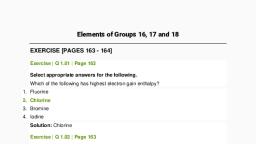
smallest atomic radii in their respective periods due to maximum effective nuclear charge., , very high ionisation enthalpy. Due to increase in atomic size, ionisation enthalpy, decreases down the group., , maximum negative electron gain enthalpy in the corresponding periods, Electron gain enthalpy of the elements of the group becomes less negative down the group., , However, the negative electron gain enthalpy of fluorine, is less than that of chlorine., , It is due to small size of fluorine atom. As a result, there are strong interelectronic repulsions, in the relatively small 2p orbitals of fluorine and thus, the incoming electron does not, experience much attraction., , They have very high electronegativity., , The electronegativity decreases . ., down the group. Fluorine is the most electronegative element in the periodic table