Page 1 :
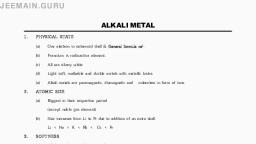
ALKALI METAL, 1., , 2., , PHYSICAL STATE, (a), , One electron in outermost shell & General formula ns1., , (b), , Francium is radioactive element., , (c), , All are silvery white, , (d), , Light soft, malleable and ductile metals with metallic lustre., , (e), , Alkali metals are paramagnetic, diamagnetic and colourless in form of ions., , ATOMIC SIZE, (a), , Biggest in their respective period, (except noble gas element), , (b), , Size increases from Li to Fr due to addition of an extra shell., Li < Na < K < Rb < Cs < Fr, , 3., , SOFTNESS, (a), , (b), , Alkali metals are soft because of (i), , Large atomic size, , (ii), , BCC crystal structure (HCP in Li), , (iii), , Loose packing (68% packing efficiency), , (iv), , Weak metallic bond, , Cs is the softest metal in s-block, Atomic size , , 4., , 1, strength of metallic bond, , softness , , 1, Melting & Boiling point, , MELTING POINT AND BOILING POINT, (a), , Weak interatomic bonds are due to their large atomic radii and presence of only one valence electron, hence melting point and boiling point are low., , (b), , Decreasing order of melting point and boiling point is, Li > Na > K > Rb > Cs, , (c), , With the increase in the size of metal atom, the repulsion of the non-bonding electrons increases and, therefore melting point and boiling point decreases from Li to Cs., , 5., , ELECTRO POSITIVE CHARACTER OR METALLIC CHARACTER, Electropositivity, , 1/Ionisation Potential, , Due to their larger size electron can easily be removed to form M+ ion. Electro positive property increases from, Li to Cs.
Page 2 :
6., , FLAME TEST, Alkali metals and their salts gives characteristic colour to bunsen flame. The flame energy causes an excitation, of the outer most electron which on dropping back to ground state emits absorbed energy as visible light, Ex., , 7., , Li-Crimson red, , Na-Golden yellow, , Rb-Red violet, , Cs-Blue, , K-Violet, , REACTION WITH NH3, (a), , 2Li, , + NH3 Li2NH (Lithimide), , 2Na + 2NH32NaNH2 + H2, (Sodamide), (b), , Solubility in liquid ammonia, , (i), , All the alkali metals dissolves in NH3 (liq.) and produces blue solution., , (ii), , This blue solution conducts electricity and possesses strong reducing power, due to the presence of, ammoniated electrons., Na(s) + (x+y) NH3, , [Na(NH3)x]+ + [e(NH3)y]–, ammoniated electron, , (iii), 8., , This dilute solution is paramagnetic in nature., , PHOTO ELECTRIC EFFECT, (a), , Atomic size of K, Rb and Cs is quite large, so their ionisation potential is very low, , (b), , Due to very low ionisation potential their valence shell electrons gets excited even by absorbing visible, light. That's why Cs is used in photo cells., , 9., , STANDARD OXIDATION POTENTIAL, (a), , All the alkali metals have high +ve values of standard oxidation potential (tendency of releasing electrons, in water or self ionic solutions), , (b), , So these are good reducing agent, having upper most positions in the electro chemical series., , (c), , Li has highest standerd oxidation potential (+3.05 eV) due to its high hydration energy. Such that it converts, into. Li+ ion by loosing one electron., , Order of standard oxidation potential of s - block element, Li > K > Ba > Sr > Ca > Na > Mg > Be, Hydration energy Charge density on ion, 10., , HYDRATION ENERGY (HEAT OF HYDRATION), (a), , Alkali metals salts are generally soluble in water due to hydration of cations by water molecules., , (b), , Smaller the cation, greater is the degree of its hydration.
Page 3 :
(c), , Li+, Na+ K+ Rb+, Cs+, , * Degree of hydration decreasing, * Hydration energy decreasing, * Hydrated ion size decreasing, * Ionic conductance increasing, , 11., , REDUCING PROPERTY, (a), , Since alkali metals have high standard oxidation potential, so these are strongest reductants., , (b), , Reducing property increases down the group in gaseous or molten state, Li+ < Na+ < K+ < Rb+ < Cs+, , (c), , But in aqueous solution order is Li+ > K+ ~ Rb + > Cs+ > Na+, , 12., , REACTION WITH AIR, (a), , Alkali metals gets turnish in air due to the formation of oxide at their surface hence they are kept in, kerosene or paraffin oil., , (b), , These elements reacts with moist air to form carbonates, 4Na + O2, , 2Na2O, , Na2O + H2O 2NaOH, (moist), 2NaOH + CO2 Na2CO3 + H2O, (in air), In dry air only Li gives nitride and oxide both while other elements gives only oxides., 13., , REACTION WITH OXYGEN, Oxide ion [O2–] :, Li forms only Li2O (Lithium oxide)., Peroxide [O 2] —2 :, Na reacts with O2 to form peroxide (Na2O2)., Super oxide [O2–] :, K, Rb and Cs forms MO2 type oxides (super oxides) in excess of O2. So super oxides are paramagnetic and, coloured., , M, , O2, , MO, 2, Oxide, , O2, , MO, 2 2, perioxide, , O2, , MO, 2 2, super, oxide, , (Li2O) (Na2O2) (KO2, RbO2, CsO2), Their stability order is –, Normaloxide > Peroxide > Superoxide
Page 6 :
COMPOUNDS OF ALKALI METALS, 1., , SODIUM (NA), NATRIUM, (a), , Extraction : Down's Process, By Electrolysis of fused NaCl + CaCl2 + NaF, At cathode (Iron Vessel) :, , Na+ +e–, –, , At Anode (Graphite) :, , 2Cl, , Na(s), Cl2 + 2e–, , (i), , (CaCl2 + NaF) is used to lower Melting point (8000C) of NaCl to about 6000C., , (ii), , Aqueous sodium chloride cannot be used for preparing sodium by electrolysis. Because instead of metallic, sodium, hydrogen gas will be liberated at cathode., , 2., , (b), , Properties, , (i), , It is a crystalline soft metal., , (ii), , Highly reactive, so kept in kerosene., , (iii), , Na dissolves in liquid NH3 to giveblue solution., , (c), , Uses, , (i), , In the preparation of sodium amalgam (used as reducing agent), , (ii), , In sodium vapour lamp, which emits monochromatic yellow light., , (iii), , As heat transfer medium in nuclear reactors., , SODIUM CHLORIDE NaCl, (a), , Occurrence : Sea water is the main source and also found in salt lakes., , (b), , Preparation, , (i), , Sea water NaCl(2.7 – 2.9%), , (ii), , It contains impurities – Na2SO4, MgCl2, CaCl2 etc., , (iii), , Insoluble impurities removed by filtration., , (iv), , Filtrate, , HCl gas passed, , HCl, , Evaporation, by solar heat, , crude NaCl, , Pure NaCl precipitation (Common ion effect), _, , Cl, , NaCl, , +, , _, , Na + Cl, , –, , Ionic product of [Na+] [Cl ] > solubility product of NaCl hence it precipitates out., (v), , MgCl2 and CaCl2 are more soluble in water so left in solution., , (c), , Properties, , (i), , Table salt is slightly hygroscopic due to the presence of magnesium and calcium chlorides in small amounts., , (ii), , Reaction with AgNO3, NaCl + AgNO3, , NaNO3 + AgCl(white ppt.), , Reaction with K2Cr2O7 + conc. H2SO4, (iii), , , 4NaCl + K2Cr2O7 + 5H2SO4 , 4NaHSO4 + K2SO4 + 2CrO2Cl2 + 3H2O, , (orange red), (d), , Uses, , (i), , As a preservative for pickles, meat and fish., , (ii), , For making freezing mixture with Ice.
Page 11 :
ALKALINE EARTH METAL, 1., , 2., , PHYSICAL STATEE, (a), , Two electrons in outer most shell & General formula ns2., , (b), , Radium is radioactive element., , (c), , All are greyish white., , (d), , These metals are harder than alkali metals., , (e), , These are diamagnetic and colourless in form of ions or in metal states., , ATOMIC SIZE, Smaller than IA group elements, since extra charge on nucleus attracts the electron cloud., (a), Size increases gradually from Be to Ba, Be < Mg < Ca < Sr < Ba, (b), , 3., , SOFTNESS, (a), (i), (ii), (iii), (iv), (b), , 4., , These metals are slightly harder than IA group because of Smaller atomic size, FCC, HCP crystal structures, Packing capacity 74%, Stronger metallic bond due to presence of two electrons in valence shell., Be is the hardest metal in s-block., , MELTING POINT AND BOILING POINT, (a), , Metallic bond is stronger than IA group due to smaller atomic size and two electrons in valence shell, hence melting point and boiling point are higher., , (b), , Decreasing order of melting point and boiling point is, Be > Ca > Sr > Ba > Mg, Melting point and Boiling point of Ca, Sr and Ba is higher than Mg because of presence of d-orbitals in, the outer most shell, which forms stronger metallic bond., , (c), 5., , In s-block elements, Be is the smallest, Cs is the biggest, , ELECTRO POSITIVE CHARACTER OR METALLIC CHARACTER, Their atomic size is smaller than IA group so these are lesser electro positive than IA group. Electropositivity, increases from Be to Ba, , 6., , FLAME TEST, (a), , Be and Mg atoms, due to small size, bind their electrons more strongly, so are not excited to higher level,, hence no flame test., , (b), , Other elements gives characteristic colour to flame, Ca-Brick red, , Sr-crimson red, , Ba-Apple green, 7., , REACTION WITH NH3, (a), , On increasing metal ion concentrate solution converts into bronze colour due to cluster formation of metal, ions., , (b), , Solubility in liquid ammonia, , (i), , Only Ca, Sr and Ba gives blue solution of ammoniated electron.
Page 12 :
JEE-Chemistry, (ii), , Be and Mg are small in size and have high ionisation potential so do not dissolves in liquid NH3., , (iii), , Dark blue colour of solution becomes fade if it allowed to stand for a long time, it is because of metal, amide formation., , (iv), , Blue colour of solution disappears on addition of ammonium salt, due to NH3 formation., NH4+ +, , 8., , NH2 2NH3, , PHOTO ELECTRIC EFFECT, These elements do not show this property as their atomic size is small hence ionisation potential is higher than, IA group., , 9., , 10., , STANDARD OXIDATION POTENTIAL, (a), , They have lower values of standard oxidation potential due to their small size., , (b), , Increasing order of standard oxidation potential is -, , (c), , Be < Mg < Ca < Sr < Ba, , Tendendy of loosing electron increases, , HYDRATION ENERGY (HEAT OF HYDRATION), (a), , Due to smaller ionic size and higher charge density their hydration energy is high., , (b), , Its decreasing order is, Be+2 > Mg+2 > Ca+2 > Sr+2 > Ba+2, , Hydration energy 1/cation size, , (c), 11., , 12., , 13., , REDUCING PROPERTY, (a), , Less reductant than alkali metals, , (b), , Order of reducing property in aqueous and gaseous medium is, , Be+2 < Mg+2 < Ca+2 < Sr+2 <, REACTION WITH AIR, , Ba+2, , (a), , Except Be, these metals are easily turnished in air, as a Layer of oxide is formed on the surface., , (b), , Barium in powdered form, burst into flame on exposure to air., , (c), , In moist air, except Be all the elements converts into carbonates., , (d), , In dry air Be and Mg gives nitride and oxide both while other gives only oxides., , REACTION WITH OXYGEN, (a), (b), , (c), (d), , Alkaline earth metals reacts with O2 to form 'MO' type oxides, (M = Be, Mg, Ca, Sr, Ba), But Ca, Sr and Ba due to low ionisation potential and more reactivity, forms MO2 (peroxides) at low, temperature., Ex. CaO2, SrO2, BaO2, Peroxides are coloured due to Lattice deffect., BeO shows amphoteric property., weak base, M, , g, , O, , CaO, SrO & BaO Strong base
Page 13 :
14., , (e), , Basic properties increases from Be to Ba, , (f), , Its stability order general oxide > peroxide > super oxide, , REACTION WITH WATER, (a), , These metals reacts slowly with water gives H2 and metals hydroxides., M + 2H2O M(OH)2 + H2, , (b), , Be does not reacts with water, , (c), , Mg reacts only with hot water, , (d), , Ca, Sr, Ba reacts with cold water but not as energetically as alkali metals. order of reactivity, Ba > Sr > Ca > Mg > Be, , (e), 15., , from Be(OH)2 to Ba(OH)2 basic property and stability increases., , HALIDES, (a), , Alkaline metals reacts with X (Halogen) to form MX2., Ex., , (BeCl2, MgCl2, CaCl2 etc.), , (b), , Ionic nature of MX2 increases from BeCl2 to BaCl2, , (c), , Ba burns in contact with Cl2, , (d), , Hydrolytic nature of these halides decreases from BeCl2 to BaCl2, , (e), , BeCl2 and MgCl2 are covalent in nature. Order of ionic nature –, BeCl2 < MgCl2 < CaCl2 <, , SrCl2, , <, , BaCl2, , Solubility in water, BeCl2, 16., , >, , MgCl2, , >, , CaCl2, , >, , SrCl2, , >, , BaCl2, , CARBONATES, (a), , All the alkaline metals forms MCO3 type carbonates., , (b), , Except BeCO3, all the carbonates are stable towards heat, , BeCO3 BeO + CO2, , (c), , Order of decreasing stability BaCO3 > SrCO3 > CaCO3 > MgCO3 > BeCO3, , 17., , NITRATES, (a), , Alkaline earth metals forms M(NO3)2 type nitrates. (M –Alkaline earth metal)., , (b), , Stability increases from Be(NO3)2 to Ba(NO3)2 but these are less stable than IA group, due to smaller, atomic size., , (c), , All alkaline metals nitrates on heating gives oxides and NO2 + O2, , M(NO3)2 Oxides + NO2 + O2, , (d), , Be(NO3)2 forms a layer of BeO on its surface so reaction stops.
Page 18 :
9., , PLASTER OF PARIS (2CaSO4.H2O ), (a), , Preparation : It obtained when gypsum is heated at 1200C, 2(CaSO4.2H2O), , 2CaSO4.H2O + 3H2O, , (b), , Properties, , (i), , It is a white powder., , (ii), , It has the property of setting to a hard mass when a paste with water is allowed to stand aside for, sometime., , 10., , (iii), , When it heated at 2000C, anhydrous CaSO4 is formed., , (c), , Uses, , (i), , In surgery for setting broken bones, , (ii), , In making casts for toys, statues etc., , (iii), , In making blackboard chalks., , SIMILARITIES BETWEEN LITHIUM AND MAGNESIUM, (a), , Both lithium and magnesium are harder and lighter than other elements in the respective groups., , (b), , Lithium and magnesium react slowly with cold water. Their oxides and hydroxides are much less soluble, and their hydroxides decompose on heating. Both form a nitride by direct combination with nitrogen,, Li3N and Mg3N2., , (c), , The oxides, Li2O and MgO do not combine with excess oxygen to give a peroxide or a superoxide., , (d), , The carbonates of lithium and magnesium decompose easily on heating to form the oxide and CO2. Solid, bicarbonates are not formed by lithium and magnesium., , (e), , Both LiCl and MgCl2 are soluble in ethanol., , (f), , Both LiCl and MgCl2 are deliquescent and crystallise from aqueous solution as hydrates,, LiCl.2H2O and MgCl2.8H2O., , 11., , DIAGONAL SIMILARITY BETWEEN BERYLLIUM AND ALUMINIUM : In many of its properties, beryllium, resembles aluminium. Thus –, (a), , The two elements have same electronegativity and their charge/ radius ratios., , (b), , Both metals are fairly resistant to the action of acids due to a protective film of oxide on the surface. Both, metals are acted upon by strong alkalies to form soluble complexes, beryllates [Be(OH) 4 ]2– and, aluminates, [Al(OH)4 ]– ., , (c), , The chlorides of both beryllium and aluminium, Cl, Cl-Be Be-Cl, Cl, , Cl, , Cl, Al, , Cl, , Cl, Al, , Cl, , Cl, , have bridged chloride structures in vapour phase., (d), , Salts of these metals form hydrated ions, Ex. [Be(OH2)4 ]2+ and [Al (OH2)6 ]3+ in aqueous solutions. Due, to similar charge/ radius ratios of beryllium and aluminium ions have strong tendency to form complexes., For example beryllium forms tetrahedral complexes such as BeF4 2– and [Be(C2 O4 )2 ]2– and aluminium, forms octahedral complexes like AlF6 3– and [Al(C2 O4)3]3–.