Notes of Class 12th Paid Batch, Chemistry coordination - Study Material
Page 1 :
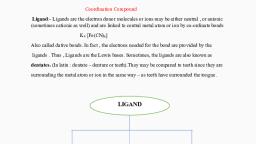
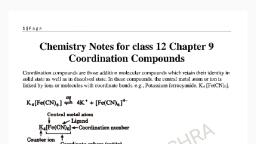
Coordination Compounds, Recap Notes, Werner’s coordination theory :, It explains the nature of bonding in, complexes. Metals show two different, kinds of valencies:, – Primary valency : Non directional and, ionisable. It is equal to the oxidation state, of the central metal ion., – Secondary valency : Directional, and non-ionisable. It is equal to the, coordination number of the metal. It, is commonly satisfied by neutral and, negatively charged or sometimes by, positively charged ligands., X, , X, , The ionisation of the coordination, compound is written as :, [Co(NH3)6]Cl3, [Co(NH3)6]3+ + 3Cl–, , Representation of CoCl3 . 6NH3 complex, according to Werner's theory, , Addition compounds : The compounds, formed by combination of two or more simple, compounds are called addition compounds., They are of two types :, X, , Double salt : A compound formed by, combination of two or more simple, compounds, which is stable in solid state, only is called double salt. In solution it, breaks into component ions. e.g.,, , X, , K2SO4⋅Al2(SO4)3⋅24H2O;, Potash alum, FeSO4⋅(NH4)2SO4⋅6H2O;, Mohr’s salt, KCl⋅MgCl2⋅6H2O;, Carnallite, Complex compound : A compound, formed by combination of two or more, simple compounds which retain its, identity both in solid and solution states, is called complex compound., e.g., K4[Fe(CN)6], Potassium ferrocyanide, [Cu(NH3)4]SO4, Cupramine sulphate, , Some important terms pertaining, coordination compound :, X Coordination entity : The central metal, atom or ion and ligand taken together, is called coordination entity. It may be, positive, negative or neutral., e.g., [Cu(NH3)4]2+, [Fe(CN)6]4–, [Ni(CO)4], X Central atom : The atom or ion with, which definite number of ligands are, attached in a definite geometry is called, central atom/ion. Any atom/ion which has, high positive charge density or vacant, orbitals of suitable energy may be central, atom or ion, e.g., transition metals,, lanthanoids. It is Lewis acid (electron, acceptor)., X Ligands : Molecules or ions which are, bound to the central atom/ion in the, coordination entity are called ligands. A, molecule or ion which has high negative, charge or dipole or lone pair of electrons, may be ligands. It is Lewis base (electron, donor).
Page 2 :
X, , Classification of ligands :, Ligands, On the basis, of charge, , On the basis, of bonding, , On the basis of, number of donor sites, , Negative ligands, –, –, –, –, CN , F , Cl , NO2 ,, –, –, 2–, NO3 , OH , O, , Monodentate : Only one, donor site e.g., H2O, NH3, , Positive ligands, +, +, +, NO2 , NO , N2H5, , e.g., (COO–)2, CH2, , NH2, , CH2, , NH2, , Neutral ligands, H2O, NH3, CO,, NH2OH, CH3NH2, , Bidentate : Two donor sites, (Oxalato), , (Ethylenediamine), , Polydentate : More than, two donor sites e.g.,, EDTA (Hexadentate), , Chelating ligands : A bidentate or polydentate, ligand which forms more than one coordinate, bonds in such a way that a ring is formed., CH2 NH2, CH2 NH2, (Ethylenediamine), Ambidentate ligands : Monodentate ligand which, contains more than one coordinating atom (or, donor atom)., M, M, , X, , X, , Coordination number (C.N.) : The, total number of coordinate bonds, through which the central metal atom, or ion is attached with ligands is known, as coordination number. Examples :, [Ag(CN)2]– : C.N. = 2, [Cu(NH3)4]2+ : C.N., = 4, [Cr(H2O)6]3+ : C.N. = 6, Coordination sphere : The central, atom and the ligands which are directly, attached are collectively known as, coordination sphere. It is non-ionisable, and written enclosed in square brackets., The ionisable groups are written outside, the brackets., Example :, [Cu(NH3)4] SO4, , Coordination, sphere, , X, , Ionisable, group, , [Cu(NH3)4]2+ + SO42–, , Coordination polyhedron : The spatial, arrangement of the ligand atoms which, are directly attached to the central atom, defines a coordination polyhedron about, the central atom, e.g., [(Co(NH3)6)]2+, is octahedral [Ni(CO)4] is tetrahedral., Octahedral is most common coordination, polyhedron., , or, , O, N, , –, , N O, M, , O, O, , –, , M, , SCN, M, or, NCS M, , CN, or, NC, , Homoleptic and heteroleptic complexes:, X Homoleptic complexes : Complexes in, which a metal is bound to only one kind of, ligands are called homoleptic complexes., e.g., [Co(NH3)6]3+, [Ti(H2O)6]3+, [Cu(CN)4]3–, X Heteroleptic complexes : Complexes, in which the central atom is bound, to different type of ligands are called, heteroleptic complexes., e.g., [Co(NH3)4Cl2], K2[Fe(CN)5NO],, [Fe(H2O)5NO]SO4, Nomenclature of coordination, compounds :, X Rules for writing the formula of, coordination compounds :, – Formula of the cation whether simple or, complex must be written first, followed by, anion., – The coordination sphere is written in, square brackets., – Within the coordination sphere the, sequence of symbols is, first the metal atom, followed by anionic ligand then neutral, ligand finally cationic ligand. Ligands of, same type are arranged alphabetically., – Polyatomic ligands are enclosed in, parentheses., – The number of cations or anions to be, written in the formula is calculated on the, basis that total positive charge must be, equal to the total negative charge, as the, complex as a whole is electrically neutral.
Page 3 :
X, , –, –, , –, –, X, , –, –, , –, , –, , –, , Rules for naming coordination, compounds :, The cation is named first then the anion., In naming coordination sphere, ligands, are named first in alphabetical order, followed by metal atom and then oxidation, state of metal by a roman numeral in, parentheses., The complex part is written as one word., When the coordination sphere is anionic,, name of central metal ends in – ate., Naming of ligands :, Name of anionic ligands end in – o., –, e.g., Cl : Chlorido, Neutral ligands (with a few exceptions), retain their names e.g., NH3 : Ammine, Name of cationic ligands end in – ium., +, e.g., NO2 : Nitronium, Certain ligands are represented by, abbreviations in parentheses instead of, their complex structural formulae., e.g., ethylenediamine(en)., Ambidentate ligands are named by using, different names of ligands or by placing, the symbol of donor atom., , �e.g., —SCN (Thiocyanato-S or Thiocya–, nato), —NCS (Thiocyanato-N or Isothio–, cyanato), —ONO (Nitrito-O or Nitrito),, –, —NO2 (Nitrito-N or Nitro), – The prefixes di-, tri-, tetra-, pentaand hexa- are used to indicate the, number of each ligand. If the ligand, name includes such a prefix, the ligand, name should be placed in parentheses, and preceded by bis-(2), tris-(3),, tetrakis-(4), pentakis-(5) and hexakis-(6)., Bonding in coordination compounds :, X Valence bond theory : It was developed, by Pauling., – A suitable number of vacant orbitals must, be present in the central metal atom or, ion for the formation of coordinate bonds, with the ligands., – Central metal ion can use appropriate, number of s, p or d-orbitals for, hybridisation depending upon the total, number of ligands., – The outer orbital (high spin) or inner, orbital (low spin) complexes are formed, depending upon whether outer d-orbitals, or inner d-orbitals are used., , C. No., , Type of, hybridisation, , 2, , sp, , Linear, , [Ag(NH3)2]+, [Ag(CN)2]–, , 3, , sp2, , Trigonal planar, , [HgI3], , sp3, , Tetrahedral, , Ni(CO)4, [NiX4]2–, [ZnCl4]2–, [CuX4]2–,, where, X = Cl–, Br–, I–, , dsp2, , Square planar, , [Ni(CN)4]2–, [Cu(NH3)4]2+, [Ni(NH3)4]2+, , dsp3, , Trigonal bipyramidal, , [Fe(CO)5], [CuCl5]3–, , sp3d, , Square pyramidal, , [SbF5]2–, , d2sp3, , Octahedral (Inner orbital), , [Cr(NH3)6]3+, [Fe(CN)6]3–, , sp3d2, , Octahedral (Outer orbital), , [FeF6]3–, [Fe(H2O)6]2+, [Ni(NH3)6]2+, , 4, , 5, 6, , Geometry, , Inner orbital complexes, , Examples, –, , Outer orbital complexes, , Involves inner d-orbitals i.e., (n – 1)d-orbitals., , Involves outer d-orbitals i.e., nd-orbitals., , Low spin complexes, , High spin complexes, , Have less or no unpaired electrons., e.g., [Co(NH3)6]3+, [Co(CN)6]4–, , Have large number of unpaired electrons., e.g., [MnF6]3–, [CoF6]3–
Page 4 :
– Low spin complexes are generally, diamagnetic and high spin complexes are, paramagnetic., – Paramagnetism ∝ No. of unpaired electrons., – Magnetic moment = n(n + 2) B.M. where, n = number of unpaired electrons., X Crystal field theory : It assumes the, ligands to be point charges and there is, electrostatic force of attraction between, ligands and metal atom or ion. When, ligands approach the central metal ion,, then the five degenerate orbitals do, not possess equal energy any more and, results in splitting, which depends upon, nature of ligand field strength., – Greater the ease with which the ligand, can approach the metal ion, the greater, will be the crystal field splitting caused by it., – Crystal field splitting in octahedral, coordination complexes is shown as :, , – If Do > P, then pairing of electrons takes, place and a low spin complex is formed., – Crystal field splitting in tetrahedral, complexes is shown as :, , – Difference in energy between e and t2, level is less in tetrahedral complexes., 4, ∆t = ∆o, 9, , – Spectrochemical series : Arrangement, of ligands in the order of increasing field, strength., Weak field, ligands, , Increasing order of CFSE (∆ ), , o, , → Strong field, ligands, , –, , –, , I– < Br– < SCN– < Cl– < S2– < F < OH <, –, C2O42– < H2O < NCS < edta4– < NH3 < en <, NO–2 < CN– < CO, , – If Do < P (where ‘P’ is energy required, for forced pairing of electrons) then the, electrons will remain unpaired and a high, spin complex is formed., , Colour of coordination compounds :, The magnitude of CFSE (Do) for most of the, complexes is of the same order as the energy, of a photon of visible light. Hence, whenever, d-d transition takes place, it imparts colour, to the complex. The colour of the complex is, the colour complementary to the wavelength, absorbed.
Page 5 :
94, , CBSE Board Term-II Chemistry Class-12, , Practice Time, , OBJECTIVE TYPE QUESTIONS, , 1. The correct IUPAC name of the coordination, compound K3[Fe(CN)5NO] is, (a) potassium pentacyanonitrosylferrate(II), (b) potassium pentacyanonitroferrate(III), (c) potassium nitritopentacyanoferrate(IV), (d) potassium nitritepentacyanoiron(II)., , 6. Hexaamminenickel(II) hexanitrocobaltate(III), can be written as, (a) [Ni(NH3)6][Co(NO2)6], (b) [Ni(NH3)6]3[Co(NO2)6]2, (c) [Ni(NH3)6] [Co(NO2)6], (d) [Ni(NH3)6(NO2)6]Co, , 2. Ammonia acts as a very good ligand but, ammonium ion does not form complexes because, (a) NH3 is a gas while NH4+ is in liquid form, (b) NH3 undergoes sp3 hybridisation while NH4+, undergoes sp3d hybridisation, (c) NH 4+ ion does not have any lone pair of, electrons, (d) NH4+ ion has one unpaired electron while, NH3 has two unpaired electrons., , 7. Which of the following is correct?, (a) Valence bond theory explains the colour of, the coordination compounds., (b) [NiCl4]2– is diamagnetic in nature., (c) EDTA is a chelating ligand., (d) A bidentate ligand can have four coordination, sites., , 3. Correct formula of tetraamminechloridonitroplatinum(IV) sulphate can be written as, (a) [Pt(NH3)4(ONO)Cl]SO4, (b) [Pt(NH3)4Cl2NO2]2SO4, (c) [Pt(NH3)4(NO2)Cl]SO4, (d) [PtCl(ONO)NH3(SO4)], 4. The magnitude of magnetic moment (spin, only) of [NiCl4]2– will be, (a) 2.82 B.M., (b) 0, (c) 1.23 B.M., (d) 5.64 B.M., 5. Consider the following coordination compounds., (i) [Pt(NH3)4Cl2]Br2, (ii) [Pt(NH3)4Br2]Cl2, (iii) [Co(NH3)4Cl2]NO2, Which of the following observations is correct?, (a) (i) will give a pale yellow and (ii) will give a, white precipitate with AgNO3 solution., (b) (iii) will give a white precipitate with AgNO3, solution., (c) (i), (ii) and (iii) will give white precipitate, with AgNO3 solution., (d) None of the above coordination compounds, will give white precipitate with AgNO3, solution., , 8. Electronic configuration of [Cu(NH3)6]2+ on, the basis of crystal field splitting theory is, (a) t42g e5g, , 6 3, (b) t2g, eg, , (c) t 92g e0g, , (d) t 52g e4g ., , 9. Which of the following primary and secondary, valencies are not correctly marked against the, compound?, (a) [Cr(NH3)6]Cl3 p = 3, s = 6, (b) K2[PtCl4] p = 2, s = 4, (c) [Pt(NH3)2Cl2] p = 2, s = 4, (d) [Cu(NH3)4]SO4 p = 4, s = 4, 10. What will be the correct order of absorption, of wavelength of light in the visible region, for the complexes, [Co(NH3)6]3+, [Co(CN)6]3–,, [Co(H2O)6]3+ ?, (a) [Co(CN)6]3– > [Co(NH3)6]3+ > [Co(H2O)6]3+, (b) [Co(NH3)6]3+ > [Co(H2O)6]3+ > [Co(CN)6]3–, (c) [Co(H2O)6]3+ > [Co(NH3)6]3+ > [Co(CN)6]3–, (d) [Co(CN)6]3– > [Co(H2O)6]3+ > [Co(NH3)6]3+, 11. Which of the following does not depict the, correct name of the compound?, (a) K2[Zn(OH)4] : Potassium, tetrahydroxozincate(II)
Page 6 :
(b) [Co(NH3)5CO3]Cl : Pentaammine, carbonatochlorocobaltate(III), (c) Na3[Co(NO2)6] : Sodium hexanitrocobaltate(III), (d) K3[Cr(CN)6] : Potassium hexacyanochromate(III), , 19. Which of the following shall form an, octahedral complex?, (a) d 4(low spin), (b) d 8(high spin), 6, (d) None of these, (c) d (low spin), , 12. When excess of ammonia is added to copper, sulphate solution, the deep blue coloured complex, is formed. The complex is, (a) tetrahedral and paramagnetic, (b) tetrahedral and diamagnetic, (c) square planar and diamagnetic, (d) square planar and paramagnetic., , 20. The increasing order of crystal field splitting, strength of the given ligands is, –, –, –, (a) NH3 < Cl < CN < F < CO < H2O, –, –, –, (b) F < Cl < NH3 < CN < H2O < CO, –, –, –, (c) Cl < F < H2O < NH3 < CN < CO, –, –, (d) CO < CN < NH3 < H2O < F < Cl–, , 13. Arrange the following complexes in increasing, order of conductivity of their solutions., (ii) [Co(NH3)4Cl2]Cl, (i) [Co(NH3)3Cl3], (iv) [Co(NH3)5Cl]Cl2, (iii) [Co(NH3)6]Cl3, (a) (i) < (ii) < (iv) < (iii), (b) (ii) < (i) < (iii) < (iv), (c) (i) < (iii) < (ii) < (iv), (d) (iv) < (i) < (ii) < (iii), 14. Which of the following complexes will have, tetrahedral shape?, (b) [Pd(CN)4]2–, (a) [PdCl4]2–, 2–, (c) [Ni(CN)4], (d) [NiCl4]2–, 15., (a), (b), (c), (d), , The name of [Co(NH3)5NO2]Cl2 will be, pentaamminonitrocobalt(II) chloride, pentaamminenitrochloridecobaltate(III), pentaamminenitrito-N-cobalt(III) chloride, pentanitrosoamminechlorocobaltate(III)., , 16. Which of the following ligands form a chelate?, (a) Acetate, (b) Oxalate, (c) Cyanide, (d) Ammonia, 17. Copper sulphate dissolves in ammonia due, to the formation of, (b) [Cu(NH3)4]SO4, (a) Cu2O, (c) [Cu(NH3)4]OH, (d) [Cu(H2O)4]SO4, 18. When excess of aqueous KCN solution is, added to an aqueous solution of copper sulphate,, the complex [Cu(CN)4]2– is formed. On passing, H2S gas through this solution no precipitate of, CuS is formed because, (a) sulphide ions cannot replace CN– ions, (b) [Cu(CN)4]2– does not give Cu2+ ion in the, solution, (c) sulphide ions from H2S do not form complexes, (d) sulphide ions cannot replace sulphate ions, from copper sulphate solution., , 21. The number of, [Ni(CO)4] is, (a) one, (c) three, , unpaired electrons in, (b) two, (d) zero, , 22. [Fe(CN)6]4– and [Fe(H2O)6]2+ show different, colours in dilute solution because, (a) CN– is a strong field ligand and H2O is a, weak field ligand hence magnitude of CFSE, is different, (b) both CN– and H2O absorb same wavelength, of energy, (c) complexes of weak field ligands are generally, colourless, (d) the sizes of CN– and H2O are different hence, their colours are also different., 23. In which of the following compounds, the, transition metal is in oxidation state of zero?, (a) [Fe(H2O)3(OH)3], (b) [Ni(CO)4], (d) [Co(NH3)6]Cl3, (c) [Fe(H2O)6]SO4, 24. A substance appears coloured because, (a) it absorbs light at specific wavelength in, the visible part and reflects rest of the, wavelengths, (b) ligands absorb different wavelengths of light, which give colour to the complex, (c) it absorbs white light and shows different, colours at different wavelength, (d) it is diamagnetic in nature., 25. Which of the following statements is correct, about [Co(H2O)6]2+ complex?, (a) Electronic configuration = 3d7 → t52g e2g, no. of, unpaired electrons = 3, m = 3.87 B.M., (b) Electronic configuration = 3d6 → t42g e2g, no. of, unpaired electrons = 2, m = 2.87 B.M., (c) Electronic configuration = 3d7 → t62g e1g , no. of, unpaired electrons = 1, m = 2.87 B.M.
Page 7 :
(d) Electronic configuration = 3d7 = t32g e4g , no. of, unpaired electrons = 3, m = 3.87 B.M., 26. Hexacyano complexes of metals in their, +2 oxidation state are usually yellow while the, corresponding hexaaqua compounds are often, blue or green. This is so because, (a) hexacyano complexes absorb orange or red, light thus appear yellow while hexaaqua, complexes absorb indigo thus appear yellow, (b) hexacyano complexes absorb indigo thus, appearing yellow while hexaaqua complexes, absorb orange or red light thus appear blue, or green, (c) hexacyano complexes absorb yellow light, while hexaaqua complexes absorb blue light, (d) CN– ions are yellow in colour while aqua ions, are blue or green in colour., 27. Low spin tetrahedral complexes are not, formed because, (a) for tetrahedral complexes, the CFSE is lower, than pairing energy, (b) for tetrahedral complexes, the CFSE is, higher than pairing energy, (c) electrons do not go to eg in case of tetrahedral, complexes, (d) tetrahedral complexes are formed by weak, field ligands only., 28. Which of the following sets of examples and, geometry of the compounds is not correct?, (a) Octahedral – [Co(NH3)6]3+, [Fe(CN)6]3–, (b) Square planar – [Ni(CN)4]2–, [Cu(NH3)4]2+, (c) Tetrahedral – [Ni(CO)4], [ZnCl4]2–, (d) Trigonal, [CuCl4]2–, , bipyramidal, , –, , [Fe(NH3)6]2+,, , 29. A coordination compound CrCl3⋅4H2O gives, white precipitate of AgCl with AgNO3. The molar, conductance of the compound corresponds to two, ions. The structural formula of the compound is, (a) [Cr(H2O)4Cl3], (b) [Cr(H2O)3Cl3]H2O, (d) [Cr(H2O)4Cl]Cl2, (c) [Cr(H2O)4Cl2]Cl, 30. Among the following, which are ambidentate, ligands?, (ii) NO–3, (i) SCN–, –, (iii) NO2, (iv) C2O42–, (a) (i) and (iii), (b) (i) and (iv), (c) (ii) and (iii), (d) (ii) and (iv), , 31. The lowest value of paramagnetism is shown, by, (b) [Fe(CN)6]3–, (a) [Co(CN)6]3–, 3–, (c) [Cr(CN)6], (d) [Mn(CN)6]3–, 32. Which of the following is a tridentate ligand?, (a) EDTA4–, (b) (COO)22–, –, (c) dien, (d) NO2, 33. Which of the, paramagnetism?, (a) [Cr(H2O)6]3+, (c) [Cu(H2O)6]2+, , following, , has, , largest, , (b) [Fe(H2O)6]2+, (d) [Zn(H2O)2]2+, , 34. Identify the statement which is not correct?, (a) Coordinate compounds are mainly known for, transition metals., (b) Coordination number and oxidation state of, a metal are same., (c) Tetrahedral complexes form low spin, complex., (d) A ligand donates at least one electron pair to, the metal atom to form a bond., 35. When aqueous solution of potassium fluoride, is added to the blue coloured aqueous CuSO4, solution, a green precipitate is formed. This, observation can be explained as follows., (a) On adding KF, H2O being weak field ligand, –, is replaced by F ions forming [CuF4]2– which, is green in colour., (b) Potassium is coordinated to [Cu(H2O)4]2+ ion, present in CuSO4 and gives green colour., (c) On adding KF, Cu2+ are replaced by K+, forming a green complex., (d) Blue colour of CuSO4 and yellow colour of KI, form green colour on mixing., 36. The formula of the complex diamminechlorido, (ethylenediamine)nitroplatinum(IV) chloride is, (a) [Pt(NH3)2Cl(en)NO2]Cl2, (b) Pt[Pt(NH3)2(en)Cl2NO2], (c) Pt[(NH3)2(en)NO2]Cl2, (d) Pt[(NH3)2(en)NO2Cl2], 37. Using valence bond theory, the complex, [Cr(H2O)6]3+ can be described as, (a) sp3d2, outer orbital complex, paramagnetic, (b) dsp2, inner orbital complex, diamagnetic, (c) d2sp3, inner orbital complex, paramagnetic, (d) d2sp3, outer orbital complex, diamagnetic.
Page 8 :
38. The ligand N(CH2CH2NH2)3 is, (a) bidentate, (b) tridentate, (c) tetradentate, (d) pentadentate., 39. Which of the following is not correctly, matched?, (a) Coordination compound containing cationic, complex ion : [Fe(H2O)2(C2O4)2]2SO4, (b) Coordination compound containing anionic, complex ion : [Ag(NH3)2]Cl, (c) Non-ionic, coordination, compound, :, [Co(NO2)3(NH3)3], (d) Coordination compound containing cationic, and anionic complex ion : [Pt(NH3)4] [CuCl4], 40. A coordination compound X gives pale, yellow colour with AgNO3 solution while its, isomer Y gives white precipitate with BaCl2. Two, compounds are isomers of CoBrSO4⋅5NH3. What, could be the possible formula of X and Y?, (a) X = [Co(NH3)5SO4]Br, Y = [Co(NH3)5Br]SO4, (b) X = [Co(NH3)5Br]SO4, Y = [Co(NH3)5SO4]Br, (c) X = [Co(NH3)5Br(SO4)], Y = [CoBr(SO4)(NH3)5], (d) X = [Co(Br)5NH3]SO4, Y = [CoBr(SO4)]NH3, 41. When one mole of each of the following, complexes is treated with excess of AgNO3 which, will give maximum amount of AgCl?, (b) [Co(NH3)5Cl]Cl2, (a) [Co(NH3)6]Cl3, (c) [Co(NH3)4Cl2]Cl, (d) [Co(NH3)3Cl3], 42. Which of the following descriptions about, [FeCl6]4– is correct about the complex ion?, (a) sp3d, inner orbital complex, diamagnetic, (b) sp3d2, outer orbital complex, paramagnetic, (c) d2sp3, inner orbital complex, paramagnetic, (d) d2sp3, outer orbital complex, diamagnetic, 43. According to Werner’s theory of coordination, compounds,, (a) primary valency is ionisable, (b) secondary valency is ionisable, (c) primary and secondary valencies are, ionisable, (d) neither primary nor secondary valency is, ionisable., 44. CuSO4⋅5H2O is blue in colour while CuSO4 is, colourless due to, (a) presence of strong field ligand in CuSO4⋅5H2O, (b) due to absence of water (ligand), d-d, transition are not possible in CuSO4, (c) anhydrous CuSO4 undergoes d-d transitions, due to crystal field splitting, (d) colour is lost due to loss of unpaired electrons., , 45. Which of the following complexes will show, maximum paramagnetism?, (b) 3d 5, (a) 3d 4, 6, (c) 3d, (d) 3d 7, 46. Among the following compounds which is, both paramagnetic and coloured?, (b) [Co(SO4)], (a) K2Cr2O7, (c) (NH4)2[TiCl6], (d) K3[Cu(CN)4], 47. Which of the following rules is not correct, regarding IUPAC nomenclature of complex ions?, (a) Cation is named first and then anion., (b) In coordination sphere, the ligands are, named alphabetically., (c) Positively charged ligands have suffix ‘ate’., (d) More than one ligand of a particular type are, indicated by using di, tri, tetra, etc., 48. Mark the correct statements regarding the, geometry of complex ions., (i) The geometry of the complex ion depends, upon the coordination number., (ii) If coordination number is 6, the complex is, octahedral., (iii) If coordination number is 4, the geometry of, the complex may be tetrahedral or square, planar., (a) (i), (ii) and (iii), (b) (i) and (ii) only, (c) (i) and (iii) only, (d) (ii) and (iii) only, 49. Which of the following is not a neutral, ligand?, (b) NH3, (a) H2O, (c) ONO, (d) CO, 50. In coordination compounds metals show, two type of linkages : primary and secondary., Primary valency is ionisable and corresponds to, conductivity. Several coordination compounds, are formed by Co(III) with ligand NH3 and Cl–, both., Conductivity of complex I corresponds to 1 : 3, electrolyte, conductivity of complex II corresponds, to 1 : 2 electrolyte while conductivity of complex, 3 and 4 corresponds to 1 : 1 electrolyte. So correct, option about these complexes is, (a) complex I is [(Co(NH 3 ) 6 ]Cl 3 with purple, colour, (b) complex II is [(Co(NH 3) 6]Cl 3 with purple, colour, (c) complex III is [Co(NH3)4Cl2]Cl with violet, colour, (d) both (b) and (c)
Page 9 :
51. Ms. Anjali class 12 th chemistry teacher, explained IUPAC nomenclature of coordination, compounds in her class. Then she asked students, to write the names of 5 coordination compounds., Kavya written these five names :, [Cr(NH 3 ) 3 (H 2 O) 3 ]Cl 3 - Triamminetriaqua, chromium(III)chloride, [Ag(NH 3 ) 2 ][Ag(CN) 2 ], Diamminesilver(I) dicyanidosilver(I), [CoCl2(en)2]Cl-Dichloridobis(ethane-1,, �, 2-diammine) cobalt (III) chloride, K3[Al(C2O4)3] - Potassium trioxalatoaluminium (III), [Ni(CO)4]-Tetracarbonylnickel(0), Few names given by her were not correct as, she didn’t follow one rule while naming these, compounds. That one rule is, (a) the ligands are name in an alphabetical, order before the name of central atom/ion., (b) prefixes mono, di, tri etc. are used to indicate, the number of individual ligands in the, coordination entity., (c) if the complex ion is cation, the metal is, named same as the element., (d) if the complex ion is anion, the metal ends, with suffix – ate., Octahedral complex, 52. Fex+ + SCN–, Fey+ + CN–, Octahedral complex, (x and y may or may not be equal), The difference between the spin-only magnetic, moments is 4.2 B.M. approximately. The reason, for this difference in magnetic moment is, (a) CN– is a strong ligand while SCN– is a weak, ligand, , (b) Fe is present in O.S. I in complex with SCN–, while in O.S. III in complex with CN–, (c) SCN– is a strong ligand while CN– is a weak, ligand, (d) x is 3 while y is 1., 53. If a ligand is weak, the complex will be, high spin while if the ligand is strong then the, complex will be low spin. Here few complexes, are listed:, I. [Cr(H2O)6]2+, II. [CoCl4]2–, III. [Fe(H2O)6]2+, IV. [Mn(H2O)6]2+, V. [Ni(CO)4], VI. [Ni(CN)4]2–, The complexes which have zero magnetic, moment are., (a) I and V, (b) II and VI only, (c) III and IV, (d) V and VI only, 54. Some details of few Nickel complexes are, given below:, Complex I : Diamagnetic and square planar, Complex II : Paramagnetic and tetrahedral, Complex III : Diamagnetic and tetrahedral, Complex IV : Paramagnetic and Octahedral, Which is not correct option for the given, complexes?, (a) The ligand in complex I is CN– and it has, dsp2 hybridisation., (b) The ligand in complex II is Cl– and it has, sp3 hybridisation., (c) The ligand in complex IV is H2O and it has, d2sp3 hybridisation., (d) The ligand in complex III is CO and it has, sp3 hybridiation., , Case Based MCQs, rise to on absorption spectrum consisting of a, single peak that can be represented as shown :, , Absorbance, , Case I : Read the passage given below and, answer the following questions from 55 to 57., The extent to which the set of d-orbitals is, split in the electrostatic field produced by the, ligands depends upon several factors. Two of, the most important factors are the nature of, the ligands and the nature of the metal ion. In, order to see this effect, consider the complex ion, [Ti(H2O)6]3+. The Ti3+ ion has a single electron in, the 3d-orbital, and we refer to it as d1 ion. In the, octahedral field generated by six H2O molecules,, the single electron will reside in one of the three, degerate t2g orbitals. Under spectral excitation,, the electron is promoted to an e.g., orbital giving, , 20,300, u (cm–1), , The maximum absorption in the spectrum for, [Ti(H2O)6]3+ occurs at 20,300 cm–1 which is, equal to 243 kJ mol–1.This gives the value of
Page 10 :
Do directly, but only in case of simple d1 ions., Other complexes containing the Ti3+ ion (e.g.,, [Ti(NH3)6]3+, [TiF6]3–, etc.) could also be prepared, and spectra obtained for these complexes. If this, was done, it would be observe that the absorption, maximum occurs at a different energy for each, complex. Because the maximum corresponds, to the splitting of d-orbitals, the ligands could, be ranked in terms of their ability to cause the, splitting of orbital energies. Such a ranking, is known as the spectrochemical series and for, several common ligands the following order of, decreasing energy is observed, CO > CN– >NO2– >, en > NH3 > H2O > OH– > F–, Cl– > Br–. In general,, the splitting in tetrahedral fields is only about, half as large as that in octahedral fields., 55. Which of the following ligands has lowest Do, value?, (a) CN–, (b) CO, (d) NH3, (c) F–, 56. The visible spectra of salts of the following, complexes are measured in aqueous solution, for which complex would the spectrum contain, absorption with highest Emax values?, , (a) [Co(H2O)6]2+, , (c) [Co(NH3)6]3+, , (b) [Co(H2O)6]3+, , (d) [Co(CN)6]3–, , 57. Which of the following statements is incorrect, for complex [Ti(H2O)6]3+ ?, (a) [Ti(H2O)6]3+ is violet in colour., (b) [Ti(H2O)6]3+ is an octahedral complex., (c) Exitation of electron in [Ti(H2O)6]3+ occurs, as, t12g e0g → t02g e1g, (d) The colour of the complex [Ti(H2O)6]3+ arises, due to d-d and f-f transition of the electron., Case II : Read the passage given below and, answer the following questions., Werner, a Swiss chemist in 1892 prepared and, characterised a large number of coordination, compounds and studied their physical and, chemical behaviour. He proposed that, in, coordination compounds, metals possess two, types of valencies, viz. primary valencies, which, are normally ionisable and secondary valencies, which are non-ionisable. In a series of compounds, of cobalt (III) chloride with ammonia, it was found, that some of the chloride ions could be precipitated, , as AgCl on adding excess of AgNO3 solution in, cold, but some remained in solution. The number, of ions furnished by a complex in a solution can, be determined by precipitation reactions. The, measurement of molar conductance of solutions, of coordination compounds helps to estimate the, number of ions furnished by the compound in, solution., In the following questions (Q. No. 58-62), a, statement of assertion followed by a statement, of reason is given. Choose the correct answer, out of the following choices on the basis of the, above passage., (a) Assertion and reason both are correct, statements and reason is correct explanation, for assertion., (b) Assertion and reason both are correct, statements but reason is not correct, explanation for assertion., (c) Assertion is correct statement but reason is, wrong statement., (d) Assertion is wrong statement but reason is, correct statement., The following questions are multiple choice, questions. Choose the most appropriate answer :, 58. Assertion : The complex [Co(NH3)3Cl3] does, not give precipitate with silver nitrate solution., Reason : The given complex is non-ionisable., 59. Assertion : The complex [Co(NH3)4Cl2]Cl, gives precipitate corresponding to 2 mol of AgCl, with AgNO3 solution., Reason : It ionises as [Co(NH3)4Cl2]+ + Cl–., 60. Assertion : CoCl3⋅4NH3 gives 1 mol of AgCl, on reacting with AgNO3, its secondary valency, is 6., Reason : Secondary valency corresponds to, coordination number., 61. Assertion : 1 mol of [CrCl2(H2O)4]Cl ⋅ 2H2O, will give 1 mol of AgCl on treating with AgNO3., Reason : Cl– ions satisfying secondary valanceis, will not be precipitated., 62. Assertion : CoCl3⋅3NH3 is not conducting, while CoCl3⋅5NH3 is conducting., Reason : The complex of CoCl3⋅3NH3 is, [CoCl3(NH3)3] while that of CoCl3⋅5NH3 is, [CoCl(NH3)5]Cl2.
Page 11 :
Case III : Read the passage given below and, answer the following questions from 63 to 66., Valence bond theory considers the bonding, between the metal ion and the ligands as purely, covalent. On the other hand, crystal field theory, considers the metal-ligand bond to be ionic arising, from electrostatic interaction between the metal, ion and the ligands. In coordination compounds,, the interaction between the ligand and the metal, ion causes the five d-orbitals to split-up. This, is called crystal field splitting and the energy, difference between the two sets of energy level is, called crystal field splitting energy. The crystal, field splitting energy (Do) depends upon the, nature of the ligand. The actual configuration of, complexes is divided by the relative values of Do, and P (pairing energy)., If Do < P, then complex will be high spin., If Do > P, then complex will be low spin., 63. The crystal field splitting energy for, octahedral (Do) and tetrahedral (Dt) complex is, related as, 1, 4, (a) ∆t = ∆ o, (b) ∆t = ∆ o, 2, 9, 2, 3, (c) ∆t = ∆ o, (d) ∆t = ∆ o, 5, 5, 64. On the basis of crystal field theory, the, electronic configuration of d 4 in two situations :, (a) Do > P and (b) Do < P are, (a), (b), (a) t2g4 eg0, , 3 1, t2g, eg, , 3 1, (b) t2g, eg, , 4 0, t2g, eg, , 3 1, (c) t2g, eg, , t2g3 eg1, , 4 0, (d) t2g, eg, , 4 0, t2g, eg, , 65. Using crystal field theory, calculate magnetic, moment of central metal ion of [FeF6]4–., (a) 1.79 B.M., (b) 2.83 B.M., (c) 3.85 B.M., (d) 4.9 B.M., 66. Electronic configuration of d-orbitals in, [Ti(H2O)6]3+ ion in an octahedral crystal field is, 1 0, (a) t2g, eg, , 2 0, (b) t2g, eg, , (c) t02g e1g, , (d) t12g e1g, , Few rules for naming coordination compounds, are :, (I) In ionic complex, the cation is named first, and then the anion., (II) In the coordination entity, the ligands are, named first and then the central metal ion., (III)When more than one type of ligands are, present, they are named in alphabetical order, of preference without any consideration of, charge., 67. The IUPAC name of the complex, [Pt(NH3)3Br(NO2)Cl]Cl is, (a) triamminechlorobromonitroplatinum(IV), chloride, (b) triamminebromonitrochloroplatinum(IV), chloride, (c) triamminebromidochloridonitroplatinum, (IV) chloride, (d) triamminenitrochlorobromoplatinum(IV), chloride., 68., (a), (b), (c), (d), , The IUPAC name of [Ni(CO)4] is, tetracarbonylnickel(II), tetracarbonylnickel(0), tetracarbonylnickelate(II), tetracarbonylnickelate(0)., , 69. As per IUPAC nomenclature, the name of the, complex [Co(H2O)4(NH3)2]Cl3 is, (a) tetraaquadiamminecobalt(II) chloride, (b) tetraaquadiamminecobalt(III) chloride, (c) diamminetetraaquacobalt(II) chloride, (d) diamminetetraaquacobalt(III) chloride., 70. Which of the following represents correct, formula of dichloridobis(ethane-1, 2-diamine), cobalt(III) ion?, (a) [CoCl2(en)]2+, , (b) [CoCl2(en)2]2+, , (c) [CoCl2(en)]+, , (d) [CoCl2(en)2]+, , 71. Correct formula of pentaamminenitrito-Ocobalt(III) sulphate is, (a) [Co(NO2)(NH3)5]SO4, (b) [Co(ONO)(NH3)5]SO4, (c) [Co(NO2)(NH3)4](SO4)2, (d) [Co(ONO)(NH3)4](SO4)2, , Case IV : Read the passage given below and, answer the following questions from 67 to 71., , Case V : Read the passage given below and, answer the following questions from 72 to 76., , Coordination compounds are formulated and, named according to the IUPAC system., , To explain bonding in coordination compounds, various theories were proposed. One of the
Page 12 :
important theory was valence bond theory., According to that, the central metal ion in the, complex makes available a number of empty, orbitals for the formation of coordination bonds, with suitable ligands. The appropriate atomic, orbitals of the metal hybridise to give a set of, equivalent orbitals of definite geometry., The d-orbitals involved in the hybridisation may, be either inner d-orbitals i.e., (n – 1)d or outer, d-orbitals i.e., nd., For example, Co3+ forms both inner orbital and, outer orbital complexes, with ammonia it forms, [Co(NH3)6]3+ and with fluorine it forms [CoF6]3–, complex ion., 72., (a), (b), (c), (d), , Which of the following is not true for [CoF6]3–?, It is paramagnetic., It has coordination number of 6., It is outer orbital complex., It involves d2sp3 hybridisation., , 73. [Cr(H2O)6]Cl3 (at. no. of Cr = 24) has a, magnetic moment of 3.83 B.M. The correct, distribution of 3d-electrons in the central metal, of the complex is, , (a) 3d1xy , 3d1 2, (c), , , 3d1yz, , x − y2, 3d1xy , 3d1zy , 3d12, z, , 1, 1, 1, (b) 3d xy , 3d yz , 3dzx, , (d) 3d1 2, , x − y2, , , 3d12 , 3d1xz, z, , 74. Which of the following is true for, [Co(NH3)6]3+ ?, (a) It is an octahedral, dimagnetic and outer, orbital complex., (b) It is an octahedral, paramagnetic and outer, orbital complex., (c) It is an octahedral, paramagnetic and inner, orbital complex., (d) It is an octahedral, dimagnetic and inner, orbital complex., 75. The paramagnetism of [CoF6]3– is due to, (a) 3 electrons, (b) 4 electrons, (c) 2 electrons, (d) 1 electron., 76. Which of the following is an inner orbital or, low spin complex?, (a) [Ni(H2O)6]3+, , (b) [FeF6]3–, , (c) [Co(CN)6]3–, , (d) [NiCl4]2–, , Assertion & Reasoning Based MCQs, For question numbers 77-90, a statement of assertion followed by a statement of reason is given. Choose, the correct answer out of the following choices., (a) Assertion and reason both are correct statements and reason is correct explanation for assertion., (b) Assertion and reason both are correct statements but reason is not correct explanation for assertion., (c) Assertion is correct statement but reason is wrong statement., (d) Assertion is wrong statement but reason is correct statement., 77. Assertion : The [Ni(en)3]Cl2 (en =, ethylenediamine) has lower stability than, [Ni(NH3)6]Cl2., Reason : In [Ni(en)3]Cl2 the geometry of Ni is, octahedral., 78. Assertion : Ethylenediaminetetraacetate, ion forms an octahedral complex with the metal, ion., Reason : It has six donor atoms which coordinate, simultaneously to the metal ion., 79. Assertion : All the octahedral complexes of, Ni2+ must be outer orbital complexes., Reason : Outer orbital octahedral complexes are, given by weak ligands., 80. Assertion : The second and third transition, series elements have lesser tendency to form low, , spin complex as compared to the first transition, series., Reason : The CFSE (Do) is more for 4d and 5d., 81. Assertion : [Fe(CN)6]3– has d2sp3 type, hybridisation., Reason : [Fe(CN)6]3– ion shows magnetic, moment corresponding to two unpaired electrons., 82. Assertion : [Ti(H2O)6]3+ is coloured while, [Sc(H2O)6]3+ is colourless., Reason : d – d transition is not possible in, [Sc(H2O)6]3+., 83. Assertion : Thiocarbonyl is a neutral ligand., Reason : Thiocarbonyl has three donor atoms, but behaves as a bidentate ligand.
Page 13 :
84. Assertion : The ligand N–3 is named as, nitride., Reason : N3– is derived from HN3., 85. Assertion : [CrCl2(H2O)4]NO3 is, dichlorotetraaquachromium(III) nitrate., Reason : In writing the name of the complex, cation is written first followed by the anion., 86. Assertion, , :, , [Fe(CN)6]3–, 4–, , paramagnetic while [Fe(CN)6], , is, , weakly, , is diamagnetic., , Reason : [Fe(CN)6]3– has +3 oxidation state, while [Fe(CN)6]4– has +2 oxidation state., , 87. Assertion : [Al(NH3)6]3+ does not exist in, aqueous solution., Reason : NH3 is a neutral ligand., 88. Assertion : Low spin complexes have less, number of unpaired electrons., Reason : [FeF6]3– is a low spin complex., 89. Assertion : [Pt(NH3)2Cl2] is square planar., Reason : The oxidation state of platinum is + 2., 90. Assertion : Cu(OH)2 is soluble in NH4OH, but not in NaOH., Reason : Cu(OH)2 forms a soluble complex with, NH3., , SUBJECTIVE TYPE QUESTIONS, , Very Short Answer Type Questions (VSA), 1. Write the hybridisation and number of, unpaired electrons in the complex [CoF 6 ] 3– ., (Atomic no. of Co = 27), 2. What do you understand by ‘denticity of a, ligand’?, 3. Explain the term crystal field splitting in an, octahedral field., 4. Wr i t e t h e f o r m u l a o f t h e f o l l o w i n g, coordination compound :, Iron (III) hexacyanoferrate(II), 5. When a coordination compound CrCl3⋅6H2O, is mixed with AgNO 3 , 2 moles of AgCl are, , precipitated per mole of the compound. Write, structural formula of the complex., 6. Why a solution of [Ni(H 2 O) 6 ] 2+ is green, while a solution of [Ni(CN)4]2– is colourless?, (At. no. of Ni = 28), 7., , Write the IUPAC name of, [Cr(NH3)6][Co(CN)6]., , 8. What is the difference between a complex, and a double salt?, 9. Chelates are generally more stable than the, complexes of unidentate ligands. Explain., 10. Write the coordination number and oxidation, state of platinum in the complex [Pt(en)2Cl2]., , Short Answer Type Questions (SA-I), 11. Why is [NiCl4]2– paramagnetic but [Ni(CO)4], is diamagnetic? (At. no. : Cr = 24, Co = 27, Ni = 28), 12. (i) On the basis of crystal field theory, write, the electronic configuration of d4 ion if Do < P., (ii) Write the hybridization and magnetic, behaviour of the complex [Ni(CO)4]., (At. no. of Ni =28), 13. Out of [CoF6]3– and [Co(C2O4)3]3–, which one, complex is, (i) diamagnetic (ii) more stable, (iii) outer orbital complex and, (iv) low spin complex ?, (Atomic no. of Co = 27), , 14., the, (i), (ii), , Using IUPAC norms write the formulae for, following :, Pentaamminenitrito–O–cobalt(III) chloride, Potassium tetracyanonickelate(II), , 15. Explain the following term giving a suitable, example : Ambidentate ligand, 16. U s i n g v a l e n c e b o n d t h e o r y, e x p l a i n, the geometry and magnetic behaviour of, [Co(NH3)6]3+., (At. no. of Co = 27), 17. Why Co 2+ is easily oxidised to Co 3+ in, presence of a strong ligand?
Page 14 :
18. Write down the IUPAC name of the following, complex : [Cr(NH3)2Cl2(en)]Cl, 19. Ravi prepared a complex compound of cobalt, with NH3 and NO2 as donor ligands. He got a, red precipitate. Sohan also prepared the same, complex using same metal salt solution and, same ligands. He obtained yellow crystals., Sohan complained his teacher that his chemicals, were different so he got different product. But, their teacher is satisfied with both the results., Now answer the following questions :, (i) What type of ligand is present in the given, , compounds which is responsible for changing, colour?, (ii) Write IUPAC name of both the compounds., 20. Give the formula of each of the following, coordination entities :, (i) Co 3+ ion is bound to one Cl – , one NH 3, molecule and two bidentate ethylene diamine, (en) molecules., (ii) Ni2+ ion is bound to two water molecules and, two oxalate ions., Write the name and magnetic behaviour of each, of the above coordination entities., (At. nos. Co = 27, Ni = 28), , Short Answer Type Questions (SA-II), 21. Write the IUPAC names of the following, coordination compounds :, (ii) K3[Fe(CN)6], (i) [Cr(NH3)3Cl3], (iii) [CoBr2(en)2]+, 22. The splitting pattern of d-orbitals in, octahedral and tetrahedral geometry are reverse, of each other. Why?, 23. (a) What is d-d transition?, (b) Tetrahedral complexes are always of high, spin. Explain., 24. For the complex [NiCl4]2–, write, (i) the IUPAC name, (ii) the hybridization type, (iii) the shape of the complex., (Atomic no. of Ni = 28), 25. Write the name, the structure and the, magnetic behaviour of each one of the following, complexes :, (i) [Pt(NH3)2Cl(NO2)] (ii) [Co(NH3)4Cl2]Cl, (iii) Ni(CO)4, (At. nos. Co = 27, Ni = 28, Pt = 78), 26. [Mn(CN) 6 ] 3– has two unpaired electrons, whereas [MnCl6]3– has four unpaired electrons., Why?, , (ii) Hybrid orbitals and shape of the complex, (iii) Magnetic behaviour of the complex, (iv) Name of the complex., 29. Name the following coordination entities, and describe their structures., (i) [Fe(CN)6]4–, (ii) [Cr(NH3)4Cl2]+, 2–, (iii) [Ni(CN)4], 30. Explain the following :, (i) Anhydrous CuSO4 is white while hydrated, CuSO4 is blue in colour., (ii) [Ti(H2O)6]Cl3 is violet in colour but becomes, colourless on heating., 31. For the complex [Fe(CN) 6 ] 3– , write the, hybridization type, magnetic character and spin, nature of the complex. (At. number : Fe = 26), 32. Give reason : [CoF6]3– is outer orbital but, [Co(NH3)6]3+ is inner orbital complex., 33. Write the state of hybridization, the shape, and the magnetic behaviour of the following, complex entities :, (i) [Cr(NH3)4Cl2]Cl, (ii) [Co(en)3]Cl3, (iii) K2[Ni(CN)4], , 27. Write the IUPAC name, deduce the geometry, and magnetic behaviour of the complex, K4[Mn(CN)6]., [Atomic no. of Mn = 25], , 34. (a) What is meant by crystal field splitting, energy? On the basis of crystal field theory,, write the electronic configuration of d 4 in, terms of t2g and eg in an octahedral field when, (ii) Do < P, (i) Do > P, (b) Write two limitations of crystal field theory., , 28. For the complex [Fe(en)2Cl2]Cl, identify the, following :, (i) Oxidation number of iron, , 35. [Ni(H 2O) 6] 2+ is green and becomes violet, when ethane-1, 2-diamine is added to it. Identify, the observation.
Page 15 :
Long Answer Type Questions (LA), 36. (i) Using crystal field theory, draw energy, level diagram, write electronic configuration of, the central metal atom/ion and determine the, magnetic moment value in the following :, (a) [CoF6]3–, (b) [FeF6]3–, (c) [Fe(CN)6]4–, (ii) FeSO 4 solution mixed with (NH 4 ) 2 SO 4, solution in 1:1 molar ratio gives the test of Fe2+, ion but CuSO 4 solution mixed with aqueous, ammonia in 1 : 4 molar ratio does not give the, test of Cu2+ ion. Explain why?, 37. Write down the IUPAC name for each of the, following complexes and indicate the oxidation, state, electronic configuration and coordination, number. Also give stereochemistry and magnetic, moment of the complex:, (i) K[Cr(H2O)2(C2O4)2].3H2O, (ii) [Co(NH3)5Cl]Cl2, (iii) [CrCl3(py)3], (iv) Cs[FeCl4], (v) K4[Mn(CN)6], , OBJECTIVE TYPE QUESTIONS, 1., , (a), , 2. (c) : NH+4 ion does not have any lone pair of electrons, which it can donate to central metal ion hence it does not, form complexes., 3. (c) : Tetraamminechloridonitroplatinum(IV) sulphate can, be written as [Pt(NH3)4(NO2)Cl]SO4., 4., , (a) : In [NiCl4]2–, Ni is in +2 oxidation state., , 38. (a) What are bidentate ligands? Explain, with examples., (b) Explain the coordination sites of polydentate, ligands taking an example of EDTA., (c) Calculate charge on the central metal in the, following complexes:, (i) [Cu(NH3)6]2+ (ii) [Ag(CN)2]–, 39. Give the oxidation state, d-orbital occupation, and coordination number of the central metal, ion in the following complexes :, (i) K3[Co(C2O4)3], (ii) [Cr(en)2Cl2]Cl, (iii) (NH4)2[CoF4], (iv) [Mn(H2O)6]SO4, 40. (a) Explain hybridisation in the complex, which contains hexacyanidoferrate(III) ion., (b) Based on the valence bond theory describe, the formation and nature of hexaaminecobalt(III), chloride., (c) How will you show that hexafluorocobaltate(III) ion is paramagnetic in nature?, , 6. (b) : [Ni(NH3)6]3[Co(NO2)6]2, Hexaamminenickel(II) hexanitrocobaltate(III), 7., , (c), , 8. (b) : In [Cu(NH 3 ) 6 ] 2+ , oxidation state of Cu = +2,, Cu2+ = 3d 9, 6 3, 3d 9 = t 2g, eg, 9. (d) : In [Cu(NH3)4]SO4 primary valency is 2 and secondary, valency is 4., , = 2(2 + 2) = 2.82 B.M., , 10. (c) : The CFSE of the ligands is in the order :, H2O < NH3 < CN–, Hence, excitation energies is in the order:, [Co(H2O)6]3+ < [Co(NH3)6]3+ < [Co(CN)6]3–, hc, 1, ⇒E ∝, From the relation E =, λ, λ, , 5. (a) : [Pt(NH3)4Cl2]Br2, [Pt(NH3)4Cl2]2+ + 2Br–, Br– + AgNO3, AgBr + NO–3, , The order of absorption of wavelength of light in the visible, region : [Co(H2O)6]3+ > [Co(NH3)6]3+ > [Co(CN)6]3–, , In [NiCl4]2– :, Magnetic moment, µ = n (n + 2), [ n = number of unpaired electrons], , Pale yellow ppt., , [Pt(NH3)4Br2]Cl2, Cl– + AgNO3, , , [Pt(NH3)4Br2], AgCl + NO–3, White ppt., , 2+, , + 2Cl, , –, , 11. (b) : [Co(NH3)5CO3]Cl, Pentaamminecarbonatocobalt(III) chloride, 12. (d) : CuSO4 + 4NH3, , [Cu(NH3)4]2+ + SO42–, , deep blue
Page 16 :
In [Cu(NH3)4]2+, oxidation state of Cu = +2, 3d, , Cu2+ : 3d9 :, , ××, , 4s, , 4p, , ××, , ×× ××, , 1 electron from 3d is shifted to 4p, , 2, , Hybridisation is dsp hence geometry is square planar and, paramagnetic due to presence of one unpaired electron., , 23. (b) : In metal carbonyls, metal is in zero oxidation state., 24. (a) : A substance absorbs light at specific wavelength, in the visible part of the spectrum and reflects the rest of the, wavelengths. Each wavelength represents a different colour, hence corresponding colour is observed., 25. (a) : In [Co(H 2 O) 6 ] 2+ , oxidation state of Co = +2,, Co2+ = 3d 7, , 13. (a) : Higher the number of ions in the solution, higher, is the conductivity., No. of ions : [Co(NH3)3Cl3] = 0; [Co(NH3)4Cl2]Cl = 2, , [Co(NH3)5Cl]Cl2 = 3; [Co(NH3)6]Cl3 = 4, 14. (d) : In [NiCl4]2–, oxidation state of Ni = + 2, [NiCl4]2– :, sp3 hybridisation and tetrahedral shape., 15. (c) : The name of [Co(NH3)5NO2]Cl2 is, pentaamminenitrito-N-cobalt(III) chloride., 16. (b) : Oxalate is a bidentate ligand hence forms a chelate., , 17. (b) : CuSO4 + 4NH3, , [Cu(NH3)4]SO4, , 18. (b) : When excess of aqueous KCN solution is added to, aqueous CuSO4 solution, highly stable [Cu(CN)4]2– is formed, which does not give Cu2+ ion in the solution, hence copper, sulphide, is not formed., [Cu(CN)4]2– + 4H2O, [Cu(H2O)4]2+ + 4CN–, 19. (c) : In d 6 (low spin), electrons get paired up to make, two empty d-orbitals. Hybridisation is d 2sp3 (octahedral) and, the complex is low spin., 20. (c) : In general, the ligands can be arranged in a series, in the order of increasing field strength as, I– < Br– < SCN– < Cl– < S2– < F– < OH– < C2O2–, 4 < H 2O <, NCS– < edta4– < NH3 < en < NO–2 < CN– < CO, 8, , 2, , 21. (d) : Ni (Z = 28) : 3d 4s, Oxidation state of Ni in [Ni(CO)4] = 0, , 5 2�, t 2g, eg, , µ = n (n + 2) = 3(3 + 2) = 15 = 3.87 B.M.�, , [ n = 3], , 26. (b) : The ligand CN– absorbs indigo, the high energy, radiation and thus appears yellow. The aqua complexes have, much smaller CFSE, they absorb orange or red light and thus, appear blue or green., 27. (a) : Crystal field stabilisation energy for tetrahedral, complexes is less than pairing energy hence they do not pair, up to form low spin complexes., 28. (d) : [CuCl4]2– – Tetrahedral, [Fe(NH3)6]2+ – Octahedral, 29. (c) : It gives precipitate with AgNO3 it means it gives, Cl– ions in the solution. Since conductivity corresponds to two, ions, it shows one Cl– is outside the coordination sphere. The, structure will be, [Cr(H2O)4Cl2]Cl, [Cr(H2O)4Cl2]+ + Cl–, AgNO3 + Cl–, , AgCl + NO–3, white ppt., , 30. (a) : SCN– and NO–2 are ambidentate ligands since they, have more than one donor atoms to attach to the central, metal atom., 31. (a) : Electronic configuration of Co3+ = 3d 6, [Co(CN)6]3– :, No. of unpaired electrons = 0, hence, shows no paramagnetism., , No. of unpaired electrons = 0, , 32. (c) : Dien (Diethylenetriamine) has the following, structure, ⋅⋅, ⋅⋅, ⋅⋅, H2N — CH2 — CH2 — NH — CH2 — CH2 — NH2, , 22. (a) : CN – is a strong field ligand hence pairing of, electrons takes place while in case of H2O pairing does not, take place. Both ligands show different magnitude of crystal, field splitting energy hence absorb different wavelengths and, show different colours., , 33. (b) : More the number of unpaired electrons, higher is, its paramagnetism., Cr3+ : 3d 3, Fe2+ : 3d 6, Cu2+ : 3d 9, Zn2+ : 3d10, Fe2+ has four unpaired electrons hence it shows highest, paramagnetism., , In [Ni(CO)4] :
Page 18 :
[Fe(H2O)6]2+ : Fe2+ → [Ar]3d 64s0, 3d, 4 unpaired electrons, [Mn(H2O)6]2+ : Mn2+, 3d, , 4s, , → [Ar]3d 54s0, 4s, , 8, , [Ni(CO)4] : Ni → [Ar]3d 4s, 3d, , 67. (c) : Ligands are named in alphabetical order irrespective, of their charge., 71. (b) : Ligand NO–2 is ambidentate ligand as it can donate, electrons through either nitrogen (NO2) or oxygen (ONO)., , 2, , 4s, , 72. (d) : It involves sp3d 2 hybridisation and not d 2sp 3., , Zero unpaired electrons, , [Ni(CN)4]2– : Ni2+ → [Ar]3d 84s0, 3d, , 66. (a) : In [Ti(H2O)6]3+, Ti is in +3 oxidation state and there, is only one electron in d-orbital., , 68. (b) 69. (d) 70. (d), , 5 unpaired electrons, 0, , Magnetic moment (m) = n (n + 2) = 4(4 + 2) = 4.9 B.M., , 4s, , Zero unpaired electrons, , Hence, [Ni(CO)4] and [Ni(CN)4]2– have zero unpaired electrons, i.e., zero magnetic moment., 54. (c) : [Ni(CN) 4]2– : dsp2 hybridisation (square planar, complex) and have zero unpaired electrons (diamagnetic), [NiCl 4] 2– : sp 3 hybridisation (tetrahedral) and have two, unpaired electrons (paramagnetic), [Ni(H2O)6]2+ : sp3d2 hybridisation (octahedral) and have two, unpaired electrons (paramagnetic), [Ni(CO)4] : sp 3 hybridisation (tetrahedral) and have zero, unpaired electrons (diamagnetic), , 73. (b) : Magnetic moment of 3.83 B.M. suggests that it, has 3 unpaired electrons,, \ n = 3 i.e., Cr3+ : 3d 3, It involves d 2sp 3 hybridisation so correct distribution of, electrons is 3dxy1 , 3dyz1 , 3dzx1 ., 74. (d) : [Co(NH3)6]3+ is d2sp3 hybridised with all electrons, paired hence, it is diamagnetic and inner orbital complex., 75. (b) :, Co, , :, , [CoF6]3– :, , 3d, , 55. (c) : Because F– is a weak field ligand., 56. (d) : [Co(CN)6]3– complex would contain absorption, with highest Emax value because according to spectrochemical, series, the crystal field splitting energy of CN– ion is very high., 57. (d) , , 58. (a), , 59. (d) : [Co(NH3)4Cl2]Cl + AgNO3, �[Co(NH3)4Cl2]+ + AgCl↓, Thus it gives precipitate of 1 mol of AgCl., 60. (b) : CoCl 3 ·4NH 3 gives 1 mol AgCl on reaction, with AgNO 3, hence the complex can be represented as, [CoCl2(NH3)4]Cl., 61. (a) : The Cl– ions outside the coordination sphere can, only be precipitated., 62. (a) , , 4p, , 4s, , 3d, 3+, , 4p, , 4s, , F, , –, , sp3d 2 hybridisation, F– F– F–, F–, , 4d, , F–, , 76. (c) : Inner orbital complexes are formed with strong, ligands as they force electrons to pair up and hence the, complex will be either diamagnetic or will have less number, of unpaired electrons., 77. (d) : [Ni(en)3]Cl2 is a chelating compound and chelated, complexes are more stable than similar complexes with, unidentate ligands as dissociation of the complex involves, breaking of two bonds rather than one., In [Ni(en)3]Cl2, Ni with d 8 configuration shows octahedral, geometry., 78. (a), 79. (b) : Ni2+ configuration, , 63. (b), , 64. (a) : When Do > P, the electrons paired up in the t2g, level rather than going to the eg level, so, 4 0, when Do > P : t2g, eg, and Do < P : t2g3 eg1, 4, 65. (d) : Fe2+ : 3d 6 ⇒ t 2g, eg2, , (Since, F– is a weak field ligand), Hence four unpaired electrons are present., , During rearrangement only one 3d-orbital may be made, available by pairing the electrons. Thus, inner d 2 sp 3, hybridisation is not possible. So, only sp 3 d 2 (outer), hybridisation can occur.
Page 19 :
82. (a) : [Sc(H 2 O) 6 ] 3+ has no unpaired electron in its, d subshell and thus d – d transition is not possible whereas, [Ti(H2O)6]3+ has one unpaired electron in its d-subshell which, gives rise to d – d transition to impart colour., 83. (c) : Thiocarbonyl (CS) has one donor atom., 84. (d) : N3– is named as azido. It is derived from HN3., , H2N CH2 CH2 NH2, , :, , 81. (c) : [Fe(CN) 6 ] 3– ion shows magnetic moment, corresponding to one unpaired electron., , 2. Denticity : The number of coordinating groups present, in a ligand is called the denticity of ligand., For example, bidentate ligand ethane-1, 2-diamine has two, donor nitrogen atoms which can link to central metal atom., :, , 80. (d) : 4d and 5d elements have greater tendency to, form low spin complex (allows better pairing of electrons), in comparison to 3d because the difference in energy of t2g, and eg (CFSE, Do) increases in 4d and 5d., , Ethane-1, 2-diamine, , 3. The splitting of the degenerate d-orbitals into three, orbitals of lower energy, t2g set and two orbitals of higher, energy eg set due to the interaction of ligand in an octahedral, crystal field is known as crystal field splitting in an octahedral, field., , 85. (d) : Correct IUPAC name is tetraaquadichloridochromi, um(III) nitrate., 86. (b) : [Fe(CN)6]3– has one unpaired electron, hence it, shows paramagnetic nature while [Fe(CN)6]4– possesses no, unpaired electron and thus shows diamagnetic nature., 87. (b) : The complex ion [Al(NH3)6]3+ undergoes the change, into new complex ion [Al(H2O)6]3+ in aqueous medium due, to higher heat of hydration of aluminium ion on account of, its small size., [Al(NH3)6]3+ + 6H2O → [Al(H2O)6]3+ + 6NH3, 88. (c) : [FeF6]3– is a high spin complex since F– is a weak, field ligand., 89. (b) : The outer electronic configuration of platinum in, ground state is 5d 96s1. The Pt2+ ion formed by the loss of, two electrons has outer electronic configuration of 5d 8. In the, presence of strong ligands (NH3) two unpaired electrons in, the 5d-subshell pair up. This is followed by dsp2 hybridisation, resulting in the formation of four hybridised vacant orbitals, which accommodate four pairs of electrons from four ligands, (two from ammonia and two from Cl–). As such the resulting, complex is square planar., 90. (a), , SUBJECTIVE TYPE QUESTIONS, 1., , Oxidation state of Co ion in [CoF6]3– is +3., , Co3+ :, Co3+ in [CoF6]3– :, , No. of unpaired electrons = 4, , 4., , Fe4[Fe(CN)6]3, , 5. For one mole of the compound, two moles of AgCl, are precipitated which indicates that two ionisable chloride, ions in the complex. Hence, its structural formula is, [CrCl(H2O)5]Cl2.H2O, 6. [Ni(H 2 O) 6 ] 2+ is a high spin complex (D o small), while [Ni(CN)4]2– is a low spin square planar complex., In [Ni(H2O)6]2+ complex, d-d transitions are taking place on, absorbing low energy radiation (red component of spectrum), from visible region showing green as the complementary, colour., In [Ni(CN)4]2– complex, d-d transitions do not take place in, the visible region of spectrum, d-d transitions take place in, the UV region and hence, complex is colourless., 7., , Hexaamminechromium(III) hexacyanocobaltate(III)., , 8. Double salts dissociate into ions completely when, dissolved in water. On the other hand, in complexes, the, complex ion does not dissociate., 9. Chelates are cyclic compounds so they are more stable, than normal complexes. In chelates ligands are held by two, or more bonds with the transition metals. e.g.,, , 10. Coordination number and oxidation state of Pt in the, complex [Pt(en)2Cl2] are 6 and +2 because en is a bidentate, and neutral ligand.
Page 20 :
11. [NiCl4]2– contains Ni2+ ion with 3d 8 configuration., , [CoF6]3– :, , Ni2+, Ground state, , Cl – is a weak field ligand. Hence, outer 4s and, 4p-orbitals are used in hybridisation., [NiCl4], , 6, , [Co(C2O4)3]3– :, , 2–, , with 4Cl– ligands, , 3, , It has two unpaired electrons hence, it is paramagnetic., [Ni(CO)4] contains Ni(0) – 3d 84s2 configuration., Ni(0), , 3d, , 4s, , 4p, , Ground state, , CO is a strong field ligand hence, 4s-electrons will shift to, 3d-orbital making 4s-orbital vacant., , �, (i) [Co(C2O4)3]3– is diamagnetic as all electrons are paired., (ii) [Co(C2O4)3]3– is more stable as C2O42– is a chelating, ligand and forms chelate rings., (iii) [CoF6]3– is an outer orbital complex as it undergoes, sp 3 d 2 hybridization using the outer 4d-orbital., (iv) [Co(C2O4)3]3– is low spin complex due to absence of, any unpaired electron., 14. (i) [Co(NH3)5(ONO)]Cl2 , , [Ni(CO)4], , (ii), , K2[Ni(CN)4], , 15. Ambidentate ligand : A unidentate ligand which can, coordinate to central metal atom through two different atoms, is called ambidentate ligand., For example, NO2– ion can coordinate either through nitrogen, or through oxygen to the central metal atom/ion., , The complex has all paired electrons hence, it is diamagnetic., 12. (i) For d 4 ion, if Do < P, the fourth electron enters one, 3, , of the eg orbitals giving the configuration t2 g e g1. Ligands, for which Do < P are known as weak field ligands and form, high spin complexes., , 16. Oxidation state of cobalt in [Co(NH3)6]3+ is +3., 3d6, , Co3+ :, , 4s0, , 4p0, , Ground State, , [Co(NH3)6]3+ ion :, , (ii) [Ni(CO)4] contains Ni(0) – 3d 84s2 configuration., Ni(0), , 3d, , 4s, , 4p, , CO is a strong field ligand hence, 4s-electrons will shift to, 3d-orbital making 4s-orbital vacant., , Hybridisation – d 2sp3, Structure – Octahedral, (low spin), Nature – Diamagnetic, , [Ni(CO)4], , IUPAC name : Hexaamminecobalt(III) ion, , Ground state, , 17. In presence of strong field ligand, Co(II) has electronic, 6 1, eg ., configuration t2g, eg, , The complex has all paired electrons hence, it is diamagnetic., 13. Formation of [CoF 6 ] 3– and [Co(C 2 O 4 ) 3 ] 3– can be, represented as :, , �o > P, t2g, , It can easily lose one electron present in eg orbital to give stable, t 62g configuration. This is why Co2+ is easily oxidised to Co3+ in, the presence of strong field ligand.
Page 21 :
18. Diamminedichlorido(ethane-1,2-diamine)chromium(III), �chloride., 19. (i) Ambindent ligands (NO2, ONO) present in the given, compounds., (ii) [Co(NH3)5(NO2)]Cl2 (Yellow), Pentaamminenitrito-N-cobalt(III) chloride, [Co(NH3)5(ONO)]Cl2 (Red), Pentaamminenitrito-O-cobalt(III) chloride, 20. (i) [Co(en)2Cl(NH3)]2+, Amminechloridobis(ethane-1,2-diamine)cobalt(III) ion, In presence of strong NH3 and en ligand, Co3+ (3d 6) forms, low spin complex. Hence, complex is diamagnetic., (ii) [Ni(ox)2(H2O)2]2– : Diaquadioxalatonickelate(II) ion, In the presence of weak ox and H2O ligand, Ni(II) forms high, spin complex (sp3d 2 hybridisation). It is paramagnetic., 21. (i) Triamminetrichloridochromium(III), (ii) Potassium hexacyanoferrate(III), (iii) Dibromidobis(ethane-1,2-diamine)cobalt(III) ion, 22. In octahedral complex ligands approach along the axes., So axial orbitals (dx2 – y2, dz2) lie directly in the path of ligand, and experience greater repulsion than the non-axial orbitals., Whereas in tetrahedral complex ligands are closer to nonaxial orbitals (i.e. dxy, dxz and dyz). So, non-axial orbitals, experience greater force of repulsion than the axial orbitals., i.e. approach of ligands in octahedral and tetrahedral fields, is opposite of each other. This is why splitting pattern of, d-orbitals in octahedral and tetrahedral geometry is reverse, of each other., , Ground state :, Ni2+ ion :, [NiCl4]2– :, , The complex ion has tetrahedral geometry and is paramagnetic, due to the presence of unpaired electrons., 25. (i) [Pt(NH3)2Cl(NO2)] :, Diamminechloridonitrito-N-platinum(II), It is square planar and diamagnetic., (ii) [Co(NH3)4Cl2]Cl :, Tetraamminedichloridocobalt(III) chloride, It is octahedral and diamagnetic., (iii) Ni(CO)4 : Tetracarbonylnickel(0), It is tetrahedral and diamagnetic., 26. In [Mn(CN)6]3–, Mn is in +3 state so, it has configuration, of 3d 4., Since CN– is a strong field ligand hence pairing of electrons, in 3d-orbital takes place., eg, Free metal ion, 4, (3d ), , t2g, In strong octahedral, ligand field, , So, [Mn(CN)6]3– has two unpaired electrons. But in [MnCl6]3–,, Cl– is a weak field ligand, so no pairing takes place and it, has 4 unpaired electrons., 27. Mn (Z = 25), , 23. (a) When ligands approach the central metal, atom or, ion of complex its d-orbital breaks into two parts t2g and eg, levels. When light falls on the complex the complex absorbs, light of suitable frequency for transfer of electron from lower, level to higher level. This jump of electron from one d-level, to another is called d-d transition., , (b) For tetrahedral complexes crystal field splitting energy ∆t, is always less than pairing energy. So, tetrahedral complexes, are always high spin., 24. Tetrachloridonickelate(II) ion, Ni atom (Z = 28), , Ground state :, Mn2+ ion :, [Mn(CN)6]4– :, , IUPAC name : Potassium hexacyanomanganate(II), Geometry : Octahedral, No. of unpaired electrons, n = 1, Magnetic behaviour : paramagnetic, 28. (i) [Fe(en)2Cl2]Cl, x + 0 × 2 + (–1) × 2 + (–1) × 1 = 0, Oxidation number of iron = +3, , \ x = +3
Page 22 :
(ii) d2sp3 hybridisation and octahedral shape., (iii) Paramagnetic due to presence of one unpaired electron., (iv) dichloridobis(ethane-1,2-diamine)iron(III) chloride, 29. (i) [Fe(CN)6]4– : Hexacyanidoferrate(II) ion, Hybridisation - d 2sp3, Structure : Inner orbital octahedral complex, CN, CN, , CN, Fe, , CN, , CN, CN, , H3N, , Cr, Cl, , NH3, , Since F– is a weak field ligand. So, outer d-orbitals will be, used., , Since, outer d-orbital is used for hybridisation. So, it is outer, orbital complex., In [Co(NH3)6]3+, Co is in +3 state., , (ii) [Cr(NH3)4Cl2]+ :, Tetraamminedichloridochromium(III) ion, Hybridisation - d 2sp3, Structure : Inner orbital octahedral complex, H3N, , :, , 4–, , Octahedral, , NH3, , 32. In [CoF6]3–, Co is in +3 state and has 3d 6 configuration., , :, , Since NH3 is a strong field ligand pairing of electrons in, 3d-orbital takes place to make two 3d orbitals vacant., 4s, 4p, , +, , Cl, , Octahedral, 2–, , (iii) [Ni(CN)4] : Tetracyanidonickelate(II) ion, Hybridisation - dsp2, Structure - Square planar, , Square planar, , 30. (i) Anhydrous CuSO4 has no ligand. So, crystal field, splitting does not occur so, it does not show any colour but, in hydrated form it is linked with H2O ligand so, it shows, colour due to d-d transition., (ii) [Ti(H2O)6]Cl3 is a complex compound. In presence of 6, H2O molecules the d-orbitals of Ti3+ undergo splitting. The, compound is coloured (violet) due to d-d transition. On heating, water molecules escape, d-orbitals become degenerate. There, is no d-d transition. Hence compound becomes colourless., 31. Fe atom (Z = 26), Ground state :, 0, , Fe, , 3+, , Since it uses inner d-orbital for its hybridisation so, it is inner, orbital complex., 33., Complex Central Hybridi- Geometry, metal sation, of, ion/ of metal complex, atom, ion, involved, , Magnetic, behaviour, , [Cr(NH3)4, Cl2]Cl, , Cr3+, , d 2sp3, , Octahedral Paramagnetic, , [Co(en)3]Cl3, , Co3+, , d 2sp3, , Octahedral Diamagnetic, , K2[Ni(CN)4], , Ni, , 2+, , dsp, , 2, , Square, planar, , Diamagnetic, , 34. (a) The difference of energy between two splitted, levels of d-orbitals is called crystal field splitting energy. It, is denoted by D or 10 Dq., For octahedral Do, for tetrahedral it is Dt and for square, planar Dsp., , 0, , ion :, , Dq, , [Fe(CN)6]3– ion, , The complex ion has inner orbital octahedral geometry, (low spin) and is paramagnetic due to the presence of one, unpaired electron., , 4 0, (i) When Do > P, t 2g, eg, (ii) When Do < P,t 32g e1g, (b) (i) It assumes ligand to be point charges., (ii) It does not take into account the covalent character of, bonding between the ligand and the central atom.
Page 24 :
shown below:, O, (5), –, , O, , (6), –, , O, , C, , H2C, , (1), , N, C, , (c) The charge carried by a complex ion is the algebraic, sum of charges carried by the central ion and the ligands, coordinated to it. Thus [Cu(NH3)6]2+ carries a charge of +2, and because ammonia molecule is neutral therefore, Cu2+, carries a charge of +2. [Ag(CN)2]–, ion carries a charge of, –1 and two cyanide ions coordinated to it carry a charge of, –1 each. So, Ag+ carries a charge of +1., , O, , H2C, , (2), , CH2, , CH2, , CH2, , C, , CH2, , C, , N, , (3), –, , O, , (4), , O, , O–, , O, Structure of ethylenediamminetetraacetate ion, , 39. , , S.No., , Complex, , Oxidation state of, metal atom, , Coordination, number of central, metal atom, , d-orbital occupation, , (i), , K3[Co(C2O4)3], , +3, , 6, , Co3+ = 3d 6; (t2g)6, (eg)0, , (ii), , [Cr(en)2Cl2]Cl, , +3, , 6, , Cr3+ = 3d 3; (t2g)3, , (iii), , (NH4)2[CoF4], , +2, , 4, , Co2+ = 3d 7; (e)4, (t2)3, , (iv), , [Mn(H2O)6]SO4, , +2, , 6, , Mn2+ = 3d 5; (t2g)3, (eg)2, , 40. (a) Formation of hexacyanidoferrate(III) ion; [Fe(CN)6]3– :, Electronic configuration of iron in the ground state is 3d 64s2., The oxidation state of iron is +3 in this complex. Iron (III) has, outer electronic configuration 3d54s0. It has been experimentally observed that this complex has one unpaired electron., To account for this, two unpaired electrons in 3d subshell, pair up, thus leaving two 3d-orbitals empty. These two vacant, 3d-orbitals, alongwith one 4s-orbital and three 4p-orbitals, hybridise to give six equivalent d2sp3 hybridised orbitals. Six, pairs of electrons, one from each cyanide ion, occupy the six, vacant hybrid orbitals so produced. The complex has octahedral geometry and is paramagnetic due to the presence of, one unpaired electron., , 2, , 3, , The complex evidently involves (n – 1)d nsnp hybridisation, and is, therefore, called inner orbital or low spin complex., (b) The outer electronic configuration of cobalt (III) ion, is 3d 6. According to Hund’s rule, four of the 3d-orbitals, are singly filled and one 3d-orbital has a pair of electrons., Octahedral complexes are formed through d2sp3 hybridisation, , for which the metal atom must have two of its 3d-orbitals, empty. This is achieved by the pairing of the two 3d-electrons, as a result of the energy released due to the approach of, the ligands. This results in the formation of an octahedral, complex. As is evident from the figure, the complex does not, contain any unpaired electron and is, therefore, diamagnetic., , (c) In [CoF6]3– complex, the 3d-orbitals remain undisturbed, while the outer 4d-orbitals are used for hybridisation, as, Co3+ ion, , [CoF6]3– ion, , The complex is paramagnetic since it contains four unpaired, electrons., ,



 Learn better on this topic