Page 1 :
Carbon and its Compounds, SYLLABUS, Covalent bonding in carbon compounds. Versatile nature of carbon, Homologous series,, Nomenclature of carbon compounds containing functional groups (halogens, alcohol,, ketones, aldehydes, alkanes and alkynes), Difference between saturated hydrocarbons, and unsaturated hydrocarbons, Chemical properties of carbon compounds (combustion,, oxidation, addition and substitution reaction), Ethanol and Ethanoic acid (only properties, and uses), Soaps and detergents., , Facts that Matter, Carbon, Symbol – C, Electronic configuration – 2, 4, Valency – 4 (tetravalency), Occurrence in nature → Earth’s crust → 0.02% in the form of minerals like carbonates,, coal, petroleum., In atmosphere – 0.03% of carbon dioxide (gaseous form)., Carbon forms covalent bonding and covalent compounds which do not conduct, electricity. A covalent bond is formed by mutual sharing of electrons. This mutual sharing of, electrons occurs in such a way that each of the combining atom acquires the stable electronic, configuration of the nearest noble gas. A single bond is formed when each of the two, combining atoms share 1 electron each, a double bond is formed when atoms contribute 2, electrons each and triple bond is formed when each atom contributes 3 electrons., , Allotropy ⎯⎯→ Some elements exist in two or more different forms. This phenomenon, is known as allotropy.
Page 2 :
Allotropes of Carbon ⎯⎯→ Carbon has 3 allotropes: diamond, graphite and, fullerenes. In diamond carbon atoms are bonded together in tetrahedral lattice arrangement., In graphite carbon atoms are bonded together in sheets of hexagonal lattice., In fullerenes, carbon atoms are bonded together in spherical, tubular, or ellipsoidal forms., Organic compounds: The tetravalency of carbon gives a possibility of large number of, compounds. Earlier it was thought carbon compounds can be extracted from organisms only., Hence carbon compounds are also called organic compounds., , NCERT IN-TEXT ACTIVITIES SOLVED, Activity 4.1, List of ten things used or consumed daily, Things, , Metals, , Glass/Clay, , Other materials, , Fan, Bed, Toothbrush, Spoon, Tumbler, Clothes, Pencil, Pen, Books, , Aluminium/Iron, —, , —, —, , —, Wood (C), Plastic, nylon (C), , Stainless steel, Glass, Cotton (C), Wood (C), Plastic (C), Paper-obtained from wood (C), , Graphite, Steel, , Bread, , Wheat (C), , (C) ⎯⎯→ indicates carbon, Most substances contain carbon in it., Activity 4.2, Calculate the difference in the formulae and molecular masses for (a) CH3OH and C2H5OH, (b) C2H5OH and C3H7OH, and (c) C3H7OH and C4H9OH., (a), , CH3OH, , ⎫, ⎬, C2H5OH ⎭, , differ by CH2, , Mass CH3OH, , C2H5OH, , 12 + 1 × 3 + 16 + 1 = 32 u, , (12 × 2) + (1 × 5) + 16 + 1 = 46 u, Difference → 46 – 32 = 14 u, , (b) C2H5OH, , ⎫, ⎬, C3H7OH ⎭, , Mass, , differ by CH2, C2H5OH, , C3H7OH, , (12 × 2 ) + (1 × 5) + 16 + 1 = 46 u (12 × 3) + (1 × 7) + 16 + 1 = 60 u, Difference → 60 – 46 = 14 u
Page 3 :
(c) C3H7OH, , ⎫, ⎬, C4H9OH ⎭, Mass, , differ by CH2, C3H7OH, 60 u, , C4H9OH, (12 × 4) + (1 × 9) + 16 + 1 = 74 u, Difference →74 – 60 =14 u, , All 3 groups given above show a similarity→Two consecutive members differ by CH2, group and mass 14 u., Homologous Series, Chloro alkane, , Alcohol, , Aldehyde, , CH3Cl, , CH3—OH, , HCHO, , C2H5Cl, , C2H5—OH, , CH3CHO, , C3H7Cl, , C3H7—OH, , C2H5CHO, , C4H9Cl, , C4H9—OH, , C3H7CHO, , Ketone, O, &, CH3— C —CH3, O, &, C2H5— C —CH3, O, &, C3H7— C —CH3, O, &, C4H9— C —CH3, , Carboxylic acid, HCOOH, CH3COOH, C2H5COOH, C3H7COOH, , Activity 4.3, Heating of different carbon compounds, observing the flame and smoke., Carbon Compounds, , Nature of flame, , Deposits on Metal, , Camphor, , Smoky flame, , Carbon deposits on metal, , Alcohol, , Non-sooty flame, , No carbon, , Acetone, , Non-sooty flame, , No carbon, , Naphthalene, , Smoky flame, , Carbon deposits on metal, , Alcohol and acetone burns with non-sooty flame—complete combustion takes place., Camphor, naphthalene burns with sooty flame—incomplete combustion takes place., Activity 4.4, Bunsen burner is used to study the different types of flame by adjusting the holes at the, base of the burner., (i) When hole is c losed—Yellow, sooty flame is formed, black deposits of carbon is, obtained on spoon when placed above the flame., (ii) When the hole is open—Blue flame is formed, no black deposits of carbon is, obtained on spoon when placed above the flame., Activity 4.5, Take 3 ml of ethanol in a test tube and warm it gently in a water bath., Add 5% solution of alkaline potassium permanganate drop by drop to this solution.
Page 4 :
• The colour of KMnO4 slowly fades and disappears completely. When excess of, KMnO4 is added, the colour will not disappear as alcohol gets oxidised to form, carboxylic acid., In this case ethanol gets oxidised to form ethanoic acid due to KMnO4 but the, excess KMnO4 will not decolourise., Activity 4.6, Take a test tube with ethanol in it and drop a small piece of sodium metal in it. The reaction, takes place and hydrogen gas is evolved., To test the presence of hydrogen gas, bring a burning match stick near the mouth of the, test tube, it will burn with pop sound., 2Na + 2CH3CH2OH ⎯→ 2CH3CH2ONa + H2, , Sodium, , Ethanol, , Sodium ethoxide, , Hydrogen, , Activity 4.7, pH test and litmus test of acetic acid and dilute hydrochloric acid and litmus test., Litmus test, pH, dil. CH3COOH, Blue litmus turns red, 5 – 6 less acidic, dil. HCl, , Blue litmus turns red, , 2 – 3 more acidic, , Activity 4.8, Take 1 ml ethanol and 1 ml glacial acetic acid along with a few drops of concentrated, sulphuric acid in a test tube., Warm in a water-bath for at least five minutes. Pour into a beaker containing, 20–50 ml of water., • Pleasant fruity smelling compound is obtained called ester., Such a chemical reaction is called esterification., Conc. H SO, , 4, 2, → CH COOC H + H O, CH3—COOH + CH3—CH2OH ⎯⎯⎯⎯⎯⎯, 3, 2 5, 2, dehydrating agent, , Ethanoic acid, , Ethanol, , Formation of ester, , Ester, , Water
Page 5 :
Activity 4.9, Take a spatula full of sodium carbonate in a test tube and add 2 ml of dilute ethanoic acid., Pass the gas produced through freshly prepared lime water. Repeat the above procedure with, sodium hydrogen carbonate., • Following reactions take place, 2CH3COOH + Na2CO3 ⎯⎯→ 2CH3COONa + H2O + CO2, CH3COOH + NaHCO3 ⎯⎯→ CH3COONa + H2O + CO2, The brisk effervescence of CO2 gas is obtained which when pass through lime water, turns it milky., , Activity 4.10, Take about 10 ml of water each in two test tubes. Add a drop of oil (cooking oil) to both the test tubes, and label them as A and B. To test tube B, add a few drops of soap solution. Now, shake both the test, tubes vigorously for the same period of time., , Shake the test tubes and then leave it undisturbed for some time. This shows how soap, cleans dirt. Dirt is oily in nature. Hydrophobic part of soap bonds with dirt and dirty clothes, are cleaned., Activity 4.11, Take about 10 ml of distilled water and 10 ml of hard water in separate test tubes., Add a couple of drops of soap solution to both. Shake the test tubes vigorously for an, equal period of time., The test tube which contains distilled water produces foam and the test tube with hard, water forms curdy white precipitate., Activity 4.12, Take two test tubes with 10 ml of hard water in each. Add five drops of soap solution to one, and five drops of detergent solution to the other. Shake both the test tubes for the same, period., • Solution of hard water and soap forms curdy white precipitate., The hard water and detergent forms foam.
Page 6 :
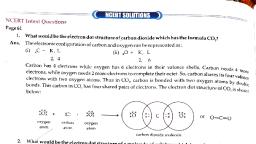
NCERT IN-TEXT QUESTIONS SOLVED, Q1. What would be the electron dot structure of carbon dioxide which has the formula CO2?, Ans. The electron dot structure of CO2 is, , Q2. What would be the electron dot structure of a molecule of sulphur which is made up of, eight atoms of sulphur?, , Q3. How many structural isomers can you draw for pentane?, Ans. Three structural isomers can be drawn from pentane., Pentane : C5H12, , n-Pentane, , Iso-Pentane, , Neo-Pentane, , Q4. What are the two properties of carbon which lead to the huge number of carbon, compounds we see around us?, Ans. Carbon form large number of compounds due to the following properties:, (a) Catenation → Carbon shows the property of catenation that is the ability to, form bonds with other carbon atoms forming long chains both branched and, unbranched chains, and even rings.
Page 7 :
(b) Tetravalency → Carbon has valency 4, it is capable of bonding with 4 other carbon, atoms or atoms of other non-covalent elements, giving rise to compounds with, specific properties depending on the elements present in the compound., (c) Isomerism → Carbon compounds show the property of isomerism that is, compounds having same molecular formula but different structural formula., Q5. What would be the formula and electron dot structure of cyclopentane?, Ans. The formula of cyclopentane is C5H10., The electron dot structure is, , H H, , C, H, H, , H, , C, , C, , H, H, , C, , C, , H, H, , H, , Q6. Draw the structures for the following compounds., (i) Ethanoic acid, (ii) Bromopentane, (iii) Butanone, (iv) Hexanal, Are structural isomers possible for bromopentane?, Ans., , (i) Ethanoic acid CH3COOH, , (ii) Bromopentane C5H11Br, , (iii) Butanone C2H5COCH3, , (iv) Hexanal [C5H11CHO], Isomers of Bromopentane, H, , H H H, , H H, , C, , C, , C, , Br H, , H, , C, , H H, , C, , 3-Bromopentane, , H
Page 8 :
Q7. How would you name the following compounds:, (i) CH3—CH2—Br, , (ii), , (iii), Ans., , (i) Bromo ethane, , (ii) Methanal, , (iii) Hex-1-yne, Q8. Why is the conversion of ethanol to ethanoic acid an oxidation reaction?, Ans. Conversion of ethanol to ethanoic acid is an oxidation reaction because oxygen is, added to ethanol to convert it to ethanoic acid., CH3 – CH2OH, Ethanol, , Alk.KMnO +heat, , 4, ⎯⎯⎯⎯⎯⎯⎯⎯⎯, ⎯, →, (or)Acidified K Cr O +heat CH3COOHd, 2, , 2 7, , Ethanoic aci, , In the above reaction alk. KMnO4/acidified K2Cr2O7 add oxygen to ethanol hence, they are called oxidising agent., Q9. A mixture of oxygen and ethyne is burnt for welding. Can you tell why a mixture of, ethyne and air is not used?, Ans. If air is used, incomplete combustion will take place giving a sooty flame and less, heat is produced. When pure oxygen is used ethyne burns completely producing large, amount of heat and blue flame. This heat is sufficient for a metal to melt and welding, is done., Q10. How would you distinguish experimentally between an alcohol and a carboxylic acid?, Ans. (a) Acid test: Reaction with carbonates/hydrogen carbonates., Take samples of alcohol and carboxylic acid in 2 test tubes, and add sodium, carbonate or sodium bicarbonate solution to each. The compound which will, produce brisk effervescence of CO2 gas will be acid., (b) Alcohol test: Take small amount of ethanol and ethanoic acid in test tube A and, B. Add 5% solution of alkaline potassium permanganate drop by drop to this, solution and warm the test tube., The colour of potassium permanganate will disappear in test tube containing alcohol., Q11. What are oxidising agents?, Ans. The compounds which add oxygen to other substance are known as oxidising agent., For example, alkaline potassium permanganate solution and acidified potassium, dichromate, both can convert alcohol into carboxylic acid, i.e., ethanoic acid., Alk. KMnO +heat, , 4, CH3COOH + H2O, CH3 – CH2OH ⎯⎯⎯⎯⎯⎯⎯⎯⎯→, Acidified K Cr O +heat, , Ethanol, , 2, , 2 7, , Ethanoic acid
Page 9 :
Q12. Would you be able to check if water is hard by using detergent?, Ans. No, because detergent forms lather in both, hard and soft water., Q13. People use variety of methods to wash clothes. Usually after adding the soap, they ‘beat’ the, clothes on a stone, or beat it with a paddle, scrub with a brush or the mixture is agitated in, a washing machine. Why is agitation necessary to get clean clothes?, Ans. Soap lowers the surface tension of water. The long chain non-ionic hydrocarbon group, in soap gets attached to the oil or grease droplets and loosens them from the fibres, of cloth along with the dirt. However this loosening is insufficient to remove the, grease with dirt completely. Hence the clothes are agitated to remove the grease droplets, completely., , QUESTIONS FROM NCERT TEXTBOOK, Q1. Ethane, with the molecular formula C2H6 has, (a) 6 covalent bonds., , (b) 7 covalent bonds., , (c) 8 covalent bonds., , (d) 9 covalent bonds., , Ans. (b) 7 covalent bonds., Q2. Butanone is a four-carbon compound with the functional group, (a) carboxylic acid., , (b) aldehyde., , (c) ketone., , (d) alcohol., , Ans. (d) ketone., Q3. While cooking, if the bottom of the vessel is getting blackened on the outside, it means, that, (a) the food is not cooked completely., , (b) the fuel is not burning completely., , (c) the fuel is wet., , (d) the fuel is burning completely., , Ans. (b) The fuel is not burning completely., Q4. Explain the nature of the covalent bond using the bond formation in CH3Cl., Ans. Bond formation in CH3Cl, , Carbon forms single covalent bond by sharing one electron pair with three hydrogen, atoms and one chlorine atom. Chlorine being more electronegative adds polar nature, to C—Cl bond., Q5. Draw the electron dot structure for, (a) ethanoic acid., , (b) H2S., , (c) propanone., , (d) F2.
Page 10 :
Ans. The electron dot structure are as follows:, (a) Ethanoic acid – CH3COOH, , (b) H2S, , (c) Propanone, , (d) F2, Q6. What is an homologous series? Explain with an example., Ans. It is a group of members of same class of organic compound having similar chemical, properties, they have same general formula., They have same functional group, when arranged in the ascending order of molecular, mass they differ by 14 a.m.u. or —CH2 group., Example: Alkane, General formula — CnH2n+2, Methane, CH4 ⎫, –CH2, Ethane, C 2H6 ⎬, ⎭, Propane, C 3H8, Butane, C 4H10, Q7. How can ethanol and ethanoic acid be differentiated on the basis of their physical and, chemical properties?, Ans. Physical Properties, Ethanoic acid, , Ethanol, , 1. Pungent smell, , Pleasant smell, , 2. Melting point 290 K, , M.P. is 156 K, , 3. Boiling point 391 K, , B.P. is 351 K, , Chemical Properties, Ethanoic acid, 1. Ethanoic acid + Sodium, , Ethanol, No CO2 gas produced., , bicarbonate gives CO2 gas., 2. On addition of alk. KMnO4 the, colour does not disappear., , On addition of alk. KMnO4, the colour disappear.
Page 11 :
Q8. Why does micelle formation take place when soap is added to water? Will a micelle be, formed in other solvents such as ethanol also?, Ans. Soap molecules have two ends with different properties. One end is hydrophilic, which, dissolves in water and other end is hydrophobic, it dissolves in hydrocarbons. When, soap is added to water, the ionic end of soap will form a unique orientation and keep, the hydrocarbon tail away from it., The cluster of molecules is formed in which the hydrophobic tails are in the interior, of the cluster and the ionic ends are on the surface of the cluster. Hence, micelle, formation takes place., Soap is soluble in ethanol hence the micelle formation will not take place., , Q9. Why are carbon and its compounds used as fuels for most applications?, Ans. Carbon and its compounds undergo combustion to produce heat, the amount of heat, released can be handled and used so they are used as fuels for most applications., Q10. Explain the formation of scum when hard water is treated with soap., Ans. Hard water contains salts of calcium and magnesium. When soap molecule comes in, contact with these salts it forms a curdy white precipitate (compound insoluble in, water) called scum., Soap + Hard water ⎯→ scum, Q11. What change will you observe if you test soap with litmus paper (red and blue)?, Ans. Soap is alkaline in nature, hence it will turn red litmus into blue, blue litmus will, remain blue., Q12. What is hydrogenation? What is its industrial application?, Ans. When unsaturated hydrocarbons (double/triple bond) are reacted with hydrogen in, presence of a catalyst like nickel, the hydrogen gets added across the double/triple, bond and converts the unsaturated hydrocarbon into saturated hydrocarbon. Such, reaction is called addition reaction or hydrogenation., Example :, Industrial use: It is used to convert vegetable oil into vanaspati ghee., Ni, Vegetable oil + H2 ⎯⎯⎯⎯, 473K → Vanaspati ghee
Page 12 :
Q13. Which of the following hydrocarbons undergo addition reactions?, C2H6, C3H8, C3H6, C2H2 and CH4., Ans. Addition reaction takes place in unsaturated hydrocarbons., Hence C3H6 and C2H2 are unsaturated hydrocarbons and will show addition reaction., Q14. Give a test that can be used to differentiate chemically between butter and cooking oil., Ans. Butter is saturated compound and oil is unsaturated compound., Test, alk. potassium permanganate + Unsaturated → Pink colour disappear., (Pink colour), hydrocarbon, Therefore, when we add oil to a test tube containing alkaline potassium permanganate, solution, the pink colour of the solution disappear. Colour of alkaline potassium, permanganate will not disappear in the test tube containing butter., Q15. Explain the mechanism of cleaning action of soaps., Ans. Soap molecule has two ends, the charged end that gets attracted towards water is, called hydrophilic and the long carbon chain that repels water is called hydrophobic, end. When soap is dissolved in water, the carbon chain i.e., hydrophobic end gets, attracted towards the oil, dirt and grease. The hydrophilic end stays away from this., The micelle formation takes place., The tail entangles dirt, oil or grease, if required the agitation is done. Lot of rinsing is, a done with water so that water molecules attract charged (Na+) end and carries the, soap molecules with dirt attached to it and clean the clothes, utensils, etc., , MORE QUESTIONS SOLVED, I. MULTIPLE CHOICE QUESTIONS, 1. The isomeric pair is, (a) ethane and propane, , (b) propane and butane, , (c) ethane and ethane, , (d) butane and 2-methyl propane
Page 13 :
2. The structural formula of ethyl ethanoate, , (a), , (b), , (c), , (d), , 3. Which of the following is used to oxidise ethanol to ethanoic acid?, (a) Alkaline KMnO4, , (b) Conc. H2SO4, , (c) Acidified K2Cr2O7, , (d) All of above, , 4. The compound which gives a brisk effervescence with sodium metal and not with, sodium hydrogen carbonate is, (a) ethanol, , (b) ethanoic acid, , (c) both ethanoic acid and ethanol, , (d) none of these, , 5. Identify the product formed when methane reacts with chlorine in the presence of, sunlight is, (a) C2Cl 6, , (b) CH3Cl, , (c) CHCl4, , (d) None of these, , 6. Which is denatured spirit?, (a) ethanol only, , (b) ethanol and methanol (50%), , (c) ethanol and methanol (5%), , (d) methanol only, , 7. Drinking alcohol and driving may cause serious accidents. To discourage this, police, randomly test drivers for alcohol using a breath analyser. The breath analyser works, because, (a) Alcohol makes the breath dry and the machine registers moisture, (b) Alcohol makes the breath hotter which changes the machine reading, (c) Alcohol causes more saliva which the machine checks., (d) Alcohol in the breath cause a chemical change registered by the machine., 8. Tertiary butane gets oxidised with oxidising agents like alkaline KMNO4 to, (a) Isobutane, , (b) Ter-butyl alcohol, , (c) Secondary-propyl alcohol, , (d) All of above, , 9. According to IUPAC system, the correct name of the organic compound is, , (a) 2-bromobutanoic acid, , (b) 2-bromobutysis acid, , (c) 3-bromobutanoic acid, , (d) 3-bromo-2-hydroxybutan-2-one
Page 14 :
10. The substance not responsible for the hardness of water is, , 11., , 12., , 13., , 14., , 15., , 16., , 17., , (a) sodium nitrate, (b) calcium hydrogen carbonate, (c) calcium carbonate, (d) magnesium carbonate, The by product of soap is, (a) isoprene, (b) glycerol, (c) butene, (d) ethylene glycol, Covalent compounds, (a) have high melting and boiling points, (b) are mostly soluble in water, (c) are formed between atoms of metals and non-metals, (d) are formed by the sharing of electrons in the bonding atoms., The heteroatoms present is, CH3 – O – CH2 – CH2 (Br), (a) oxygen, (b) carbon, (c) hydrogen, (d) bromine, Vinegar is a solution of, (a) 30% – 40% acetic acid in alcohol (b) 5% – 8% acetic acid in alcohol, (c) 5% – 8% acetic acid in water, (d) 15% – 20% acetic acid in water, Which of the following can be used for the denaturation of ethyl alcohol?, (a) Methyl alcohol, (b) Pyridines, (c) Copper sulphate, (d) All of above, Soaps are formed by saponification of, (a) alcohols, (b) glycosides, (c) simple esters, (d) carboxylic acids, The correct electron dot structure of a water molecule is, (a), , (b), , (c), , (d), , 18. Acetic acid was added to a liquid X kept in a test tube. A colourless and odourless gas, Y was evolved. The gas was passed through lime water which turned milky. It was, concluded that:, (a) Liquid X is sodium hydroxide and the gas Y is CO2, (b) Liquid X is sodium carbonate and the gas Y is CO2, (c) Liquid X is sodium acetates and the gas Y is CO2, (d) Liquid X is sodium chloride and the gas Y is SO2., 19. For gas welding used for welding broken pieces of iron, we normally use a mixture of, (a) Ethane and oxygen, (b) Ethene and oxygen, (c) Ethyne and oxygen, (d) Ethene and air
Page 15 :
20. Identify the compound that undergoes bromination reaction:, | |, –C–C–, (a), | |, , | |, (c) – C – C – C, | |, , | | |, –C–C–C–, (b), | | |, , C–, , (d) All of above, , 21. Bromine reacts with saturated hydrocarbon at room temperature in the, (a) absence of sunlight, (b) presence of water, (c) presence of sunlight, (d) presence of hydrochloric acid, 22. The number of single and double bonds present in benzenes are, (a) 9 and 6, (b) 9 and 3, (c) 12 and 3, (d) 12 and 6, 23. Identify the correct way of numbering an organic compound (according to IUPAC), (a), , (b), , (c), , (d), , 24. Identify the functional group present in the following compound, , (a) aldehyde, (b) bromine, (c) carboxylic, (d) both bromine and carboxylic group, 25. The upper and lower homologue of C2H5OH are respectively, (a) methyl alcohol and butyl alcohol (b) ethyl alcohol and propyl alcohol, (c) butyl alcohol and propyl alcohol (d) propyl alcohol and methyl alcohol, 26. Which is not true about homologous series?, (a) They have same general formula. (b) They differ from other by CH3 group., (c) They have same functional group. (d) They have same chemical properties.
Page 16 :
27. Name the following aromatic compound, , (a) toluene, (b) aniline, (c) phenol, (d) furan, 28. Ethanoic acid was added to sodium carbonate solution and the gas evolved was tested, with a burning splinter. The following four observations were reported. Identify the, correct observation., (a) The gas burns with pop sound and the flame gets extinguished, (b) The gas does not burn but the splinter burns with pop sound, (c) The flame extinguishes and the gas does not burn, (d) The gas burns with a blue flame and the splinter burns brightly, 29. Which of the following is not a straight chain?, (a) CH 3 − CH 2 − CH 2 − CH 2, |, CH 3, , (b) CH3 – CH2 – CH2 – CH2 – CH3, , CH 3, , CH 3, |, H, (c) 2 C − H 2 C − CH 2 − CH 3, , \, CH − CH 2 − CH 3, , (d), /, H3C, , 30. The general formula for alkanes is C nH2n+1–CHO. The value of ‘n’ for the first, member., (a) 1, (b) 0, (c) 0.5, (d) 1.1, 31. An organic compound ‘X’ has the molecular formula C3H6O2. It has a pleasant smell, but does not turn blue limus red. It has structural formula, , O, ||, (a) H3C− C − OH, , (b) CH3 − C − O CH3, , ||, O, (c) both (a) and (b), , (d) None of the above
Page 17 :
Answers, 1., 8., 15., 22., 29., , (d), (b), (d), (b), (d), , 2., 9., 16., 23., 30., , (b), (c), (c), (a), (b), , 3., 10., 17., 24., 31., , (d), (a), (c), (d), (b), , 4., 11., 18., 25., , (a), (b), (b), (d), , 5., 12., 19., 26., , (b), (d), (a), (b), , 6., 13., 20., 27., , (c), (d), (d), (a), , 7., 14., 21., 28., , (b), (c), (c), (c), , II. VERY SHORT ANSWER TYPE QUESTIONS (1 Mark), Q1. What is a hydrocarbon?, Ans. It is a compound of hydrogen and carbon., Q2. Give different forms in which carbon occurs in nature., Ans. Carbon occurs in free form e.g., graphite and diamond in combined form like carbon, dioxide, carbonates, etc., In earth’s crust–0.02% and in atmosphere–0.03%., Q3. Name two types of hydrocarbon., Ans. Hydrocarbon – Saturated and unsaturated., Q4. What are covalent bonds?, Ans. Bond which are formed by sharing of a pair of electrons between two atoms is called, covalent bonds., Q5. What is catenation?, Ans. Carbon has the unique ability to form bonds with the other atoms of carbon which, gives rise to large molecules. This property of self linking is called catenation., Q6. Name two allotropes of carbon., Ans. Two allotropes are – Crystalline and amorphous, Crystalline form – Diamond and graphite., Amorphous form – Charcoal, coal, coke., Q7. Why covalent compounds have low melting and boiling points?, Ans. As the bond is formed by sharing of electrons between two atoms. Intermolecular, forces are small between the covalent compounds. These bonds break easily., Q8. Define oxidising agents., Ans. Some substances are capable of adding oxygen to others. These substances are known, as oxidising agents., Example: alkaline KMnO4 and acidified K2Cr2O7., Q9. Give the reaction to show how alcohol is converted into carboxylic acid., alk. KMnO4 + heat, , ⎯, → CH3COOH, Ans. CH3 — CH2OH ⎯⎯⎯⎯⎯⎯⎯, acidified K Cr O, Alcohol, , 2, , 2 7, , Carboxylic acid
Page 18 :
Q10. Identify the compound, , Ans. Propyne., Q11. Name the compound, , Ans. Benzene, C6H6., Q12. Give two properties of ethanol., Ans. (a) Liquid at room temperature, (b) Soluble in H2O in all proportions, Q13. Give the formula for the functional group of aldehyde., Ans., Q14. What are heteroatoms?, Ans. An element or group of elements which replaces one or more hydrogen (H) atoms, from hydrocarbon, such that valency of carbon remains satisfied., Example: CH4 ⎯→ CH3 – OH, Hence, —OH is a heteroatom., Q15. Define catalyst., Ans. Catalyst are substances that cause a reaction with a change in rate of reaction, without, itself undergoing any change., Example: Micelle acts as a catalyst to convert unsaturated hydrocarbon into, saturated hydrocarbon., Q16. Complete the following reaction:, , Ans.
Page 19 :
Q17. Give the full form of IUPAC., Ans. IUPAC → International Union of Pure and Applied Chemistry., Q18. How can esters be converted into soap?, Ans. By saponification reaction, by adding/reacting ester with NaOH., Q19. How can we convert CH3CH2OH into C2 H4 ?, Ans. By adding conc. sulphuric acid into it which acts as dehydrating agent and removes, water from it., Conc., → CH2==CH2 + H2O, CH3 – CH2OH ⎯⎯⎯⎯, H 2 SO4, , Q20. Give two properties of ionic compounds., Ans. (i) High melting point and high boiling point., (ii) Can conduct electricity., Q21. What is the melting point of acetic acid?, Ans. M.P. = 290 K., , Q22. Name the given compound, , ., , Ans. 2-Butanone., Q23. How can you convert ethene into ethane?, Ans. By adding hydrogen to ethene in the presence of a catalyst., Q24. What is addition reaction? Give one example., Ans. The process of adding hydrogen across the double bonds of unsaturated hydrocarbons, is called addition reaction., Ni, → H3C—CH3, For example : H2C==CH2 + H2 ⎯⎯⎯⎯, Catalyst, , Ethene, , Ethane, , Q25. What is esterification reaction?, Ans. The reaction in which alcohol reacts with carboxylic acid to produce a new compound, called ester is called esterification., Q26. Give two uses of methane gas., Ans. (i) It is used as a fuel (ii) It is the major component of biogas and CNG., Q27. What is isomerism?, Ans. A property in which a compound can exist in different structural formula but its, molecular formula remains the same., Q28. Why can’t we test hard water with detergents?, Ans. Detergents form lather with both hard and soft water hence we cannot distinguish, between them.
Page 20 :
Q29. What is hydrophilic?, Ans. The substance showing attraction towards water is called hydrophilic., Q30. Name the second member of alkyne series., Ans. Propyne, Q31. Give the names of the functional group, (i) —CHO, , (ii) —C==O, , Ans. (i) —CHO → Aldehyde, , (ii), , → Ketone, , Q32. The structural formula of an ester is, , H H O, , H H, , H C C C O C C, H H, , H, , H H, , Name the alcohol and the acid from which it would have been formed., Ans. Alcohol is C2H5OH ethanol, Acid is H3C—H2C—COOH propanoic acid., Q33. Give the IUPAC name of acetic acid and propyl alcohol., Ans. Acetic acid – Ethanoic acid, Propyl alcohol – Propanol, Q34. What will happen to the litmus solution in carboxylic acid?, Ans. Red litmus remains the same but blue litmus changes to red., Q35. Give the electron dot structure of CH3Cl and C2H2., Ans. CH 3Cl, , C2H2, Q36. Draw the electron dot structure of N2 and NH3., Ans. N2 ⎯→, , NH3 ⎯→, , x, x, , N, , xx, xx, xx, , N xx
Page 21 :
Q37. Why do soaps form scum when added to hard water?, Ans. Hard water contains carbonate and sulphate salts of magnesium or sodium ions which, react with the soap molecule to form a compound which is insoluble in water. Hence, soaps form scum with hard water., Q38. What happens when ethanol burns in air?, Ans. Ethanol burns to form carbon dioxide and water., Q39. Give the IUPAC name and write the functional group present in vinegar., Ans. Vinegar IUPAC name is acetic acid CH3COOH, Functional group –COOH, Q40. A compound has a molecular formula C2H6O. It is used as a fuel. Name the compound, and name its functional group., Ans. C2H6O is an alcohol, i.e. ethanol C2H5OH, Functional group is —OH., , III. SHORT ANSWER TYPE QUESTIONS (2 or 3 Marks), Q1. What is the reactive site in the given hydrocarbon? Write its name., H3C—CH2—CH==CH—CH3, Ans. The reactive site is at a place where double bond is present., Name of the compound is 2-pentene., Q2. What is the difference in the number of carbon and hydrogen atoms between two, successive members of a homologous series? Also give the difference in their atomic masses., Ans. The difference is of 1 carbon and two hydrogen atoms i.e., —CH2 and mass difference, is 14 a.m.u., Q3. Name the peculiar/specific chemical property exclusive in case of saturated hydrocarbons, and unsaturated hydrocarbons., Ans. Saturated hydrocarbons show substitution reaction in which hydrogen atom gets, substituted by other elements or atoms. Unsaturated hydrocarbons show addition, reaction, in which hydrogen atom gets added across the double bond or triple bond, of the compound., Q4. Why acetic acid is called glacial acetic acid?, Ans. Acetic acid has very low melting point i.e. 290 K, hence it freezes during winters in, cold countries. So it is called glacial acetic acid., Q5. Why does carbon forms large number of compounds?, Ans. Carbon forms large number of compounds because of tetravalency and catenation, property., Tetravalency – Carbon has valency 4, to attain noble gas configuration carbon share, its valence electrons with other elements like hydrogen, chlorine, etc., Catenation – Carbon also shows the property of self-linking in which it forms long,, branched or cyclic chains to form large number of compounds.
Page 22 :
Q6. Write the structural formula for bromopentane and ethanoic acid., Ans. Bromopentane (C5H12Br), , Ethanoic acid (CH3COOH), , H O, , H H H H H, , H C C OH, , H C C C C C Br, , H, , H H H H H, , Q7. How does ethanoic acid react with carbonates and hydrogen carbonates? Show it with, the equation., Ans. Ethanoic acid reacts with carbonates and hydrocarbonates to form salt, CO2 and H2O., The salt formed is sodium acetate., 2CH3COOH + Na2CO3 ⎯→ 2CH3COONa + H2O + CO2, CH3COOH + NaHCO3 ⎯→ CH3COONa + H2O + CO2, Q8. Draw the structures of two isomers of butane., Ans. Butane C4H10, , H H H H, H C C C, (i), , C H, , H H H H, , H, , H, , H, , H C, , C, , C, , H, (ii), , n-butane, , H, , H, , H C H, , H, iso-butane, , Q9. A student burns a hydrocarbon in air and obtains sooty flame. Give two reasons for this, observation., Ans. Sooty flame could be obtained due to, (i) Incomplete combustion of saturated hydrocarbons., (ii) Combustion of unsaturated hydrocarbon., Q10. Differentiate between saturated and unsaturated hydrocarbons. Give one example for, each., Ans., , Saturated hydrocarbon, , Unsaturated hydrocarbon, , 1. It consist of single bond in, carbon–carbon., , Double or triple bond in carbon–carbon, is present., , 2. It burns with blue flame., , It burns with sooty flame., , 3. Show substitution reaction, , Show addition reaction., , 4. Less reactive, Eg. CH4 Methane, C2H6 Ethane, , More reactive, E.g. H2C=CH2 Ethene, HC≡≡CH Ethyne
Page 23 :
Q11. Write the general formula for each of the following hydrocarbons and give one example, for each., (i) Alkene, (ii) Alkyne, Ans. (i) Alkene CnH2n e.g., C2H4 ethene, (ii) Alkyne CnH2n–2 e.g., C2H2 ethyne, Q12. Name the functional groups of the following:, O, , (a) CH3—Cl, , &, , (b), , CH3— C –OH, , (d), , C2H5OH, , O, &, , (c) CH3— C – CH3, , Ans. (a) Chloro (Halogen), (b) Carboxylic acid, (c) Ketone, (d) Alcohol, Q13. Explain substitution reaction with example., Ans. The reaction of saturated hydrocarbon with chlorine in which each hydrogen atom, slowly gets substituted with chlorine atom is called substitution reaction., CH 4 + Cl 2 ⎯⎯→ CH3Cl + HCl, Methane, , Chlorine, , Methyl, chloride, , Hydrochloric, acid, , Q14. Diamond and graphite show different physical properties although they are made up of, carbon and shows same chemical properties. What is this property called?, Ans. This property is allotropy., The physical properties are different because the carbon-carbon bonding in both the cases, varies. In diamond one carbon atom is bonded with four other carbon atoms with strong, covalent bond so it is hard, while in case of graphite each carbon forms two strong bonds, with other two carbon atoms and one weak bond is formed with third carbon atom and, forms hexagonal rings which slide over each other, so it is soft., Q15. What is denatured alcohol?, Ans. When ethanol is mixed with methanol or some poisonous substances such as copper, sulphate, pyridine which makes it unfit for drinking such alcohol is called denatured, alcohol., Q16. What is esterification and give its uses?, Ans. It is the reaction in which esters are formed by reacting carboxylic acid with alcohol, in the presence of concentrated sulphuric acid., Carboxylic acid + alcohol ⎯⎯→ Ester + water, C2H5OH + CH3COOH ⎯⎯→ CH3COOC2H5 + H2O, Ethanol, , Ethanoic acid, , Ester, , Uses:(i) It is used as flavour in ice-cream and sweets., (ii) It is a sweet smelling substance.
Page 25 :
(ii) Ethanoic acid: On oxidation of ethanol with an oxidising agent like alkaline, KMnO4 or acidified K2Cr2O7, ethanoic acid is formed., alk. KMnO, , 4, → CH COOH, CH3—CH2OH ⎯⎯⎯⎯⎯⎯⎯, 3, acidified K Cr O, 2, , 2 7, , ethanoic acid, , (iii) Ester: To get esters, ethanol is reacted with any carboxylic acid., acid, Example: C2H5OH + CH3COOH ⎯⎯⎯, → CH3COOC2H5 + H2O, , Ethanol, , Ethanoic acid, , Ester, , The above reaction takes place in the presence of an acid., Q21. Write the chemical equations for the following reactions:, (i) Conversion of oils into fats, , (ii) Oxidation of ethanol, , (iii) Ethanoic acid with sodium hydroxide., , Ans. (i), , (ii) Oxidation of ethanol, alk. KMnO, , 4, → CH3COOH, C2H5OH ⎯⎯⎯⎯⎯, , Ethanol, , Ethanoic acid, , (iii) CH3COOH + NaOH ⎯→ CH3COONa + H2O, Ethanoic acid, , Sodium, hydroxide, , Sodium, acetate, , Q22. An organic compound ‘X’ which is also called antifree mixture has the molecular formula, C2H6O ‘X’ on oxidation gives a compound ‘Y’ which gives effervescence with a baking soda, solution. What can X and Y be? Write their structural formula., Ans. X is ethanol, (C2H5OH), Y is ethanoic acid (CH3COOH), Structural formula, , H H, , H O, , Ethanol H C C OH, , Ethanoic acid H C C OH, , H H, , H, , Q23. Write the structures of isomers of hexane., , H H H H H H, Ans. (i) H C C C, , C C, , C H, , H H H H H H, , n-Hexane
Page 26 :
H, , H, , H H, , H, , (ii) H C, , C, , C, , C H, , H, , H C H, , C, , H H, , 2-Methyl pentane, , H, , H, , H, , H, , H, , H H, , (iii) H C, , C, , C, , C, , C H, , 3-Methyl pentane, , H H C H H H, , H, , H, , H H H H, (iv) H C C C, , H, , C H, , 2, 3-Dimethyl butane, , H, CH3 CH3, CH3, , (v) H3C, , C, , CH2, , CH3, , 2, 2-Dimethyl butane, , CH3, Q24. Complete and balance the following equations:, (a) CH3CH2OH + O2 ⎯→, (b) Na + CH3CH2OH ⎯→, (c) CH3–CH2OH, Ans. (a) 2CH3CH2OH + 6O2 ⎯⎯→ 4CO2 + 6H2O + heat + light, (b) 2Na + 2CH3CH2OH ⎯⎯→ 2CH3CH2ONa + H2, conc. H SO, , 4, 2, (c) CH3–CH2OH ⎯⎯⎯⎯⎯→, H2C==CH2 + H2O, , Q25. Give two uses of ethanol and one harmful effect of it., Ans. Ethanol is a good solvent so it is used in making medicines such as tincture iodine,, cough syrups and many tonics. Ethanol is also used in making alcoholic drinks., Harmful effects: Intake of small amount of ethanol leads to drunkenness. Intake of, even small amount of ethanol can be lethal. Long-term use or consumption can lead, to severe health problems., Q26. (a) Why are covalent compounds generally poor conductors of electricity?, (b) Name the following compound:
Page 28 :
(b) Take two test tubes, add ethanol and ethanoic acid in test tube A and B, respectively. Add sodium carbonate/sodium hydrogen carbonate solution in both, the test tubes, the test tube which will produce brisk effervescence of CO2 gas will, contain ethanoic acid. Ethanol do not evolve CO2 gas when reacted with Na2CO3/, NaHCO3., (c) When an organic acid reacts with an alcohol in presence of an acid as catalyst, it, produces fruity smelling compound called ester. Such a reaction is called, esterification., Conc. H2SO4, Example: CH3COOH + C2H5OH ⎯⎯⎯⎯⎯, → CH3COOC2H5 + H2O, Q29. (a) Name the compound CH3COOH and identify its functional group., (b) Give a chemical test to identify this compound., (c) Name the gas evolved when this compound acts on solid sodium carbonate. How, would you identify this gas?, (AI CBSE 2008 C), Ans. (a) Ethanoic acid, functional group is—COOH (Caboxylic/group), (b) Take few drops of ethanoic acid in a test tube and add sodium hydrogen carbonate, solution to it. Brisk effervescence of CO2 gas is formed., (c) CO2 gas is evolved. To identify the gas, pass it through freshly prepared limewater, it turns milky due to the formation of milky white precipitate of CaCO3., Ca(OH)2 + CO2 ⎯⎯→ CaCO3 + H2O, White ppt., , Q30. (a) Give a chemical test to distinguish between saturated and unsaturated hydrocarbons., (b) (i) Name the products formed when ethanol burns in air., (ii) What two forms of energy are liberated on burning alcohol?, (c) Why is the reaction between methane and chlorine considered a substitution reaction?, (AI CBSE 2008 C), Ans. (a) On adding bromine water, the unsaturated hydrocarbon decolourises the bromine, water but the saturated hydrocarbon will not decolourise bromine water., (b) (i) Ethanol burns in air to produce carbon dioxide and water., C2H5OH + 3O2 ⎯⎯→ 3CO2 + 3H2O + heat, (ii) Two forms of energy obtained are heat energy and light energy., (c) When methane reacts with chlorine, the hydrogen atom of methane is replaced by, chlorine atom step by step and hence it is termed as substitution reaction., CH4 + Cl2 ⎯⎯→ CH3Cl + HCl, Q31. Give reason for the following observations:, (a) The element carbon forms a very large number of compounds.
Page 29 :
(b) Air holes of a gas burner have to be adjusted when the heated vessels get blackened by, the flame., (c) Use of synthetic detergents causes pollution of water., , (CBSE 2009), , Ans. (a) Carbon forms large number of compounds due to its property of catenation, i.e., self linking. They form isomeric compounds i.e. compounds with same molecular, formula but different structural formula., (b) The vessels blacken due to deposits of black carbon particles on it which is caused, due to incomplete combustion of fuel. Air holes are adjusted so that air enters, through the holes and helps in complete combustion of the fuel., (c) Synthetic detergent is non-biodegradable, it remains in the water thereby causing, water pollution., Q32. (a) What is a ‘homologous series’ of substances?, (b) In an organic compound, which parts largely determine its physical and chemical, properties?, (c) Write a chemical equation to represent the reaction of ethanol with acidified solution, of potassium dichromate., (AI CBSE 2009), Ans. (a) Homologous series is a series of organic compounds having same general formula,, all members of the compounds show same chemical properties and slight, gradation in physical properties., (b) Functional group., (c) CH3CH2OH + 2[O], Ethanol, , acidified, ⎯⎯⎯⎯⎯⎯, →, CH3COOH, K2Cr2O7, , + H2O, , Ethanoic acid, , Q33. (a) What is vinegar?, (b) Describe with a chemical equation, what happens when sodium hydrogen carbonate, reacts with ethanoic acid., (AI CBSE 2009), Ans. (a) The 5% – 10% aqueous solution of acetic acid is called vinegar., (b) CH3COOH + NaHCO3 ⎯⎯→ CH3COONa + H2O + CO2, Acetic acid, Sodium acetate, Ethanoic acid reacts with sodium bicarbonate to produce brisk effervescence of, CO2 gas and sodium acetate., Q34. (a) Write the names of the functional groups in:, (i), , (ii), , (b) Describe a chemical test to distinguish between ethanol and ethanoic acid., (c) Write a chemical equation to represent what happens when hydrogen gas is passed, through an unsaturated hydrocarbons in the presence of nickel as a catalyst., (CBSE 2009 F)
Page 31 :
Ans. (a) A = Alkaline KMnO4 or acidified K2Cr2O7, (b) B = CH3COOC2H5, (c) C = CH3COONa, (d) D = CH3COOH; E = CO2, (e) E = CO2; F = CaCO3, Q3. What are soaps? Explain the mechanism of the cleansing action of soaps? Soaps form scum, with hard water. Explain why? How this problem is overcome by use of detergents?, Ans. Soaps are sodium salts of fatty acids. It is biodegradable and shows cleansing action, by removing dirt., Mechanism of cleansing action: Soap has molecules with tadpole like structure., Na+, ion, Carbon chain, , Its head is made of Na + ion which is hydrophilic and long tail is made up of, hydrocarbon chain which is hydrophobic, it attracts the dirt and removes it. When, soap is added to water it forms micelles and helps in removing the dirt which sticks, to the carbon chain. On rinsing the cloth with water it helps in removing the dirt, as, Na+ is hydrophilic. It attracts water and carries its tail entangled with dirt and flows, away with water., Scum formation: Soaps form scum with hard water because hard water has salts, of calcium and magnesium which react with soap to form insoluble compound called, scum., In case of detergents, the salts present in hard water does not react with the molecules, of detergent to form insoluble compound called scum, but the molecules of detergent, remain as it is and helps in the cleansing action., Q4. (a) What do you mean by allotropy?, (b) What is isomerism?, (c) Give one example of homologus series, give two properties of it., (d) What is the full form of IUPAC?, Ans. (a) Allotropy: It is the property of an element in which element show same chemical, properties but different physical properties, due to difference in the bonding of, atoms., Example: Diamond and graphite are having same chemical properties but they, look/appear to be physically different as the bonding in both differs., C C, C, C, C, C C, , C, , C, , C, , C, , Diamond, , C, , C, , C, , C, , C, , Graphite, , C
Page 32 :
(b) Isomerism: It is the property of hydrocarbons which show same molecular, formula but exhibits different structural formulae., Example: Butane, , H H, , C3 H, , C C CH3, , n-butane, , H H, H3C, , CH, , CH3, , iso-butane, , CH3, Both of them show different properties., (c) Homologous series: When the members of a hydrocarbon family obey same, general formula they are said to be in homologous series. When the members are, arranged in increasing order of their molecular masses:, Example: Alkane – CnH2n+2, CH 4, , — Methane, , C 2H6, , — Ethane, , C 3H8, , — Propane, , C 4H10 — Butane, Properties:, (i) The difference between two consecutive members of homologous series is of, —CH2 and mass 14 a.m.u., (ii) They all show same chemical properties and slight gradation in their physical, properties., (d) IUPAC: International Union of Pure and Applied Chemistry., Q5. (a) What are hydrocarbons?, (b) Give difference between saturated and unsaturated hydrocarbons., (c) Why does carbon form large number of compounds?, Ans. (a) Hydrocarbons – A compound of carbon and hydrogen., (b), , Saturated, , Unsaturated, , 1. C—C single bond, , C==C, C≡≡C double or triple bond., , 2. Alkanes CnH2n+2, , Alkenes CnH2n, and Alkynes CnH2n–2, , 3. Undergo substitution reaction, , Undergo addition reaction, , 4. Burns with blue flame, , Burns with sooty flame, , (c) Carbon forms large number of compounds due to, (i) Catenation – Self linking property which leads to long straight chains,, branched chains and cyclic chains.
Page 33 :
(ii) Isomerism – Compound of carbon can exist in more than one structural, formula but has same molecular formula., (iii) Tetravalency – To acquire noble gas configuration, carbon shares its outer, electrons with other elements, thus form covalent bond with other elements., Q6. (a) Why does carbon form compounds mainly by covalent bonding?, (b) List any two reasons for carbon forming a very large number of compounds., (c) An organic acid ‘X’ is a liquid which often freezes during winter time in cold countries,, has the molecular formula, C2H4O2. On warming it with ethanol in the presence of a, few drops of concentrated sulphuric acid, a compound ‘Y’ with a sweet smell is formed., (i) Identify ‘X’ and ‘Y’., (ii) Write a chemical equation for the reaction involved., , (CBSE 2008), , Ans. (a) Carbon forms compounds mainly by covalent bonding because carbon has small, size, so neither it can loose four electrons easily, because very high amount of, energy will be required, nor it can gain four electrons. Hence, it shares four, electrons forming covalent bonds., (b) (i) Due to catenation – Self linking property, (ii) Tetravalency of carbon – Forms compounds with other elements., (c) (i) ‘X’ is CH3COOH, it freezes during winter in cold countries., ‘Y’ is ester CH3COOC2H5, Conc. H2SO4, (ii) CH3COOH + C2H5OH ⎯⎯⎯⎯⎯, → CH3COOC2H5 + H2O, Ethanoic acid Ethanol, Ester, , Q7. (a) What is homologous series of compounds? List any two characteristics of a homologous, series., (b) (i) What would be observed on adding 5% solution of alkaline potassium permanganate, solution drop by drop to some warm ethanol taken in a test tube?, (ii) Write the name of the compound formed during the chemical reaction., (c) How would you distinguish experimentally between an alcohol and a carboxylic acid, on the basis of a chemical property?, (CBSE 2008), Ans. (a) Organic compounds when arranged in series having same general formula and, similar chemical properties is called homologous series., Two characteristics of homologous series., (i) Each successive member differ by —CH2 group, 14 u., (ii) The method of preparation and chemical properties of members of, homologous series is same.
Page 34 :
(b) (i) The colour of KMnO4 will get discharged because ethanol gets oxidised to, form ethanoic acid., alk. KMnO4, CH3CH2OH + 2(O) ⎯⎯⎯⎯⎯, → CH3COOC2H5 + H2O, , (ii) Ethanoic acid, (c) On adding sodium bicarbonate solution to both the test tubes containing ethanol, and ethanoic acid then the test tube containing carboxylic acid (ethanoic acid), will show brisk effervescence due to formation of CO2 gas. Alcohol will not react, with sodium bicarbonate., Q8. (a) What is a functional group in a carbon compound? Identify the functional group, present in CH3COOH and C2H5OH., (b) State the principle on which the cleansing action of soap is based., , (CBSE 2008 F), , Ans. (a) The atom or group of atoms which determines the properties of a compound is, called functional group., — OH is alcohol group, — COOH is carboxylic group, (b) Cleansing action of soap depends on its structure, it has two ends hydrophobic, which attracts dirt, oil or grease and hydrophilic end which attracts water., , The dirt is carried by hydrophobic portion which is attached to hydrophilic end, which gets attached to water and is washed away., Q9. (a) What is homologous series? Give one example., (b) What will happens if ethanoic acid reacts with ethanol in the presence of an acid as, a catalyst? Name the reaction. Write the chemical reaction for this reaction., (c) Why are soaps ineffective in hard water?, , (CBSE 2008 C), , Ans. (a) Homologous series is series of compounds having same functional group and same, chemical properties. When members of the series are arranged in ascending order,, two successive members differ by –CH2 group and mass 14 u., Example :, , Alcohol, CH3OH, C2H5OH, , CH2 mass 14. a.m.u, , C3H7OH, (b) Ethanol reacts with ethanoic acid to produce a fruity smelling compound called, ester, the conc. sulphuric acid is used as dehydrating agent which removes water., Such reaction is called esterification.
Page 35 :
Example:, , (c) Hard water contains salts of Ca and Mg. Soap molecule reacts with these salts to, produce white precipitate called scum, which is insoluble in water and the, cleansing action of soap becomes ineffective., Q10. (a) Distinguish between esterification and saponification reactions of organic compounds., (b) With a labelled diagram describe an activity to show the formation of an ester., (AI CBSE 2009), Ans. (a) Esterification: Reaction in which carboxylic acid reacts with alcohol in presence, of conc. H2SO4 to form a fruity smelling compound called ester., Conc. H2SO4, CH3COOH + C2H5OH ⎯⎯⎯⎯⎯⎯, → CH3COOC2H5 + H2O, , Ethanoic acid, , Ethanol, , Ester, , Saponification: It is a reaction in which an ester reacts with alkali solution to, form a compound called soap., CH3COOC2H5 + NaOH ⎯⎯→ CH3COONa + C2H5OH, Ester, , Sodium, hydroxide, , Sodium, ethanoate, , Ethanol, , (b) Activity to show the formation of an ester: Take a test tube and add, ethanol, acetic acid and few drops of conc. H2SO4 in it. Warm it over a water, bath, i.e., keeping the test tube in a beaker containing water. Pleasant, fruity, smelling compound called ester is formed., Conc. H2SO4, CH3COOH + C2H5OH ⎯⎯⎯⎯⎯⎯, → CH3COOC2H5 + H2O
Page 36 :
Q11. (a) The structural formula of an ester is, , Write the structural formula of the corresponding alcohol and the acid., (b) (i) Mention the experimental conditions involved in obtaining ethene from ethanol., (ii) Write the chemical equation for the above reaction., (c) Explain the cleansing action of soap., Ans. (a) CH3COOH, Ethanoic acid, , (CBSE 2009 F), , and CH3CH2OH, Ethanol, , (b) (i) Ethanol when heated in presence of conc. H2SO4, it gets dehydrated to form, ethene at 160°C – 170°C., Conc. H SO, , 4, 2, ⎯, → H2C = CH2 + H2O, (ii) C2H5OH ⎯⎯⎯⎯⎯⎯, 160°C – 170°C, , (c) Cleansing action of soap: Soap consists of two ends, long chain of hydrocarbon, is called hydrophobic which repels water and attracts dirt and grease. The other, end is hydrophilic which attracts water., When soap is added to water it forms micelle structure as shown below., , The tail of the soap sticks to the dirt inwards and the head points outward. When, water is agitated, the dirt sticks to more number of soap molecules. On lot of, rinsing with water, the water washes away soap molecule with dirt attached to it., , V. QUESTIONS ON HIGH ORDER THINKING SKILLS (HOTS), Q1. A, B, C are members of homologous series their melting points are –183°C, –138°C, 130°C, respectively. Among these, (i) Which member will have least number of carbon atoms?, (ii) Which member will have maximum number of carbon atoms?, Ans. (i) A will have least number of carbon atoms., (ii) C will have maximum number of carbon atoms., Q2. A hydrocarbon compound A is active ingredient of wine and cough syrup. A on oxidation, with acidified K2Cr2O7 forms compound B. Identify the compound A and B and write the, chemical equations involved.
Page 37 :
Ans. A is ethanol, C2H5OH, B is ethanoic acid, CH3COOH, acid K Cr O, , 2 2 7, ⎯, → CH3COOH, Equation : C2H5OH ⎯⎯⎯⎯⎯, , Q3. Write an activity to show the acidic nature of ethanol. Give the chemical equation of the, reaction taking place., Ans. Take ethanol in a test tube and drop a small piece of sodium about the size of a grain, of rice into it. The reaction evolves a colourless gas which is hydrogen., Hydrogen gas can be tested by bringing a burning splinter/match stick near the mouth, of the test tube, it burns with the popping sound., This activity proves that ethanol like other acids release H2 gas, 2Na + 2CH3CH2OH ⎯⎯→ 2CH3CH2ONa + H2, Q4. A compound ‘X’ has molecular formula C2H6O is saturated hydrocarbons and is a very, good solvent. How can you convert it into unsaturated hydrocarbon? Identify X and show, its conversion with the help of equation., Ans. ‘X’ is CH3—CH2OH ethanol. It can be made unsaturated by heating it with conc., H2SO4 which is a dehydrating agent removes water from it, thereby forming ethene., Hot conc., → H2C==CH2 + H2O, CH3—CH2OH ⎯⎯⎯⎯, H2SO4, , Ethanol, , Ethene, , Q5. Take about 20 ml of castor oil in a, beaker. Add 30 ml of 20% sodium, hydroxide solution. Heat the mixture, with continuous stirring for a few, minutes till the mixture thickens. Add, 5–10 g of common salt to this. Stir the, mixture well, allow it to cool, soaps is, obtained., , A, , Soft, Water, , Hard, Water, , Oil, B, , C, , (a) Why do we use common salt to make soap?, (b) What will happen if you will add the above made soap solutions to the following test, tubes A, B, and C., (c) Can we use potassium hydroxide instead of sodium hydroxide., Ans. (a) Salt: NaCl is added while making soap, because it will help the reaction to occur, faster and adds sodium ion to increase the reaction rate., (b) In test tube A: Soap + Oil ⎯→ Lather/foam is formed. Carboxylic chain dissolves, in oil., In test tube B: Soap + Hard water ⎯→ Insoluble compound called scum is formed., In test tube C: Soap + soft water ⎯→ Froth is formed., (c) Yes, we can use potassium hydroxide to prepare soap.
Page 38 :
VI. VALUE-BASED QUESTIONS, Q1. A student reports the police about the illegal vending of alcohol near his school. He also, knew about denatured alcohol., (a) What is denatured alcohol?, (b) What would happen if somebody consumes denatured alcohol?, (c) What value is reflected by a student who reported the matter to police?, Ans. (a) Denatured alcohol is ethanol when added with poisonous methanol or copper, sulphate solution., (b) On drinking denatured alcohol a person may die., (c) Value reflected by student is society’s law and order., Q2. Suman always carried her tiffin box in a jute bag while most of her friends got it packed, in a poly bag., (a) What type of bonding is present in polythene?, (b) Give one advantage of carrying jute and disadvantage of poly bag., (c) Which value is reflected in Suman by using jute bag?, Ans. (a) In polythene, long chain of ethene is present – C = C –., (b) Jute bag is biodegradable and will not cause pollution. While poly bag is nonbiodegradable and causes pollution., (c) Suman shows the value of a responsible behaviour., Q3. Geeta helps her mother in washing clothes, toilets, balconies every Sunday. She uses the, leftover detergent water of washing machine to clean toilets., (a) Why is detergent used in washing clothes?, (b) Give one advantage of detergent over soap., (c) What value of Geeta is reflected in the above task?, Ans. (a) Detergents have strong cleansing ability and can remove oil and dirt from clothes, or other surfaces., (b) Soap cannot be used in hard water but detergents can be used in hard water., (c) Geeta is trying to reduce water pollution and water shortage problem. She also, shows helpful to her mother and responsible behaviour., , TEST YOUR SKILLS, Q1. Classify the following carbon compounds on the basis of the nature of flame obtained on, burning them., Camphor, Alcohol, Acetone and Naphthalene., Q2. Give the electron dot structure of CO2.
Page 39 :
Q3. Name the given compound:, H, |, H—C=O, Q4. How many covalent bonds are present in C2H6?, Q5. The physical properties of a carbon compound is – It has pungent smell, M.P. is 156 K, and B.P. is 351 K. Name the compound., Q6. What is hydrogenation? What is its industrial application?, Q7. Give a test that can be used to differentiate between ghee and oil., Q8. What is functional group? Identify the functional group present in CH3COOH and C2H5OH., Q9. Explain the mechanism of cleaning action of soaps., Q10. Complete the following equations:–, Conc. H2SO4, , (i) CH3CH2OH ⎯⎯⎯⎯⎯⎯→, Heat, , Sunlight, (ii) CH4 + Cl2 ⎯⎯⎯⎯⎯, →, Conc., , →, (iii) C2H5OH + CH3COOH ⎯⎯⎯⎯, H SO, 2, , 4, , Q11. (a) Give a chemical test to distinguish between saturated and unsaturated hydrocarbons., (b) Name the product formed when ethanol burns in air., (c) Why is the reaction between methane and chlorine considered as substitution reaction?