Notes of Class 12th Paid Batch, Chemistry amines.pdf - Study Material
Page 1 :
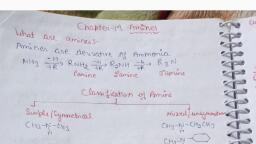
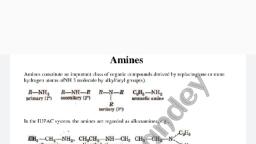
Amines, Recap Notes, AMINES, , In secondary and tertiary amines, when two, or more groups are the same, the prefix di, or tri is appended before the name of alkyl, group., , Amines : These are alkyl or aryl derivatives, of ammonia and are obtained by replacing, one, two or three hydrogen atoms by alkyl/, aryl groups., , Structure : Nitrogen orbitals in amines are, sp3-hybridised and the geometry of amines is, pyramidal. Due to the presence of unshared, pair of electrons, the angle C N E, (where, E is C or H) is less than 109.5°., , Nomenclature : In common system, an, aliphatic amine is named by prefixing alkyl, group to amine, i.e., alkylamine. In IUPAC, system, amines are named as alkanamines., Classification :, , Amines, , Aliphatic, , Aromatic, , Primary (1°) Amines, –NH2 group attached to, , Secondary (2°) Amines, NH group attached to, , one alkyl group (R—NH2), , two alkyl groups (R2NH), , Simple, Both alkyl groups, are same., (R2NH), , Mixed, Both alkyl groups, are different., (R′NHR), , Tertiary (3°) Amines, N group attached to three, alkyl groups (R3N), , Mixed, Simple, Either all three are different or, All three alkyl, groups are same. two are same, one is different, (R3N), (R′RR′′N or RRR′N), , Preparation :, :, :, :, :, :, :
Page 2 :
Limitations of Gabriel phthalimide, synthesis :, – It is used for the preparation of only, 1°° amines. tert-Butylamine is a 1°° amine,, but cannot be prepared by this method. In, this case, elimination takes place., – Aromatic amines cannot be prepared by, this method because aryl halides do not, undergo nucleophilic substitution reaction, with potassium phthalimide under mild, conditions., X, , Physical properties :, X, , Lower amines are gases and liquids but, higher amines are solids., , X, , Primary and secondary amines have, higher boiling points than other organic, compounds due to hydrogen bonding., , X, , Primary and secondary amines are, soluble in water due to hydrogen bonding, between NH2 and H2O molecules., , X, , Chemical properties :, X Basic character of amines :, – Amines are basic in nature due to the, presence of lone pair of electrons on, nitrogen atom., – Aliphatic amines are stronger bases than, ammonia due to +I effect of alkyl groups, present in amines., – Aromatic amines are weaker bases than, ammonia due to –I effect of aryl group., – Beside inductive effect, there are other, effects like steric effect, solvation effect,, resonance effect which affect the basic, strength of amines., – In gaseous phase, the order of basicity, of amines is 3°° amine > 2°° amine > 1°°, amine > NH3., – In aqueous phase, despite of inductive, effect, solvation effect and steric hindrance, also play an important role. Thus, the, order of basicity of amines is, (C2H5)2NH > (C2H5)3N > C2H5NH2 > NH3, and (CH3)2NH > CH3NH2 > (CH3)3N > NH3, , Chemical reactions :, , (Unpleasent smell), , X, , Identification of primary, secondary and tertiary amines :, Test, , Primary amine, , Secondary amine, , Tertiary amine, , 1., , Reaction with, nitrous acid., , Gives alcohol with, effervescence of N2, gas., , Gives oily, nitrosoamine which, gives Liebermann’s, nitrosoamine test., , Forms nitrite in cold, which is soluble in, water and on heating, gives nitrosoamine., , 2., , Reaction with, benzene sulphonyl, chloride, (Hinsberg’s reagent), , Gives N-alkylbenzene, sulphonamide which, is soluble in alkali., , Gives N,, N-dialkylbenzene, sulphonamide which, is insoluble in alkali., , No reaction, , 3., , Carbylamine test :, Reaction with, chloroform and, alcoholic KOH, , Forms carbylamine, or isocyanide (RNC), with characteristic, unpleasant odour., , No reaction, , No reaction
Page 6 :
28. Electrophilic substitution of aniline with, bromine- water at room temperature gives, (a) 2-bromoaniline, (b) 3-bromoaniline, (c) 2, 4, 6-tribromoaniline, (d) 3, 5, 6-tribromoaniline., 29. The decreasing order of boiling points, of ethyldimethylamine, n-butylamine and, diethylamine is, n-Butylamine > Diethylamine > Ethyldimethylamine., This trend of boiling point can be explained as, (a) boiling point increases with increase in, molecular mass, (b) tertiary amines have highest boiling point, due to highest basicity, (c) intermolecular hydrogen bonding is maximum, in primary amines and absent in tertiary, amines, (d) intramolecular hydrogen bonding is present, in tertiary amines., 30. Which of the following is used as Hinsberg’s, reagent?, (a) C6H5SO2Cl, (b) C6H5SO3H, (c) C6H5NHCH3, (d) C6H5COCH3, 31. Canonical structures of anilinium ion, obtained by accepting a proton are given below., Choose the correct statements., , (a) Anilinium ion has two stable canonical, structures I and III., (b) II is not an acceptable structure because, carbonium ion is less stable., (c) Only I and III are acceptable aromatic, canonical structures since II is non-aromatic., (d) Anilinium ion has three stable canonical, structures I, II and III., 32. Which of the following gas evolved when, methylamine reacts with nitrous acid?, (b) Cl2, (c) N2, (d) H2, (a) CH4, 33. What is obtained, reacts with aniline in, hydroxide?, (a) Benzoic acid, (c) Acetanilide, , when benzoyl chloride, the presence of sodium, (b) Benzanilide, (d) Azobenzene, , 34. Aniline can be converted into benzylamine, by which of the following processes in sequence?, , (a), (b), (c), (d), , NaNO2 + HCl, CuCN, H2/Ni, Br2/CCl4, KCN, LiAlH4, HNO2, K2Cr2O7/H+, Sn + HCl, CH3OH, KMnO4, OH–, H3+O, , 35. For a nitration of aniline, which of the, following steps is followed?, (a) Direct nitration using nitrating mixture, (conc. HNO 3 + conc. H 2 SO 4 ) followed by, oxidation., (b) Using fuming HNO3 carrying out reaction, at 273 K followed by hydrolysis., (c) Using NaNO2 and HCl followed by reaction, with conc. HNO3 followed by hydrolysis., (d) Acetylation followed by nitration and, hydrolysis., 36. What is the end product in the following, sequence of reactions?, , (a) Aniline, (b) Phenol, (c) Benzene, (d) Benzenediazonium chloride, 37. Which of the following has highest pK b, value?, (a) (CH3)3CNH2, (b) NH3, (c) (CH3)2NH, (d) CH3NH2, , 38. Which of the following reactions is not, correctly matched?, (a) Reaction used to convert amide into primary, amine with one carbon atom less – Hoffmann, bromamide reaction, (b) Reaction used to convert primary amines, into isocyanides – Carbylamine reaction, (c) Reaction used to distinguish primary,, secondary and tertiary amines – Hinsberg’s, reaction, (d) Preparation of primary amines using, phthalimide – Victor Meyer’s synthesis, 39. Which of the following compounds cannot be, identified by carbylamine test?, (a) CH3CH2NH2, (b) (CH3)2CHNH2, (c) C6H5NH2, (d) C6H5NHC6H5, , 40. When excess of ethyl iodide is treated with, ammonia, the product is, (a) ethylamine, (b) diethylamine, (c) triethylamine, (d) tetraethylammonium iodide.
Page 8 :
Case Based MCQs, Case I : Read the passage given below and, answer the following questions from 53 to 56., RCONH2 is converted into RNH2 by means of, Hoffmann bromamide degradation. During the, reaction amide is treated with Br2 and alkali to get, amine. This reaction is used to descend the series, in which carbon atom is removed as carbonate ion, (CO32–). Hoffmann bromide degradation reaction, can be written as :, O, O, OH–, Cl, Cl, Br2, NH2, NH – Br, (ii), (i), O, OH–, , C, Cl, , OH, , O, H, , (iii), , (iv), H2O, , N, , O, , Cl, , N, , Cl, (v), , –CO2, , N – Br, , ••, , NH2, , Cl, (vi), , 53. Hoffmann bromamide degradation is used, for the preparation of, (a) primary amines, (b) secondary amines, (c) tertiary amines, (d) secondary aromatic amines., 54. Which is the rate determining step in, Hoffmann bromamide degradation?, (a) Formation of (i), (b) Formation of (ii), (c) Formation of (iii), (d) Formation of (iv), 55. Which of the following is used for the, conversion of (i) to (ii)?, (a) KBr, (b) KBr + CH3ONa, (c) KBr + KOH, (d) Br2 + KOH, 56. What are the constituent amines formed when, the mixture of (i) and (ii) undergoes Hoffmann, bromamide degradation?, 15, , CONH2, D, (a), , (ii), , (i), , 15, , NH2,, D, , CONH2, , NH2, , D, , (b), , NH2,, D, , (c), (d), , 15, , NH2,, , 15, , NH2, , 15, , NH2, , 15, , NHD,, , Case II : Read the passage given below and, answer the following questions from 57 to 60., The amines are basic in nature due to the presence, of a lone pair of electron on N-atom of the –NH2, group, which it can donate to electron deficient, compounds. Aliphatic amines are stronger bases, than NH3 because of the +I effect of the alkyl, groups. Greater the number of alkyl groups, attached to N-atom, higher is the electron density, on it and more will be the basicity. Thus, the, order of basic nature of amines is expected to be, 3° > 2° > 1°, however the observed order is 2° > 1°, > 3°. This is explained on the basis of crowding, on N-atom of the amine by alkyl groups which, hinders the approach and bonding by a proton,, consequently, the electron pair which is present, on N is unavailable for donation and hence, 3° amines are the weakest bases., Aromatic amines are weaker bases than ammonia, and aliphatic amines. Electron-donating groups, such as –CH3, –OCH3, etc. increase the basicity, while electron-withdrawing substitutes such as –, NO2, –CN, halogens, etc. decrease the basicity of, amines. The effect of these substituents is more, at p than at m-positions., 57. Which one of the following is the strongest, base in aqueous solution?, (a) Methyl amine, (b) Trimethyl amine, (c) Aniline, (d) Dimethyl amine, 58. Which of the following order of basicity is, correct?, (a) Aniline > m-toluidine > o-toluidine, (b) Aniline > o-toluidine > m-toluidine, (c) o-Toluidine > aniline > m-toluidine, (d) o-Toluidine < aniline < m-toluidine
Page 10 :
66. The strongest base among the following is, (b) p-NO2 – C6H4NH2, (a) C6H5NH2, (c) m-NO2 – C6H4NH2 (d) C6H5CH2NH2, , 68. Which of the following statements is not, correct?, , 67. Which among the following shoes maximum, pKb value ?, , (b) Primary amines form hydrogen bonds., , (a), , NH, , (c) (CH3CH2)2NH, , (b), , NHCH3, , (d) (CH3)2NH, , (a) Methylamine is more basic than NH3., , (c) Ethylamine has higher boiling point than, propane., (d) Dimethylamine is less basic than, methylamine., , Assertion & Reasoning Based MCQs, For question numbers 69-80, a statement of assertion followed by a statement of reason is given. Choose, the correct answer out of the following choices., (a) Assertion and reason both are correct statements and reason is correct explanation for assertion., (b) Assertion and reason both are correct statements but reason is not correct explanation for assertion., (c) Assertion is correct statement but reason is wrong statement., (d) Assertion is wrong statement but reason is correct statement., 69. Assertion : Ortho substituted anilines are, usually weaker bases than anilines., Reason : This is due to ortho effect., 70. Assertion : In Hoffmann bromamide, reaction, the amine formed has one carbon atom, less than the parent 1° amide., Reason : N-methyl acetamide undergoes Hoffmann, bromamide reaction., 71. Assertion : In strongly acidic solutions,, aniline becomes more reactive towards electrophilic, reagents., Reason : The amino group being completely, protonated in strongly acidic solution, the lone, pair of electrons on the nitrogen is no longer, available for resonance., 72. Assertion : Ammonia is more basic than water., Reason : Nitrogen is less electronegative than, oxygen., 73. Assertion : Me3N reacts with BF3 whereas, Ph3N does not., Reason : The electron pair on nitrogen atom in, Ph3N is delocalised in the benzene ring and is not, available for boron in BF3., , 74. Assertion : Aniline is a weaker base than, cyclohexylamine., Reason : Aniline undergoes halogenation even, in the absence of a catalyst., , 75. Assertion : Controlled nitration of aniline, at low temperature mainly gives m-nitroaniline., Reason : In acidic medium, –NH2 group gets, converted into m-directing group., 76. Assertion : Ammonolysis of alkyl halides, involves the reaction between alkyl halides and, alcoholic ammonia., Reason : Reaction can be used to prepare 1°, 2°, 3°, amines and finally quaternary ammonium salts., 77. Assertion : Aniline does not undergo, Friedel-Crafts reaction., Reason : –NH2 group of aniline reacts with AlCl3., 78. Assertion : Boiling point of amines are, lower than those of alcohols and carboxylic acids., Reason : Amines are much more soluble in water, than less polar solvents like alcohol, ether, etc., 79. Assertion : Nitration of aniline can be done, conveniently by protecting the amino group by, acetylation., Reason : Acetylation increases the electron, density in the benzene ring., 80. Assertion : Aniline hydrogen sulphate, on, heating, forms p-aminosulphonic acid., Reason : The sulphonic acid group is, electron-withdrawing.
Page 11 :
SUBJECTIVE TYPE QUESTIONS, , Very Short Answer Type Questions (VSA), 1. Write chemical equations for the following, conversion :, Benzyl chloride to 2-phenylethanamine., 2., , What carbylamine reaction ?, , 3. Rearrange the following in an increasing, order of their basic strengths :, C6H5NH2, C6H5N(CH3)2, (C6H5)2NH and CH3NH2, 4. Write IUPAC name of the following, compound: (CH3CH2)2NCH3, , 5. Propanamine and N, N-dimethylmethanamine, contain the same number of carbon atoms, even, though propanamine has higher boiling point, , than N, N-dimethylmethanamine. Why?, 6. Arrange the following compounds in, increasing order of solubility in water :, C6H5NH2, (C2H5)2NH, C2H5NH2, 7., , Write the structure for N-ethylmethylamine., , 8. How will you convert the following :, Aniline into N-phenylethanamide, (Write the chemical equations involved.), 9. Why primary aromatic amines cannot be, prepared by Gabriel phthalimide synthesis?, 10. Draw the structure of N, N-diethylethanamine., , Short Answer Type Questions (SA-I), 11. How are the following conversions carried out?, (i) CH3CH2Cl to CH3CH2CH2NH2, , 16. Give the structures of A, B and C in the, following reactions :, , (ii) Benzene to aniline, , (i) C6H5NO2, , 12. Account for the following :, , (ii) CH3CN, , (i) Tertiary amines do not undergo acylation, reaction., (ii) Amines are more basic than comparable, alcohols., 13. Complete the following reactions :, (i) CH3CH2NH2 + CHCl3 + alc. KOH Heat, NH2, (ii), , + HCl(aq), , 14. Acetamide is less basic than ethanamine., Why?, 15. Write the structures of the main products of, the following reactions :, NH2, (i), (ii), , (CH3CO)2O, , A, , B, , C, C, , (i) Methylamine and dimethylamine, (ii) Aniline and N-methylaniline, 18. How would you account for the following :, (i) Aniline is a weaker base than cyclohexylamine., (ii) Methylamine in aqueous medium gives, reddish-brown precipitate with FeCl3., 19. How will you convert the following :, (i) Nitrobenzene into aniline, (ii) Ethanoic acid into methanamine, 20. Give the structure of of products A and B in, the given sequence of reactions., (i) R, , C, O, , (CH3)2NH, , B, , 17. Give the chemical tests to distinguish between, the following pairs of compounds :, , Pyridine, , SO2Cl, , A, , (ii) R, , C, , N, , H2/Ni, , Na(Hg)/C2H5OH, , NH2, , (i) LiAlH4, (ii) H2O, , B, , A
Page 12 :
Short Answer Type Questions (SA-II), 21. How are the following reactions carried out?, Write the equations and conditions., (i) Acetic acid to ethylamine, , 28. Write the structure of N-methylethanamine., 29. Write the structure of 2-aminotoluene., , (i), , 30. Amit wants to manufacture aniline for the, synthesis of dye stuff. For this he has selected, tin and hydrochloric acid as reducing agent for, the reduction of nitrobenzene. But his friend, suggested to use iron scrap and hydrochloric, acid as the reducing agent., , (ii) CH3CH2CH2NH2 and CH3NHCH2CH3, , (i) Write the chemical equation for the reduction, of nitrobenzene to aniline., , (ii) Bromocyclohexane to cyclohexanamine., (iii) Methylamine to dimethylamine., 22. Which amine in each of the following pairs, is a stronger base? Give reason., , Now answer the following questions :, , 23. Write the structures of main products when, aniline reacts with the following reagents :, (i) Br2 water, , 31. (a) Give a simple chemical test to distinguish, between aniline and N, N-dimethylaniline., , (ii) HCl, , (iii) (CH3CO)2O/pyridine, 24. A compound X (C7H7Br) reacts with KCN, to give Y (C8H7N). Reduction of Y with LiAlH4, yields Z (C8H11N). Z gives carbylamine reaction,, reacts with Hinsberg’s reagent in the presence, of aq. KOH to give a clear solution. With NaNO2, and HCl at 0°C (Z) gives a neutral compound, which gives red colour with ammonium cerric, nitrate. What are X, Y and Z ?, 25. (a) Give one chemical test to distinguish, between the compounds of the following pairs :, (i) CH3NH2 and (CH3)2NH, , (ii) (C2H5)2NH and (C2H5)3N, , (b) Why aniline does not undergo Friedel–Crafts, reaction?, 26. Write the structures of A, B and C in the, following sequence of reactions :, (i) C6H5 CONH2, C, , (ii) CH3 Cl, , KCN, , Br2/aq. KOH, KI, , B, LiAlH4, , A, C, , A, , NaNO2 +HCl, 0-5°C, , B, , CHCl3 + alc. KOH, , 27. Write the structure of, , (ii) Why Amit’s friends has suggested to use, scrap iron and HCl in place of tin and HCl?, , �, , 2, 4-dinitrochlorobenzene., , (b) Arrange the following in the increasing, order of their boiling point :, C2H5NH2, C2H5OH, (CH3)3N, 32. Write the chemical equations for the, following conversions :, (i) Ethyl isocyanide to ethylamine., (ii) Aniline to benzonitrile, (iii) Aniline to p-nitroaniline., 33. An aromatic compound ‘A’ on treatment with, aqueous ammonia and heating forms compound, ‘B’ which on heating with Br2 and KOH forms a, compound ‘C’ of molecular formula C6H7N. Write, the structures and IUPAC names of compounds, A, B and C., 34. Account for the fact that although N,, N-dimethyl aniline is only slightly more basic, than aniline, 2, 6-dimethyl N, N-dimethyl aniline, is much more basic than 2, 6-dimethyl aniline., 35. Give reasons :, (i) Acetylation of aniline reduces its activation, effect., (ii) CH3NH2 is more basic than C6H5NH2., , (iii) Although —NH2 is o/p directing group, yet, aniline on nitration gives a significant amount, of m-nitroaniline.
Page 13 :
Long Answer Type Questions (LA), 36. (a) Write structures of different isomers, corresponding to the molecular formula, C3H9N., Write IUPAC name of the isomers which will, liberate nitrogen gas on treatment with nitrous, acid., (b) Classify the following amines as primary,, secondary and tertiary :, NH2, N(CH3)2, (i), , (ii), , (iii) (C2H5)2CHNH2, , (iv) (C2H5)2NH, , 37. (a), , 38. (a) Write the reactions of (i) aromatic and, (ii) aliphatic primary amines with nitrous acid., (b) Write the chemical equations for the following, conversions, (i) Chlorobenzene to p-chloroaniline, (ii) Aniline to p-bromoaniline, 39. Write the structure of the reagents/organic, compounds A to F in the following sequence of, reactions :, , X, , Find X and Y. Is Y optically active? Write the, intermediate steps., (b) Which of the following is more acidic and why?, , OBJECTIVE TYPE QUESTIONS, 1., , Br2 /, NaCN, (d) : CH 2 = CH 2 , → CH 2Br − CH 2Br →, CCl, 4, , (X), , LiAlH 4, , �, , NCCH 2CH 2CN , → H 2 NCH 2CH 2CH 2CH 2 NH 2, (Y ), , (1, 4- Diaminobutane), , (Z ), , COOH, , 2., , SOCl2, , (a) :, Benzoic, acid, , 3., , COCl, , CONH2, NH3, , Benzoyl, chloride, (X), , NH2, , Br2, KOH, , Benzamide, (Y), , Aniline, (Z), , 40. Give plausible explanation for each of the, following :, (i) Why are amines less acidic than alcohols of, comparable molecular masses?, (ii) Why do primary amines have higher boiling, point than tertiary amines?, (iii) Why are aliphatic amines stronger bases, than aromatic amines?, , 5. (c) : Only primary amines will give carbylamine reaction., 6. (d) : Aryl amines are less basic than alkyl amines because, phenyl group exerts –I effect and one pair of electrons on, nitrogen is in conjugation resulting in decrease in electron, density on nitrogen atom for protonation., 7. (c) : The boiling points of amines vary in the order of, primary > secondary > tertiary., 8. (b) : Primary and secondary amines can form hydrogen, bonds whereas tertiary amines fail to do so. Hence, their, boiling points are lowest., 9. (c) :, , (c) :, 10. (a), 11. (d) :, , 4., , (b) :
Page 16 :
NH2, Br2/NaOH, , 62. (a) : A primary amine forms N-alkylbenzene sulphonamide, with Hinsberg’s reasent because of the presence of an acidic, hydrogen on the N-atom, dissolves in aqueous KOH., , 15, , +, , NH2, , 63. (b), , D, , 64. (a) : Tertiary amine does not contain a replaceable, hydrogen on the nitrogen atom. So, 3° amine does not react, with Hinsberg’s reagent., , cross product (not formed), 15, , CONH2 +, , CONH2, , 65. (c), , D, Br2/NaOH, , NH2 +, , 15, , NH2, , D, 57. (d) : The increasing order of basicity of the given, compounds is (CH3)2NH > CH3NH2 > (CH3)3N > C6H5NH2., Due to the +I effect of alkyl groups, the electron density on, nitrogen increases and thus, the availability of the lone pair, of electrons to proton increases and hence, the basicity of, amines also increases. So, aliphatic amines are more basic, than aniline. In case of tertiary amine (CH3)3N, the covering, of alkyl groups over nitrogen atom from all sides makes the, approach and bonding by a proton relatively difficult, hence, the basicity decreases. Electron withdrawing groups decrease, electron density on nitrogen atom and thereby decreasing, basicity., 58. (d) : In general, electron donating (+R) group which, when present on benzene ring (–NH2, –OR, –R, etc.) at the, para position increases the basicity of aniline., Ortho substituted anilines are weaker bases than aniline due, to ortho effect., , T, , T, , 59. (d) : In case of ethylamines, the combined effect of, inductive effect, steric effect and solvation effect gives the, order of basic strength as, (C2H5)2NH > (C2H5)3N > C2H5NH2 > NH3, (2°) , , (3°), , (1°), , 60. (b) : In non-aqueous solvents the basic strength of alkyl, amines follows the order :, tertiary amines > secondary amines > primary amines., 61. (c), , 66. (d) , , 67. (a), , 68. (d) : Dimethylamine is more basic than methylamine., 69. (a) : Ortho effect is a consequence of steric and, electronic factors., 70. (c) : Only primary amines can be prepared from amides, (RCONH2) by treating with Br 2 and KOH. Thus, N-methyl, acetamide i.e., CH3CONHCH3 does not undergo Hoffmann, bromamide reaction., 71. (d) : In strongly acidic medium, aniline gets protonated, and so the lone pair of electrons is not available to produce, +E or +M effects. On the other hand, the –NH3 group exerts, strong –I effect and thus it causes the deactivation of the, ring, , ., , 72. (a) : Ammonia is more basic than water. It is because, nitrogen being less electronegative than oxygen, has a greater, tendency to donate electrons., 73. (a), 74. (b) : Aniline exists as resonance hybrid. As a result, of resonance, the lone pair of electrons on nitrogen gets, delocalized over the benzene ring and thus, is less easily, available for protonation than in case of cyclohexylamine, where no such resonance takes place., 75. (a) : Under acidic condition, aniline gets protonated, to anilinium ion (–NH 3+ group). This is deactivating and, m-directing group. Thus, controlled nitration of aniline mainly, gives m-nitroaniline., 76. (b) , , 77. (a), , 78. (b) : It is because hydrogen bonding is less pronounced, in primary and secondary amines than that in alcohols or, carboxylic acids and nitrogen is less electronegative than, oxygen., 79. (c) : Acetylation decreases the electron density in, the benzene ring and deactivate the ring hence control the, reaction., 80. (b) : –NH2 being o, p-directing group directs –SO3H, group to less hindered p-position.
Page 19 :
Br2, , 26. (i), , 0–5�C, NaNO2+ HCl, , aq. KOH, , that of amines because oxygen is more electronegative than, nitrogen., +, , H, 32. �, (i) C 2H5 − N →, →, = C + 2 HOH , Ethyl isocyanide, , (A), , Hydrolysis, , C 2 H5 NH2 + HCOOH, Ethylamine, , KI, , (ii) CH3—Cl, , , KCN, , CH3CN, , (C), LiAlH4, , (ii), (B), , CH3CH2NH2, , (A) , , (B), , , (iii), 27., , 2, 4-Dinitrochlorobenzene, , 28. �, CH3CH2NHCH3, CH3, , 29., , NH2, , 2-Aminotoluene, , 30. (i) �, [Fe + 2HCl → FeCl2 + 2H] × 3, , (ii) Amit’s friend has suggested to use scrap iron and, hydrochloric acid because in this reaction FeCl2 formed gets, hydrolysed to release HCl during the reaction. Thus only small, amount of HCl is required to initiate the reaction and scrap, iron is also cheaper., 31. �, (a) �A niline undergoes isocyanide test (carbylamine, reaction) whereas, N, N – dimethylaniline does not., NH2, �, + CHCl3 + 3KOH, NC, Aniline, + 3KCl + 3H2O, Phenyl isocyanide, (foul smell), , (�b) �Increasing order of boiling points :, (CH3)3N < C2H5NH2 < C2H5OH, Tertiary amine does not have hydrogen to form hydrogen, bonding and hydrogen bonding in alcohol is stronger than, , 33. �, Formula of the compound ‘C’ indicates it to be an amine., Since it is obtained by the reaction of Br2 and KOH with the, compound ‘B’ so compound ‘B’ can be an amide. It is also, indicated because ‘B’ is obtained from compound ‘A’ by reaction, with ammonia following by heating. So compound ‘A’ could, be an aromatic acid. Formula of compound ‘C’ shows that it, is aniline, then ‘B’ is benzamide and compound ‘A’ is benzoic, acid. The sequence of reactions can be written as follows :, , 34. �, Extended p bonding between the amino nitrogen and, the ring requires the s bonds on N atom to become coplanar, with the ring and its ortho bonds., Presence of bulky substituents in the ortho positions, (2, 6-positions) sterically hinder the attainment of this, geometry (coplanarity) and thus interferes with the base—, weakening extended p bonding., Because of this effect, (called steric inhibition of resonance), 2, 6-dimethyl N, N-dimethyl aniline is much more basic than, 2, 6-dimethyl aniline.
Page 20 :
35. (i) �After acetylation of aniline, acetanilide is formed, in which due to the presence of, , group having, , CH3, CH3 CH CH CH3, , –I effect, electron density on N-atom decreases and hence,, activation effect of aniline gets reduced., (ii), , NH2 + HCl, , (X), , NH2, , NaNO2/HCl, –N2, , CH3, , +, , CH3 C CH CH3, H, , +, , H2O, , NH3Cl–, , (iii) Nitration is carried out with conc. HNO3 in the presence, of conc. H2SO4. In the presence of these acids, the –NH2, +, , group of aniline gets protonated and is converted into –NH3, group. This positively charged group acts as a strong electron, withdrawing and meta-directing group. Hence, the incoming, electrophile goes to m-position., 36. �, (a) �In all, four structural isomers are possible. These are, as follows :, , (b), , is more acidic due to the strong electron, , withdrawing power (–I effect) of fluorine., 38. �, (a) (i) Aromatic primary amines react with nitrous acid, to form diazonium salts., , Primary amines :, (ii) Aliphatic primary amines also form diazonium salts, on reaction with nitrous acid but they are unstable and, decompose to give the corresponding alcohols as the major, product with the evolution of nitrogen., , Secondary amines :, , HCl, R − NH2 + HNO2 , → R − N2 + Cl − , 273 − 278 K, , , , Tertiary amines :, , H O, , Only primary amines react with HNO2 to liberate N2 gas., (i), , (ii), , (b) (i), , (ii), , �(b) (i), , 2, , → R − OH + N2 + HCl, , (ii), (iii), , (iv), CH3, , *, , 37. �, (a) CH3 – CH – CH – CH3, (X), , NaNO2/HCl, , NH2, CH3, CH3 – C – CH2 – CH3 + N2 + NaCl + H 2O, OH, , Y (rearranged product), , 39. �, Structure of reagents/organic compounds :, A = Benzene
Page 21 :
R − NH2 → R, , B = Nitrobenzene, , NH, –, , H, +, , R–O–H→R–O +H, (ii) Primary amines (R – NH2) have two hydrogen atoms, on nitrogen which can undergo intermolecular hydrogen, bonding whereas no such hydrogen bonding is present in, tertiary amines (R3N). So primary amines boil at a higher, temperature than tertiary amines., (iii) In aromatic amines, the lone-pair of electrons on nitrogen, atom is involved in resonance with the benzene ring as shown, below for aniline., , C = Aniline, D = Phenyl isocyanide, E = Methyl phenyl amine, , F = Acetic anhydride, 40. �, (i) �In alcohols, the hydrogen atom is attached to more, electronegative oxygen atom whereas nitrogen of amines is, less electronegative. After the loss of H+ ion, the negative, charge is more easily accommodated on oxygen than in case, of nitrogen in amines. Hence, amines have lesser tendency to, lose H+ ions, so they are less acidic than alcohols., , It shows that this pair of electrons is less available, for protonation. In case of aliphatic amines electron, releasing alkyl groups increase electron density on nitrogen, atom. So, aliphatic amines are stronger bases than aromatic, amines., ,



 Learn better on this topic