Page 1 :
FINANCIAL MANAGEMENT
Page 2 :
MEANING
Page 3 :
ROLE OF FINANCE MANAGER
Page 6 :
PROFIT MAXIMIZATION, Profit maximization: Profit maximization is considered as the goal of financial management. , 1.The term 'profit' is used in two senses. In one sense it is used as an owner oriented., 2. In this concept it refers to the amount and share of national Income that is paid to the owners of business.
Page 7 :
3. The second way is an operational concept i.e. profitability. , , 4. It is the traditional and narrow approach, which aims at, maximizes the profit of the concern.
Page 8 :
WEALTH MAXIMIZATION, Wealth Maximization: Wealth maximization is one of the modern approaches, which involves latest innovations and improvements in the field of the business concern., , 2. The term wealth means shareholder wealth or the wealth of the persons those who are involved in the business concern. Wealth maximization is also known as value maximization or net present worth maximization.
Page 9 :
3.This objective is a universally accepted concept in the field of business. It removes technical disadvantages of the profit maximization., , 4.Wealth maximization is superior to the profit maximization because the main aim of the business concern under this concept is to improve the value or wealth of the shareholders.
Page 11 :
Click to add text
Page 12 :
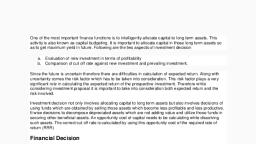
INVESTMENT DECISION, 1. Investment Decision:, A financial decision which is concerned with how the firm’s funds are invested in different assets is known as investment decision. Investment decision can be long-term or short-term., A long term investment decision is called capital budgeting decisions which involve huge amounts of long term
Page 13 :
investments and are irreversible except at a huge cost. Short-term investment decisions are called working capital decisions, which affect day to day working of a business., It includes the decisions about the levels of cash, inventory and receivables.
Page 14 :
FACTOR AFFECTING CAPITAL BUDGETING DECISION, 1. Availability of Funds, All the projects are not requiring the same level of investments. Some projects require huge amount and having high profitability. If the company does not have adequate funds, such projects may be given up., 2. Minimum Rate of Return on Investment, Every management expects a minimum rate of return or cut-off rate on capital investment. It refers to the point of below which a project would not be accepted., 3. Future Earnings, The future earnings may be uniform or fluctuating. Even though, the company expects guaranteed future earnings in total which affects the choice of a project.
Page 15 :
4. Quantum of Profit Expected, It is necessary to assess the quantum of profit expected on implementation of selected project. Here, the term profit refers to realized amount of projects as per the accounting records., 5. Cash Inflows, The term cash inflows refers to profit after tax but before depreciation. The reason is that recording of depreciation is a book entry and there is no actual cash outflow. Hence, depreciation amount is included in the cash inflow.
Page 17 :
MEANING OF FINANCING DECISION, The Financing Decision is yet another crucial decision made by the financial manager relating to the financing-mix of an organization. It is concerned with the borrowing and allocation of funds required for the investment decisions., , The financing decision involves two sources from where the funds can be raised: using a company’s own money, such as share capital, retained earnings or borrowing funds from the outside in the form debenture, loan, bond, etc. The objective of financial decision is to maintain an optimum capital structure, i.e. a proper mix of debt and equity, to ensure the trade-off between the risk and return to the shareholders.
Page 18 :
FACTORS AFFECTING FINANCING DECISION;��The Debt-Equity Ratio helps in determining the effectiveness of the financing decision made by the company. While taking the financial decisions, the finance manager has to take the following points into consideration:, The Risk involved in raising the funds. The risk is higher in the case of debt as compared to the equity., The Cost involved in raising the funds. The manager chose the source with minimum cost.
Page 19 :
The Level of Control, the shareholders, want in the organization also determines the composition of capital structure. They usually prefer the borrowed funds since it does not dilute the ownership., , The Cash Flow from the operations of the business also determines the source from where the funds shall be raised. High cash flow enables to borrow debt as interest can be easily paid., , The Floatation Cost such as broker’s commission, underwriters fee, involved in raising the securities also determines the source of fund. Thus, securities with minimum cost must be chosen.