Page 1 :
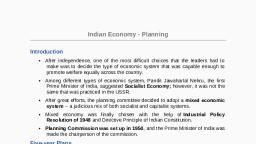
), , 2), , 3), , CBSE CLASS 11 ECONOMICS, INDIAN ECONOMIC DEVELOPMENT, REVISION NOTES, CHAPTER-2, INDIAN ECONOMY 1950-1990, , Different Economic Systems, , There are three forms of economic organization:, , Capitalist economy: Capitalist economy depends upon the market forces of demand and, supply. In this type of economy only those consumer goods will be produced that have, good demand in the market and yield profit top the producers. The only aim is profit, , maximization and the consumers are free to consume whatever they like., , Socialist economy: Socialist economy is a system in which all the decisions are taken by, the government. In this system the government decides what goods are to be produced in, , accordance with the needs of the society, how goods are to be produced and how to be, distributed., , Mixed economy: In a mixed economy, public and private sector exist side by side. Both, , price mechanism and central planning authority decide what, how and for whom to, produce. India is a mixed economy., , Economic Planning: Means utilization of country’s resources in different development, , activities in accordance with national priorities., , India has completed its 12th five-year plan(FYP) and the 13" FYP (2017-22) has started., , Goals of Planning in India

Page 2 :
Long Term Goals (To be achieved over a period of 20 years), , Long Term Goals/Objectives of Planning, , 1), 2), 3), 4), 5), , 1), 2), 3), 4), , Modernization - Adoption of new technology and changes in social outlook,, Self-reliance - Reducing dependence on imports., , Economic Growth - Increase in the aggregate output of Goods & services., , Equity - Reduction in inequality of income and wealth., , Full employment - Refers to a situation when all the people in the working age group is, , actually engaged in some gainful employment., Short Term Goals (To be achieved over a period of five years), , Short Term Goals/Objectives of Planning, Short term objectives vary from plan to plan depending on current needs of the country., , For example, first plan (1951-56) focused on higher agricultural production while in, second plan (1956-61) shifted the focus from agriculture to Industry. In India growth and, equity are the objectives of all the five year plans. The goal of current five-year plan, (12th, 2012-17) is Inclusive Development., , AGRICULTURE, , Role of A: Iture, , Agriculture is the backbone of Indian economic system and economic, , activity. The role of agriculture can be clearly seen from the, , following:, , Agriculture contributes significantly in national income., , It provides employment to a large labour force., , It provides the basis for industrial development,, , A large portion of country’s trade and services depends upon agricultural operations., , Main Features of Indian A: itu
Page 3 :
1), 2), 3), 4), , 5), 6), 7), 8), , 1), , 2), , 3), , Low productivity., Disguised unemployment., Dependence on rainfall., , Subsistence farming-objective of farmer is to secure subsistence for his family not to carn, , profit., Traditional inputs., , Small holdings., Backward technology., Landlord tenant conflict., , Problems of Indian Agriculture, , Statistics reveal that India poorly lags behind in both land and labour productivity, as, , compared to other countries., , Institutional problems, a. Defective tenancy reforms., , b. Lack of credit and marketing facilities., , c, Size of holding., , General Problems, a. Pressure of population on land,, , b. Land degradation., , c. Subsistence farming., , Technical Problems, a. Obsolete technique of production., b. Lack of irrigation facilities., c. Cropping pattern., , Reforms in Indian Agriculture
Page 4 :
1), , 2), 3), 4), 5), 6), , 1), 2), 3), 4), , ., )), 2), 3), 4), 5), 6), 2, , Land Reforms, , Land reforms refer to changes bought about in the agrarian structure through direct, intervention by the state., , To increase efficiency and productivity in agriculture., , Abolition of intermediaries., , Lack of political will., Problems of voluntary surrender by tenants., , Inadequate proof of tenancy., , General Reforms, , Expansion of irrigation facilities., , Provision of credit., , Regulated markets and co-operative marketing societies., , Support price policy., , Green Reyolution, The HYVP, NAS or Green Revolution was launched in October 1965., , Use of package inputs., , Scientific rotation of crops., , Minor irrigation works were taken up., Rise in production and productivity., Increase in income., , Increase in employment., , ACHIEVEMENTS OF GREEN REVOLUTION, , 1), 2), 3), 4), 5), 6), , Rise in production and productivity., , Increase in income., , Rise in commercial farming., , Impact on social revolution-use of new technology HYV seeds, fertilisers etc., Increase in employment., , Substantial Rise in Average.
Page 5 :
FAILURES OF GREEN REVOLUTION, , 1) Restricted to limited crops and areas such as two crops wheat & rice growing states like, Punjab, Haryana, U.P. and Andhra Pradesh., , 2) Partial removal of poverty., , 3) Neglected land reforms., , 4) Increase in income disparity between small and big farmers., , 5) Ecological degradation., , > INDUSTRY, ¢ Role of Industrial Sector of India, , Industrialization plays an important role in the economic development of a country., Industrially well developed economies are economically prosperous. Role of industrialization, , lies in:, , 1) Meeting ever rising demand., 2) Raising people’s income., , 3) High potenti, , 4), , , , , uch progres: of research and development., 3) Expansion of public sector.