Page 1 :
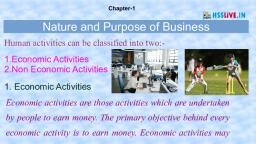
Chapter-1, , Nature and Purpose of Business, Human activities can be classified into two:1.Economic Activities, 2.Non Economic Activities, 1. Economic Activities, Economic activities are those activities which are undertaken, by people to earn money. The primary objective behind every, economic activity is to earn money. Economic activities may, be business, profession or employment.
Page 2 :
Examples for Economic Activities, A worker working in a factory, A teacher teaching in a school, A doctor runs his-own clinic, Practice of a lawyer, Farmer cultivates his land, Activities of a business man
Page 3 :
Non Economic Activities, , Non economic activities are those activities which are undertaken by people, without the intention of earning money. They are done for getting, psychological satisfaction or as a hobby., , Examples:House wife cooking food for her family, Boy helping an old man to cross the road, Gardening as a hobby, Playing Football
Page 4 :
Human Activities, , Economic Activities, , Business, , Profession, , Non Economic Activities, , Employment, Religious, , Patriotic, , Social
Page 5 :
Business, Business is an economic activity carried out regularly, with the objective of earning profit. Business carries an, element of risk and uncertainty. It is concerned with, production, purchase and sale of goods or supply of, services to earn profit. Manufacturing, trading, mining,, banking, transport, insurance etc. are business activities.
Page 6 :
Features of Business, , , An Economic Activity, , , , Production and purchase of goods and, services, , , , Sale or exchange of goods and services, , , , Regularity in dealings, , , , Profit motive, , , , Element of risk, , , , Uncertainty of return, , , , Creation of utility
Page 7 :
Profession, Profession is an occupation, in which application of special, knowledge and skill of a person is necessary. It involves, rendering of personal services of a special and expert nature., They get fee as return for their service. Services of doctor,, lawyers, charted accountants etc. are example for profession.
Page 8 :
Employment, Employment refers to an occupation in which, people work for others regularly and get salary, or wage in return.
Page 9 :
Difference between Business, Profession and Employment, Basis, of, Difference, , Business, , Profession, , Employment, , Commencement A business canA person can engage inAn employee can work in, start at any time his profession only afteran office only after getting, getting membership of aappointment letter from his, professional body., employer., Nature of work Production, orRendering, purchase, andpersonalized, sale of goodsservice, and services, Qualification, , ofPerforming the works, expertassigned by the employer, , No., minimumIn, professionIn, employment, qualification isspecialized, qualification is decided by, required, inknowledge, andthe employer., business, training is required
Page 10 :
Basis of, Difference, , Business, , Profession, , Employment, , Reward, , Profit, , Fees, , Wage or salary, , Risk, , High risk in business, , Fees is generally regular, so Salary is fixed and, there is very little risk, regular, so there is no, risk, , Transfer of, ownership, , We can sell the ownership It is not possible in profession It is not possible in, of a business to another, employment., person, , Capital Investment, , In business capital, investment is needed, , Code of Conduct, , In business there is noIn profession professionalNorms of behavior laid, code of conduct to becode of conduct to bedown by the employer, followed, followed., are to be followed., , In profession limited capital In employment no, investment is needed for, Capital investment is, establishment of office, needed
Page 11 :
Classification of Business Activities, , On the basis of function we can classify business activities into two:-, , 1.Industry, 2.Commerce, Industry, It is that part of business activities which is concerned with, production of goods and extraction of materials. It includes, business activities like raising and processing natural resources,, manufacturing or assembling goods, construction of buildings etc., Industries can be classified into three broad categories namely, primary, secondary and tertiary.
Page 12 :
1.Primary Industries, It includes all those business activities, which are concerned with, extraction of natural resources, reproduction and development of, living organisms, plants etc. Primary industries can be classified into, two namely extractive industries and genetic industries., A. Extractive Industry, Extractive industries extract or draw out products from natural, sources like soil, water, air etc. It extract timber from forest, fish, from sea, coal and iron are from soil etc. Primary industries supply, basic raw materials to manufacturing industries., Eg. Mining, hunting, fishing from natural sources, fruit gathering, agriculture
Page 13 :
B Genetic Industries, The industries which are concerned with reproduction, or multiplication of certain species of plants or animals to, earn profits from their sale are known as genetic, industries., Eg. Agriculture nursery, poultry farming, cattle breeding,, pisciculture (fish farming), forestry etc.
Page 14 :
2.Secondary Industries, These industries engaged in the process of manufacturing, goods or constructing building roads etc. Secondary Industries, use the raw materials supplied by the primary industry., Secondary industries can be further subdivided into two:A) Manufacturing Industry, B) Construction Industry
Page 15 :
A. Manufacturing Industry, Manufacturing Industries are engaged in the process of, converting raw materials into finished good and create, form utilities. They convert cotton into textile, timber into, furniture, iron ore into steel etc. On the basis of methods, of operation used for production, we can classify, manufacturing industries into four categories., , a. Analytical industry, b. Synthetic industry, c. Processing industry, d. Assembling industry
Page 16 :
B Construction Industry, These industries are engaged in the construction of buildings,, dams, bridges, roads, canals etc. The raw materials required for, these industries are supplied by the manufacturing industries and, extractive industries. Construction industries outputs are always, immovable.
Page 17 :
C Tertiary Industry, Tertiary industries are providing support service to primary and, secondary industries. Tertiary Industries consists of banking,, Insurance, advertising, communication etc.
Page 18 :
Industry, , Primary, , Extractive, , Tertiary, , Secondary, , Genetic, , Manufacturing, , Construction, , Business=Industry + Commerce, Commerce=Trade + Aids to Trade
Page 19 :
2.Commerce, Commerce includes trade and aids to trade. Buying and selling of, goods is termed as trade. But there are a lot of activities that, facilitates the process of trade. These are called aids to trade, (helpers to trade).Aids to trade include banking, insurance,, communication, advertisement and warehousing.
Page 20 :
Trade, Trade is the central activity (nucleus) of commerce. Trade refers, to buying and selling of goods and services with the objective of, earning profit. It helps the movement of goods from the producer, to the ultimate consumers. Traders are the connecting link, between producer and consumer. In the absence of traders,, producers will have to go in search of consumers. Trade may be, of Internal Trade or External Trade.
Page 21 :
Trade, , Home Trade, , Wholesale Trade, , Foreign Trade, , Retail Trade, , Import, , Export, , Entrepot
Page 22 :
Aids To Trade, These are services which help in removing various hindrances, which arise in the process of trade. The important aids to trade are, transportation, communication, banking, insurance, warehousing,, and advertising., , Transportation, Communication, Banking, Insurance, Warehousing, Advertisement, Insurance,
Page 23 :
Objectives of Business, Economic Objectives, , 1.Earning Profit, 2.Innovation, 3.Creation of Customers, 4.Productivity, 5.Workers performance, and attitude, , Social Objectives, , 1.Supply Quality goods at, Reasonable price, 2.Welfare of employees, 3.Community Service
Page 24 :
Role of Profit in Business, Securing profit is the basic requirement of a business. Profit, making is essential in business due to the following reasons., , 1.Profit is a source of Income, 2.Profit is essential for growth and expansion, 3.Profit is the index of business performance, 4.Profit Increases the efficiency of business, 5.Profit enhances prestige
Page 25 :
Business Risks, Risk means the possibility of loss. In business risk is unavoidable., Business enterprises usually face two types of risks. They are:1.Speculative risk, Speculative risk involves both the possibility of gain as well, as loss. It may arise due to change in demand, change in the price, of raw material etc. it may increase or decrease., Business Risk, Speculative, , Pure, , 2. Pure Risk, Pure risk involves only the possibility of loss or no loss. The, chance of fire, theft, etc. are examples of pure risk.
Page 26 :
Nature of Business Risk, ➢, , Business risk is due to uncertainties, , ➢, , Risk is an essential part of every business, , ➢, , Profit is the reward for risk taking, , ➢, , Risk depends mainly upon the nature and size, of business
Page 27 :
Methods of dealing with Business Risk, No business enterprise can escape from the presence of risk., There are many ways for a businessman to deal a risk situation., , , , , , , , , Take precautionary, equipments., , measures, , like, , firefighting, , Take an insurance policy to cover various types of, risks., Decide not to enter into high risk business transaction., Take measures like create provisions in the current, earning as in the case of provisions for bad debts.
Page 28 :
Causes of Business Risk, 1.Natural Causes, 2.Economic Causes, 3.Human Causes, 4.Government Causes, 5.Physical Causes
Page 29 :
Factors to be considered while starting a business, ➢, , Selecting the line of business, , ➢, , Size of the firm, , ➢, , Choice of form of ownership, , ➢, , Location of the business, , ➢, , Financial requirements, , ➢, , Physical facilities, , ➢, , Work force, , ➢, , Launching the enterprise, , OR, , OR, , SMALL BUSINESS, , OR