Page 1 :
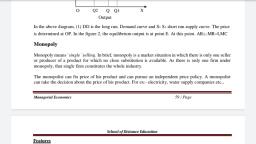
supernOr, , OLLLs e v e n i n t h e l o n g p e r i o d , w h e r e a s a, , firm, , in, , Fig., , 1.T2 (B) e a r n s o n l y, , normal profits., , 7, , MONOPOLY, So far we have discussed how prices are determined under the conditions of, , perfect competition. In actual life, such conditions are rarely fulfilled. The other, extreme of perfect competition is absence of any competition. Such a situation is, known as pure monopoly., In the real world, a situation arises between these two extremes, which are, , described as "imperfect competition" or "monopolistic competition.", , Meaning, The term Monopoly' consist of two words Mono' and 'poly'. Mono means single,, poly means seller. Thus, when there is only one seller of a commodity in the market, can be called as monopoly market. There are various definitions of 'monopoly' given by, various economists. Prof. Lerner defines it as, 'any seller who is confronted with a, , falling demand curve for his product., The Monopoly refers to, that market situation in which there is only one firm, (seller) in the market, that has a control over the supply of a commodity and which, has no close substitutes for its product in the market.', Monopoly is that type of market situation where competition among, , sellers or producers is absent. There is a single seller with complete, monopoly power (i.e., he does not face any competition)., , He is called a monopolist. He is the only producer in the industry. There are no, close substitutes for his product. Thus, when there is only one seller of a commodity, and there is no competition at all, the situation is one of pure monopoly., , A monopolist firm is itself an industry, for the distinction between a firm and an, , industry disappears under monopoly., In technical language, pure monopoly is a single firm-industry where the crosselasticity of demand between its product and the products of the other industries is, zero., , Professor E.H. Chamberlin points out that the essence of monopoly is control over, , Bupply., Pure monopoly rarely exists. in reality. It is merely a theoretical concept, because, even if there are no close substitutes, some kind of competition would alwavs be, there However, even though pure monopolies are a rare phenomenon in developed, , countries, they are found in developing countries like India in the form of State, , monopolies, e.g., the Mahanagar Telephone Nigam Ltd. (MTNL) and the Post and, , Telegraph Department of the Government of India.
Page 2 :
Business Economics, , -, , I, , (F.Y.B.Com.), , (Sem,-I), , Market Structure: Perfect Competition and Monopoly, , 21, , 20, , Characteristies of Monopoly, From the above, , discussion., , let, , us, , summarise, , the, , main, , characteristics, , of, , consumers do not spend all, , 1., 3., 4., 5., , 6., 7., , 8., Pure, , of a commodity., There is single producer, There is absence of competition., for a monopoly product., There a r e n o close substitutes, is z e r o in the case of pure, a monopoly product, Cross-elasticity of demand for, the c a s e of simple monopoly., monopoly and very low in, its commodity., o v e r supply of, The monopoly firm has control, and industry under monopoly., There is no distinction between firm, such, in developed countries. However,, Cases of pure monopolies are not found, countries., in, developing, found, cases of pure monopolies a r e, firms in the long run., A monopolist will prevent entry of new, a, , Monopoly, , -, , Price and, , Output, , Fixation, , take away the, As said by, his, of, output., level, the, whatever, whole of the community's income,, the, be, would, embracing, conceivable, Professor Chamberlin, the only perfect monopoly, supply of everything., cannot do both, or the output to be sold. He, either fix the, A pure, , A, , monopoly, , monopolist, , on one, , product,, , but, , spread it, , over, , a, , number, , It is, therefore, realistic to say that the demand for a monopolist's product will not, , monopoly as under:, , 2., , their income, , of products., , occurs, , when, , a, , producer is so powerful that he, , price, , can, , simultaneously because he has, , no, , control, , over, , the demand of the, , can, , consumers, , and, , we, , be unitary elastie throughout (since there is no perfect competition, it would not be, range, it would be more elastic and over a certain other, a, range, it would be less elastic., , horizontal). Over certain, , If the demand curve (average revenue curve) is less elastic, there is a greater, degree of imperfection in competition. If the demand curve is more elastic, there is a, greater degree of competition in the market., Demand Curve and Average Revenue Curve Same, We have said that the demand curve and average revenue curve are the same, curves. T'he demand curve shows prices and output demanded at various prices. The, price is the total expenditure divided by the total output. The average revenue is the, total revenue (receipt of the producer) divided by the total output. Since the total, expenditure is nothing but the total revenue or receipt of the seller, price and average, revenue are the same and hence the average revenue curve is nothing but the market, , demand curve., Marginal Revenue, Marginal revenue at any level of a firm's output is the addition to the total, revenue earned by selling an additional unit of output. It is the additional revenue, earned by selling n units instead of n-1 units, where n is any number., , assume full freedom of the consumer., , which is, A pure monopolist can take away the entire income of all consumers,, If he fixes, OMNP. If he fixes the price at OP level, he can sell OM quantity of output., demand curve, his output at OM^ level, his price would be OP^ as determined by the, or the outpuut., the, fix, either, can, He, c, u, r, v, e, for, price, revenue, him)., (which is the average, He cannot do both., For a pure monopolist, the demand would be, , Table: 1.4, Average Revenue and Marginal Revenues for a Monopoly Firm, Units, Sold, , 200, , hyperbola),., (a, rectangular, indicating that there would be no change in the, community's total expenditure at any price (See, Fig. 1.14)., In Fig. 1.14, AR is the demand or average, revenue curve for the monopolist's product. The, , a, , pure, , M, , Mi, OUTPUT (ASLES), , by, , Average Revenue and Marginal Revenue for, , on, , a, , (TR of n, , 200, , units -, , TR of, , n-1 units), , 200, , 200, , 2., , 180, , 360, , 180, , 160, , 160, , 480, , 160, , 120, , 4., , 140, , 560, , 140, , 80, , 5., , 120, , 600, , 120, , 40, , 100, , 600, , 100, , 0 . Ed = 1, , 80, , 560, , 80, , 60, , 480, , 60, , -80, 120, 160, , MR, , Fig. 1.14: Case of Pure Monopolist, , would, monopolist, remain, constant, at all levels, dark thick line, always, (shown, zero, , (TR+Output =, , 3., , 6., , OP price, but his total revenue would remain the same. Here, since the total revenue, of, , Marginal revenue, , Average Revenue, , Ed>1, , AR, , (OP) determined by the demand curve. If he produces more, say, OM, he can sell it at, , revenue would be, , Total, Revenue, , price), , unitary elastic, , elasticity of demand throughout is one. Here the, monopolist takes away the entire income shown by, the rectangle OMNP. He may fix the price at OP, level and allow the sales (OM) to be decided by the, demand curve. Or he may produce a fixed quantity, (output OM) and allow it to be sold at a price, , Price, , of output, the, , marginal, , X-axis), , Monopolist, , Pure monopoly is a theoretical concept, for a pure monopoly can never exist. No, roducer can ever claim to take the whole income of the community. Even assuming, , 8., , 9., , 40, , 360, , 40, , 10., , 20, , 200, , 20, , -, , 40, , Ed <1, , For the purposes of calculation, MR can be defined as the addition to total, revenue when one extra unit is sold, i.e. selling n units instead of n - 1 units, where n, , is any number., At point Q, ed = 1(QR = QP). The marginal revenue at this level of output OM is, zero. At point P, ed =, , and therefore MR at this point is equal to AR. Between P and,, , hat there are no close substitutes for a monopolist's product, the fact remains that, , Q, ed> 1and MR is positive., 3/F.Y.B.Com. - Business Economics- II (Sem.-)
Page 3 :
Business, , s's'*, , 22, , Economics, , - lI (FY.B.Com.) (Sem.-1, , at all, MR becomes negative, than o n e and. therefore,, After point Q. ed is less, r e v e n u e (TR) increases, total, the, than OM. Over the range PQ., =, levels of output greater, elasticity of, decreases (ed < 1). (ed, the, QR total r e v e n u e, range, o, v, e, r, (ed> 1) and, , demand)., 1.15), How to Draw MR Curve (See Fig., , When AR is falling (i.e. downward sloping, than AR at all, demand curve), MR is less, c u r v e s both start, levels of output. AR and MR, from the same point on Y axis (point Pin Fig.|, from, 1.15). First draw any AR curve, starting, P on Y axis and touching the X axis at a point, central point on PR, say. R. Then mark the, Draw a, perpendicular from X axis, curve., , Market Structure: Perfect Competition and Monopoly, , negative., Thus, for all levels of output, where the, , elasticity of demand is greater than one,, the marginal revenue is always positive; where the elasticity of demand is equal to, one, the marginal revenue is zero; and where the elasticity is less than one, the, marginal revenue is always negative. We can, therefore, find out the marginal, revenue at any level of output, if we know the elasticity of demand on the average, revenue curve., , 8. TYPES OF MONOPOLY, 1, , Natural Monopoly, , Natural, , monopoly, , is due to natural factors. For, , towards that point. We get zero MR M, polnt material 1s concentrated at a, when ed = 1 at point Q. Now mark, X, , on, ad, , axis),, , X axis as M. Join points P on Y, axis and M on X axis. Extend the line|, downwards below the X axis. This is MR, curve. MR c u r v e above X axis shows positive, marginal r e v e n u e (output 1 unit to 5 units in, table 1.4), and MR curve below X axis shows, negative marginal r e v e n u e (output of 7 units, onwards in table 1.4). At point M on X, MR is Zero (output of 6 units)., this point, , 13, , x, oUTPUT, , on, , axis, , Fig. 1.15 : AR & MR Curves for, , Monopolist, Relationship between AR and MR Curves, The position of the MR curve in relation to the average revenue curve (demand, curve) depends on the price elasticity of demand. The formula for caleulating marginal, revenue at various levels of output is:, , i), , =, , AR, , ii), , 2., , gives, , a, , particular, , raw, , rise to monopoly, , of diamond mines in South Africa., , Publie Utility Monopoly, , Governmental, , authorities take over complete control and management of some, utilities to protect social interests. For example, posts and telegraph, telephones,, electric power, railway transport, provision of water, are monopolised by the, government and local authorities. There may be private monopolies of public utility, services., , 8. Fiscal Monopoly, , 4., , Legal Monopoly, , Some monopolies are created and protected under certain laws. Inventors of new, processes, articles, or devices obtain monopoly powers for such inventions under, patent, trade mark and copyright laws. There are many examples of legal monopoly of, medicines., , AR. NL is the, , marginal, , revenue for, , As Professor F.W. Taussing observes in his Principles of Economics, copyrights, and patents are the simplest cases of absolute monopoly by law. However, as Professor, E.H. Chamberlin points out, such cases would fall more under monopolistic, , competition than under monopoly., 5. Voluntary Monopoly through Combinations, , Hence, elasticity is 3. MR at S is, therefore, AR x, or, , material, e.g. monopoly, Bangladesh having monopoly of raw jute., , example,, , and this, , x, , SR, At point S, the elasticity of demand is ps.SR, is 3 times PS., , ARx, , exploitation of such, , particular place, , To prevent exploitation of employees and consumers, government nationalises, certain industries and acquires fiscal monopoly power over them. For example, the, fiscal monopoly of tobacco in France, life insurance and general insurance monopoly, which used to prevail in India., , MR, , Marginal Revenue, , 23, , of demand is less than one, the MR curve will be below X-axis, indicating that MR is, , OL output., , It is 2/3 the average revenue at this output., At point Q, the elasticity of demand is one., , MR =ARx, ARx 0, , To eliminate competition and thereby secure higher prices, firms producing a, particular product may come together and make monopoly agreements. These are, known as industrial combinations. When all the firms merge into one organisation,, such a monopoly takes the form of a trust. The Associated Cement Companies (A.C.C.), , in India is an example of this kind of trust. Where, the firms maintain their individual, identity and yet enter into monopoly agreements, such combinations are known as, , trade associations, pools (loose combinations to maintain. particular higher price level, of a commodity), cartels (agreements to restrict output to get high prices; e.g. the, , Sugar Syndicate Maharashtra), and holding companies (a holding company secures, , Marginal revenue for OM level of output (where elasticity is one) is zero., The marginal revenue is negative and equal to twice, the average revenue. J, (marginal revenue) is, therefore, twice TK. For all levels of output, when the elasticity, , monopoly control over a number of firms by holding a majority of shares in them).
Page 4 :
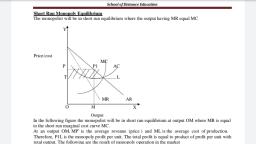
Business Economics - ll (F.Y.B.Com.) (Sem.-, , s's'R, , 24, , Market Structure: Perfect Competition and Monopoly, Marginal, , Sources of Monopoly, 1., , The, be the result of a government, A monopoly as stated above may, or monopoly in the, a private monopoly, permit, government of a country may legally, of defence equipments., (e.g. manufacture, public, , sector, , for, , reasons, , sanction., , of national security, , electricity supply,, (post office, water supply,, or essential goods to be, services, (public utility, telephones), and price, firm for reducing the cost, produced o n a large scale by a single, wastes, avoid, due, to, created, may be, (eg. monopoly of transport services). Monopolies, utilities., to duplication of services. e.g. public, and ammunitions). social equity, or economic considerations, , Control Over Supply of Inputs, the supply of an, situation may arise due to control over, used-denying access to, skilled, technology, labour,, materials,, essential input, in India., potential firm e.g. Government monopoly of Railways, these inputs to anyallowed, be, to be used by private rail companies. Monopolies may, Rail tracks are not, on, tariffs, foreign, protected through a protectionist policy of the government by putting, , Secondly., , a, , monopoly, raw, , goods., 3., , Monopoly, , Merger for Large-scale production, , is established only when the marginal cost, rising and never when it is falling because of, the horizontal shape of the marginal revenue, curve (the firm being a price-taker)., , AC, , At point Q, MR = MC; MC curve cuts, , MR from below. Hence Q is equilibrium, , Equilibriunm Point, , (MR-MC), , point., TR, (Price OP x Output OM), OMSP, TC (AC RMx Output OM), = OMRT. Since TR > TC shaded area, PSRT is Super Normal Profits, , AR, , MR, , X, , OUTPUT (Sales), , M, , However,, , under the monopoly, an, Fig. 1.16 : Monopolist's Equilibrium, equilidrium can be established where MC is, Output & Price, rising, constant or falling (see Fig. 1.18 A, B,, C. In other words, monopoly equilibrium is established under all three cost conditions, viz; increasing cost, constant cost and decreasing cost., , necessity to produce, merge into big firm, , large, , 4., , MC, Monopoly, Profts, , perfect competition, the equilibrium of a firm, , on, a result of the, scale to reduce costs. Existing small firms may, a, or may, not survive in the long period. It is only when there is single firm id such a situation, that costs are greatly reduced due to the economies of large scale production., , Thirdly, the monopoly undertaking may be, , a, , and, , Perfect Competition Under conditions of, , Legal Sanction, , arms, , Cost,, , 25, , (B), , (A), , MC, , Rival Firms Thrown out, , that, Fourthly, it may be due to pressure tactics and unfair means by a giant, rival firms are thrown out of the industry and only the giant firm remains. In India,, many such examples were revealed in the Monopoly Inquiry Commission's report., This is discussed in the later part of this chapter., , firm, , 9 PRICING UNDER MONOPOLY AND MONOPOLY EQUILIBRIUM, , MC, , Two important factors may be noticed about a monopolist., A., , the other hand,, , B., , MR, MR, , The monopolist is a price-maker and not a price-taker. (In a competitive market,, The average revenue curve is not, on, a firm is a, horizontal but slopes downwards to the right., , OUTPUT, , Fig. 1.17: (A), (B), , The monopolist can either fix his price or fix his output. He cannot do both. If he, , fixes his price. the volume ofsales will be, , determined by the demand for his, product; if he fixes his output, he will get the price determined by the demand for, his product., Conditions for Monopoly, , Equilibrium, , A, , monopolist's equilibrium output is, , that level of output where he makes the maximum profits. We have, already seen in an, earlier chapter that profits are the difference between total, revenue and total cost., , Thus,, , Total Profits = Total Revenue - Total Cost., =, , the, , M, , M, , price taker)., , (Price, , x, , Total, , Output), , -, , Total Cost., , Equilibrium (Maximum Profit) Condition, , B, No Equilibrium for Monopoly, 1.17 A, MC cuts MR from, Q. Here profits are minimum, , Fig., , In, , above, , at, , because the, , monopolist, , can, , The monopolist would try to secure that price and, quantity combination where, difference between the total revenue and the total cost is the, This means an increase in, biggest., There is no equilibrium at, This maximum profit point occurs when the, following conditions are satisfied:, 1. Marginal revenue (MR) Marginal cost (MC); and, 2. The marginal cost curve cuts the marginal, revenue curve from, belo, (see Fig. 1.16), =, , increase his, , by expanding his output, since, MC is les thar MR beyond OM output., , revenue, , total, , revenue., , Equilibrium for Monopoly, In, , Fig., , 1.17 B, MC cuts MR from, point Q. This is the point of, max1mum profit. After this point, the, total revenue would decline, because, , below, , at, , | thereafter MR is less than MC.
Page 5 :
Business Eeomomic, , I1FYB Com.)Sem, , Marken Strete Perec1 (ompertiteon ard Mornpoly, Fig. 1.19 givea ua the following informatinn, , (O, , 1., , When, , the coat, , of, , production, , (and, , henee, , the, , marginal, , monopoliat a equilibrium output would be that where MR, , enat), is, , al, , 1aero,, , so sero, , the, , This, , is, , the point where the elaaticity of demand ia one, , MC, , Amonopoliat will not produce an output at those price levels where elasticity, , AC, , of demand ia leas than one Because MR is negatsve for such outputs and the, , AC, , total, dechning, , declines The total profite of, , revenue, , MC, , The following, , R, MR, , MR, , 1, , Monopoly, h e MC, MCat, , a, , Equilibrum, , Monopoly, , ns1ng MR=, , where, , pont, , The MR=MMC, , equalibrrum utput is OM, , 3, , Marginal Cost Conditions, , Equilibrium, Monopoly, where MC is falling The, , Equilibrum, iconstant, , MC, , therefore, the conditions of equilibrium for, , a, , monopolist, , The, , at, , equilibrium, , 8, , at, , (MC is falling but it cuts, , equilibrium output is OM., , raing. fall1ng, , or constant, but it must cut MR from below in all the three situations, The elasticity of demand is grea ter than one In other words. the marzina, , Fi 1.181 (A). (R). (C), under, , monopniust would. therefore, be, , 2. MC cuta MR from belorw. An equilhbrium is prasible when MC, , OUTTUT, , guilibrium for Monopoly, , are,, , MR- MC, , a, , revenue must he positive, , Short-Period Monopoly Equilibrium output, In the short period, some factors are fixed and some are varnabe. A monopoist, may make supernormal profita, normal profits or losses in terms of fixed costs., , MR, from, below). hedepending upon the nature of demand for his product. (see Fiz 1 20 (A). (B. (C, equilibrium output is OM., , One more condition is related to the elasticity of demand., , Sper Normal, Profits MC, , No Cost of Production and Equilibrium Output, , (A), , We shal oonsider two situations here. One is where a monopolist has no cost of, productaon Sinc his marginal cost is zero, the equilibrium output will be the output, herr the marginal revenue is also zero. This would be that level of output where the, , lastacaty af demand is one (see Fig. 1.19), where, , the cost, , has MR s also zero, , is e r o , the monopolist will produce the output, This is OM output. The elasticity of demand for his product is, , where, , of production, , q a to one (see point ), , MR, , Sunce MC s ero, the equilibrium output is that where MR is also zero. It is OM, output n the above figure. At this output, the elasticity of demand is one. The, mnogolust wll not have an output which will be to the right of Q because the, elastactyof demand is less than one over the QT range, AR curve; the marginal, reveu s, , nggatzve and the total revenue is declining., , of the, , OUTHT, , OUTPUT, Fig. 1.20: (A) Supernormal Proñ, , Fie 120 (B) Normal Prodts, , Short Period Manopoly Equilihrium, , A. Supernormal Profits, MR and MC are equal at Q The equilbrium, output is OM, AR =, , profits, , are, , RM, AC =, , RS (RM, , -, , SM, , The average, , SM). T'he total, , profit, , are, , shown by the shaded area PRST., , B. Normal Profits, At Q, MR=MC. The equilibrium price is OP, and, , output, , OM., , Since, , AR, , =, , AC, , =, , MR, , only, , normal profits, , C. Losses, At Q, MR, , MC. The equilibrium price is OP, , and output OM.AC = sM and AR = RM. There, , losses for the monopolist, (shaded area PRST), , are, M, , AR, , OUMUT, , Fi, , 119ED ie One, , at, , Polnt Q, , in, , the short, , peri, , ATPUT, , Fig 1.30 (C): Losses, , Thus, in the short period as shown in, ig. 1.20 A, B, C a monopolist may earn supernormal protits, normal profits, or incur, losses, depending upon the nature of his demand eurve and costs of production.
Page 6 :
Business Economics-II (F.Y.B.Com.) (Sem. I, , Market Structure : Perfect Competition and Monopoly, , iv) Equilibrium and Cost Conditions, , Period Monopoly Equilibrium, , Long, , a firm may earn, Under perfect competition,, short period. In, the, in, supernormal profits only, profits are, supernormal, these, the long period,, n e w firms., of, competed away by the entry, situation, since, However, in a monopoly, firms, new, (a monopolist is a, there is no entry of, the, period because, in, long, even, single producer, or technical, institutional, free entry is absent for, , (C), , Losses, , ATUC, AVC, , reasons),, , monopolist would continue to, , a, , earn, , Only when MC is rising equilibrium is possible under perfect competition. A, fails to reach equilibrium if MC is falling or MC is constant because, , competitive firm, , of the non-fulfilment of conditions for equilibrium. Monopoly equilibrium is consistent, with rising, falling and constant MC, provided the slope of MC is greater than the, slope of MR., , iv) Optimal Capacity vs. Excess Capacity, A competitive firm always operates at the lowest point of its AC curve. This, means that the firm produces at an optimum cost. In the long run, as a competitive, firm earns only normal profit (because of free entry and exit), P = minimum AC. That, , supernormal profits even in the long periodia, is tto, unable to enter, (see Fig. 1.21). The new firms, secret or, because of -necessity of huge finance,, , MR, , OUTPUT, , patented, , Fig. 1.21:Supernormal Profits, , techniques, , of production, legal, firms, threats by the, , prohibition for n e w, monopolist to new firms, etc., , in Long Period, , he would, incurring losses in the short period, in the long period, his, for, in, the, product, price, an, change, appreciable, prefer to, and he begins to earn normal or supernormal profits., A monopolist continues to earn supernormal profits even in the long period. These, profits are shown by the shaded area PSRT. Price is MS. and average cost is RM,, If he has been, , close down, unless there is, , Average profit is MS - RM = RS., , possible for institutional and technical reasons, viz. requirement of huge finance,, secret or patented techniques of production, legal prohibition for new firms or threats, by the monopolist to new firms., , Competition, , and, , Monopoly, , Under perfect competition, a product is homogeneous. Monopoly product may or, , may not be homogeneous. Entry (and exit) is free under perfect competition, while, entry is blocked under monopoly., , MR vs. P> MR, product homogeneity, , Due to, , the demand curve (P = AR) faced, by a competitive, firm is perfectly elastic. Further, AR curve coincides with the MR (i.e., AR = MR), In monopoly, demand curve or, curve since every, as a, AR curve is downward sloping. MR curve is also downward sloping and lies below, , firm behaves, , 'price-taker'., , AR curve, i.e., AR > MR., , A, , But,, , competitive, in, , firm reaches, , condition, , monopoly,, , MC = MR> AR -, , P., , There occurs a misallocation of resources in monopoly resulting in 'negative, capacity'. A monopoly market produces less than its, thus, deprived in the form of smaller output. A consumer is exploited by a monopolist, since a higher price is charged., , potentiality. Society is,, , excess, , Profit, , competitive firm enjoys abnormal profit,, , of, , since, , a, , equilibrium, , when MC is equal to MR. Since AR = MR., firm can be written as MC, MR =AR = P, MR, the equilibrium condition, , competitive, AR, , normal, , profit,, , as, , well, , as, , it suffers, , fromn, , because of unrestricted entry and exit. But a monopolist may earn pure profit both in, the short run and in the long run, and may also earn normal profit. Like a competitive, firm, a monopolist may suffer from losses in the short run., , vi) Supply Curve, Under perfect competition, MC curve above the AVC curve is the short run supply, curve which shows a particular relationship between price and quantity supplied. But,, in monopoly, the concept of supply curve is irrelevant. In other words, MC curve is not, the supply curve., , vii) Discrimination, A monopolist can practice price discrimination in the sense that he can charge, , different prices for his product to different buyers. Because of homogeneity of the, product, price diserimination under perfect competition is ruled out. Thus, these two, market forms are poles apart., , iii) P = AR = MR = MC vs. P = AR > MR = MC, , equilibrium, , Perfect competition is, thus, an ideal market in the sense that resources are, This results in larger output and lower price of the product. Social, , optimally utilized., , A, , In perfect competition there are innumerable numbers of sellers who cannot, change the market price of the commodity. They behave as 'price-takers'. On the other, hand, a monopoly firm-a firm or an industry of a single seller- can alter the price of, the product., , the, , That is why price charged by a monopolist is higher than the price charged by a, competitive firm and output is smaller under monopoly than under perfect, competition. Further, in the long run, a monopoly firm may earn abnormal profit., , loss, of course in the short run. But in the long run it enjoys only normal profit, , Differences in Market Conditions, , ii) P, , A monopoly firm, on the other hand, does not operate at the lowest point of its AC, curve. Because of the nature of the demand curve, a monopoly firm operates, somewhere to the left of the minimum point of long run AC curve. This means, under-utilization of monopoly plant or wastage of resources., , v), , Following are differences between perfect competition and monopoly:, i), , say, in the long run, competitive equilibrium occurs when P = AR = MR = MC, , minimum AC. This means optimal utilization of resources., , welfare is, thus, maximizyn under perfect competition., , The supernormal profits cannot be taken away as the entry of a new firm is not, , Differences between Perfect, , 29, , g's', , 28, , -, , becomes
Page 7 :
II, Business Economics, , (FY.B.Com,), , (Sem, , I), , 30, , 8., , QUESTIONS, , card provided, downloading, for, Pleasefollow instructtons provided, , Questions and, , Answers, , available Free with scratch, , in the, , 31, , Market Structure: Perfect Competition and Monopoly, Under perfect competition there is perfect mobility of factors of production., , book9. There is Government interference in perfect competition., 10. Normal profits may be defined as that amount of money which is just sufficient to, induce the firm to stay or continue in the industry., 11. Total revenue is the sum total of receipts earned by a firm from selling its output., , A., , Answer the follow ing questions:, , 12. Total profits = Total revenue - Fixed costs., , Explain the concept of a market structure., Write a note on perfect competition and monopoly, , models, , extreme, , as two, , market structure., models, Explain why perfect competition and monopoly, , are, , two, , extreme, , cases of, , structure market structure., , 7., 8., , it helps in taking production, Explain the nature of the supply curve and how, decisions under competitive conditions., curve., Write a note on marginal cost as the competitive firm's supply, a competitive market., in, and, market, equilibrium, supply, Explain the long run, Discuss the features of perfect competition., Discuss the concepts of normal profits and supernormal profits., , 9., , Explain the concepts of total revenue, average revenue and marginal revenue, , 4., , 5., 6., , 14., , an industry in the short period., , 15. A long period is defined as the period when all factors of a firm are fixed., , 16. Mono means single, poly means seller., 17. There is competition in monopoly., 18. Natural monopoly is due to natural factors., 19. The, , homogenous factors., , 12. Explain the equilibrium ofa firm under perfect competition in the long run., , Explain the average revenue and marginal, 15. Discuss the types of monopoly., 16. What are the sources of monopoly., , 17., , revenue, , for, , a, , monopolist., , 19., , a, , price maker, , [Ans, :(1) True, (2) True, (3) False, (4) True, (5) True, (6) False, (7) False,, (8) True, (9) False, (10) True, (11) True, (12) False, (13) True, (14) True,, , (15) False, (16) True, (17) False, (18) True, (19) False, (20) Truej], C,, , Match the Following :, Column B, , Column A, , 2., , a), , the period when there, and variable factors., as, , are, , fixed, , There is no government interference., , b) due to natural factors., , Total revenue is the sum' total of, , c), , and cost, , d), , that market situation in which there, are a, large number of firms, , receipts, , Explain pricing under monopoly and monopoly equilibrium., period monopoly equilibrium., Examine the long period monopoly equilibrium., Explain the difference between perfect competition and monopoly., , 4., , 18. Discuss the short, 20., , not, , 1. Perfect competition may be defined., , 13. Define monopoly. Explain the characteristics of monopoly., 14., , monopolist is a price taker and, , 20. The monopolist can either fix his price or fix his output., , under perfect competition., 10. Examine the equilibrium of a firm under perfect competition in the short run with, 11. Explain the equilibrium of a firm in the short run under perfect competition with, heterogenous cost conditions., , condition for, ne arginal cost is equal to the marginal revenue, (MR MC) is a, equilibrium., we aad the outputs of all firms at various prices, we will get the supply curve of, =, , cases of, , Natural monopoly is, , producing homogenous products., 5., , The vast majority of firms operate | e), , P= AVC, , under a situation off, B., , State True or False :, , 1., , The term market structure refers to the, type, of market in which the firms, , Shutdown point is equal to, When factors of production, , operate., , 2., 3., 4., , The competitiveness of markets depend on the, powers of individual firms, infiuence market prices., The vast majority of firms in the real world operate under, A firm's marginal cost curve is also the, short run., , ), are, , heterogenous the efficient producer, under perfect competition., , to, 8., , perfect competition., competitive firm's supply curve in the9., the, , imperfect competition, , 8), , may, , earn, , losses in the short, , run., , h)may reduce cost and make profit., , A monopolist, The part of short run MC curve, which lies above the AVC forms the, , |i), , monopoly, , -, , ., , 6., 7., , The part of the short run, marginal cost curve which lies above the AVC, forms the, short run supply curve of the firm under competitive, , conditions., Perfect competition may be defined as, that market, situation,, in which, few number of firms producing hom0genous, product., The firm under perfect competition is a price maker., , there are, , 10. There is no distinction between firm | j), , 11. A, , long period industry equilibrium, , one in which, , short run supply curve of the firm in, , competitive conditions., , and industry in, 1s, , Ehere, , are, , losses