Notes of B. Com I, Business Economics(Micro) Demand Function.pdf - Study Material
Page 1 :
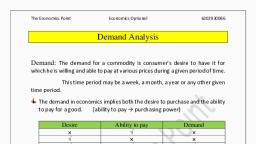
SYNOPSIS, 1., , Concept of Demand, , 2., , Law of Demand, , 3., , Determinants of Demand, , 4., , Demand Function, , 5., , Nature of Demand Curve under Different Markets, , 1., , w, , CONCEPT OF DEMAND, , economics and it is the backbone, Demand is one of the most fundamental concepts of, refers to the purchases made by a, of a market economy. In ordinary language, demand, harmful to a persons, is, consumer. It is term as desire or want for something's. Cigarettes, because they have utility)., demanded by one whose want it satisfies (Goods are demanded,, does not have a desire for its, But a nonsmoker may not have any demand for it, since he, , consumption., But in economics, the, , term demand, , has, , specific meaning. Demand does, , not, , mean mere, , desire fora commodity. To become demand, a desire must be backed by., , Ability or capacity to pay for the Commodity and, The willingness of the consumer to spend for the commodity., Demand = Desire + ability to pay +willingness to pay for it., , not, , For e.g. : A misers desire for and his ability to pay for a car is not demand, for he does, have the necessary will to pay for a car. Similarly, a poor person's desire for and his, , willingness to pay for a car is not demand because he lacks the necessary purchasing power, , One can also conceive of a person who possesses both the will and purchasing power to pay, for a commodity, yet his is not demand for that commodity if he does not desire to have that, , commodity., Demand is a Relative Concept, It should also be noted that demand for any commodity or service have no meaning, , unless it is stated with reference to the time, its price and that of related commodities,, consumer income, tastes etc. Therefore demand is a relative concept.
Page 2 :
(Sem, Husiness lronomes ( Y.B,Com,), is not meaningt, India is 40,0O0, , (P'aper, , 34, , Say, , that demand for, , s stated that, , Ambass.ador car in, when, demand in 1976, an, , AmbasSad0r, , an, , neaningful, unle, was, , prices, , a Bajaj sCooter's Comna, around the same,, car's prices were, per litre. In 1q7, around three and, was, 5,000 and petrol price, ctors happenedto, of the above facto, different if any, c a r s could be, , this, , was, , the, , 30,000, competiny, , hall, , around R, demand for Ambassa, ditferent., , was, , carS, , tor that, is the desire, the, for, demand, anv commodity, win, hus,, is always detined, as well as ability to pay for it, and, wilingness, , commodity backo, relerence, , to, , a, , partic., , time and given values of variables on which it depends., , Definition of Demand, , The demand for a commodity refers to the amount of it which will be bought per uni, , time, , at a, , particular price., , According to Benham, "Demand for anything at a given price is the amount of it whi, , will be bought per unit of time at that price"., Bober: "By demand we mean the various quantities of a given commodity or serv, which consumer would buy in one market in a given period of time, at various prices, or, various incomes, or at various prices of related goods.", , 2, , LAW OF DEMAND, The law of demand introduced by Alfred Marshall in economics explains the inve, , relationship between price and quantity demanded., Statement of the Law, , Other things remaining the same, the quantity demanded of a commodity van, inversely with its price. f price falls demand rises and if price rises demand fals., Thus, D = f (P), Where, D = demand, f = function, p = price, , Assumption, 1., , Income of the consumer should remain same., , 2, , Prices of other commodities i.e. substitutes and complements should remain the same., , 3., , There, , 4., , is no, , change, , in, , change, , in climate and, , taste, habits, preterences etc. of consume, The size and composition of population should be, , unchanged, , 5., , There is, , 6., , Tax structure should remain, , unchanged., , 7., , There should, , in the, , no, , be, , no, , change, , weather conditions., , quantity, , 8., , of, State of technology should remain constant., , 9., , There is no change in market expectation., , 10., , There, , is, , no, , change, , in credit, , facility, , to, , money in circulation., , the consumer,, , Explanation of Law, The law of demand, , usually reters to the market demand., pxolained with the help of ToiowIng market demand schedule, Market Demand Schedule, , Price of Commodity ', , (in, , (stable)., , The law of, , and diagram:, and, , demand ca, , Quantity Demanded of, , 50, , 'x, , 40, , 10, 20
Page 3 :
Demand Function, , 35, , 30, , 30, , 20, , 40, , 10, , 50, , D, 50, 40, 30, 20, 10, D, , o, , 10, , 20, , 30, , 40, , 50, , Demand, Curve, , Quantity, , Fig. 3.1, , When demand schedule is plotted on a graph, we get the demand curve 'DD'. Quantity, demanded is measured on X-axis and Price on Y-axis. DD is the demand curve, which, slopes downward from left to rightindicating an inverse or negative relationship between, price and quantity demanded. When price is T 50/- the consumer would demand 10 units., When price falls to 10, he would demand 50 units. Thus when price falls demand rises as, shown in Fig. 3.1, Exception to the Law of Demand, Despite of the above stated assumptions, there are situations when the law of demand, fails i.e., there is direct relation between price and quantity demanded If price rises,, consumption also rises and vice-versa. The cases where the law of demand fails are as, , follows:, 1. Giffen good : Giffen good is named after Sir Robert Giffen. Giffen good are not, normal goods. These are highly inferior goods like bread, potato, bajra etc. These, goods show direct price-demand relationship. When price of inferior good like, wheat falls, people instead of buying more, buy less of it and in turn switch on to, superior quality of wheat. This is known as Giffen paradox., , 2. Veblen good: Veblen good is named after Thornstein Veblen. It is a prestigious, goods. Certain commodities like diamond, precious stone, antique pieces of art etc.,, are demanded because they are expensive and have 'snob appeal'. They are, purchased simply because their prices are very high. In this type of situation,, , prestige is directly related with price of good. Higher the price of the good, greater, will be the status or prestige of the buyers in the society and vice-versa. That is why,, rich people buy more of it at higher price and less of it at a lower price., 3. Change in taste or fashion : If the tastes of consumers have undergone a change or, , if the product is gone out of fashion, the demand will not increase even if the price, is decreased., 4. Change in income: An increase in consumers' income will raise the demand for the, commodity even if its price rises.
Page 4 :
(1.Y,B.Com.) (Sem. ), Business lconomics, , 36, , 3., , famine, , or, , war, , (Paper there, , i, , like flood, drought,, case of emergencies, c o n s u m e r demand more, 5. Emergency : In, necessities and hence,, of, of shortages, of demand., insecurity and fear, is against the law, this, and, goods even at higher prices, that the price of a good wil rise, expect, f, people, in, rise, :, price, and vice-versa, which is, 6. Expectation of future, more at the present higher price, will, buy, in the future they, demand, of, law, the, against, DETERMINANTS OF DEMAND, , Demand tor, , a, , commodity depends, , on a, , number of factors., follows:, , are as, The main determinants of demand, demand for the commodity. There is an, : Price affect, 1. Price of Commodity X (Px), of a commodity rises, and demand. When price, inverse relationship between price, , its demand falls and vice-versa., 2., , Price, , Commodities, , (Pr): Related, , complementary, , commodities., , of Related, , commodities, , be classified, , can, , as, , The price of substitutes and, Price of substitute and demand, complements affect the demand for a commodity., tea and coffee are substitutes. If the, for the other goods are directly related. For e.g., tea will increase. Price of complement and, price of coffee rises, the demand for, , substitutes, , or, , demand for the other goods are inversely related. Car and petrol are complementary, and vice-versa., If the price of petrol rises, the demand for car will decrease, , 3., , goods., , Income (Y) : Income affect the demand for a commodity. Demand for a commodity, , is directly related to income of the consumer. With the rise in income, the demand, also increases and vice-versa. Thus, a rich consumer usually demands more and, , more varieties of goods than a poor consumer., , 4. Taste, Habits, and Preference (T): Demand for many goods depends on the, , person's tastes, habits and preferences. Changes in tastes, habits and preferences, etc. affect the demand for a commodity. Demand for several products like ice, , cream, chocolates, bhel-puri, etc., depends on an individual's tastes. Demand for, tea, betel, tobacco, etc., is a matter of habit. If people are habituated to a particular, commodity like coffee demand for such goods is generally high., , 5. Size of Population (P): Changes in the size and composition of population affect, demand. When population increases, demand also increases and vice-versa. If birth, rate increases, more demand for baby food, baby products as so on., , 6. Advertisement (A) : Advertisement affect the demand. A continuous advertisement, or campaign will attract the consumers and, increase the demand for such goods., Thus, demand for many products like toothpaste, toilet, , washing, , processed foods, etc., is partially caused by the advertisement effect in a powder,, modern, soap,, , man's life., 7., , Consumer's, , Expectations (E) : A consumer's expectations about the future changes, price of a given commodity also may affect its demand. When he, expectso, prices to fall in future, he will tend to buy less at the, present, price, Similarly, if he expects its prices to rise in future, he will tend prevailing, to buy more, present., in the, , 8., , Fashions (F): Demand for many, products is affected by changing fashions. o, example, demand for commodities like jeans,, salwar-kameez, etc., is based O, current fashions., , 9., , Climatic or Weather Conditions (W) : Demand for certain, products is determinet, by climatic or weather conditions. For, in summer, there is a, example,, greate, demand for cold drinks, fans, coolers, etc., , raincoats is seasonal., , Similarly, demand, , for, , umbrellas, , and
Page 5 :
37, , Demand Function, , 10.Customs (C): Demand for certain goods is determined by social customs, festivals,, etc. For example, during the Diwali festival, there is a greater demand for sweets, , and crackers, and during Christmas, cakes are more in demand., 11.Other factors (O) : Other factors such as technology, tax structure, Band Wagon, effect, quality of goods etc. affect demand., When all these above mentioned factors change, the demand pattern will be affected., 4., , DEMAND FUNCTION, -, , A mathematical expression of the relationship between quantity demanded of the, , commodity and its determinant is known as demand function., Demand function explain the relationship between the demand for a commodity and its, , determinants, Demand function for commodity X can be stated symbolically as follows:, Dx = f(Px, Pr, Y, T, P, A, E, F, W, C, O), Where, Dx = Demand for commodity x, , f, , functional relationship (factors on which demand depend), , Px = Price of commodity x, , Pr, , =, , Price of, , related goods, , Y Income, T, , Taste, habit,, , P, , Population, , A, , Advertisement, , preferences, , E = Expectation, , F, , Fashion, , W, , Weather conditions, , C, , Customs, , O = Other factors, This demand function shows that quantity demanded of commodity X is a function of, price of X (Px), price of related goods (Pr), consumer income and so on., , The variables on the right hand side are the determinants of demand and each of these, are treated as an independent variable. Quantity demanded (Dx) is treated as a dependent, variable. So any change in independent variables can cause a change in the dependent, variable., The above-stated demand function is a complicated one. Economists, therefore, adopt a, very simple statement of demand function, by assuming all other variables, except price, to, be constant. For this latin phrase 'Ceteris Paribus', meaning other things being equal, is used., Thus, an over-simplified and the most commonly stated demand function is Dx = f (Px),, which means that the demand for commodity X is the function of its price. Dx is demand, for commodity X which is dependent variable and Px is the price of X - which is, independents variable. The traditional demand theory deals with this demand function, , specifically., Demand Equation and Demand Schedule, A linear demand function may be stated as follows, D, , Where, , D, , = a - b P, , Quantity demanded, , a = Constant parameter which represents initial demand irrespective of the, , price
Page 6 :
38, , Business Economics, , b, , =Constant parameter, (P) and demand (D), , (F.Y.B.Com.), , which represents functional, , (Sem., , relationship, , -, , ), , (Paper, , between, , Note : b have a minus sign (-) which denotes a, negative function. Therefore it, that demand for a commodity is a decreasing function of its price b., , pric, , implies, , llustration, , Suppose the demand equation is D, are1, 2, 3, 4 and5., In relation to, , these, , =, , 20, , -, , 2P and the, , price, , per unit of the, , price, a demand schedule may be constructs as shown, Table 3.1, Demanded Schedule, , Price Per Unit (P), , commodity, , in table, , 3.1, , Units Demanded (D), , (D 20-2P), 18, 16, 14, , 3, 4, , 12, 10, , When the above demand schedule is, demand curve is drawn as shown in fig. 3.1, , represented graphically, , a, , linear, , (straight line), , Y, , D, , 20-2P, , D, , ., , 0, 10, , 12, , 14, , 16, , 18, , Quantity Demanded (units), Fig. 3.2: Demand Curve, , The fig. 3.2 shows the graphical representation of demand. The demand function in the, graph shows a relationahip between price and quantity demanded of commodity in a given, unit., , 5., , NATURE OF DEMAND CURVE UNDER DIFFERENT MARKETS, Demand curve indicate the relationship between demand and price. The demand curve, , slopes downward to the right (i.e. negatively sloped) indication that the quantity demanded, inversely related to price of the goods. However, the degree of price-demand relationshiP, , of a firm demand depends upon the structure of the market.
Page 7 :
39, D e m a n d Function, , Market structure is generally classified on the basis of two major aspects:, 1., , The number, , 2. The, , ofsellers; and, , Characteristics, , of, , products, such, , as, , whether the, , products, , are, , homogeneous, , or, , heterogeneous (differentiated), The nature of demand curve under different markets structure are:, 1., , Demand, , curve, , under Perfect, , Competition, sellers. All the seller, , and, Perfect competition is a market with large number of buyers, identical and perfect substitutes of, produce homogeneous product i.e., products are exactly number) units at the same market, Due to this all firms sells additional (any, one another., fírm has to accept, remain constant for the firm. In perfect competition, each, , price i.e., price, , the, , price, , fixed, , by, , the market, , supply. Thus each firm under perfect, revenue, curve or price curve or average, , forces of demand and, , price taker. Hence the demand, for a perfectly, is perfectly elastic. The demand curve, curve under pertect competition, the price fixed by the market, competitive firm is perfectly elastic because it has to accept a horizontal, line parallel to, shown by, forces of demand and supply. Graphically it is, , competition, , is a, , the X-axis, Y, , AR/Demand curve, , 0, , Quantity, Fig. 3.3, curve faced, 3.3 shows the demand, horizontal straight line demand curve., , The, , a, , fig., , by a, , firm in, , perfect competition, , market. It is, , 2., , Demand curve under Monopoly, Under monopoly, there are large number, Monopoly is opposite to perfect competition., have, which is manufactured by the firm does not, of buyer and a single seller. The product, the price, remote ones. Due to this the firm keeps reducing, any perfect substitutes but only, a price, is, units. Hence, a firm under monopoly, more, revenue) in order to sell, units only by, more, maker. Since the seller can sell, downward sloping Curve., average revenue curve is a, , (average, , reducing price, the demand, , curve or
Page 8 :
(Pane, (F.Y.B.Com.) (Sem,.- 1)I) (Paper-, , Business Economlcs, , 40, , AR/Demand curve, , X, , Quantity, Fig. 3.4, , fig. 3.4 shows the demand curve, downward sloping flat demand curve., The, , 3., , faced, , by, , a, , firm in the, , monopoly, , market. It is, , a, , Demand curve under Monopolistic Competition, , there are large number, the market structure in which, Monopolistic competition refers to, Product, firm produces a differentiated product., of buyers and sellers but here each, under, market, monopolistic, to each seller in a, differentiation confers a degree of monopoly, from the rest. The firms keep, to distinguish his product, tries, seller, Each, competition., faces a, sell more units. Thus the firm, revenue in order to, the, price/average, demand curve facedby, reducing, its product. Fig. 3.4 shows the, downward sloping demand curve for, flat demand curve, market. It is a downward sloping, competition, the, in, monopolistic, firm, a, , YA, , AR/Demand curve, , X, , 0, , Quantity, Fig. 3.5, , elastic in comparison t, competition is more, The demand curve under monopolistic, substitutes., because of presence of close, demand curve under monopoly, under, , Oligopoly, , either, there are few firms producing, where, structure, market, the, the major, Oligopoly refers to, differentiated, product. In a homogeneous oligopoly, oligopolies. In, or, homogeneous, homogeneous, Prices tend to be uniform in, identical products., are produced. They, produce, similar but not identical products, firm does not face, differentiated oligopoly,, other competitors. An oligopoly, the, from, rival firms., differentiate their products, the, action and reaction, the, curve because it depends upon, definite demand, , 4., , Demand, , curve, , tirn, *, try, , of
Page 9 :
Demand Function, , 41, , iferentiated oligopoly, price competition gives way, advertising, sales promotion activity, after sale service etc., YA, , to, , non-price competition,, , Ike, , D, , D Demand curve, Q, , X, , Quantity, Fig. 3.6, , fig. 3.6,, , In, , the demand, , is drawn with a sharp Kink at, which is the, price OP, prevailing price. The demand curve for an oligopoly firm is indeterminate., i.e. it cannot be, drawn accurately as exact behavior, pattern of a firm cannot be ascertained with, curve, , certainty., , MODEL QUESTIONS, , What, , 1., , is, , demand function? State and, , and quantity demanded., 2., , 3., 4., , graphically explain, , the, , relationship, , between, , price, , Explain the derivation of a demand curve, with the help of a demand equation for price., Explain the nature of demand curve under different markets., a), , b), , Explain the nature, markets., , of demand, , curves, , of firms in, , perfect competition, , nature of, , and, , oligopoly, , (Nov. 2016), , Using diagrams explain the difference in demand, competition and monopoly., , c)Describe the, Competition., , (March 2018), , demand, , curve, , curves, , of firms in, , perfect, , (March 2017), , under perfect competition and monopolistic, , (Nov. 2018), d) Describe the nature of demand curve under monopoly and oligopoly. (March 2019), , 5., , Explain the demand function with the help of various determinants of demand., , 6., , State and, What, , 8., , explain the determinants of demand. / What are determinants of demand., , the determinants of demand other than the, Write short notes on:, are, , price, , of the, , (Nov. 2017), good itself?(Nov. 2016), , a) Demand Function, , 9., , b) Determinants of Demand, c)Nature of demand curve under different markets., Explain the Law of Demand and what are the exceptions to it., OR, , 9, , State and explain the law of demand. Write the, of demand., , 4F.Y.B.Com-Business Economics (Sem.-) (Paper-1), , assumptions, , and, , exceptions, , to, , the law, , (Nov. 2018)
Page 10 :
Business lconomics (F. Y.B.Com.) (Sem. - ), , (Paper - ), , 42, , 10., , Explain the law of demand, , on, , demand., the basis of various determinants of, , (March 2019), , 11. Calculate thefollowing:, a), , IF, , Qox, , =, , following, , Complete the, (Nov. 2016), , demand for sports shoes., 65,000 10,000 Px describes, table Py 6,5,4,3. Show your working., =, , Solution, , When Px = 6, Qox =65,000 - 10,000(6) =65,000 60,000 =5,000, When Px, , = 5, Qpx = 65,000, , 10,000(5) = 65,000-50,000 = 15,000, , When Px = 4, Qpx = 65,000, , 10,000(4) = 65,000 40,000, , 25,000, , When Px = 3, Qpx = 65,000, , 10,000(3) = 65,000 30,000, , 35,000, , b), , The demand function for a commodity is given as Qd = 40, , functionis given as Qs = 20, , prices, , 100/-,, , 7 200/,, , 0.2P. Make a schedule of demand and supply at, , 300/, and, , 7, , 0.1P and its supply, , 400/. Find the, , equilibrium price and, (Nov. 2018), , quantity., Solution, , Quantity demanded (Qd), , Quantity supplied (Qs), , 100, , 40 0 . 1 (100) = 30, , 20-0.2 (100) =0, , 200, , 40 0.1 (200) 2 0, , 20 0.2 (200) = 200, , 300, , 40 0 . 1 (300) = 10, , 20 0 . 2 (300) = 40, , 400, , 40 0 . 1 (400) = 0, , 20-0.2 (400)= 60, , Price ), , Equilibrium price is T 200 and equilibrium quantity is 20 units (quantity demanded, is equal to quantity supplied)., c)The demand function for a commodity is given as Qd = 600 -, , 2P and its supply, , function is given as Qs = 3P. Make a schedule of demand and supply at prices, T 80/, T 100/-, F 120/, F 140/- and F 160/-. Find the equilibrium price and, (March 2019), quantity., Solution, , Price ), , Quantity demanded Qd), , Quantity supplied (Q), , 80, , 600 - 2 (86) = 440, , 3(80) =240, , 100, , 600-2 (100) = 400, , 3 (100), , 120, , 600 2 (120), , 3600, , 3 (120) = 360, , 140, , 600, , 2 (140) = 320, , 3 (140) = 420, , 160, , 600 2 (160), , 2800, , 300, , 3 (160) = 480, , Equilibrium price = R 120, Equilibrium quantity = 360 units (where quantity demanded is equal to quantity, , supplied), d), , Qx = 120, , 1.5 Px + 4A, , Estimate demand when Px =, , e)Qd, , 30 and A = 7 20,000., , Ans.: 80,075], , 100- 5P, Find the quantity demanded for price of 2, 4, 6 and 8., , [Ans.: 90, 80, 70, 601
Page 11 :
43, , Demand Function, , From the given demand function Qx = 100- 20 Px. price being in rupees derive the, Assume price 0 to 51, individuals demand schedule and demand curve., , gFor the linear demand curve Q = 100 5, P, , 20 and, , 10., , P, What is the total expenditure at, Ans.:0, 7 501, , h) For the demand equation Q = 90 3P,, , [Ans.:66), , i), , What is the quantity demanded for price of R 8., , i), , What price one would be willing to pay if the quantity demanded 60., , [Ans.:10, , OBJECTIVE QUESTIONS, A., , B., , Define the following concepts, 1., , Demand, , 2., , Demand Function, , 3., , Demand Curve, , Fill in the blanks, 1. A straight line demand curve implies, 2. Dx=a -b Px is a case of., 3. Demand and price have., , demand function., , relationship., , 4. The demand curve is, , elastic., , the, , relationship, , explains, , demand function., , between, , demand, , for, , a, , commodity, , and, , it, , determinants., , 6. The demand curve for a perfectly competitive firm is, 7. The monopoly firm faces a ., , demand curve., , 8. An.f i r m does not face a definite demand curve, Ans. (1) Linear; (2) Linear; (3) inverse; (4} perfectly; (5) Demand function; (6) perfectly, elastic; (7) downward sloping: (8) Oligopolyl, , C. Multiple choice questions:, 1. The demand curve representing a conventional demand function refers to:, a), , Price-demand functional relationship, , charge and demand variation, price charge and demand variation, , b) Proportionate relationship between price, , c)Straight relationship, , between, , d) Effective desire of the buyers., 2., , Which of the following is a case of linear demand function?, a), , Dx =, , fPx), , C)Dx = a +b Px +L, , b), , Dx =, , fPx. Py), , d), , Dx =, , 100 - 5 Px, , 3. A linear demand function is depicted through, a), , a, , straight line demand curve, , b), , d, , a downward slopping demand curve, none of the above, , c)a vertical demand curve, All ofthe following are determinants of demand except., a), , Consumer income, , c)Quantity supplied, , b), , Price of related goods, , d) Size of population
Page 12 :
Business, , Economics (., , Y.B,Com.) (Sem, , -1) (Papy, , 44, ,In a, , Varies inversely, , b), , a) Varies directly with price, c)Is independent of price, 6., , demanded., , quantity, typical demand schedule, , price, , d)Various proportionately, demand curve, , A perfect competitive firm faces a, , for its, , with price, , product., , b) downward sloping, line, d) horizontal straight, , a)upwardsloping, c)vertical straight line, 7., , with, , curve., , The demand curve under monopoly Is a ., , b) downward sloping, , a)upwardsloping, , d) None of the above, c)horizontal straight line, When demand is perfectly elastic, the demand curve is ., , ., , c)Steep, , straight line, , vertical, , b), d), , a) horizontal straight line, , None of the above, , is the desire for a commodity which is backed by ability and willinons, , 9., , gness, , pay its price., , b) Supply, , a) Demand, , Demand function, 0. Under oligopoly the firm faces a, , d)Supplyfunction, , demand curve., a) horizontal, b) vertical, d) Kinked (Indeterminate), c)upward sloping, Ans. (1 -a), (2 d), (3 -a), (4 - c), (5 -b), (6 d), (7 b), (8 -a), (9 a), (10, d)], -, , -, , -, , -, , D. Match the columns, Group 'A', , Group 'B', , Demand function, 2., , Perfect competition, , 3., , Monopoly, , 4., , Oligopoly, , [Ans. (1 d), (2, , a) Indeterminate demand curve, b), , -c), (3 b), (4 a)], , Downward sloping demand, , c) Horizontal demand curve, | d) Dx =f (Px, Y, Pr, T...), , -, , -, , I., , Group 'A', 1., , curve, , Group 'B, , Perfect competition, , a, , 2. Monopoly, , Few seller, , b) Downward sloping curve, , 3. Oligopoly, 4. Demand curve, Ans.(1- c), (2 d), (3 -a), (4 b)], , |, , Large number of buyers and, sellers, , d) Single seller, , -, , -, , E., , whether the following, are true or, false:, Demand function explainsstatements, the functional, 2./Alinear demand function implies, relationship between price, dema, and dena, price and, proportionate, .Demand for a modity, demand behaviour., depends, on, only, AA linear demand function, the commodity., may be stated price, income of the, State, , 5. The demand curve, 6. A, , monopoly firm, , for a perfectly, , aces a, , as, , D=, , a, , -bP,, , upward competitive firm is perfectly elastic., , sloping demand curve.



 Learn better on this topic