Page 1 :
The Flower Exercise Ex. 1, Question A, Multiple Choice Questions:, 1. Bougainvillea flower is an example of, (a) incomplete flower, (b) having a large nectary, (c) water pollination, (d) large colourful bracts, , 2. A flower is said to be complete when:, (a) It has the corolla and calyx, (b) It has the corolla and gynoecium, (c) It has the androecium and gynoecium, (d) It has all the four whorls, 3. The part of the flower that gives rise to the fruit is, (a) Sepals, (b) Petals, (c) Ovary, (d) Stamens, 4. The part of the flower that gives rise to the seed is, (a) Ovary, (b) Placenta, (c) Ovule, (d) Pollen grain, 5. The essential whorls of a flower are the, (a) Calyx and corolla, (b) Stamen and ovary, (c) Calyx and epicalyx, (d) Androecium and gynoecium
Page 2 :
Solution A, 1. (d) large colourful bracts, , 2. (d) It has all the four whorls., 3. (c) Ovary, 4. (c) Ovule, 5. (d) Androecium and gynoecium, Question B.1, Match the parts in Column A with the flowers or parts of flower in Column B., Column A, (a) Polyadelphous, (b) Pollen grains, (c) Free petals, (d) Non-essential, (e) Sweet fragrant fluid, , Column B, (i) Polypetalous, (ii) Calyx, corolla, (iii) Nectar, (iv) Bombax, (v) Pollen sac, , Solution B.1, Column A, , Column B, , (a) Polyadelphous, , (i) Bombax, , (b) Pollen grains, , (ii) Pollen sac, , (c) Free petals, (d) Non-essential, , (iii) Polypetalous, (iv) Calyx, corolla, , (e) Sweet fragrant fluid, , (v) Nectar, , Question C.1, Explain the following terms:, (a) Incomplete flower, (b) Staminate flower, (c) Pistillate flower, (d) Bisexual flower, , Solution C.1, (a) Incomplete flower - If one or more sets of floral structures are missing, the flower is, called incomplete flower. E.g. American elm., (b) Staminate flower - A unisexual flower which contains only the stamens, i.e., male, parts of a flower is called male or staminate flower. E.g. Eastern cottonwood., (c) Pistillate flower - A flower which contains only the carpels, i.e., female parts of a flower, is called female or pistillate flower. E.g. Date palm.
Page 3 :
(d) Bisexual flower - A flower which contains both stamens and carpels is called bisexual, or hermaphrodite flower. E.g. Hibiscus., , Question C.2, Distinguish between the following pairs:, (a) Flower and inflorescence, (b) Petals and petaloid sepals, (c) Polyandrous and polyadelphous androecium, , Solution C.2, (a) Flower and Inflorescence, , Flower, Flower is a specialized shoot in which the leaves are, modified into floral structures., , Inflorescence, Inflorescence is the mode of arrangement of flowers, on the axis of the plant., , (b) Petals and Petaloid sepals, , Petals, Petals are non-essential parts of a flower which help in, protection of reproductive parts and make the flower, attractive for pollination., , Petaloid sepals, Undifferentiated petals and sepals together form the, perianth. When perianth is non-green, it is called a, petaloid., , (c) Polyandrous and polyadelphous androecium, , Polyandrous androecium, In polyandrous androecium, filaments of the, stamens are free., , Polyadelphous androecium, In polyadelphous androecium, filaments of the, stamens are united in several groups., , Question C.3, Where the following structures/parts located and what are their functions?, (a) Placenta, (b) Thalamus, (c) Anther, (d) Stigma, , Solution C.3, (a) Placenta:, Location: Cushion or swollen region in the ovary, Function: Gives origin to ovules, (b) Thalamus:, Location: Tip of the flower stalk, Function: Bears all the parts of the flower, (c) Anther:, Location: Part of the stamen, Function: Produces male gametes or pollen grains
Page 4 :
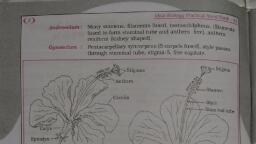
(d) Stigma:, Location: Terminal knob-like part, Function: Serves as the landing place for pollen grains during pollination, , Question D.1, Name the different types of androecium found in flowers., , Solution D.1, Types of androecium in flowers:, 1. Polyandrous: When the stamens of a flower are free, the condition is called polyandrous., 2. Monadelphous: When the filaments of anthers in a flower are fused into one group, the, condition is called monadelphous., 3. Diadelphous: When the filaments of anthers in a flower are fused into two groups, the, condition is called diadelphous., 4. Polyadelphous: When the filaments of anthers in a flower are fused into more than two groups,, the condition is called polyadelphous., Question D.2, Name the type of androecium found in, (a) China rose, (b) Bombax, (c) Pea, , Solution D.2, (a) China rose: Monadelphous, (b) Bombax: Polyadelphous, (c) Pea: Diadelphous, , Question E.1, Given below are two figures (A and B) of a certain part of a flower. Study the figures carefully and, answer the following questions:, , (a) Which major organ of a flower does the figure A represent? What is the collective term for this organ, ?, (b) Are the contents of the pollen sacs in B male or female?, (c) Can you state how the contents of the pollen sacs would come out?, , Solution E.1
Page 5 :
(a) Figure A represents stamen. Stamens collectively form Androecium., (b) Contents of the pollen sacs in B are male gametes., (c) The contents of the pollen sacs would come out through agents like air, wind, insects leading to, pollination in flowers., , Question E. 2, What are bracts? State their function., Solution E. 2, When a flower arises in the axil of a leaf-like structure, this structure is known as bract. Because, bracts are large and brightly coloured structures, they are often mistaken for petals. This helps to, attract insects for pollination., Question E. 3, Explain the terms Monadelphous, Diadelphous and Polyadelphous. In each case name a flower, possessing such an androecium., Solution E. 3, , Condition of androecium, , Explanation, , Example of flower, , Monadelphous, , Filaments of the anthers in a flower are, fused into one group, , Hibiscus, , Diadelphous, , Filaments of the anthers in a flower are, fused into two groups, , Pea, , Polyadelphous, , Filaments of the anthers in a flower are, fused into more than two groups, , Bombax