Page 1 :
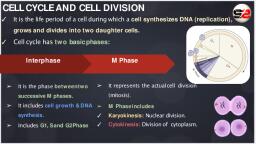
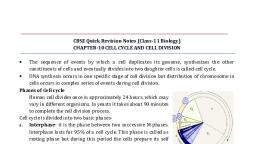
Cell Cycle and, , Cell Division, Alorganisms start their life from a single cell and grow by the addition of new cells. The, the division of pre-existing cells., new cells arise by, suggested by Rudolf Virchow in 1858 in a particular statement Omnis, that the continuity of, Cellula e Cellula, means 'every cell produces from a cell. This states, , This idea, , was, , life depends, , on, , cell reproduction, , or, , cell division., , Cell Cycle, , 1953. It is defined as the series of events, Cell cycle was introduced by Howard and Pele in, and synthesises other cell components and then, by which a cell duplicates its genome, , divides into two daughter cells., , Phases of Cell Cycle, Cel cycle occurs in the following two phases, , ytoKinesis, , 1. Interphase (undividing phase), 2. MPhase or Mitosis Phase (dividing phase), , e, l, o, p, h, a, s, e, An, a, p, h, a, s, e, Me, t, a, p, h, a, s, e, Prophase, , 1. Interphase, , (Undividing Phase), represents the phase between two successive, , M, , than 95% of, whole duration of cell cycle. Though it is called, , ases. It constitutes or lasts for, , more, , Growth and, , preparation, for cell, , division, , Go, , Growth, , G, , G2, , S, , Growth and, , duplication of, DNA, , ne, during whicn, resting phase, but it is the timethemselves, for, the, , newly, , division, , formed cells prepare, and, ie., to undergo both growth, in an orderly manner., , replication, , DNA, , aSBudAUI, Cell Cycle, , resting
Page 2 :
Encyclopedia OF GENE RAI, , IENC, , 456, Interphase involves three phases as given, , S Phase, , G1 Phase, , time between, are, , represents, , phase,, DNA, initiation of, , First gap, , and, , metabolically, , active,, , carbohydrates,, , remains, , replication,, , grow, , below, , mitosis, , Interphase, , cells, , continuously,, , produce, , replication, , replicaion, occurs, DNA, content doubles from, 2C to 4C., , content, , etc, DNA, lipids, proteins, not o c C u r ., , the same,, , Synthesis phase, DNA, , do, , G2 Phase, , phase for cell division,, phase, preparatory, lead to cell dvision or mitosis, and RNA synthesises,, , Second gap, , proteins, , 2. M Phase (Dividing Phase), , It is the phase of cell division in which already duplicated chromosomes get distrihuted, two daughter nuclei. It starts with the nuclear division (karyokinesis) and terminates, , ter, , cytokinesis., , Karyokinesis is the separation of daughter chromosomes and nucleus division and cytokine, , is the division of cytoplasm., During this phase, all components of the cell reorganise for cell division. Since. the numbers, chromosomes remain same in both parent and progeny cells, it 1s also knaown as equation, , division., , Cell Division, It is a very important phenomenon in all living organisms. Concept of cell division was firsty, propounded by a scientist Nageli and was observed by Flemming in 1882 in reptelean Tritur, mascules and gave it a name mitosis. Its complete extensive and exclusive study was done by, Belar in 1920. This is also called cell production., , Modes of Cell Division, Cell division usually occurs in following three ways, , 1. Amitosis, , 3. Meiosis, , 2. Mitosis, , 1. Amitosis, It is very rare and is not considered an exact mode of cell division. It occurs only insor, specialised cells like mammalian cartilage. embryonic membrane of some vertebrates,, tissues, diseased tissues, etc., , CytoplasnRaeleis Cell membrane, , Dividing Nucleus, , Daughter, cells, , Stages in Amitosis, , 2. Mitosis, , ns, , It was first explained by Eduard Strasburger. It usually takes place in somatic cells, , a, , as somatic division., Mitosis occurs in gonads for the multiplication of undifferentiated germ cells. It isa comgin, , Thus, it is known, , ontinuou, , em, , process that gives rise to two identical cells but the number of chromosomes in ti, , the same., , It occurs in various phases such as prophase, metaphase, anaphase, telophase and trer, , Vtokiness
Page 3 :
CYCLE, CELL, , AND CELL DIVISION, , 457, Different Phases, ***, , ************, , Prophase, , of, , Mitosis, , First and the longest phase of cell division. It continues for, , about 50 minutes., , Aster, , Centriole, , Nuclear envelope, Nucleolus, Pair of chromatids, , (chromosomes), , Centromere, , Involves the condensation of chromosomal material., Nucleoli and nuclear envelope, disappears., , Duplicated chromosomes have two identical sister, chromatids which are held together by a disc-Ike, structure (kinetochore) at centromere., , Spindles push centriole pairs to the opposite ends (poles)., , in plants, development of spindle fibres occur without the, , involvement of centrioles., *~**~~*~~~--, , Metaphase, , Short and simple phase that lasts for only 2-10 minutes., , Metaphase is the most suitable time to determine the, , Spindle fibres, , (microtubules), Centromeres on, 'equator of spindle, , number of chromosome and to study their morphology., Chromosome move towards the equatorial plane of the, , spindle., Spindle fibres extends towards the chromosome and, , attaches to the kinetochore., At equator of the spindle, the chromosomes get arranged, in the form of a plate called metaphase plate and the, , chromosome reaches to the equator., *************~*~*********, , Anaphase, , I t continues for about 2-3 minutes only., , As each chromosome moves away from the equatorial, plate, the centromeres of each chromosome splits and the, Sister chromatids separates to move towards the opposite, , Chromatids are, , pulled apart, , poles., The spindle fibres elongate and cell becomes longer and, anaphase ends when all the chromatids reaches the, , opposite poles., The chromosomes that have reached their respective, , Telophase, Pair of centrioles, -Nucleolus, Chromatin threads, , -Nuclear envelope, , poles start to decondense and lose their individuality., Reconstructuon of nuclear envelope occur in each group, of chromosomes., The chromosomes gradually uncoil and become long and, slender and are at opposite poles., , Spindle fibres get disappear, Cytokinesis beginning, (division of the cell), , Viscosity of cytoplasm decreases, which would generally, increase in prophase., Cell organelles like nucleolus, golgi complex and ER are, , reformed again, , Cytokinesis, (b) Cytokinesis, , a), , Cytokinesis in animal cell, leavage furrow Contracting ring o, , in, , plant cell, , cell wall, , New cell wall, , microfilaments, , Membrane, Daughter cells, , Cell plate, , Daughter cells, , bounded vesicle, , At t, , organelles in two daughter cells, end O mitosis, division of cytoplasm and equal distribution or cell, cell divic, larger, ivides into two smaller, OCCurs byCellrocess, original, the pro, of cytokinesis. During this process, the, Entical, , ,, , Which individually, , and, takes food, grow, divide, , the process continues., , **************
Page 4 :
Encyclopedia oF G ENERAI, , AL SCIENCE, , 458, development, in the growth, Significance of Mitosis It helps wounds;, the chromo, maintaining, in, and repair of, organisms; in the healing, and, , of, , e, , celidar, romosome numhe, NDer, , etc., and nucleocytoplasmic ratio,, , 3. Meiosis, , 1905. Meiosis as divisia, JB Farmer and Moore in, The term meiosis was given by, OCe, due to which gametes (sex cells) are prod, restricted to only reproductive cells, haOcc, rise, to, to, divides, four, give, four haploid cels, which a diploid cell, , particular time duriDg, various protists ana, in animals, Some lower plants,, It basically produce gametes, asexual reproductive bodies lingi, forms, Meiosis in asexually reproducing organisms, , at, , a, , chromosomes in the, , of number of, As meiosis results in the reduction, reduction division., half, so it is also known as, that Occur successively, It consists of two stages of division, , in an, , daughter spores, , daughter cells by, , organism with, , onns, , time, , chromosome replication., , i) First Meiotic Division (Meiosis I), (ii) Second Meiotic Division (Meiosis lI), ), , Meiosis I, , In this phase of division, parental chromoSomes replicate to, , duce, , identical sister chromatids and the number of chromosomes reduces from dininid, and hence, this type of division is called heterotypic division, , (2n), , to, , haploid (n), , four phases of division as described below, Prophasel The prophase I of meiosis is more longer than the prophase of mitosis andt, Like mitosis, it also involves the, , than 90% of time required for meiosis., Prophase I is further divided into 5 sub-stages such as leptotene, zygotene, pachytene, , takes, , more, , diplotene and diakinesis., Metaphase I During the course of this phase, spindle shifts to the position formerly, taken by nucleus and the synapsed pair of chromosomes (bivalent) get arranged around, the equator of the spindle and are attached by their centromere., , of, Anaphase I During anaphase I, homologOus chromosomes, , each, , pair gets separated and, , Reduction of chromosomes, , half of the chromosomes move to each pole., chromosome at individual poles is still double and have two chromatids., , occur, , and each, , the end or, The arrival of homologous chromosome at opposite pole shows, to, meiosis I. During this phase, chromosomes uncoil and get elongated. Cytoplasm tends a, in, formation, cell and by cell plate, get divided by cleavage (constriction) in an animal, one, nucleus., with, each, two, cells, cell and produces, , Telophase I, , plant, ic, (i1) Meiosis II The meiotic division is exactly the same in overall process as, division. There is no reduction in the number of chromosomes and the haploid nu, divide mitotically in order to produce four haploid daughter nuclei. Thus, td, , níy, , diploid nucleus which undergoes meiosis produces four haploid nuclei. 1nE, difference between mitosis and meiosis II is that interphase do not prehe, prophase in meiosis. It gets initiated immediately after cytokinesis, usually beroi, chromosomes have been fully elongated., , CE, , After meiosis II, four daughter cells are formed from the original single palc, and each one is haploid (n ) in nature., The phases involved in meiosis II are prophase lI, metaphase II, anaphase II andtelog, , hasell, , chanism, , meesin, Significance of Meiosis Meiosis is significantly proved to be the important, of, number chror from one, in, organism because this process bring stability in the, living, , an organism. It also increases genetic variability in the population of organisi, generation to next. As variations are, a source, , of, , new, , genetic, , variation., , important to the process of evolution, Ine, , acts as