Page 1 :
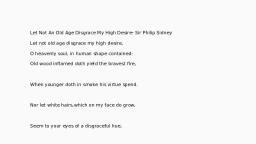
2., Let Not Old Age Disgrace My High Desire, Philip Sidney, Sir Philip Sidney (1554-86), like his famous contemporaries-William, Shakespeare, Edmund Spenser, and Walter Raleigh-belongs to the Elizabethan, age. He was born in 1554 in Kent, England, and rose to become a pillar of, the Tudor society. A very versatile man, Sidney combined different roles, like that of a courtier, soldier, poet and explorer. Added to this multifaceted, personality, Sidney was also a critic. During Sidney's time, the sonnets of, Wyatt and Surrey were gaining popularity and poetry was accepted as a, respectable genre. Yet some critics questioned poetry's claim to truth and, beauty. Sidney wrote a fine piece of criticism called A Defence of Poesy, or An Apologie for Poetry in approximately 1579, and it was published in, 1595, after his death. It is believed that Sidney wrote this in response to, an attack by Stephen Gosson (a former playwright) on drama and poetry., This single work places him among the ranks of major poet-critics such, as T. S. Eliot and Matthew Arnold., 'Let Not Old Age Disgrace My High Desire' is a sonnet which addresses, the virtues of old age., Let not old age disgrace my high desire,, O heavenly soule, in humaine shape conteind,, Old wood inflam'de, doth yeeld the bravest fire,, When yonger dooth in smoke his vertue spend,, Ne let white hares, which on my face doo grow,, Seeme to your eyes of a disgraceful hewe:, Since whitenesse doth present the sweetest show,, Which makes all eyes doo honour unto you.