Page 1 :
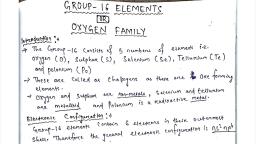
Group 16, , ELEMENTS
Page 3 :
Polonium occurs in nature as a decay, product of thorium and uranium minerals., , Livermorium is a synthetic radioactive element., , very short half-life (only a small fraction of one second), , This limits the study of properties of Lv., , Table 7.6: Some Physical Properties of Group 16 Elements, , eas) 3084, , Atomic number, , Atomic mass/g mol', Electronic configuration, Covalent radius/(pm)*, lonic radius, E* /pm, Electron gain enthalpy,, /A,,H kJ mol, lonisation enthalpy (A,H,), /kJ mo!", Electronegativity, Density /g cm™ (298 K), Melting point/K, Boiling point/K, , . Oxidation states*, , , , , , oO, , 16.00, [He]2s’2p*, , 140, -141, , 1314, 3.50, , 1.32°, , -2,-1,1,2, , , , =), , 16, , 32.06, , [Ne]3s°3p*, 104, , 184, , +200, , 1000, , 2.58, 2.06", 393°, 718, -2,2,4.6, , , , HoT, , 34, , 78.96, [Ar]3d"°4s"4p*, 117, , 198, , -195, , 941, , 2.55, 4.19°, 490, , 958, -2,2,4,6, , , , , , se, , 52, , 127.60, [Kr]4d"’5s’5p*, 137, , 221, , -190, , 869, , 2.01, 6.25, , 1260, -2,2,4,6, , Po, , , , 84, 210.00, [Xe]4/“5d'°6s'6p*, 146, , 230”, , -174, , 813, , 1.76, , 520, 1235, , , , , , 2,4 ]

Page 4 :
Electronic Configuration, , ns 2np 4. Atomic and lonic Radii, Due to increase in the number of shells, atomic and ionic, , radii increase from top to bottom in the group., , The size of oxygen atom is, however, exceptionally small., , lonisation Enthalpy, decreases down the group, , lower ionisation enthalpy values compared to those of Group15, Electron Gain Enthalpy, , less negative electron gain enthalpy than sulphur., , However, from sulphur onwards the value again, , becomes less negative upto polonium, Electronegativity, , Next to fluorine, oxygen has the highest electronegativity value., Within the group, electronegativity decreases with an, increase in atomic number., , , , This implies that the metallic character, increases from oxygen to polonium.
Page 5 :
Physical Properties, , Oxygen and sulphur are non-metals, , selenium and tellurium metalloids,, polonium is a metal( radioactive (Half-life 13.8 days))., , All these elements exhibit allotropy., , The melting and boiling points increase with an increase in atomic, number down the group, , oxygen exists as diatomic molecule (02 ) whereas, sulphur exists as polyatomic molecule (S8 )., , Chemical Properties, , The stability of -2 oxidation state decreases down the group., , . Since electronegativity of oxygen is very high, it shows only negative oxidation state as -2, except in the case of OF2 where its oxidation state is + 2., , Other elements of the, group exhibit + 2, + 4, + 6 oxidation states but + 4 and + 6 are more common., , Sulphur, selenium and tellurium usually show + 4 oxidation, state in their compounds with oxygen and + 6 with fluorine., , The stability of + 6 oxidation state decreases down the group and stability of + 4, oxidation state increases (inert pair effect)., , Bonding in +4 and +6 oxidation states is primarily covalent.