Page 2 :
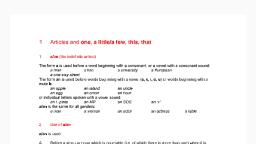
, , , , , , , , , , , , , 5. (a little/a few and little/few), A. a little/little (adjectives) are used before, uncountable nouns:, a little salt/little salt, , a few/few (adjectives) are used before plural nouns:, a few people/few people, All four forms can also be used as pronouns, either, alone or with of:, Sugar? - A little, please., Only a few of these are any good.
Page 3 :
, , , , , , , , , , B. a little, a few (adjectives and pronouns), , a little is a small amount, or what the speaker considers a, small amount. a few is a small number, or what the, speaker considers a small number., only placed before a little/a few emphasizes that the, number or amount really is small in the speaker's opinion:, , Only a few of our customers have accounts., But quite placed before a few increases the number, considerably:, I have quite a few books on art. (quite a lot of books)
Page 4 :
, , C. little and few (adjectives and pronouns), , , , little and few denote scarcity or lack and have almost, the force of a negative:, , , , , , , There was little time for consultation., Little is known about the side-effects of this drug., Few towns have such splendid trees., This use of little and few is mainly confined to written, English (probably because in conversation little and, few might easily be mistaken for a little/a few). In, conversation, therefore, little and few are normally, replaced by hardly any.
Page 5 :
, , , , , , , , , , , , A negative verb + much/many is also possible:, We saw little = We saw hardly anything/We didn't see much., Tourists come here but few stay overnight =, Tourists come here but hardly any stay overnight., But little and few can be used more freely when they are, qualified by so, very, too, extremely, comparatively, relatively, etc., fewer (comparative) can also be used more freely., , I'm unwilling to try a drug I know so little about., They have too many technicians, we have too few., There are fewer butterflies every year.
Page 6 :
, , , , , , , , , , , , , D. a little/little (adverbs), , 1. a little can be used:, (a) with verbs:, It rained a little during the night., They grumbled a little about having to wait., (b) with 'unfavourable' adjectives and adverbs:, a little anxious a little unwillingly, a little annoyed a little impatiently
Page 7 :
, , , , , , , , (c) with comparative adjectives or adverbs:, The paper should be a little thicker., Can't you walk a little faster?, rather could replace a little in (b) and can also, be used before comparatives, though a little, is more usual., , In colloquial English a bit could be used, instead of a little in all the above examples.
Page 8 :
, , , , , , , , , , , 2. little is used chiefly with better or more in fairly formal, style:, His second suggestion was little (= not much) better than, his first., He was little (= not much) more than a child when his, father died., It can also, in formal English, be placed before certain, verbs, for example expect, know, suspect, think:, , He little expected to find himself in prison. He little, thought that one day...
Page 9 :
, , , , , Note also the adjectives little-known and, little-used:, a little-used footpath, a little-known painter
Page 10 :
, , Fill in the blanks with correct words:, , , , , Q1. You will find that a Union Minister invariably has a splendid house, with .......... rooms., , , , , A. Decorated, , , , , B. Spacious, , , , , C. Small, , , , , , D. Congested
Page 11 :
, , Fill in the blanks with correct words:, , , , , Q2. Children are........ By nature., , , , , A. Depressed, , , , , B. Sluggish, , , , , , C. Credulous, , , , , D. Lazy
Page 12 :
, , Fill in the blanks with correct words:, , , , , Q3. what you say may be true, but I hold exactly the......., , , , , A. Obverse, , , , , B. Logical, , , , , C. Analytical, , , , , , , D. Concerned
Page 13 :
, , Fill in the blanks with correct words:, , , , , Q4. He....... At M.F. Hussain's painting in delight., , , , , D A. Stared, , , , , B. Glanced, , , , , , C. Gazed, , , , , D. Peered
Page 14 :
, , Choose the explanation that catches the spirit of Idiom given in each question:, , , , , Q5. To end up in smoke., , , , , , A. To ruin oneself, , , , , , B. To overcome someone, , , , , , C. To excite great applause, , , , , , , D. To be completely misunderstood
Page 15 :
, , Choose the explanation that catches the spirit of Idiom given in each question:, , , , , Q6. To show one's white feather., , , , , , A. To show arrogance, , , , , , B. To become polite, , , , , , C. To seek peace, , , , , , , D. To show signs of cowardice
Page 16 :
, , , , Choose the explanation that catches the spirit of Idiom given in each, question:, Q7. Gift of the gab., , , , , A. To be lucky, , , , , B. To have talent for speaking, , , , , C. To get something free, , , , , , , D. To distributes gifts




 Learn better on this topic