Notes of All Classes, Science & All Subjects Physics Pdf Formula Sheet - Study Material
Page 1 :
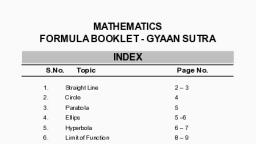
PHYSICS, FORMULA BOOKLET - GYAAN SUTRA, INDEX, S.No., 1., 2., 3., 4., 5., 6., 7., 8., 9., 10., 11., 12., 13., 14., 15., 16., 17., 18., 19., 20., 21., 22., 23., 24., 25., 26., 27., 28., 29., , Topic, , Page No., , Unit and Dimension, Rectilinear Motion, Projectile Motion & Vector, Relavitve Motion, Newton’s Laws of Motion, Friction, Work, Power & Energy, Circular Motion, Centre of Mass, Rigid Body Dynamics, Simple Harmonic Motion, Sting Wave, Heat & Thermodynamics, Electrostatics, Current Electricity, Capacitance, Alternating Current, Magnetic Effect of Current & Magnetic, force on charge, , 2, 3–4, 5–5, 5–7, 7–9, 9–9, 10 – 11, 11 – 14, 14 – 18, 18 – 25, 26 – 28, 29 – 31, 31 – 37, 37 – 40, 41 – 47, 47 – 51, 52 – 54, , Electromagnetic Induction, Geometrical Optics, Modern Physics, Wave Optics, Gravitation, Fluid Mechanics & Properties of Matter, Sound Wave, Electro Magnetic Waves, Error and Measurement, Principle of Communication, Semiconductor, , 56 – 59, 59 – 66, 67 – 70, 70 – 73, 73 – 75, 75 – 77, 77 – 79, 79 – 80, 80 – 81, 82 – 83, 84 – 85, , 54 – 56, , Page # 1
Page 2 :
PHYSICS, FORMULA BOOKLET - GYAAN SUTRAA, UNIT AND DIMENSIONS, Unit :, Measurement of any physical quantity is expressed in terms of an, internationally accepted certain basic standard called unit., *, , Fundamental Units., S.No., , Physical Quantity, , SI Unit, , Symbol, , 1, , Length, , Metre, , m, , 2, , Mass, , Kilogram, , Kg, , 3, , Time, , Second, , S, , 4, , Electric Current, , Ampere, , A, , 5, , Temperature, , Kelvin, , K, , 6, , Luminous Intensity, , Candela, , Cd, , 7, , Amount of Substance, , Mole, , mol, , *, , Supplementary Units :, S.No., , Physical Quantity, , SI Unit, , Symbol, , 1, , Plane Angle, , radian, , r, , 2, , Solid Angle, , Steradian, , Sr, , *, , Metric Prefixes :, S .N o ., , P re fix, , S ym b o l, , V a lu e, , 1, , C e n ti, , c, , 1 0 –2, , 2, , M ili, , m, , 1 0 –3, , 3, , M icro, , µ, , 1 0 –6, , 4, , Nano, , n, , 1 0 –9, , 5, , P ico, , p, , 10, , 6, , K ilo, , K, , 10, , 3, , 7, , M ega, , M, , 10, , 6, , –12, , Page # 2
Page 3 :
RECTILINEAR MOTION, Average Velocity (in an interval) :, r ri, Total displacement, = f, t, Total time taken, Average Speed (in an interval), , v av = v = <v> =, , Average Speed =, , Total distance travelled, Total time taken, , Instantaneous Velocity (at an instant) :, , r , , v inst = lim, , , t 0 t , Average acceleration (in an interval):, , , , , v, v f vi, a av =, =, t, t, Instantaneous Acceleration (at an instant):, , v , , dv, , , a =, = lim, t 0 t , dt, , , Graphs in Uniformly Accelerated Motion along a straight line, (a 0), , x is a quadratic polynomial in terms of t. Hence x t graph is a, parabola., x, , x, a<0, , xi, , xi, , a>0, t, , 0, , t, , 0, , x-t graph, v is a linear polynomial in terms of t. Hence vt graph is a straight line of, slope a., v, e, op, sl, , =, , v, , a, u, , slo, , pe, =, , a, , u, a is positive, 0, , t, , a is negative, 0, , t, , Page # 3
Page 4 :
v-t graph, at graph is a horizontal line because a is constant., a, a, , a, , positive, acceleration, , 0, a, , t, , 0, , negative, acceleration, , a-t graph, Maxima & Minima, , dy, d, =0 &, dx, dx, and, , dy , , < 0 at maximum, dx , , dy, d, =0&, dx, dx, , dy , , > 0 at minima., dx , , Equations of Motion (for constant acceleration), (a), v = u + at, (b), (c), , 1 2, 1 2, at s = vt , at, 2, 2, v 2 = u2 + 2as, , s = ut +, , (u v ), t, (e), 2, For freely falling bodies : (u = 0), (taking upward direction as positive), (a), v = – gt, , (d), , s=, , (b), , s=–, , (c), , 1 2, gt, 2, v 2 = – 2gs, , (d), , sn = –, , s = vt , , 1 2, gt, 2, , xf = xi + ut +, , sn = u +, , 1 2, at, 2, , a, (2n 1), 2, , hf = hi –, , 1 2, gt, 2, , g, (2n 1), 2, , Page # 4
Page 5 :
PROJECTILE MOTION & VECTORS, 2u sin , g, , Time of flight :, , T=, , Horizontal range :, , R=, , u 2 sin 2, g, , Maximum height :, , H=, , u 2 sin 2 , 2g, , Trajectory equation (equation of path) :, y = x tan –, , gx 2, 2, , 2, , 2u cos , , = x tan (1 –, , x, ), R, , Projection on an inclined plane, y, , , , , x, Up the Incline, , Down the Incline, , 2u 2 sin cos( ), g cos 2 , , 2u 2 sin cos( ), , Time of flight, , 2u sin , g cos , , 2u sin , g cos , , Angle of projection with, incline plane for maximum, range, , , , 4 2, , , , 4 2, , Maximum Range, , u2, g(1 sin ), , u2, g(1 sin ), , Range, , g cos 2 , , RELATIVE MOTION, , , , v AB ( velocity of A with respect to B ) v A v B, , , , a AB (acceleration of A with respect to B ) a A aB, , Relative motion along straight line -, , , , , x BA x B x A, , Page # 5
Page 6 :
CROSSING RIVER, A boat or man in a river always moves in the direction of resultant velocity, of velocity of boat (or man) and velocity of river flow., 1., , Shortest Time :, , Velocity along the river, v x = v R., Velocity perpendicular to the river, v f = v mR, The net speed is given by v m =, 2., , 2, v mR, v R2, , Shortest Path :, velocity along the river, v x = 0, and velocity perpendicular to river v y =, The net speed is given by v m =, , 2, v mR, v R2, , 2, v mR, v R2, , at an angle of 90º with the river direction., velocity v y is used only to cross the river,, Page # 6
Page 7 :
d, therefore time to cross the river, t = v =, y, , d, 2, v mR, , v R2, , and velocity v x is zero, therefore, in this case the drift should be zero., , v R – v mR sin = 0, or, v R = v mR sin , vR, = sin–1 , v mR, RAIN PROBLEMS, , , , v Rm = v R – v m, , or, , , , , , , or, , v Rm =, , 2, v R2 v m, , NEWTON'S LAWS OF MOTION, 1., , From third law of motion, , F AB FBA, F AB = Force on A due to B, FBA = Force on B due to A, 2., , From second law of motion, Fx =, , 5., , 6., , 7., , 8., , dPx, = max, dt, , Fy =, , dPy, dt, , = may, , Fz =, , dPz, = maz, dt, , WEIGHING MACHINE :, A weighing machine does not measure the weight but measures the, force exerted by object on its upper surface., , , SPRING FORCE, F kx, x is displacement of the free end from its natural length or deformation, of the spring where K = spring constant., SPRING PROPERTY K × = constant, = Natural length of spring., If spring is cut into two in the ratio m : n then spring constant is given, by, 1 =, , m, ;, mn, , 2 =, , n., mn, , k = k 11 = k 22, , Page # 7
Page 8 :
9., , 11., , 12., , For series combination of springs, , 1, 1, 1, , , ......., k eq k 1 k 2, , For parallel combination of spring, , keq = k1 + k2 + k3 ............, , SPRING BALANCE:, It does not measure the weight. t measures the force exerted by the, object at the hook., Remember :, , a, , (m 2 m1 )g, m1 m 2, , T, , 2m1m2g, m1 m2, , Vp =, , V1 V2, 2, , aP =, , a1 a2, 2, , WEDGE CONSTRAINT:, , Components of velocity along perpendicular direction to the contact, plane of the two objects is always equal if there is no deformations, and they remain in contact., , Page # 8
Page 9 :
13., , NEWTON’S LAW FOR A SYSTEM, , , , , Fext m1a1 m2 a2 m3 a3 ......, , Fext Net external force on the system., m 1, m 2, m 3 are the masses of the objects of the system and, , a1,a2 ,a3 are the acceleration of the objects respectively.., NEWTON’S LAW FOR NON INERTIAL FRAME :, , , , , FRe al FPseudo ma, , Net sum of real and pseudo force is taken in the resultant force., , , a = Acceleration of the particle in the non inertial frame, , FPseudo = m a, Frame, , (a) Inertial reference frame: Frame of reference moving with constant velocity., (b) Non-inertial reference frame: A frame of reference moving with, non-zero acceleration., , FRICTION, Friction force is of two types., (a), Kinetic, (b), Static, KINETIC FRICTION : f k = k N, The proportionality constant k is called the coefficient of kinetic friction, and its value depends on the nature of the two surfaces in contact., STATIC FRICTION :, It exists between the two surfaces when there is tendency of relative motion but no relative motion along the two contact surfaces., This means static friction is a variable and self adjusting force., However it has a maximum value called limiting friction., f max = sN, 0 f s f smax, , f ri, ct, io, n, , fstatic, , st, at, ic, , Friction, , 14., , maximum, , s N, , kN, , Applied Force, , Page # 9
Page 10 :
WORK, POWER & ENERGY, WORK DONE BY CONSTANT FORCE :, , W= F . S, WORK DONE BY MULTIPLE FORCES, , , , , F = F 1 + F 2 + F 3 + ....., , , W = [ F ] . S, ...(i), , , , , , , W = F 1 . S + F 2 . S + F 3 . S + ....., or, W = W 1 + W 2 + W 3 + .........., WORK DONE BY A VARIABLE FORCE, dW =, , , F.ds, , RELATION BETWEEN MOMENTUM AND KINETIC ENERGY, p2, and P =, 2m, , K=, , 2 m K ; P = linear momentum, , POTENTIAL ENERGY, , , , U2, , U1, , dU , , U, , , , r, , , , r2, , r1, , , F dr, , i.e.,, , U 2 U1 , , , , r2, r1, , , F dr W, , , F d r W, , , , CONSERVATIVE FORCES, F= –, , U, r, , WORK-ENERGY THEOREM, W C + W NC + W PS = K, Modified Form of Work-Energy Theorem, W C = U, W NC + W PS = K + U, W NC + W PS = E, , Page # 10
Page 11 :
POWER, The average power ( P or pav) delivered by an agent is given by P or, pav =, , W, t, , , , dS, , F dS, P, = F, = F . v, dt, dt, , CIRCULAR MOTION, 1., , Average angular velocity, , , , av =, , 2 1, , =, t 2 t1, t, , , , 2., , Instantaneous angular velocity, , 3., , Average angular acceleration, , 4., , Instantaneous angular acceleration, , 5., 7., , , , =, , d, dt, , , , , , 2 1, , av = t t =, t, 2, 1, , d, d, =, dt, d, , Relation between speed and angular velocity v = r and v r, Tangential acceleration (rate of change of speed), , , , at =, , , , =, , dV, d, dr, =r, = , dt, dt, dt, , 8., , Radial or normal or centripetal acceleration , , 9., , Total acceleration, , , , a a t a r a = (at2 + ar2)1/2, , , , , Where a t r and a r v, , ar =, , v2, = 2r, r, at, a, , O, ar or a c, , v, , , , P, , Page # 11
Page 12 :
10., , Angular acceleration, , d, , =, (Non-uniform circular motion), , dt, , , , , W, ACotation, R, , 12., , 13., , Radius of curvature R =, , v2, mv 2, =, a, F, , If y is a function of x., , i.e. y = f(x), , , , R=, , dy 2 , 1 , dx, , , 3/2, , d2 y, dx 2, , Normal reaction of road on a concave bridge, N = mg cos +, , , , mv 2, r, , O, , N, , , , concave, bridge, , V, , mgcos, mg, , 14., , Normal reaction on a convex bridge, N = mg cos –, , , N, , mv 2, r, , V, , , , convex, bridge, , mgcos, , mg, , O, , 15., , Skidding of vehicle on a level road, , , , v safe , , gr, , 16., , Skidding of an object on a rotating platform, , , , max =, , g / r, , Page # 12
Page 13 :
17., , Bending of cyclist, , 18., , Banking of road without friction, , 19., , Banking of road with friction , , 20., , tan =, , v2, rg, , tan =, , v2, rg, , v2, tan , , rg 1 tan , Maximum also minimum safe speed on a banked frictional road, rg ( tan ) , Vmax , , (1 tan ) , , 1/ 2, , Vmin, , rg (tan ) , , , (1 tan ) , , 1/ 2, , 21., , Centrifugal force (pseudo force) f = m2 r, acts outwards when the, particle itself is taken as a frame., , 22., , Effect of earths rotation on apparent weight N = mg – mR2 cos2 ;, where latitude at a place, , 23., , Various quantities for a critical condition in a vertical loop at different, positions, C, O, , D, , B, , , A, , P, N, , ×, (1), Vmin 4gL, (for completing the circle), , (2), , (3), , Vmin 4gL, , Vmin 4gL, , (for completing the circle) (for completing the circle), , Page # 13
Page 14 :
24., , Conical pendulum :, fixed pointor, suspension, O, /////////////, , L, , T, , T cos , , h, , , r, , mg, , T cos = mg, T sin = m2 r, Time period =, , , 25., , 2, , L cos , g, , Relations amoung angular variables :, 0 Initial ang. velocity, = 0 + t, d , or , , r, , O, a, r, , (Perpendicular, to plane of paper, directed outwards, for ACW rotation), , at or V, , Find angular velocity, Const. angular acceleration, Angular displacement, , 1 2, t, 2, 2 = 02 + 2 , , = 0t +, , CENTRE OF MASS, , , , Mass Moment : M = m r, CENTRE OF MASS OF A SYSTEM OF 'N' DISCRETE PARTICLES, , , , m1r1 m 2 r2 ........ m n rn, , , ; rcm, rcm =, m1 m 2 ........ mn, , Page # 14
Page 15 :
n, , , , m r, , i i, , =, , i 1, n, , m, , 1, , rcm =, M, , n, , , , m r, , i i, , i 1, , i, , i 1, , CENTRE OF MASS OF A CONTINUOUS MASS DISTRIBUTION, , x cm =, , x dm , y, dm, , cm, , =, , y dm , z, dm, , cm, , =, , z dm, dm, , dm = M (mass of the body), , , , CENTRE OF MASS OF SOME COMMON SYSTEMS, A system of two point masses m1 r1 = m2 r2, , The centre of mass lies closer to the heavier mass., , , , Rectangular plate (By symmetry), , xc =, , b, 2, , yc =, , L, 2, , Page # 15
Page 18 :
(a), , e=1, , (b), , e=0, , (c), , 0<e<1, , Impulse of Reformation = Impulse of Deformation, Velocity of separation = Velocity of approach, Kinetic Energy may be conserved, Elastic collision., Impulse of Reformation = 0, Velocity of separation = 0, Kinetic Energy is not conserved, Perfectly Inelastic collision., Impulse of Reformation < Impulse of Deformation, Velocity of separation < Velocity of approach, , Kinetic Energy is not conserved, Inelastic collision., VARIABLE MASS SYSTEM :, If a mass is added or ejected from a system, at rate kg/s and relative, , velocity v rel (w.r.t. the system), then the force exerted by this mass, , on the system has magnitude v rel ., , Thrust Force ( Ft ), , dm , Ft v rel , , dt , Rocket propulsion :, If gravity is ignored and initial velocity of the rocket u = 0;, m0 , ., m , , v = v r ln , , RIGID BODY DYNAMICS, 1., , RIGID BODY :, VAsin1, A, , A, 1, , VA, , VAcos1, , B, VB, , 2, , B, VBsin2, , VBcos2, , Page # 18
Page 19 :
If the above body is rigid, VA cos 1 = VB cos 2, VBA = relative velocity of point B with respect to point A., , A, , B, VBA, Types of Motion of rigid body, , Pure Rotational, Motion, , Pure Translational, Motion, , 2., , Combined Translational and, Rotational Motion, , MOMENT OF INERTIA (I) :, Definition : Moment of Inertia is defined as the capability of system, to oppose the change produced in the rotational motion of a body., Moment of Inertia is a scalar positive quantity., = mr12 + m 2 r22 +........................., = + + +........................., S units of Moment of Inertia is Kgm 2., Moment of Inertia of :, 2.1, A single particle : = mr2, where m = mass of the particle, r = perpendicular distance of the particle from the axis about, which moment of Inertia is to be calculated, 2.2, For many particles (system of particles) :, n, , =, , mr, , 2, , i i, , i1, , 2.3, , For a continuous object :, =, , dmr, , 2, , where dm = mass of a small element, r = perpendicular distance of the particle from the axis, Page # 19
Page 20 :
2.4, , For a larger object :, =, , d, , element, , where d = moment of inertia of a small element, 3., , TWO IMPORTANT THEOREMS ON MOMENT OF INERTIA :, 3.1, Perpendicular Axis Theorem, [Only applicable to plane lamina (that means for 2-D objects only)]., z = x + y, 3.2, , (when object is in x-y plane)., , Parallel Axis Theorem, (Applicable to any type of object):, = cm + Md2, , List of some useful formula :, Object, , Moment of Inertia, , 2, MR 2 (Uniform), 5, , Solid Sphere, , 2, MR 2 (Uniform), 3, , Hollow Sphere, , MR2 (Uniform or Non Uniform), , Page # 20
Page 21 :
Ring., , MR 2, (Uniform), 2, , Disc, , MR 2 (Uniform or Non Uniform), , Hollow cylinder, , MR 2, (Uniform), 2, , Solid cylinder, , ML2, (Uniform), 3, , ML2, (Uniform), 12, , Page # 21
Page 22 :
2m 2, (Uniform), 3, , AB = CD = EF =, , Ma2, (Uniform), 12, , Square Plate, , Ma2, (Uniform), 6, , Square Plate, , =, , M(a 2 b 2 ), (Uniform), 12, , Rectangular Plate, , M(a 2 b 2 ), (Uniform), 12, , Cuboid, Page # 22
Page 24 :
6., , ROTATIONAL EQUILIBRIUM :, For translational equilibrium., , and, , Fx 0, , ............. (i), , Fy 0, , ............. (ii), , The condition of rotational equilibrium is, z 0, , 7., , , ANGULAR MOMENTUM ( L ), 7.1, Angular momentum of a particle about a point., , , L = r P, , L = r × P, , , , L = rpsin, , , L = P× r, 7.3 Angular momentum of a rigid body rotating about fixed axis :, , , L H = H, LH = angular momentum of object about axis H., IH = Moment of Inertia of rigid object about axis H., = angular velocity of the object., 7.4 Conservation of Angular Momentum, Angular momentum of a particle or a system remains constant if, ext = 0 about that point or axis of rotation., 7.5, , Relation between Torque and Angular Momentum, , dL, , =, dt, Torque is change in angular momentum, , Page # 24
Page 25 :
7.6, , Impulse of Torque :, , dt J, , J Change in angular momentum., , For a rigid body, the distance between the particles remain unchanged, during its motion i.e. rP/Q = constant, For velocities, with respect to Q, , with respect to ground, , P, r, Q, , P, r, , r, , , , Q, , , , , , VQ, , wr, VQ, , VP VQ 2 r 2 2 VQ r cos , For acceleration :, , , , are same about every point of the body (or any other point, outside which is rigidly attached to the body)., Dynamics :, , , , cm cm , Fext Ma cm, , , Psystem Mv cm ,, 1, 1, Mv cm2 +, cm 2, 2, 2, , , Angular momentum axis AB = L about C.M. + L of C.M. about AB, , , , L AB cm rcm Mv cm, , Total K.E., , =, , Page # 25
Page 26 :
SIMPLE HARMONIC MOTION, S.H.M., F = – kx, General equation of S.H.M. is x = A sin (t + ); (t + ) is phase of the, motion and is initial phase of the motion., Angular Frequency () :, , =, , 2, = 2f, T, , Time period (T) :, , T=, , 2, m, = 2, , k, , k, m, , Speed :, , v A 2 x2, 2, a = x, , Acceleration :, Kinetic Energy (KE) :, , 1, 1, 1, mv 2 =, m2 (A2 – x2) = k (A2 – x2), 2, 2, 2, , 1, Kx2, 2, , Potential Energy (PE) :, Total Mechanical Energy (TME), = K.E. + P.E. =, , 1, 1, 1, k (A2 – x2) +, Kx2 =, KA2 (which is constant), 2, 2, 2, , SPRING-MASS SYSTEM, , k, , (1), , , smooth surface, , , , T = 2, , m, k, , m, , (2), T = 2, , m1m 2, , where =, known as reduced mass, (m1 m 2 ), K, , Page # 26
Page 27 :
COMBINATION OF SPRINGS, Series Combination :, Parallel combination :, SIMPLE PENDULUM, , T = 2, , 1/keq = 1/k1 + 1/k2, keq = k1 + k2, , , =, 2, g, geff . (in accelerating Refer-, , ence Frame); geff is net acceleration due to pseudo force and gravitational, force., COMPOUND PENDULUM / PHYSICAL PENDULUM, Time period (T) :, , , T = 2 mg, , where, = CM + m2 ; is distance between point of suspension and, centre of mass., TORSIONAL PENDULUM, Time period (T) :, , T = 2, , , C, , where, C = Torsional constant, , Superposition of SHM’s along the same direction, x1 = A1 sin t &, x2 = A2 sin (t + ), A2, A, A1, , If equation of resultant SHM is taken as x = A sin (t + ), A=, , 1., , A12 A 22 2A1A 2 cos , , &, , tan =, , A 2 sin , A1 A 2 cos , , Damped Oscillation, Damping force, , , F – bv, equation of motion is, mdv, = –kx – bv, dt, b2 - 4mK > 0 over damping, , Page # 27
Page 28 :
b2 - 4mK = 0 critical damping, b2 - 4mK < 0 under damping, For small damping the solution is of the form., k b , 1, , x = A 0 e – bt / 2m sin [ t + ], where ' – , m 2m , , , , , , 2, , For small b, angular frequency ' k / m, 0, – bt, , Amplitude A A 0 e 2m, l, , Energy E (t) =, , 1, KA2 e – bt / m, 2, , Quality factor or Q value , Q = 2, , where , ' , 2., , k b2, ., m 4m 2, , , Y , , ', E, = 2, | E |, Y, , b, 2m, , Forced Oscillations And Resonance, External Force F(t) = F0 cos d t, x(t) = A cos (dt + ), F0, , A, , 2 2, 2, m d, , , , , , , 2, , and, d2 b2 , , , (a) Small Damping A , , tan , , v0, d x0, , F0, , , , m 2 2d, , , , (b) Driving Frequency Close to Natural Frequency A , , F0, db, , Page # 28
Page 29 :
STRING WAVES, GENERAL EQUATION OF WAVE MOTION :, 2y, t, , 2, , = v2, , 2y, x 2, , x, ), v, where, y (x, t) should be finite everywhere., , y(x,t) = f (t ±, , , , , x, , f t represents wave travelling in – ve x-axis., v, x, , f t represents wave travelling in + ve x-axis., v, , y = A sin (t ± kx + ), , TERMS RELATED TO WAVE MOTION ( FOR 1-D PROGRESSIVE, SINE WAVE ), (e) Wave number (or propagation constant) (k) :, , k = 2/ =, (rad m –1), v, (f) Phase of wave : The argument of harmonic function (t ± kx + ), is called phase of the wave., Phase difference () : difference in phases of two particles at any, time t., 2, 2, =, x, Also. , t, , T, SPEED OF TRANSVERSE WAVE ALONG A STRING/WIRE., v=, , T, , , where, , T Tension, mass per unit length, , POWER TRANSMITTED ALONG THE STRING BY A SINE WAVE, Average Power P = 22 f 2 A2 v, Intensity, , I=, , P, s, , = 22 f 2 A2 v, , REFLECTION AND REFRACTION OF WAVES, yi = Ai sin (t – k1x), y t A t sin ( t k 2 x) , if incident from rarer to denser medium (v2 < v1), y r A r sin ( t k 1x) , , Page # 29
Page 30 :
y t A t sin (t – k 2 x), if incident from denser to rarer medium. (v 2 > v 1), y r A r sin (t k1x) , (d), Amplitude of reflected & transmitted waves., 2k 1, k1 k 2, Ai, A i & At =, Ar =, k1 k 2, k1 k 2, STANDING/STATIONARY WAVES :(b), y1 = A sin (t – kx + 1), y2 = A sin (t + kx + 2), , 2 1 , , , , sin t 1 2 , y1 + y2 = 2 A cos kx , 2 , 2 , , , , , 2 1 , , represents resultant amplitude at, The quantity 2A cos kx , 2 , , x. At some position resultant amplitude is zero these are called nodes., At some positions resultant amplitude is 2A, these are called antinodes., , (c) Distance between successive nodes or antinodes = ., 2, (d) Distance between successive nodes and antinodes = /4., (e) All the particles in same segment (portion between two successive, nodes) vibrate in same phase., (f) The particles in two consecutive segments vibrate in opposite phase., (g) Since nodes are permanently at rest so energy can not be transmitted across these., VIBRATIONS OF STRINGS ( STANDING WAVE), (a) Fixed at both ends :, 1. Fixed ends will be nodes. So waves for which, 2, , 3, L=, L=, L=, 2, 2, 2, , are possible giving, L=, , as, , n, 2, , or =, , v=, , T, , , fn =, , 2L, where n = 1, 2, 3, ...., n, , n, 2L, , T, , n = no. of loops, , , Page # 30
Page 31 :
(b) String free at one end :, 1. for fundamental mode L =, , , = or = 4L, 4, , fundamental mode, First overtone L =, , 4L, 3, Hence =, 3, 4, , first overtone, , , , so f 1 =, , 3, 4L, , T, (First overtone), , , Second overtone f 2 =, 1, , n , 2, , so f n = , 2L, , 5, 4L, , T, , , T (2n 1) T, , , 4L, , , HEAT & THERMODYNAMICS, Total translational K.E. of gas =, < V2 > =, , 3P, , , Vrms =, , 1, 3, 3, M < V2 > =, PV =, nRT, T, 2, 2, 2, , 3P, =, , , 3 RT, =, Mmol, , 3 KT, m, , Important Points :, – Vrms , , T, , V, , 8 KT, m = 1.59, , Most probable speed Vp =, , KT, m, , 2 KT, = 1.41, m, , Vrms = 1.73, , KT, m, , KT, Vrms > V > Vmp, m, , Degree of freedom :, Mono atomic f = 3, Diatomic f = 5, polyatomic f = 6, Page # 31
Page 32 :
Maxwell’s law of equipartition of energy :, Total K.E. of the molecule = 1/2 f KT, For an ideal gas :, f, nRT, 2, , Internal energy U =, , Workdone in isothermal process :, , W = [2.303 nRT log10, , Internal energy in isothermal process :, Work done in isochoric process :, Change in int. energy in isochoric process :, , Vf, ], Vi, , U = 0, dW = 0, , f, R T = heat given, 2, Isobaric process :, Work done W = nR(Tf – Ti), change in int. energy U = nCv T, heat given Q = U + W, , U = n, , f, , f, R, Cp = 1 R, 2, 2 , Molar heat capacity of ideal gas in terms of R :, , Specific heat :, , Cv =, , (i) for monoatomic gas :, , Cv, , (iii) for triatomic gas :, Cp, , , = 1 , , Mayer’s eq. Cp – Cv = R, , =, , Cv, Cp, , (ii) for diatomic gas :, , In general :, , Cp, , Cv, , Cp, Cv, , = 1.67, , = 1.4, , = 1.33, , 2, f , , for ideal gas only, , Adiabatic process :, Work done W =, , nR (Ti Tf ), 1, Page # 32
Page 33 :
In cyclic process :, Q = W, In a mixture of non-reacting gases :, Mol. wt. =, , n1M1 n2M2, n1 n 2, , Cv =, , n1C v 1 n 2C v 2, n1 n 2, , n1Cp n2 Cp ....., Cp (mix ), 1, 2, = C, = n C n C ...., v ( mix ), 1 v1, 2 v2, , Heat Engines, , Efficiency , , , work done by the engine, heat sup plied to it, , Q, W QH – Q L, 1– L, = Q Q, Q, H, H, H, , Second law of Thermodynamics, Kelvin- Planck Statement, It is impossible to construct an engine, operating in a cycle, which will, produce no effect other than extracting heat from a reservoir and performing an equivalent amount of work., , Page # 33
Page 34 :
Rudlope Classius Statement, It is impossible to make heat f low f rom a body at a lower, temperature to a body at a higher temperature without doing external work, on the working substance, Entropy, f, , Q, change in entropy of the system is S =, S f – Si , T, , , i, , Q, T, , In an adiabatic reversible process, entropy of the system remains constant., Efficiency of Carnot Engine, (1) Operation I (Isothermal Expansion), (2) Operation II (Adiabatic Expansion), (3) Operation III (Isothermal Compression), (4) Operation IV (Adiabatic Compression), Thermal Efficiency of a Carnot engine, V2 V3, Q 2 T2, T, , , 1– 2, V1 V4 Q1 T1 , T1, , Page # 34
Page 35 :
Refrigerator (Heat Pump), Refrigerator, Hot (T2), , Hot (T1), Q2, , Q1, W, , Coefficient of performance, , , Q2, 1, 1, = , =, T, T, W, 1, 1, –1, –1, T2, T2, , Calorimetry and thermal expansion, Types of thermometers :, (a) Liquid Thermometer :, , 0 , × 100, T = , 100 0 , , (b) Gas Thermometer :, Constant volume :, , P P0 , T = P P × 100, 0, 100, , ; P = P0 + g h, , V , T= , T, V V 0, (c) Electrical Resistance Thermometer :, , Constant Pressure :, , R t R0 , T = R R × 100, 0, 100, , Thermal Expansion :, (a) Linear :, L, = L T, 0, , or, , L = L0 (1 + T), , Page # 35
Page 36 :
(b) Area/superficial :, A, = A T, 0, , or, , A = A0 (1 + T), , or, , V = V0 (1 + T), , (c) volume/ cubical :, r=, , V, V0 T, , , , 2 3, Thermal stress of a material :, , , F, , Y, A, , Energy stored per unit volume :, , 1, 1 AY, E, ( L )2, K(L)2, or, 2, 2 L, Variation of time period of pendulum clocks :, , E=, , T =, , 1, T, 2, , T’ < T - clock-fast : time-gain, T’ > T - clock slow : time-loss, CALORIMETRY :, Specific heat S =, , Q, m.T, , Q, n.T, Water equivalent = mWSW, , Molar specific heat C =, , HEAT TRANSFER, Thermal Conduction :, , dQ, dT, = – KA, dt, dx, , Thermal Resistance :, , R=, , , KA, , Page # 36
Page 37 :
Series and parallel combination of rod :, , eq, =, , 1 2, , ....... (when A = A = A = .........), 1, 2, 3, K1 K 2, , (i) Series :, , K eq, , (ii) Parallel :, , Keq Aeq = K1 A1 + K2 A2 + ...... (when 1 = 2 = 3 = .........), , for absorption, reflection and transmission, r+t+a=1, U, Emissive power :, E=, A t, dE, Spectral emissive power :, E =, d, E of a body at T temp., Emissivity :, e=, E of a black body at T temp., E (body ), = E (black body), a (body ), Wein’s Displacement law :, m . T = b., b = 0.282 cm-k, Stefan Boltzmann law :, u = T4, s = 5.67 × 10⁻⁸ W/m2 k4, u = u – u0 = e A (T4 – T04), , Kirchoff’s law :, , Newton’s law of cooling :, , d, = k ( – 0) ; = 0 + (i – 0) e–k t, dt, , ELECTROSTATICS, Coulomb force between two point charges, 1 q1q2, 1 q1q2 , , r̂, 3 r =, 4 0r | r |2, 4 0 r | r |, The electric field intensity at any point is the force experienced, , , F, by unit positive charge, given by E , q0, , , F, , , , , , Electric force on a charge 'q' at the position of electric field, , , , intensity E produced by some source charges is F qE, , , , Electric Potential, , Page # 37
Page 38 :
If (W P)ext is the work required in moving a point charge q from infinity, to a point P, the electric potential of the point P is, Vp , , , , , ( Wp )ext , , q, acc 0, , Potential Difference between two points A and B is, VA – VB, , Formulae of E and potential V, Kq, Kq, Kq , (i), Point charge E= 2 r̂ = 3 r , V =, r, |r|, r, (ii), , (iii), , , , Infinitely long line charge 2 r r̂ = 2Kr̂, 0, r, V = not defined, v B – v A = –2K ln (rB / rA), , Infinite nonconducting thin sheet 2 n̂ ,, 0, , V = not defined, v B v A , (iv), , , rB rA , 2 0, , Uniformly charged ring, KQx, , Eaxis =, , R, , 2, , x2, , , , 3/2, , ,, , Ecentre = 0, , KQ, , KQ, ,, Vcentre =, R, R2 x2, x is the distance from centre along axis., , Vaxis =, , (v), , Infinitely large charged conducting sheet, , , n̂, 0, , , rB rA , 0, Uniformly charged hollow conducting/ nonconducting /solid, conducting sphere, , V = not defined, v B v A , (vi), , , , kQ, , (a), , for E , , (b), , KQ, , E 0 for r < R, V = R, , |r|, , 2, , r̂ , r R, V =, , KQ, r, , Page # 38
Page 39 :
(vii) Uniformly charged solid nonconducting sphere (insulating material), , (a), , , kQ, KQ, E 2 r̂ for r, R,V=, |r|, r, , (b), , , KQ r, r for r, E 3 , R,, 3 0, R, , (viii), , V=, , , (3R2–r2), 6 0, , thin uniformly charged disc (surface charge density is ), , Eaxis = 2, 0, , , x, 1 , 2, , R x2, , , , , , Vaxis =, , 2, R x 2 x, , 2 0 , , , , Work done by external agent in taking a charge q from A to B is, (W ext)AB= q (VB – VA) or (W el ) AB = q (VA – VB) ., , , , The electrostatic potential energy of a point charge, U = qV, , , , U = PE of the system =, U1 U2 ..., = (U12 + U13 + ..... + U1n ) + (U23 + U24 + ...... + U2n ), 2, + (U34 + U35 + ..... + U3n ) ...., , , , Energy Density =, , , , Self Energy of a uniformly charged shell = Uself , , , , 1 2, E, 2, , KQ 2, 2R, Self Energy of a uniformly charged solid non-conducting sphere, 3KQ 2, 5R, Electric Field Intensity Due to Dipole, , 2KP, , (i) on the axis E = 3, r, , , KP, (ii) on the equatorial position : E = – 3, r, , = Uself , , , , (iii) Total electric field at general point O (r,) is Eres =, , KP, r, , 3, , 1 3 cos 2 , , Page # 39
Page 40 :
, , , , Potential Energy of an Electric Dipole in External Electric Field:, , , , U = - p. E, Electric Dipole in Uniform Electric Field :, , , torque p x E ; F = 0, Electric Dipole in Nonuniform Electric Field:, , , E, torque p x E ; U = p E , Net force |F| = p, r, , , , , , Electric Potential Due to Dipole at General Point (r, ) :, , P cos, p.r, , V=, 4 0 r 2, 4 0 r 3, The electric flux over the whole area is given by, , = E.dS = En dS, , , , E, , , , , , S, , S, , Flux using Gauss's law, Flux through a closed surface, , qin, E = E dS =, ., 0, , , , , , Electric field intensity near the conducting surface, =, , , , , n̂, 0, , Electric pressure : Electric pressure at the surface of a conductor is, given by formula, P=, , , , 2, where is the local surface charge density.., 2 0, , Potential difference between points A and B, B, , VB – VA = –, , , , , , E .d r, A, , , , , , , , , E = î x V ĵ x V k̂ z V = – î x ĵ x k̂ z V, , , , , , = – V = –grad V, , Page # 40
Page 42 :
Dependence of Resistance on Temperature :, R = Ro (1 + )., Electric current in resistance, V2 V1, R, ELECTRICAL POWER, P = V, , I=, , 5., , Energy =, , pdt, , P = I2R = V =, , V2, ., R, , H = Vt = 2 Rt =, , V2, t, R, , H = 2 RT Joule =, , 2RT, Calorie, 4.2, , 9., , KIRCHHOFF'S LAWS, 9.1, Kirchhoff’s Current Law (Junction law), in = out, 9.2, Kirchhoff’s Voltage Law (Loop law), IR + EMF =0”., , 10., , COMBINATION OF RESISTANCES :, Resistances in Series:, R = R1 + R2 + R3 +................ + Rn (this means Req is greater then any, resistor) ) and, V = V1 + V2 + V3 +................ + Vn ., V1 =, 2., , R2, R1, V ;, V ; V2 =, R1 R 2 ......... R n, R1 R 2 ......... R n, , Resistances in Parallel :, , Page # 42
Page 43 :
11., , WHEATSTONE NETWORK : (4 TERMINAL NETWORK), , When current through the galvanometer is zero (null point or balance, point), 13., , P R, = , then PS = QR, Q S, , GROUPING OF CELLS, 13.1, Cells in Series :, , Equivalent EMFEeq = E1 E 2 ....... En [write EMF's with polarity], Equivalent internal resistance, 13.2, , req = r1 r2 r3 r4 .... rn, , Cells in Parallel:, 1, , E eq, , 2 .... n, r1, r2, rn, , [Use emf with polarity], 1 1 ..... 1, r1, r2, rn, , 1, 1 1, 1, , .... , req, r1 r2, rn, , 15., , AMMETER, A shunt (small resistance) is connected in parallel with galvanometer, to convert it into ammeter. An ideal ammeter has zero resistance, , Page # 43
Page 44 :
Ammeter is represented as follows -, , If maximum value of current to be measured by ammeter is then, I G . RG = (I – I G )S, G .R G, RG, S= G, when >> G., G, , where = Maximum current that can be measured using the given, ammeter., , S=, , 16., , VOLTMETER, A high resistance is put in series with galvanometer. It is used to, measure potential difference across a resistor in a circuit., , For maximum potential difference, V = G . RS + G RG, , 17., , V, RS = – RG, G, POTENTIOMETER, , =, , If, , RG << RS RS , , V, G, , , r R, , VA – VB =, , , .R, Rr, , Potential gradient (x) Potential difference per unit length of wire, x=, , VA VB, , R, =, ., L, R r L, , Page # 44
Page 45 :
Application of potentiometer, (a) To find emf of unknown cell and compare emf of two cells., In case ,, In figure (1) is joint to (2) then balance length = 1, 1 = x1, ....(1), in case ,, In figure (3) is joint to (2) then balance length = 2, 2 = x2, ....(2), 1 1, , 2 2, , If any one of 1 or 2 is known the other can be found. If x is known then, both 1 and 2 can be found, (b), , To find current if resistance is known, VA – V C = x 1, IR1 = x1, x 1, = R, 1, , Similarly, we can find the value of R2 also., Potentiometer is ideal voltmeter because it does not draw any current, from circuit, at the balance point., (c), To find the internal resistance of cell., I st arrangement, 2nd arrangement, , Page # 45
Page 46 :
by first arrangement, ’ = x1, by second arrangement IR = x2, =, , , x 2, ,, R, , also =, , ', x 2, =, r 'R, R, , ...(1), , ', r 'R, , , , x 1, x 2, =, r 'R, R, , 1 2 , , r’ = R, 2 , , (d)Ammeter and voltmeter can be graduated by potentiometer., (e)Ammeter and voltmeter can be calibrated by potentiometer., 18., , METRE BRIDGE (USE TO MEASURE UNKNOWN RESISTANCE), If AB = cm, then BC = (100 – ) cm., Resistance of the wire between A and B , R , [ Specific resistance and cross-sectional area A are same for whole, of the wire ], or, R = , ...(1), where is resistance per cm of wire., , If P is the resistance of wire between A and B then, P , P = (), Similarly, if Q is resistance of the wire between B and C, then, Q 100 – , , Q = (100 – ), ....(2), Dividing (1) by (2),, , P, , =, Q, 100 , , Page # 46
Page 47 :
Applying the condition for balanced Wheatstone bridge, we get R Q = P X, Q, 100 , or, X=, R, P, , Since R and are known, therefore, the value of X can be calculated., , , , x=R, , CAPACITANCE, 1., , (i), , q V, , q = CV, q : Charge on positive plate of the capacitor, C : Capacitance of capacitor., V : Potential difference between positive and negative plates., , (ii), , Representation of capacitor :, , (iii), , Energy stored in the capacitor : U =, , (iv), , Energy density =, , (, , 1, QV, Q2, CV2 =, =, 2, 2C, 2, , 1, 1, r E2 = K E2, 2, 2, r = Relative permittivity of the medium., K= r : Dielectric Constant, For vacuum, energy density =, , (v), (a), , ,, , 1, E2, 2 , , Types of Capacitors :, Parallel plate capacitor, 0r A, 0 A, = K, d, d, A : Area of plates, d : distance between the plates( << size of plate ), Spherical Capacitor :, Capacitance of an isolated spherical Conductor (hollow or solid ), C= 4 r R, R = Radius of the spherical conductor, Capacitance of spherical capacitor, , C=, , (b), , , , , b, , , , 4 0K 2ab, C=, (b a), , 1 2, a, , ab, C= 4, (b a ), b, , K1 K2 K3, , a, , Page # 47
Page 48 :
(c), , Cylindrical Capacitor : >> {a,b}, , Capacitance per unit length =, (vi), , (vii), , 2 , F/m, n(b / a) , , , , b, , Capacitance of capacitor depends on, (a), Area of plates, (b), Distance between the plates, (c), Dielectric medium between the plates., Electric field intensity between the plates of capacitor, , V, E= , 0, , d, , Surface change density, (viii), 2., , Force experienced by any plate of capacitor :, , F=, , q2, 2A 0, , DISTRIBUTION OF CHARGES ON CONNECTING TWO CHARGED, CAPACITORS:, When two capacitors are C1 and C2 are connected as shown in figure, , (a), , Common potential :, , , , V=, , (b), , Q 1' = C1V =, , Total ch arg e, C1V1 C 2 V2, = Total capaci tan ce, C1 C 2, , C1, (Q 1 + Q 2), C1 C 2, , C2, Q 2' = C2 V = C C (Q 1 +Q 2), 1, 2, , Page # 48
Page 50 :
Time constant = CReq., I=, , (ii), , q0, , , e – t / , , V –t/, e, R, , Discharging of Capacitor :, q = q0 e – t / , q0 = Initial charge on the capacitor, I=, , q0, , , e –t/, q, R, , q0, C, , 0.37v0, , , 5., , t, , Capacitor with dielectric :, (i), Capacitance in the presence of dielectric :, C=, +, , V, , K0 A, = KC0, d, , +, – – – – – – – – – – – – b, 0, , b0, , + + + + + + + + + + + + + + + b, –, –, , C0 = Capacitance in the absence of dielectric., Page # 50
Page 51 :
b, , , V, Ein = E – Eind = – = K =, d, 0, 0, 0, , (ii), , E:, , , Electric field in the absence of dielectric, 0, , Eind : Induced (bound) charge density., (iii), , 1, )., K, , Force on dielectric, (i), , F, , When battery is connected, , 0b(K 1)V 2, 2d, , , b, , b, +, F, , x, , (ii), , , , 6., , b = (1 –, , d, , –, , When battery is not connected, , F=, , Q2, 2C2, , dC, dx, , * Force on the dielectric will be zero when the dielectric is fully inside., , Page # 51
Page 52 :
ALTERNATING CURRENT, 1., , AC AND DC CURRENT :, A current that changes its direction periodically is called alternating current (AC). If a current maintains its direction constant it is called direct, current (DC)., , 3., , ROOT MEAN SQUARE VALUE:, Root Mean Square Value of a function, from t1 to t2, is defined as, t2, , f, , dt, , t1, , f rms =, 4., , 2, , ., , t 2 t1, , POWER CONSUMED OR SUPPLIED IN AN AC CIRCUIT:, 2, , , Pdt, Average power consumed in a cycle =, , Vm, , o, , 2, , , =, , 1, V cos , 2 m m, , m, , . cos = Vrms rms cos., 2, 2, Here cos is called power factor., =, , ., , Page # 52
Page 53 :
5., , SOME DEFINITIONS:, The factor cos is called Power factor., m sin is called wattless current., Vrms, Vm, =, m, rms, L is called inductive reactance and is denoted by XL., , Impedance Z is defined as Z =, , 6., , 1, is called capacitive reactance and is denoted by XC., C, PURELY RESISTIVE CIRCUIT:, , I=, , v s Vm sin t, =, = m sin t, R, R, , m =, , Vm, R, , rms =, , Vrms, R, 2, , <P> = Vrmsrmscos , 7., , Vrms, R, , PURELY CAPACITIVE CIRCUIT:, I= =, , =, , Vm, cos t, 1, C, , Vm, cos t = m cos t., XC, , XC =, , 1, and is called capacitive reactance., C, , v, V, , T, t, , i, I, , t, , Page # 53
Page 54 :
IC leads by v C by /2 Diagrammatically, (phasor diagram) it is represented as, m, ., Vm, , Since º, <P> = Vrms rmscos , MAGNETIC EFFECT OF CURRENT & MAGNETIC FORCE ON, CHARGE/CURRENT, 1., , Magnetic field due to a moving point charge, q( v r ), B 0 , 4, r3, v, , 2., , r, , Biot-savart's Law, , 0I d r , dB , , 4 r 3 , , , , 3., , , , Magnetic field due to a straight wire, B=, , 1, r 2, , P, , 0 I, (sin 1 + sin 2), 4 r, , , 4., , Magnetic field due to infinite straight wire, r, , 0 I, 2 r, Magnetic field due to circular loop, , B=, 5., , (i), , At centre, , (ii), , At Axis, , , , B=, 0 , , NR2, , P, , 0NI, 2r, , , , , B = 2 2 2 3/2 , (R x ), , Page # 54
Page 55 :
6., , Magnetic field on the axis of the solenoid, 2, , 7., , 1, , B=, , 0 nI, (cos 1 – cos 2), 2, , Ampere's Law, , , , B.d 0I, 8., , Magnetic field due to long cylinderical shell, B = 0, r < R, 0 I, ,r R, 2 r, , =, 9., , Magnetic force acting on a moving point charge, , , a., F q ( B), ×, ×, ×, ×, , (i), B, ×, ×, , m, r, qB, , ×, , B×, × r, ×, , ×, , ×, , ×, , ×, , ×, ×, , 2m, T=, qB, , , (ii), , , , r, B, , 2m, qB, , , , , F q ( B) E, T=, , , , b., 10., , 12., , Pitch =, , 2m cos , qB, , , , Magnetic force acting on a current carrying wire, , , F I B, Magnetic Moment of a current carrying loop, M=N·I·A, Torque acting on a loop, , MB, , , , 11., , m sin , qB, , , , Page # 55
Page 56 :
13., , Magnetic field due to a single pole, 0 m, ·, 4 r 2, Magnetic field on the axis of magnet, , B=, 14., , 0 2M, ·, 4 r 3, Magnetic field on the equatorial axis of the magnet, , B=, 15., , 0 M, ·, 4 r 3, Magnetic field at point P due to magnet, , B=, 16., , B=, , 0 M, 4 r 3, , 1 3 cos 2 , P, , r, , , S, , N, , ELECTROMAGNETIC INDUCTION, =, , , , , B.ds, , 1., , Magnetic flux is mathematically defined as, , 2., , Faraday’s laws of electromagnetic induction, , 3., , d, dt, Lenz’s Law (conservation of energy principle), According to this law, emf will be induced in such a way that it will oppose, the cause which has produced it., Motional emf, , E=–, , 4., , Induced emf due to rotation, Emf induced in a conducting rod of length l rotating with angular speed , about its one end, in a uniform perpendicular magnetic field B is 1/2 B , 2., Page # 56
Page 57 :
1., EMF Induced in a rotating disc :, Emf between the centre and the edge of disc of radius r rotating in a, , Br 2, 2, Fixed loop in a varying magnetic field, magnetic field B =, , 5., , If magnetic field changes with the rate, , dB, , electric field is generated, dt, , r dB, 2 dt, This electric field is non conservative in nature. The lines of force associated with this electric field are closed curves., , whose average tangential value along a circle is given by E=, , 6., , Self induction, , = (Nt ) (LIt ) Lt I ., The instantaneous emf is given as, , = d (dtN) d(dtLI ) LdI, dt, , Self inductance of solenoid = µ0 n2 r2., 6.1, Inductor, It is represent by, electrical equivalence of loop, , , , VA L, , dI, VB, dt, , 1 2, L, 2, Growth Of Current in Series R–L Circuit, If a circuit consists of a cell, an inductor L and a resistor R and a switch S, ,connected in series and the switch is closed at t = 0, the current in the, , Energy stored in an inductor =, , 7., , circuit I will increase as I = (1 e, R, , Rt, L, , ), , Page # 57
Page 58 :
The quantity L/R is called time constant of the circuit and is denoted by ., The variation of current with time is as shown., , 1. Final current in the circuit =, , 8, , , , which is independent of L., R, , 2. After one time constant , current in the circuit =63% of the final current., 3. More time constant in the circuit implies slower rate of change of current., Decay of current in the circuit containing resistor and inductor:, Let the initial current in a circuit containing inductor and resistor be 0., Current at a time t is given as I = 0, , Rt, e L, 1, , Current after one time constant : I = 0 e =0.37% of initial current., 9., , 10., , Mutual inductance is induction of EMF in a coil (secondary) due to, change in current in another coil (primary). If current in primary coil is I,, total flux in secondary is proportional to I, i.e. N (in secondary) I., or, N (in secondary) = M I., The emf generated around the secondary due to the current flowing around, the primary is directly proportional to the rate at which that current changes., Equivalent self inductance :, L, , 1., , 2., , VA VB, dI / dt, , ..(1), , Series combination :, L = L1 + L2, ( neglecting mutual inductance), L = L1 + L2 + 2M (if coils are mutually coupled and they have, winding in same direction), L = L1 + L2 – 2M (if coils are mutually coupled and they have, winding in opposite direction), Parallel Combination :, 1 1, 1, , , L L1 L 2, , ( neglecting mutual inductance), Page # 58
Page 59 :
For two coils which are mutually coupled it has been found that M L1L 2, or M =k L1L 2 where k is called coupling constant and its value is less, than or equal to 1., , E s Ns p, , , where denotaEp Np s ,, tions have their usual meanings., NS > NP, ES > EP , , for step up transformer., 12., , LC Oscillations, 2 , , Magnetic, , Core, S, , EP, , Primary, coil, , ES, , Secondary, coil, , 1, LC, , GEOMETRICAL OPTICS, 1., , Reflection of Light, (b), i = r, 1.3, Characteristics of image due to Reflection by a Plane, Mirror:, (a) Distance of object from mirror = Distance of image from the mirror., (b) The line joining a point object and its image is normal to the reflecting, surface., (c) The size of the image is the same as that of the object., (d) For a real object the image is virtual and for a virtual object the image, is real, , 2., , Relation between velocity of object and image :, From mirror property : xim = - xom , yim = yom and zim = zom, Here xim means ‘x’ coordinate of image with respect to mirror., Similarly others have meaning., , Page # 59
Page 60 :
Differentiating w.r.t time , we get, v (im)x = -v(om)x ;, v (im)y = v (om)y ;, 3., , v (im)z = v (om)z ,, , Spherical Mirror, , 1 1 2 1, + = =, v u R f, , (b), , ....., , Mirror formula, , x co–ordinate of centre of Curvature and focus of Concave, mirror are negative and those for Convex mirror are positive., In case of mirrors since light rays reflect back in - X direction,, therefore -ve sign of v indicates, real image and +ve, sign of v indicates virtual image, Lateral magnification (or transverse magnification), m=, , h2, h1, , m =, , v, ., u, , dv, v2 ., =, du, u2, , (d), , On differentiating (a) we get, , (e), , On dif f erentiating (a) with respect to time we get, , dv, dv, v 2 du, 2, ,where, is the velocity of image along Principal, dt, dt, u dt, axis and, , (f), , du, is the velocity of object along Principal axis. Negative, dt, , sign implies that the image , in case of mirror, always moves, in the direction opposite to that of object.This discussion is, for velocity with respect to mirror and along the x axis., Newton's Formula:, XY = f 2, X and Y are the distances ( along the principal axis ) of the object, and image respectively from the principal focus. This formula can, be used when the distances are mentioned or asked from the, focus., , 1, f, , (g), , Optical power of a mirror (in Diopters) =, , (h), , f = focal length with sign and in meters., If object lying along the principal axis is not of very small size, the, v 2 v1, longitudinal magnification = u u, 2, 1, , (it will always be inverted), Page # 60
Page 61 :
4., , Refraction of Light, , speed of light in vacuum c, ., speed of light in medium v, , vacuum. , 4.1, , Laws of Refraction (at any Refracting Surface), Sin i, , (b), , = Constant for any pair of media and for light of a given, Sin r, wave length. This is known as Snell's Law. More precisely,, , Sin i, n, v, , = 2 = 1 = 1, Sin r, n1, v2, 2, 4.2, Deviation of a Ray Due to Refraction, Deviation () of ray incident at i and refracted at r is given by = |i r|., 5., , 7., , Principle of Reversibility of Light Rays, A ray travelling along the path of the reflected ray is reflected along the, path of the incident ray. A refracted ray reversed to travel back along its, path will get refracted along the path of the incident ray. Thus the incident, and refracted rays are mutually reversible., Apparent Depth and shift of Submerged Object, At near normal incidence (small angle of incidence i) apparent depth (d), is given by:, d=, , d, n relative, , nrelative =, , , , n i (R .I.of medium of incidence ), n r (R.I.of medium of refraction ), , , 1 , Apparent shift = d 1 n , rel , , Refraction through a Composite Slab (or Refraction through a, number of parallel media, as seen from a medium of R. I. n0), Apparent depth (distance of final image from final surface), , =, , t1, n1 rel, , +, , t2, n2 rel, , +, , t3, n3 rel, , +......... +, , tn, nn, , rel, , Page # 61
Page 62 :
, , 1, , , , n 1rel, , Apparent shift = t1 1, 8., , , , 1, + t2 1, n 2 rel, , , , , n , +........+ 1 n , , n rel , , , , Critical Angle and Total Internal Reflection ( T. I. R.), C = sin 1, , nr, nd, , (i), (a), (b), 9., , Conditions of T. I. R., light is incident on the interface from denser medium., Angle of incidence should be greater than the critical, angle (i > c)., Refraction Through Prism, 9.1, Characteristics of a prism, , 9.2, , = (i + e) (r1 + r2) and r1 + r2 = A, = i + e A., Variation of versus i, , Page # 62
Page 63 :
(1), (2), , There is one and only one angle of incidence for which the angle, of deviation is minimum., When = min , the angle of minimum deviation, then i = e and, r1 = r2, the ray passes symmetrically w.r.t. the refracting surfaces., We can show by simple calculation that min = 2imin – A, where imin = angle of incidence for minimum deviation and r = A/2., nrel =, , (3), , , , A m, 2, sin A2, , sin, , , , , where n, , =, rel, , nsurroundings, , Alsomin = (n 1) A (for small values of A), For a thin prism ( A 10o) and for small value of i, all values of, = ( nrel 1 ) A, , 10., , n prism, , where nrel =, , nprism, nsurrounding, , Dispersion Of Light, The angular splitting of a ray of white light into a number of components, and spreading in different directions is called Dispersion of Light. This, phenomenon is because waves of different wavelength move with same, speed in vacuum but with different speeds in a medium., The refractive index of a medium depends slightly on wavelength also., This variation of refractive index with wavelength is given by Cauchy’s, formula., Cauchy's formula n () = a , , b, 2, , where a and b are positive constants, , of a medium., Angle between the rays of the extreme colours in the refracted (dispersed) light is, called angle of dispersion., For prism of small ‘A’ and with small ‘i’ :, = (nv – nr)A, Deviation of beam(also called mean deviation), = y = (ny – 1)A, Dispersive power () of the medium of the material of prism is given by:, n v nr, = n 1, y, , For small angled prism ( A 10o ) with light incident at small angle i :, n v nr, , v r, =, =, ny 1, y, , y, , =, , angular dispersion, deviation of mean ray (yellow), Page # 63
Page 64 :
[ ny =, =, , n v nr, if ny is not given in the problem ], 2, , nv nr, n v nr, v r, = n 1 [take ny =, if value of ny is not given in, y, y, 2, , the problem], nv, nr and ny are R. I. of material for violet, red and yellow colours respectively., 11., , Combination of Two Prisms, Two or more prisms can be combined in various ways to get different, combination of angular dispersion and deviation., (a), Direct Vision Combination (dispersion without deviation), The condition for direct vision combination is :, , n v nr , n v n r , 1 A , 1 A n y 1 A = ny 1 A, , 2, , 2, , (b), , 12., , Achromatic Combination (deviation without dispersion.), Condition for achromatic combination is: (nv nr) A = (nv nr) A, , Refraction at Spherical Surfaces, For paraxial rays incident on a spherical surface separating two media:, , n, n2, n n1, 1 = 2, u, v, R, where light moves from the medium of refractive index n1 to the medium, of refractive index n2., Transverse magnification (m) (of dimension perpendicular to principal axis), due to refraction at spherical surface is given by m =, 13., , v R v / n 2 , =, , u R u / n1 , , Refraction at Spherical Thin Lens, A thin lens is called convex if it is thicker at the middle and it is, called concave if it is thicker at the ends., For a spherical, thin lens having the same medium on both sides:, , 1 1, , = (nrel 1), v, u, , 1, 1, , , , R1 R2 , , where nrel =, , nlens, nmedium, , Page # 64
Page 65 :
1, = (nrel 1), f, , 1, 1, , , , R1 R2 , , 1 1, 1, , =, f, v, u, m=, , Lens Maker's Formula, , v, u, , Combination Of Lenses:, , 1 1 1 1, ..., F f1 f2 f3, , OPTICAL INSTRUMENT, , SIMPLE MICROSCOPE, D, Magnifying power : U, 0, , when image is formed at infinity M , , D, f, , When change is formed at near print D. MD 1 , , COMPOUND MICROSCOPE, Magnifying power, M, , V0D 0, U0U e, , M , , V0D, U0 f e, , MD , , V0, U0, , , D, 1 , , , f, e , , , D, f, , Length of Microscope, L = V0 + Ue, L = V0 + f e, D.f e, LD = V0 D f, e, , Page # 65
Page 67 :
MODERN PHYSICS, , , Work function is minimum for cesium (1.9 eV), , , , work function W = h0 =, , , , Photoelectric current is directly proportional to intensity of incident radiation., ( – constant), , , , Photoelectrons ejected from metal have kinetic energies ranging from 0 to, KEmax, Here, KEmax = eVs, Vs - stopping potential, Stopping potential is independent of intensity of light used (-constant), Intensity in the terms of electric field is, , , , , I=, , , , , hc, 0, , 1, E2.c, 2 0, , h, ., , Einstein equation for photoelectric effect is, , Momentum of one photon is, , h = w0 + kmax , , , , Energy E =, , hc, hc, = + eVs, , 0, , 12400, , eV, ( A 0 ), Force due to radiation (Photon) (no transmission), When light is incident perpendicularly, (a), a=1 r=0, A, , , Pressure =, c, c, r = 1, a = 0, , F=, (b), , 2A, 2, ,, P=, c, c, when 0 < r < 1 and a + r = 1, , F=, (c), , F=, , A, , (1 + r), P =, (1 + r), c, c, , Page # 67
Page 68 :
When light is incident at an angle with vertical., (a), a = 1, r = 0, A cos , ,, c, r = 1, a = 0, , F=, (b), , P=, , , F cos , =, cos2 , c, A, , 2A cos 2 , 2 cos2 , ,, P=, c, c, 0 < r < 1,, a+r=1, , F=, (c), , , , cos 2 , (1 + r), c, De Broglie wavelength, , , , h, h, h, =, =, 2mKE, mv P, Radius and speed of electron in hydrogen like atoms., , P=, , =, , rn =, , n2, a0, Z, , a0 = 0.529 Å, , Z, v, n 0, Energy in nth orbit, , v 0 = 2.19 x 10⁶ m/s, , vn =, , , , En = E1 ., , , , , , , , Z2, , E1 = – 13.6 eV, n2, Wavelength corresponding to spectral lines, 1, 1, 1, =R 2 2, , n1 n2 , for Lyman series, n1 = 1, n2 = 2, 3, 4..........., Balmer, n1 = 2, n2 = 3, 4, 5..........., Paschen, n1 = 3, n2 = 4, 5, 6..........., The lyman series is an ultraviolet and Paschen, Brackett and Pfund series, are in the infrared region., n(n 1), Total number of possible transitions, is, , (from nth state), 2, If effect of nucleus motion is considered,, n2 m, rn = (0.529 Å), ., , Z, En = (–13.6 eV), , Z2, n, , 2, , ., , , m, , Page # 68
Page 69 :
, , , , , , , , , Here µ - reduced mass, Mm, µ=, , M - mass of nucleus, (M m), Minimum wavelength for x-rays, hc, 12400, min = eV = V (volt) Å, 0, 0, Moseley’s Law, v = a(z – b), a and b are positive constants for one type of x-rays (independent of Z), Average radius of nucleus may be written as, R = R0A1/3,, R0 = 1.1 x 10⁻¹⁵ M, A - mass number, Binding energy of nucleus of mass M, is given by B = (ZMp + NMN – M)C2, Alpha - decay process, A, Z, , X Az 24 Y 24 He, , Q-value is, , , , , , , , Q = m AZ X m, Beta- minus decay, A, Z, , A4, z 2 Y, , m He C, 4, 2, , 2, , A, , X z 1 Y , A, , , , Q- value = [ m ( zA X) m ( Z1 Y )] c 2, Beta plus-decay, A, z X, , , , A, Z 1 Y, , + + + , A, , , , Q- value = [ m ( zA X) m ( Z1 Y ) 2 me] c 2, Electron capture : when atomic electron is captured, X-rays are emitted., A, z X, , + e , , A, Z 1 Y, , +, A, , , , Q - value = [ m ( zA X) m ( Z1 Y )] c 2, In radioactive decay, number of nuclei at instant t is given by N = N0 e–t ,, -decay constant., , , , Activity of sample :, , , , Activity per unit mass is called specific activity., 0.693, Half life : T1/2 =, , T1/ 2, Average life : Tav =, 0.693, , , , , A = A0 e–t, , Page # 69
Page 70 :
, , A radioactive nucleus can decay by two different processes having half, lives t1 and t2 respectively. Effective half-life of nucleus is given by, 1 1 1, ., t t1 t 2, , WAVE OPTICS, Interference of waves of intensity 1 and 2 :, resultant intensity, = 1 + 2 + 2 1 2 cos () where, = phase, difference., , , = , , For Constructive Interference :, , max =, , 1, , For Destructive interference :, , min, , 1, , If sources are incoherent, YDSE :, Path difference, p = S2P – S1P = d sin , if, , d<<D, , if, y << D, for maxima,, p = n, , for minima, , p =, , , , =, , , , , 2, , 2, , 2, = 1 + 2 , at each point., , dy, D, , y = n, , , , (2n 1) 2, p = , (2n 1) , , 2, , , (2n 1) 2, y= , (2n 1) , 2, , , 2, , n = 0, ±1, ±2 ......., , n 1, 2, 3............., n -1, - 2, - 3........, n 1, 2, 3............., n -1, - 2, - 3......., , D, d, Here, = wavelength in medium., , where, fringe width =, , d, nmax = , , total number of maxima = 2nmax + 1, d 1, Highest order minima :, nmax = , 2, total number of minima = 2nmax., , Highest order maxima :, , Page # 70
Page 71 :
Intensity on screen :, , = 1 + 2 + 2 1 2 cos () where, =, , 2, p, , , , , 1 = 2, = 41 cos2 , 2 , YDSE with two wavelengths 1 & 2 :, The nearest point to central maxima where the bright fringes coincide:, y = n11 = n22 = Lcm of 1 and 2, , If, , The nearest point to central maxima where the two dark fringes, coincide,, 1, 1, y = (n1 – ) 1 = n2 – ) 2, 2, 2, Optical path difference, popt = p, =, , 2, 2, p =, vacuum, , , = ( – 1) t., , popt., , D, B, = ( – 1)t ., d, , , YDSE WITH OBLIQUE INCIDENCE, In YDSE, ray is incident on the slit at an inclination of 0 to, the axis of symmetry of the experimental set-up, , S1, , P1, 1, , 0, dsin0, , 2, , O, P2, , S2, O', , B0, , We obtain central maxima at a point where, p = 0., or, 2 = 0., This corresponds to the point O’ in the diagram., Hence we have path difference., d(sin 0 sin ) for points above O, , d(sin 0 sin ) for points between O & O', p = , d(sin sin ) for points below O', 0, , , ... (8.1), Page # 71
Page 72 :
THIN-FILM INTERFERENCE, for interference in reflected light, , 2d, , for destructiv e interference, n, , = , 1, for constructi ve interference, (n 2 ), for interference in transmitted light, 2d, , n, , = , 1, (n 2 ), , , for constructive interference, for destructive interference, , Polarisation, , , = tan .(brewster's angle), + r = 90°(reflected and refracted rays are mutually, perpendicular.), , , , Law of Malus., I = I 0 cos2, I = KA2 cos2, , , , Optical activity, , t, , C, , , , , LC, , = rotation in length L at concentration C., Diffraction, , , , a sin = (2m + 1) /2 for maxima., , , , sin =, , , , Linear width of central maxima =, , , , Angular width of central maxima =, , where m = 1, 2, 3 ......, , m, , m = 1, 2, 3......... for minima., a, 2d, a, 2, a, , Page # 72
Page 73 :
2, , , , sin / 2 , 0 , , /2 , , , , Resolving power ., , where =, , a sin , , , , , R = – , 2, 1, , where , , , 1 2, , = 2 - 1, 2, , GRAVITATION, GRAVITATION :, Universal Law of Gravitation, m1 m 2, m m, F, or F = G 1 2 2, r2, r, where G = 6.67 × 10⁻¹¹ Nm2 kg–2 is the universal gravitational constant., Newton's Law of Gravitation in vector form :, , Gm1m2, , r̂12, F12 =, r2, , , Gm1m2, & F2 1 =, r2, , G m1 m2, Now r̂12 r̂21 , Thus F21 , r̂12 ., r2, , Comparing above, we get F12 F21, , GM, F, = 2, m, r, Gravitational potential : gravitational potential,, Gravitational Field, , V=–, , GM, ., r, , Ring., , V=, , E=, , E=–, , dV, ., dr, , GM, , 1., , or E = –, , 2, , 2 1/ 2, , x or (a r ), , &, , E=, , GM r, 2, , (a r 2 )3 / 2, , r̂, , GM cos , x2, , Page # 73
Page 74 :
Gravitational field is maximum at a distance,, 2 and it is – 2GM 3 3 a 2, , r=± a, 2., , Thin Circular Disc., , , 2GM, 2GM , r, , 1 cos , 1, & E=–, 2 , 1 = –, a2, a, r 2 a 2 2 , Non conducting solid sphere, (a) Point P inside the sphere. r < a, then, , 2GM 2 2, a r, V=, a 2 , , , , 3., , V= , , GM, 2a, , 3, , 1, 2, , , , , r, , , , , , , GM r, , (3a 2 r 2 ) & E = –, , , and at the centre V = –, a3, (b) Point P outside the sphere ., , 3GM, and E = 0, 2a, , GM, GM, & E=– 2, r, r, 4., Uniform Thin Spherical Shell / Conducting solid sphere, (a), Point P Inside the shell., GM, r < a , then V =, &, E=0, a, (b), Point P outside shell., GM, GM, r > a, then V =, &, E=– 2, r, r, VARIATION OF ACCELERATION DUE TO GRAVITY :, 1., Effect of Altitude, , r > a, then V = , , gh =, , 2., 3., , GMe, , , h, = g 1 , Re, , R e h2, , , , , , , 2, , ~, , , , , , , , Re , , 2h, when h << R., g 1 , , , , d , , gd = g 1 , , Re , Effect of the surface of Earth, The equatorial radius is about 21 km longer than its polar radius., , Effect of depth, , We know, g =, , GMe, R 2e, , Hence gpole > gequator., , SATELLITE VELOCITY (OR ORBITAL VELOCITY), 1, , 1, , g R 2e 2, GM e 2, v0 = , =, , , , R e h , R e h , , Page # 74
Page 75 :
When h << Re then v 0 =, , gRe, , 3, –1, 1, 9.8 6.4 10 6 = 7.92 × 10 ms = 7.92 km s, Time period of Satellite, , , , v0 =, , 1, , T=, , 2 R e h, 1, , 3, , 2 R e h, =, , R e , g, , g R 2e 2, , , R e h , Energy of a Satellite, , 2, , , , GMem, GMem, GM e m, K.E. =, ; then total energy E = –, r, 2r, 2R e, Kepler's Laws, Law of area :, The line joining the sun and a planet sweeps out equal areas in equal, intervals of time., 1, r (rd), area swept, 1 2 d, 2, Areal velocity =, =, =7, r, = constant ., dt, time, 2, dt, , U=, , Hence, , 1 2, r = constant. Law of periods :, 2, , T2, R3, , = constant, , FLUID MECHANICS & PROPERTIES OF MATTER, FLUIDS, SURFACE TENSION, VISCOSITY & ELASTICITY :, 1., , f, F, A, , or F f ., a A, a, Hydrostatic Paradox, PA = PB = PC, (i) Liquid placed in elevator : When elevator accelerates upward with, acceleration a0 then pressure in the fluid, at depth ‘h’ may be given by,, p = h [g + a0], , Hydraulic press., , p=, , and force of buoyancy, B = m (g + a0), (ii) Free surface of liquid in horizontal acceleration :, tan =, , a0, g, Page # 75
Page 76 :
p1 – p2 = a0, , where p1 and p2 are pressures at points 1 & 2., a 0, Then h1 – h2 =, g, (iii) Free surface of liquid in case of rotating cylinder., , h=, , v2, 2r 2, =, 2g, 2g, , Equation of Continuity, a1v1 = a2v2, In general av = constant ., Bernoulli’s Theorem, i.e., , P, 1 2, +, v + gh = constant., , 2, 2gh, , 2, (vi) Torricelli’s theorem – (speed of efflux) v= 1 A 22 ,A2 = area of hole, , A1, , A1 = area of vessel., restoring force, , F, , ELASTICITY & VISCOSITY : stress = area of the body A, , change in configuration, original configuration, L, Longitudinal strain =, L, V, v = volume strain =, V, , Strain, =, (i), (ii), (iii), 1., , Shear Strain : tan or =, , Young's modulus of elasticity Y =, , x, , F/ A, FL, , L / L AL, , 1, 1, (stress × strain) =, (Y × strain2 ), 2, 2, k = Yr0., , Potential Energy per unit volume =, Inter-Atomic Force-Constant, , Page # 76
Page 77 :
dv, dv, or F = – A, dx, dx, , Newton’s Law of viscosity,, , F A, , Stoke’s Law, , Terminal velocity =, , F = 6 r v., , 2 r 2 ( )g, 9, , , SURFACE TENSION, Surface tension(T) =, , Total force on either of the imaginary line (F ), ;, Length of the line ( ), , W, A, Thus, surface tension is numerically equal to surface energy or work, done per unit increase surface area., , T=S=, , 4T, = pexcess ;, r, 2T, Inside the drop :, (p – pa) =, = pexcess, r, 2T, Inside air bubble in a liquid :(p – pa) =, = pexcess, r, Inside a bubble :, , (p – pa) =, , Capillary Rise, , h=, , 2T cos , rg, , SOUND WAVES, (i), (ii), , (iii), , Longitudinal displacement of sound wave, = A sin (t – kx), Pressure excess during travelling sound wave, , Pex = B, (it is true for travelling, x, = (BAk) cos(t – kx), wave as well as standing waves), Amplitude of pressure excess = BAk, , E, , Where E = Ellastic modulus for the medium, = density of medium, Speed of sound C =, , –, , for solid, , C=, , Y, , Page # 77
Page 78 :
where Y = young's modulus for the solid, , B, , where B = Bulk modulus for the liquid, –, , for liquid, , C=, , B, P, RT, , , , , M0, where M0 is molecular wt. of the gas in (kg/mole), Intensity of sound wave :, , –, , for gases, , C=, , Pm2, <> = 2 f A v =, 2v, 2 2, , (iv), , 2, , <>, , Pm2, , , L = 10 log10 dB, 0, W/m 2 (This the minimum intensity human ears can, , Loudness of sound :, where I 0 = 10–12, listen), , Intensity at a distance r from a point source = , , P, 4r 2, , Interference of Sound Wave, if, P1 = pm1 sin (t – kx 1 + 1), P2 = pm2 sin (t – kx 2 + 2), resultant excess pressure at point O is, p = P1 + P2, p = p0 sin (t – kx + ), p0 =, , 2, 2, pm, pm, 2pm1 p m2 cos , 1, 2, , where = [k (x 2 – x 1) + (1 – 2)], (i), (ii), , and, I = I 1 + I 2 + 2 1 2, For constructive interference, = 2n and p0 = pm1 + pm2 (constructive interference), For destructive interfrence, = (2n+ 1) and p0 = | pm1 – pm2 | (destructive interference), 2, x., , Condition for constructive interference : x = n, , If is due to path difference only then =, , Condition for destructive interference : x = (2n + 1), , , , 2, , Page # 78
Page 79 :
(a), , If, , pm1 = pm2 and , resultant p = 0 i.e. no sound, (b), If, pm1 = pm2 and = 0 , 2, 4, ..., p0 = 2pm & I 0 = 4I 1, p0 = 2pm1, Close organ pipe :, , v 3v 5v, (2n 1)v, , , ,.........., 4 4 4, 4, Open organ pipe :, v 2v 3v, nV, , , ,.........., f=, 2 2 2, 2, Beats : Beatsfrequency = |f 1 – f 2|., Doppler’s Effect, f=, , n = overtone, , vv , , The observed frequency,, , 0, f = f v v , s , , , and, , v vs , , = , v , , Apparent wavelength, , ELECTRO MAGNETIC WAVES, Maxwell's equations, , E dA Q / , B dA 0, E d , , (Gauss's Law for electricity), , 0, , (Gauss's Law for magnetism), , – d B, dt, , B d i, , 0 c, , (Faraday's Law), , 0 0, , d E, dt, , (Ampere-Maxwell Law), , Oscillating electric and magnetic fields, E= Ex(t) = E0 sin (kz - t), z, z t , , = E0 sin 2 – vt = E0 sin 2 – T , , , , , E0/B0 = c, , c = 1/ 0 0, , c is speed of light in vaccum, , v 1/ , , v is speed of light in medium, Page # 79
Page 80 :
U energy transferred to a surface in time t is U, the magnitude of, p, c, the total momentum, delivered to this surface (for complete, absorption) is p, Electromagnetic spectrum, Type, Radio, , Wavelength, range, > 0.1m, , Microwave, , 0.1m to 1mm, , Infra-red, , 1mm to 700nm, , Light, , 700nm to, 400nm, , Ultraviolet, , 400nm to 1nm, , X-rays, Gamma, rays, , 1nm to 10, –3, , –3, , nm, , < 10 nm, , Production, Rapid, acceleration, and, decelerations of electrons in, aerials, Klystron value or magnetron, value, Vibration of atoms and, molecules, Electrons in atoms emit light, when they move from one, energy level to a lower, energy, Inner shell electrons in, atoms moving from one, energy level to a lower level, X-ray tubes or inner shell, electrons, Radioactive decay of the, nucleus, , Detection, Receiver's aerials, , Point contact diodes, Thermopiles Bolometer,, Infrared, photographic, film, The eye, photocells,, Photographic film, , photocells photographic, film, Photograpic film, Geiger, tubes, lonisation chamber, do, , ERROR AND MEASUREMENT, 1., , Least Count, , mm.scale, L.C =1mm, , 2., , Screw gauge Stop Watch Temp thermometer, Vernier, L.C=0.1mm L.C=0.1mm L.C=0.1Sec L.C=0.1°C, , Significant Figures, Non-zero digits are significant, Zeros occurring between two non-zeros digits are significant., Change of units cannot change S.F., In the number less than one, all zeros after decimal point and to, the left of first non-zero digit are insignificant, The terminal or trailing zeros in a number without a decimal, point are not significant., Page # 80
Page 81 :
3., , Permissible Error, Max permissible error in a measured quantity = least count of, the measuring instrument and if nothing is given about least count, then Max permissible error = place value of the last number, f (x,y) = x + y then (f)max = max of ( X Y), f , f (x,y,z) = (constant) xa yb zc then , f max, , , x, y, z , = max of a x b y c z , , , , 4., , Errors in averaging, Absolute Error an = |amean -an|, , , Mean Absolute Error amean = , , , Relative error =, , n, , , , | a | , i, , i1, , , , n, , a mean, a mean, , a mean, Percentage error = a, ×100, mean, , 5., , Experiments, Reading of screw gauge, Thicknes of object Re ading of screw gauge, , main circular , , , Least , , scale scale , reading reading count , , , , , least count of screw gauge =, , pitch, No. of circular scale division, , Vernier callipers, Thicknes of object Re ading of vernier calliper, main vernier , , , Least , , scale scale , reading reading count , , , , , Least count of vernier calliper = 1 MSD –1 VSD, Page # 81
Page 82 :
PRINCIPLE OF COMMUNICATION, Transmission from tower of height h, , the distance to the horizon dT =, dM =, , 2RhT, , 2RhT 2RhR, , Amplitude Modulation, The modulated signal cm (t) can be written as, cm(t) = Ac sin ct +, , A c, A c, cos (C - m) t –, cos (C + m), 2, 2, , Modulation index ma , , Change in amplitude of carrier wave kA m, , Amplitude of original carrier wave, Ac, , where k = A factor which determines the maximum change in the, amplitude for a given amplitude Em of the modulating. If k = 1 then, ma =, , A m A max – A min, , Ac, A max – A min, , If a carrier wave is modulated by several sine waves the total modulated, index mt is given by mt =, , m12 m22 m23 ........., , Side band frequencies, (f c + f m) = Upper side band (USB) frequency, (fc - f m) = Lower side band (LBS) frequency, Band width = (fc + fm) - (f c - f m) = 2fm, Power in AM waves : P , , 2, Vrms, R, 2, , Ac , , , A2, 2, (i) carrier power, Pc , c, R, 2R, , Page # 82
Page 83 :
2, , ma A c , ma A c , 2 2, , , , , 2 2 ma A c, (ii) Total power of side bands Psb = 2 2 , , , R, 2R, 4R, A c2 ma2, (iii) Total power of AM wave PTotal = Pc + Pab = 2R 1 2, , Pt ma2, (iv) P 1 2, c, , , , , , , , , P, ma2 / 2, and sb , , Pt, ma2 , , 1, , , 2 , , , (v) Maximum power in the AM (without distortion) will occur when, ma = 1 i.e., Pt = 1.5 P = 3Pab, (vi) If Ic = Unmodulated current and It = total or modulated current, , t, ma2, Pt, 2t, , 1, , , , P, , , 2, 2c, c, c, , , , , , , , Frequency Modulation, Frequency deviation = = (fmax - fc) = f c - fmin = kf ., , Em, 2, , Carrier swing (CS) = CS = 2 × f, Frequency modulation index (mf), fmax – fc fc – fmin k f Em, , , , =. mf = f , fm, fm, fm, m, , Frequency spectrum = FM side band modulated signal consist of infinite number of side bands whose frequencies are (fc ± f m), (f c ± 2f m),, (f c ± 3fm)........., (f )max, Deviation ratio = (f ), m max, ( f )actual, Percent modulation , m = (f ), max, , Page # 83
Page 84 :
SEMICONDUCTOR, Conductivity and resistivity, , P (– m), Metals, 10–2 -10–6, , (–1m–1), 102 – 108, , semiconductors 10–5 -10–6, , 105 – 10–6, , Insulators, , 1011 –1019, , 10–11 – 10–19, , Charge concentration and current, [ n = e], In case of intrinsic semiconductors, P type, n >> e, i = ie + ih, e n = i2, Number of electrons reaching from valence bond to conduction bond., = A T 3 / 2 e – Eg / 2kT (A is positive constant), = e ( e me + n n), for hype, n = Na >> e., for – type, e = Na >> h, Dynamic Resistance of P-N junction in forward biasing =, , V, , , Transistor, CB amplifier, Samll change in collector current (ic ), (i) ac current gain c = Samll change in collector current ( i ), e, Collector current (ic ), (ii) dc current gain dc = Emitter current (i ) value of dc lies, e, between 0.95 to 0.99, Change in output voltage ( V0 ), (iii) Voltage gain AV = Change in input voltage ( V ), f, AV = aac × Resistance gain, Change in output power ( P0 ), (iv) Power gain = Change in input voltage ( P ), C, , Power gain = a2ac × Resistance gain, (v) Phase difference (between output and input) : same phase, (vi) Application : For High frequency, , Page # 84
Page 85 :
CE Amplifier, i c , (i) ac current gain ac = i VCE = constant, b, ic, (ii) dc current gain dc = i, , b, , V0, (iii) Voltage gain : AV = V = ac × Resistance gain, i, P0, (iv) Power gain = P = 2ac × Resistance, i, , (v) Transconductance (gm) : The ratio of the change in collector in, collector current to the change in emitter base voltage is called trans, i c, AV, conductance i.e. gm = V, . Also gm = R RL = Load resistance., EB, L, , , , or =, 1, , , 1– , (v) Transconductance (gm) : The ratio of the change in collector in collector current to the change in, emitter base voltage is called trans conductance, i.e. gm = . Also gm = RL = Load resistance., Relation between and : , , Page # 85
Page 86 :
ROUGH WORK, , Page # 86



 Learn better on this topic