Page 1 :
Literary Devices, 1. Simile: This is a figure of speech in which an explicit comparison is made between two essentially, different things, actions or feelings. This is done by using words such as 'like' and 'as'., (i) She looked, Like a corpse., (ii) Like rootless weeds., 2. Metaphor: This is one of the most common and widespread figures of speech in which a thing,, idea or action is referred to by a word or phrase denoting some other idea or action, but is used to, highlight a common factor between them. Through a metaphor, an analogy is drawn between two, dissimilar things. For example, Walt Whitman wrote: And now the grass seems to me 'the beautiful, uncut hair of graves'. He is the star of the class., 3. Personification: In personification, non-living objects and abstract ideas are spoken of as having, human-like characteristics. Example - The wind was lurking outside., 4. Epithet: An adjective applied to a person or a thing that clearly describes a quality or a particular, characteristic, for example: 'Black period'., 5. Imagery: The use of language aimed at forming mental images against physical images. In a literary, work, such a language evokes a sense of impression by literal or figurative reference to the object,, scenes or action. By use of imagery, a poet or writer appeals to the senses, than to the sight., 6. Irony: A figure of speech in which what is actually said is the opposite of what is intended. In, literature, irony is a technique of indicating a discrepancy between what is meant and what is said., 7. Oxymoron: A figure of speech in which two contradictory terms are combined in a compressed, paradox to produce a rhetorical effect, such as 'living death', 'sound of silence', etc., 8. Refrain: A phrase, or verse or a line repeated at intervals in a poem or a song, usually at the end, of each stanza. A refrain functions to establish the metre of a poem, characterizes its tone and, maintains the atmosphere of the subject., 9. Allegory: A literary composition where places, characters and events are symbolically represented., Winter's moon- symbolic of decay., 10. Alliteration: An expression, a phrase where the same letter or sound at the beginning of words is, repeated. Example – short sweet song, Wilson walked wearil closely connected., 11. Repetition: Repetition occurs when poets repeat words, phrases or stanzas to emphasize a point or, land a musical effect, example - smile and smile and smile (My Mother at Sixty-six)., Scanned with CamScanner
Page 2 :
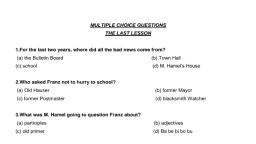
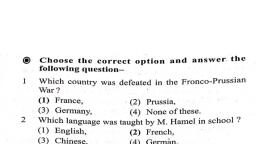
3, LITERATURE, FLAMINGO (Prose)., 1. THE LAST LESSON, Alphonse Daudet, About the Author, Alphonse Daudet (13 May 1840 - 16 December 1897) was a French short story writer and novelist. He is, remembered chiefly as the author of sentimental tales of provincial life in the south of France. All his life, he recorded his observations of other people in little notebooks, which he used as a reservoir of inspiration., Daudet represents a synthesis of conflicting elements and his actual experience of life, at every social level, and in the course of travels, helped to develop his natural gifts. His major works include 'Tastain', 'Le Petit, Chose', 'In the land of Pain' and The Last Lesson'., Theme, "The Last Lesson' revolves around the language and its importance to the citizens of a country. It is the duty, of every citizen to safeguard the language of the country as it is the identity of that country. The lesson depicts, how after defeating France in the war, the Prussians wanted to rule over not only the territory of France but, also over the minds and hearts of the people. The story reinforces the fact that we value something more, when it is lost. The pain and anguish of the students and the teacher is evident as everyone realizes how, things were taken for granted. The lesson emphasizes the importance of the mother tongue for everyone, and the need to realize the fact that it is our language which gives us our identity, respect and freedom., Summary, "The Last Lesson' is set in the days of the Franco-Prussian War. France was defeated by Prussia and the, districts of Alsace and Lorraine had passed into Prussian hands. The orders came from Berlin to teach only, German in the schools of Alsace and Lorraine., The story tells the effect of this transition on the people through the eyes of a young boy, Franz. The story, describes what is just another ordinary day for Franz who started very late for school that morning. In fact,, he was reluctant to go to school as he had not prepared his French lesson on participles and his teacher,, M. Hamel, was going to conduct an oral test on the topic in the class. Initially, he thought of spending the, bright warm day outdoors enjoying the chirping of birds and drilling of Prussian soldiers at the back of the, sawmill, but finally he decided to go to school., On the way, Franz passed the town hall, where he saw a large crowd reading the bulletin board which had, been a source of all bad news. Franz didn't stop there and rushed to the school., When Franz arrived at the school, he found a strange quietness there. He found that his classmates were, already seated in their places and the teacher had already started teaching. The back benches were occupied, by the village elders who were grim and solemn. To his surprise, M. Hamel was in his formal dress that he, used to wear only on the inspection or prize distribution days. Franz found M. Hamel to be kinder than usual., Scanned with CamScanner
Page 3 :
He didn't scold Franz for being late and allowed him to take his seat. Franz was shocked to get the news, that it was their last lesson in French and the new German teacher would take charge on the following day., He was full of regret for not learning his mother tongue and felt a sudden love for French. He even started, liking M. Hamel and forgot all about his ruler and crankiness. When M. Hamel asked Franz to answer a, question on participles, he was not able to answer. Even then, M. Hamel didn't scold him and remarked, that the only trouble with people of Alsace was of putting off learning till the next day. He blamed parents, for sending their children to earn money rather than to school. He also blamed himself for sending students, to water his plants or for giving them a holiday when he wanted to go fishing., M. Hamel then talked of the French language, calling it the most beautiful language in the world. He told, the class to keep their language close to their hearts to feel free and happy. As long as an enslaved people, held fast to their language, they had the key to their prison. Their language could liberate them forever., As the church clock struck twelve, M. Hamel with a choked throat wrote on the blackboard Vive La France!,, i.e. Long Live France and dismissed the class., The story, written in a historical background, is a beautiful depiction of the emotional bond of people with, their mother tongue. It depicts the pathos of the situation that in order to conquer the minds of the people,, it is not enough to win a country physically by force. In order to enslave a people completely, a conqueror, needs to enslave their thoughts and make them devoid of the knowledge and use of their own mother tongue., Ada wal, Scanned with CamScanner
Page 4 :
2. LOST SPRING: STORIES OF STOLEN CHILDHOOD, Anees Jung, About the Author, Anees Jung (born 1944-) is an Indian woman writer, journalist and a columnist for major newspapers in, India and abroad. She was born at Hyderabad and received education in Hyderabad and in the United States., Her parents were renowned poets. She has written several books such as Unvciling India, Night of the New, Moon, Seven Sisters and Breaking the Silence., Theme, In this story, the author unveils the utter destitution of the ragpickers of Seemapuri and the bangle makers, of Firozabad. This story describes the grinding poverty and traditions that compel the children to live a life, of exploitation., Summary, Saheb, the son of a migrant family from Dhaka, is a ragpicker who lives in Seemapuri, at the periphery of, Delhi, and goes about barefoot rummaging around in the heaps of garbage to earn his livelihood. For the, children like Saheb, a heap of garbage is like a gold mine. Thousands of such children live with their families, in Seemapuri. They live in a slum with not even the basic amenities, such as water and sanitation, available to, them. These families are living in utter poverty. The children have nothing to do except ragpicking through, which they earn something to eat at least. Garbage to the elders is a means of survival but for these children, it is a magical wonder. In order to earn better, Saheb starts working at a tea-stall where he is paid 7800 per, month but it seems he, after this, loses his carefreeness. He works for someone else and is no longer his, own master. This loss of identity weighs heavily on his tender shoulders., Anees Jung, then tells about Mukesh, another young boy, who wants to be his own master. He is a boy from, Firozabad's glass industry and as a family tradition he has always worked in the glass bangle factory. Here,, the children work in close proximity of furnaces in such high temperatures that they are exposed to various, health hazards, even losing their eyesight., Mukesh's family, like other families of Firozabad, are victims of poverty. His father is blind, and they live in, a small half-constructed house. These people of Firozabad are exploited by the sahukars, the middlemen,, the policemen, the bureauerats and the politicians. But Mukesh is different and confident, He wants to be, a motor mechanic., In the story, the author brings out the depravity of child labour. Childhood is considered as spring of human, life full of joy, pleasure and play. But ironically millions of children like Saheb and Mukesh have lost their, spring, i.e. childhood by getting engaged in making a living., Scanned with CamScanner
Page 5 :
3. DEEP WATER, William Douglas, About the Author, William O. Douglas (16 October 1898 – 19 January 1980) was born in Maine, Minnesota and was raised in, Yakima, Washington. He was an American jurist and politician. He served as an Associate Justice of the, Supreme Court of the United States. He was nominated at the age of 40 by President Franklin D. Roosevelt, and was the youngest justice appointed to the court and served for the longest term in the history of the, Supreme Court., Theme, 'Deep Water' deals with the childhood fear of Douglas. A misadventure at the YMCA pool developed an, aversion of water in him and he suffered from hydrophobia. The story focuses on the fact that childhood fears, must never be treated lightly. If they are not tackled, then they make deep inroads into one's psychology., Douglas analyses his fear and finally determines to overcome it., Summary, 'Deep Water' is an excerpt from Of Men and Mountains written by William O. Douglas. It is an autobiographical, description of how the author develops the fear of water and, thereafter, how he finally overcame it. He, narrates that his aversion to water started when he was three or four years old and his father took him to, the beach in California. There he was knocked down by the waves and was almost buried down in water., When he was ten or eleven years old, he joined the Y.M.C.A. pool, sitting on the side of the pool all alone, a big bruiser of a boy picked him up and threw him into the deep, end of the pool. He went at once to the bottom. He was frightened, but thought of a strategy to save his life., He decided to hit the bottom and take a big jump to come to the surface and lie flat on it and then paddle, to the edge of the pool. But it seemed his way down was very long., learn to swim. One day, when he was, Before he touched the bottom, his lungs were about to burst. Though he tried to take a big jump, he came, up very slowly. As a result, he went down for a second time. His lungs ached and he started feeling dizzy., He jumped, his feet touched the bottom but it made no difference. When he went down a third time, he, sucked a lot of water while trying to breathe air. Then all his efforts stopped and he had a blackout. He was, overpowered by fear and eventually fainted., After this incident, his fear of water worsened and he did not go swimming or fishing or to any other water, sport for many years. Finally one October, he decided to overcome his fear of water. He hired an instructor, to learn to swim. He started practising swimming. Bit by bit he shed part of the panic that seized him. The, instructor tied a belt around his waist and connected it to a pulley with a rope. The author practised day, after day till he began to get back his confidence. He was able to swim the length of the pool on his own., Though the instructor was satisfied, the author felt that on many occasions his old fear of water would return., So, he continued relentlessly to swim in different waterbodies till he was confident that he had overcome, his fear., Finally, to test if he had lost the last vestiges of fear, Douglas went up to the Tieton to Conrad Meadows,, up the Conrad Creek Trail to Meade Glacier, and camped in high meadow by the side of Warm Lake., As he had experienced the terror of death, his will to live grew most intensely. This made him fearless and, confident., Scanned with CamScanner