Page 1 :
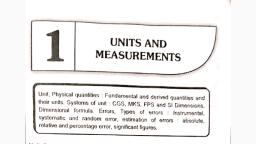
Downloaded from https:// www.studiestoday.com, , @ MEASUREMENTS AND EXPERIMENTATION, , , , , , Syllabus :, , @_ International system of units (the, syllabus). Other commonly used, , , , , simple pendulum for time., Scope - Measurement of length us, , , , numerical problems., , , , 2d S.I. units with correct symbols are given at the end |, n of units - FPS and CGS., , (ii) Measurements using common instrument , Vernier callipers and micrometre screw gauge for length and, , vernier callipers and micrometre screw gauge. Decreasing least count, leads to an increase in Sea least count (L.C.) of vernier callipers and screw gauge, zero error (basic, idea) (no numerical problems on callipers and screw gauge). Simple pendulum; time period, frequency,, , graph of length / vs. 7? only; slope of the graph. Formula 7 = 2n,/l/g Wo derivation). Only simple, , , , , , , , , , (A) SYSTEMS OF UNIT AND UNITS IN S.I. SYSTEM, , , , 1.1 NEED OF UNIT FOR MEASUREMENT, , Physics, like other branches of science, require experimental studies which involve, measurements. For the measurement of a physical, quantity, we consider a constant quantity of same, nature as a standard and then we compare the, given quantity with the standard quantity ie. we, find the number which expresses, how many times, the standard quantity is contained in the given, physical quantity. Thus, , , , Measurement is the process of comparison of, the given physical quantity with the known, , , , , , standard quantity of the same nature., , , , The standard quantity used to measure the, given physical quantity is called the unit. For, quantities of different nature, we use different units., , , , Unit is the quantity of a constant magnitude, which is used to measure the magnitudes of, other quantities of the same nature., , , , , , , , The result of measurement of a physical, quantity is expressed in terms of the following two, parameters :, , (i) The unit in which the quantity is being, measured, and, (ii) The numerical value which expresses, how, , many times the above selected unit is, contained in the given quantity., , 1, , Thus the magnitude of a physical quantity is, expressed as :, , , , , , , , Physical quantity = (numerical value) x (unit), , , , Examples : (i) If the length of a piece of cloth, is 10 metre, it means that the length is measured, in the unit metre and this unit is contained, 10 times in the length of that piece of cloth., , (ii) If the mass of a given quantity of sugar is, 5 kilogram, it means that the mass is measured, in the unit kilogram and this unit is contained, 5 times in the given quantity of sugar., , Choice of unit, , To measure a physical quantity, the unit, chosen should have the following properties :, , (i) The unit should be of convenient size., , (ii) It should be possible to define the unit, without ambiguity,, , (iii) The unit should be reproducible., , (iv) The value of unit should not change with, space and time. (i.e., it must always remain, same everywhere)., , The last three conditions (ii), (iti) and (iv) are, essential for the unit to be accepted internationally., , Kinds of unit, , Units are of two kinds : (i) Fundamental or, basic units, and (ii) Derived units., , Downloaded from https:// www.studiestoday.com
Page 2 :
Downloaded from https:// www.studiestoday.com, , (i) Fundamental or basic units, , , , A fundamental (or basic) unit is that which, is independent of any other unit or which can, neither be changed nor can be related to any, other fundamental unit. ’, , , , , , , , Examples: The units of mass, length, time,, temperature, current and amount of substance are, independent of each other. They can not be, obtained from any other unit. These are the, fundamental units., , (ii) Derived units, , The units of quantities other than those, measured in fundamental units, can be expressed, in terms of the fundamental units and they are, called the derived units. Thus, , Derived units are those which, the fundamental units or which, expressed in terms of the, uni, , , , Examples : (i) For the measurement of area,, we need to measure length and breadth in the unit, of length and then express area in a unit which is, length x length or (length)?., , (ii) The volume is expressed in a unit which is, length x length x length or (length)., , (iii) The unit of speed of a moving body is, obtained by dividing the unit of distance (i.e., length), by the unit of time i.e., it can be expressed in terms, of the units of length and time., , Thus the units used to measure area, volume,, speed, etc. are the derived units. More examples of, derived units are given ahead in article 1.6., , 1.2 SYSTEMS OF UNIT, , In mechanics, length, mass and time are the, three fundamental quantities. For the units of, these three basic quantities, following systems, have been used :, , (i) C.GS. system (or French system) : In this, system, the unit of length is centimetre (cm),, of mass is gram (g) and of time is, second (s)., , (ii) F.P.S. system (or British system) : In this, , , , , , system, the unit of length is foot (ft), of mass, is pound (Ib) and of time is second (s)., , (iii) M.K.S. system (or metric system) : In, this system, the unit of length is metre (m),, of mass is kilogram (kg) and of time is, second (s)., , The above mentioned systems are now no, longer in use and are only of historical, importance. Now we use the S.I. system of units, which is an enlarged and modified version of, the metric system., , Systeme Internationale d’Unites (or S.I. system), , In 1960, the General Conference of Weights, and Measures recommended that in addition to, the units of length, mass and time, the units of, temperature, luminous intensity, current and the, amount of*substance also be taken as fundamental, units and the units of angle and solid angle as the, complementary fundamental units. Thus in all,, now there are seven fundamental units and two, complementary fundamental units., , For S.I. system, the following table gives the, fundamental quantities, their units and their, standard symbols., , Fundamental quantities, units and symbols, , , , , , , , , , , , , , in S.I. system, , _ Quantity Unit, Mass kilogram ., Time second 8, Temperature kelvin K, Luminous intensity candela ed, Electric current ampere A, Amount of substance | mole mol*, , = ——— SS eee, , Solid angle steradian | std, , , , , , Use of prefix with a unit, , For expressing large measurements, we, use deca, hecto, kilo etc., as prefixes with the units., , * Nowadays 1 mol means | kg mol egual te 602 x 10°6, entities (i.e., atoms or molecules or items}., , 2 —, , Downloaded from https:// www.studiestoday.com
Page 3 :
The symbol and meaning of each prefix are given, , below., Prefix Symbol Meaning, deca da 10!, hecto h 10?, kilo k 10°, mega M 10°, giga G 10°, tera 1, 10!?, peta 2 10%, exa E 1018, zeta Z 107!, yotta ¥ 10%, , The various small measurements are expressed, by using the prefixes deci, centi, milli, micro, etc.,, with the units. The symbol and meaning of each, such prefix are given below., , Prefix Symbol Meaning, deci d 107, centi c 10?, milli m 103, micro uw 10-6, nano n 10°, pico P (or py) 10", femto f 107%:, ato a 1025, zepto Zz 10?!, yoeto y 10-4, , 2-5 GHz will mean 2:5 x 10° Hz,, 5-0 pF will mean 5-0 x 10-!? F, 5-0 MQ will mean, 5:0 x 10° Q, 2-0 ms will mean 2:0 x 10-3 s and so on., , S.I. unit of length, The S.I. unit of the length is metre (m)., , A metre was originally defined in 1889 as the, distance between two marks drawn on a, platinum-iridium (an alloy with 90% platinum, and 10% iridium) rod kept at 0°C in the, International Bureau of Weights and Measures, at Sevres near Paris., , Later, in 1960, the metre was re-defined as, 1,650,763-73 times the wavelength of a specified, orange-red spectral line in the emission spectrum, of Krypton-86. It is also defined as : ‘one metre, , is 1,553,164-1 times the wavelength of the red, line in the emission spectrum of cadmium’., , In 1983, the metre was re-defined in terms of, speed of light according to which one metre, , is the distance travelled by the light in, 1, , 299,792,458 of a second in air (or vacuum)., , Sub units of metre, , For the measurement of small lengths, the, metre is considered too big a unit. The most, commonly used sub units of metre are, (i) centimetre (cm), (ii) millimetre (mm),, (iii) micron (1) and (iv) nanometre (nm)., , One centimetre is one, hundredth part of a metre. i.e.,, , lem= iw m=10?m, One millimetre is one, thousandth part of a metre. i.e.,, ee, 1mm = Tooo ™ = 10° m= jo cm, , It is one-millionth, (10) part of a metre. It is expressed by the, symbol jL. It is also called micrometre (symbol [1m)., 1 micron (uy) = 10 metre, = 104cm = 107° mm., ) : It is one billionth, (10~° th) part of a metre. i.e., 1 nm = 10° m., Multiple units of metre, For the measurement of large lengths (or, distances), the metre is considered as too small, a unit. The most commonly used multiple unit, of metre is kilometre., : One kilometre is the onethousand multiple of a metre. i.e.,, 1 km = 1000 m (or 10° m)., , Non-metric units of length, , Bigger units : For the measurement of, distance between two heavenly bodies, the kilometre, is considered a too small unit. The commonly used, units for this purpose are : (i) astronomical unit, (A.U.), (ii) light year (ly) and (iii) parsec., (i) / ( One astronomical, unit is equal to the mean distance between the, earth and the sun. i.e.,, , 1A.U. = 1-496 x 10!! metre
Page 4 :
Downloaded from https:// www.studiestoday.com, , (ii) Light year (ly) : A light year is the distance, travelled by light in vacuum, in one year. i.e.,, 1 light year = speed of light x time 1 year, =3x 10⁸ ms“ x (365 x 24 x 60 x 60s), = 946 x 105 m =9-46 x 10!2km, The distance of stars from earth is generally, expressed in light years. However, light minute and, light second are its smaller units., , 1 light minute =3 x 108 ms x 60s =1-8 x 10!°m, and 1 light second =3 x 10⁸ ms! x 1s=3 x 10⁸m, (iii) Parsee : One parsec* is the distance from, where the semi major axis of orbit of earth (1 A.U.), subtends an angle of one second., , ie., Parasec x 1 = 1 ALU,, , 1-496 x 10! m, or 1 Parasee = 775600) x (/180), , 308x10'°, = pagxio® 32619, Smaller units : To express the wavelength of, light, size and separation between two molecules, (or atoms), radius of orbit of electron, etc. a small, size unit called the Angstrom (A) is used, while, the size of the nucleus is expressed by a still smaller, unit called fermi (f)., (i) Angstrom (A ) : It is 10-!th part of a metre., It is expressed by the symbol A. i.e.,, , = 3-08 x 106m, , 1 Angstrom (A) = 107° metre, = 10%cm=107 nm, 1micron = 10,000 A, and Inm = 10A, , Nowadays, A is outdated and nm is preferred over, the A. The wavelength of light, inter-atomic or, , inter-molecular separation, efc. are now commonly, expressed in nm., (ii) fermi (f) : It is 10-!5 th part of a metre. i.e.,, 1 fermi (f) = 10-5 m, The commonly used smaller and bigger units, of length are summarized in the following table., Smaller and bigger units of length, , , , * Parsec is constituted from the combination of two, words, parallax (par) and arc-second (sec)., , i 2a a ee «4, , , , 1.4 UNITS OF MASS, S.L unit of mass, , The S.I. unit of mass is kilogram (kg)., , , , However, the mass of 1 litre (= 1000 ml) of, water at 4°C is also taken as 1 kilogram., Sub units of kilogram, , For measurement of small masses,, kilogram (kg) is a bigger unit of mass., The smaller units of mass in common use are, @ gram (g) and (ii) milligram (mg)., (i) gram (g) : One gram is the one-thousandth, part of a kilogram i.e.,, Hig ar ee, , 1000, , or lkg =1000g, (ii) milligram (mg) : One milligram is, one-millionth (10) part of a kilogram or it is, one-thousandth (10-3) part of a gram. i.e.,, , Img=10%kg or Img=10%g, Multiple units of kilogram, , The bigger common units of mass used in, daily life are (i) quintal and (ii) metric tonne., , (i) quintal : It is one hundred times a kilogram,, Le., 1 quintal = 100 kg, , (ii) metric tonne :, kilogram. i.e,, 1 metric tonne = 1000 kg = 10 quintal., , kg = 103 kg, , It is one-thousand times a, , Non-metric unit of, , The mass of atomic particles such as proton,, neutron and electron is expressed in a unit called, the atomic mass unit (symbol a.m.u) or the, unified atomic mass unit (symbol u). It is, defined as below :, , The mass of 6-02 x 107° atoms of carbon —12 is, 12 kg*., * Avogadro number N = 6-02 x 10°6 per kg atom., , —<—, , Downloaded from https:// www.studiestoday.com
Page 5 :
Downloaded Srom https://, ’. 1 a.m.u (or u) = bx 02x10 kg, , = 1-66 x 1027 kg, The mass of large heavenly bodies is, measured in terms of solar mass where 1 solar, mass is the mass of the sun, i.e.,, 1 solar mass = 2 x 10° kg, , The commonly used smaller and bigger units, of mass are summarized in the following table., Smaller and bigger units of mass, , , , , , , 1.5 UNITS OF TIME, S.I. unit of time, The S.1. unit of time is second (s)., , , , One solar day is the time taken by the earth, to complete one rotation on its own axis., , For many years, the above definition of, second remained in use. But mean solar day, varies over the years, therefore in 1956, scientists, agreed to consider one year 1900 and 12 hours, as the ephemeris time and one year 1900 to be, equal to 365-2422 days. Thus,, , 1 year 1900 = 365-2422 days, 365-2422 x 86400 s, = 31556925-9747 s, second is defined, , Hence one as, 1 Fi, 31556925-0747 th part of the year 1900. i.e.,, , 1, 1 s= 37 556,925-9747 th part of the year 1900., , In 1964, a second was defined in terms of, energy change in cesium atom as follows :, , , , www. studiestoday. com, Smaller units of time, , The common smaller units of time are, millisecond (ms), microsecond (1s), shake and, nanosecond (ns) where, , Ims=10%s; 1 ps =10%s;, 1 shake = 10° s and 1 ns = 10° s., , Bigger units of time, , Sometimes second is a smaller unit of time, and so we use other units of time such as, (i) minute, (ii) hour, (iii) day, (iv) month,, (v) lunar month, (vi) year, (vii) leap year,, (viii) decade, (ix) century and (x) millennium., They are defined as below., (i) minute (min) :, of 60 second. i.e.,, , (ii) hour (h) :, 60 minutes. i.e.,, lh =60 min, , = 60 x 60s = 3600s, (iii) day : The time taken by the earth to rotate, once on its own axis is called a day. One day is, divided in 24 hours. Thus,, , l day =, , = 24 x 60 min = 1440 min, , = 24 x 60 x 60 s = 86400 s, (iv) month : The western or Gregorian Calendar, has January, March, May, July, August, October, and December each of 31 days; April, June,, September and November each of 30 days and, Feburary of 28 days (or 29 days in a leap year). To, an approximation, a month is considered to be of, 30 days and a year of 12 months to be of 365 days., (vy) lunar month : The western or Gregorian, Calendar is based on the period of revolution of, earth around the sun, but our Hindu (Vikram and, Shak) and Muslim (Hizri) Calendars are based on, the phases of moon as seen from our earth. In these, calendars, one month is the time of one lunar cycle, which is nearly 29.5 days. The period of 12 lunar, months is 354-37 days., (vi) year (yr) : One year is defined as the time in, which the earth completes one revolution around, the sun. The period of revolution of earth around, the sun is nearly 365 days. Thus,, , One minute is the duration, 1 min = 60s, , One hour is the duration of, , lyr = 365 days, = 365 x 86400 s = 3-1536 x 107s, , , , Downloaded from https:// www. studiestoday. com