Page 1 :
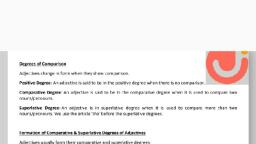
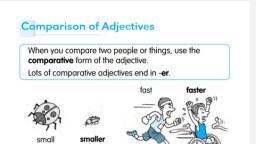
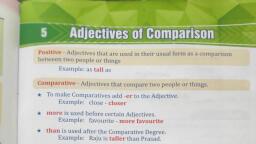
CHAPTER 101, , COMPARISON OF ADJECTIVES, , sentences: egrees )Combouo0n, , 80. Readthese, , 1 .Rama's mango is sweet., 2 . Har's mango is sweeter than Rama's., 3 . Govind's mango is the sweetest of al., , Insentence 1, the adjective sweet merely tells us that Rama's mango has the quality of, sweetness, without saying how much of this quality it has., In sentence 2, the adjective, , sweetertells us that Hari's mango, compared with Rama's,, has more of the quality of sweetness., In sentence 3, the adjective sweetest tells us that of all these, mangoes Govind's, mango has the greatest amount or highest degree of the quality of sweetness., We thus see that Adjectives change in form, to show, sweeter,, (sweet,, , parison. They are called the three Degrees of Comparison., , sweetesh, , com, , The Adjective sweet is said to be in the Positive, Degree., The Adjective sweeter is said to be in the, Comparative Degree., The Adjective sweetest is said to be in the, , Superlative Degree., , The Positive Degree of an Adjective is the, Adjective in its simple form. It is used to, denote the mere existence of some quality of what we, speak about. It is used when no, comparison is made., The Comparative Degree of an Adjective denotes a, higher degree of the quality than the, Positive, and is used when two things (or sets of things) are, , compared ; as,, , This boy is stronger than that., Which of these two pens is the better?, , Apples are dearer than oranges., , The Superlative Degree of an, Adjective denotes the, is used when more than two, things (or sets of, are, This, , things), , boy, , is the, , highest degree of the quality, and, compared ; as,, , strongest in the class., Note 1-There is another, way in which we can compare things. Instead of, saying, 'Rama is stronger than Balu', we can, say 'Balu is less strong than Rama'. Instead of saying, Hari is the laziest boy in the, class', we can say 'Hari is the least, Note 2-The, , Superlative with most sometimes used where there is no idea of compossession of a quality in a very high degree, as,, most, , parison, but merely a desire to indicate theis, This is, It was, , industrious boy in the class', , unfortunate., , a, , most, , eloquent speech., , Truly, a most ingenious device, , This usage has been called the, , Superlative of Eminence, or the Absolute Superlative., FORMATION OF COMPARATIVE AND SUPERLATIVE, 81. Most, Adjectives of one, and some of more than one, form the, by adding er and the Superlativesyllable,, Comparative, by adding est to the Positive.
Page 2 :
22, , G R A M M A R, , -, , Positive, , HIGH SCHOOL, , Comparative, , Sweet, , ENGLISH, , Superlative, , sweeter, , Ssweetest, , Small, , smaller, , Tall, , Kind, , taller, bolder, cleverer, kinder, , Young, , younger, , youngest, , Great, , greater, , greatest, , Bold, , Clever, , smallest, tallest, , boldest, , cleverest, kindest, , When the Positive ends in e, only rand st are added., Brave, Fine, White, , bravest, , braver, finer, , finest, , whiter, , whitest, , Large, , larger, , largest, , Able, , abler, , Noble, , nobler, , ablest, noblest, wisest, , wiser, Wise, When the Positive ends in y, preceded by a consonant, the y is changed into i before, , adding erand est., Happy, Easy, Heavy, Merry, Wealthy, , happier, , happiest, , easier, , easiest, , heavier, , heaviest, , merrier, , merriest, , wealthier, , wealthiest, , When the Positive is a word of one syllable and ends in a single consonant, preceded, by a short vowel, this consonant is doubled before adding er and est., Red, , redder, , reddest, , Big, , bigger, , biggest, , Hot, , hotter, , Thin, Sad, , thinner, sadder, , hottest, thinnest, saddest, , Fat, , fatter, , fattest, , 82. Adjectives of more than two syllables form the Comparative and Superlative by, , putting more and most before the Positive., Positive, Beautiful, Difficult, , Comparative, , Superlative, , more beautiful, , Industrious, , more industrious, , most, most, most, most, , more difficult, , beautiful, difficult, industrious, courageous, , more courageous, Courageous, Two-syllable adjectives ending in ful (e.g. useful), less (e.g. hopeless), ing (e.g. boring), and ed (e.g.. urprised) and many others (e.g.modern, recent, foolish, famous, certain) take, , more and most., , The following take either er and est or more and most:, feeble, handsome, She is politer/more polite than her sister., He is the politest/most polite of them., , polite, , simple, , gentle, , narrow, , cruel, , common, , pleasant, , stupid, , V83. The Comparative in er is not used when we compare two qualities in the same, person or thing. If we wish to say that the courage of Rama is greater than the courage of, Balu, we say,, Rama is braver than Balu., , But if we wish to say that the courage of Rama is greater than his prudence, we must say, Rama is more brave than prudent.
Page 3 :
-, , cOMPARIsON OF ADJECTIVESs, , 23, , 84. When two objects are compared with each other, the latter term of comparison must, , exclude, , the, , former; as,, , Iron is more useful than any other metal., , If we say, , that is, , Iron is more useful than any metal,, the same thing as, 'Iron is more, , saying, , useful than iron' since iron is itself, , a, , metal., , 1RREGULAR COMPARISON, are compared irregularly, that is, their Comparative and, 85. Thearefollowing, Adjectives, not formed from the, , Superlative, , Positive, Good, well, Bad, evil, ill, , Positive:, , Comparative, , Superlative, , worse, , best, worst, least, , better, , Little, Much, , less,lesser, , Many, , more, , most (quantity), most (number), , Late, Old, , later, latter, , latest, last, , older, elder, , Far, , farther, , oldest, eldest, farthest, , (Nigh), , (Fore), , more, , (nigher), , nighest, next, , (former), , (Fore), , further, , (in), (Up), , inner, , foremost, first, furthest, inmost, innermost, , upper, , upmost, uppermost, , (Out), , outer, (utter), , utmost, uttermost, , Note: The forms nigh, nigher, nighest, fore and utter are outdated.