Page 1 :
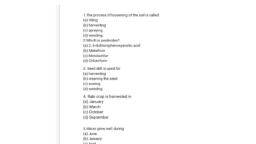
14. Leaving the agricultural land uncultivated for one, Or more seasons is know as, (1) field lallow, led, (2) crop rotation, (4) threshing, 15. Sowing the seeds manually is known as, (3) manuring, (1) ploughing, (3) tilling, 16. The method of transferring seedlings from nursery, to fleld is known as, (2) broadcasting, (4) transplantation, (1) broadcasting, (2) transplantation, (4) harvesting, (3) crop rotation, 17. The unwanted wikd plants growing along with the, crop plants are called, (1) seedlings, (2) weeds, (3) minor crops, (4) grasses, 18. Chemicals which kill weeds are known as, (1) fertilisers, (2) pesticides, (4) none of these, (3) weedicides, 19. Which preventive measure(s) avoid use of, pesticides?, (1) Crop rotation, (2) Use of pest resistant varieties of crop plant, (3) Summer ploughing, (4) All of these, 20. Chemical substances which are used to kill insects, are called, (1) fungicide, (2) insecticide, (3) weedicide, (4) all of these, 21. The process of cutting of crop after its maturation, is, (2) harvesting, (1) threshing, (3) winnowing, 22. Which of the following machines would you use to, harvest a crop as well as to beat out the grains, from the chaff?, (4) none of these, (1) Mechanical harvester, (2) Combine, (3) Thresher, (4) Harrow, 23. Separating the grain from chaff by wind is called, (1) winnowing, (3) threshing, 24. Which one of the following cause(s) plant diseases?, (2) hybridisation, (4) harvesting, (1) Viruses, (2) Bacteria, (3) Fungi, (4) All of these
Page 2 :
The science of improving crop varieties is called, (1) Plant breeding, (3) Selection, Horticulture deals with, (1) production of crops, (2) breeding of animals, (3) study of soil, (4) production of fruits and vegetables, 1., (2) Hybridization, (4) Introduction, 2., 15, 16, 3., Which of the following is a rabi crop?, (2) Cotton, (4) Maize, (1) Paddy, (3) Mustard, Paddy can be grown in, (1) summer, 17, 4., (2) autumn, (4) winter, (3) rainy season, Wheat can be grown in, 5., (2) rainy season, (1) winter, (3) spring, Loosening and turning of the soil is known as, (1) tilling, (3) transplantation, Which one of the following is not true about, ploughing?, (1) Loosens the soil, (2) Aerates the soil, (3) Makes the soil hard, (4) summer, 6., (2) broadcasting, (4) manuring, 7., (4) Allows easy penetration of roots into the soil, 8., The big pieces of soil in the ploughed field are, called, (1) crumbs, (3) lumps, Organic substances obtained from the decomposition, of dead plants and animals wastes are called, (1) fertiliser, (3) herbicide, 10. Plants get their nitrogen from the soil as, (1) nitrates, (2) flakes, (4) all of these, 9., (2) fungicide, (4) manure, (2) nitrogen dioxide, (4) nitric acid, (3) nitrogen oxide, 11. Vermicomposting involves, (1) cockroach, (3) leech, 12. Chemical substances rich in specific nutrients are, (2) earthworm, (4) roundworm, called, (1) manures, (2) fertilisers, (4) weedicides, (3) pesticides, 13. Which one of the following is not a method to, maintain the fertility of soil?, (1) Crop rotation, (3) Fleld fallow method(4) Successive cropping, (2) Biofertilizers
Page 3 :
CBSE : Class VII, 25., Cattle feed should contain, 8., (1) roughage, (2) concentrate, (3) both (1) and (2), (4) none of these, 9.