Page 1 :
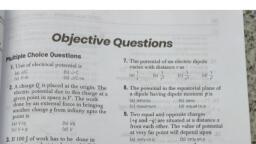
(Term, a, , =, , acitor, , A equal |, multiple Choice Questions, , equal 4. Unit of electrical potential is, , (a) J (b) Jt, (d) UiCorr, , by 2. A charge Q is placed at the origin. The, electric potential due to this charge at a, , given point in space is V. The work, done by an external force in bringing, another charge g from infinity upto the, point is, (a) V/q, c)V+q, , 3. If 100 J of work has to be done in, moving an electric charge of 4 C from a, place, where potential is — 10 V to, another place where potential is V volt,, find the value of 7, (a) 5V, , (c) 25V, , (b) Vq, (d)v, ‘ion,, , (b) 10V, (d) 15Y, , 4. The electric potential due to point, charge 3nC at distance of 9 cm is, (a)270 V (b)3 Vv, or. {c)300V (a)30V, , 5. A metallic hollow spherical surface of, radius 5 cm is charged such that the, is potential on its surface is 10 V. The, of potential at the centre is, (a) zero, (b) 10V, (c) same as at a point 5 cm away from the, surface, (d) same as at a point 25 cm away from the, surface, , 6. The potential of a large liquid drop, when eight liquid drops are combined, | __ is 20 V,, then the potential of each, single drop was, (a) 10V, {c) 5V, , (b) 7.6V, (d) 2.5V, , | Objective Questions, , 7., , 10. In a region of constant potential,, , 11., , . The potential in the equatorial plane of, , . Two equal and opposite charges, , The potential of an electric dipole, varies with distance r as, , . b) (c} (¢), ; , a dipole having dipole moment p is, la) infinite (b) zero, , (c} maximum (d) equal top, , (+9 and ~g) are situated at a distance x, from each other. The value of potential, at very far point will depend upon, , (a) onlyong (b) only on x, (c) ong:-x (d) ont, ., , (NCERT Exemplar), (a) the electric field is uniform, (b) the electric field is zero, (c). there can be no charge inside the region, (d) the electric field shall necessarily change, if, a charge is placed outside the region, , A positively charged particle is released, , from rest in an uniform electric field., , The electric potential energy of the, , charge (NCERT Exemplar), , (a) remains a constant because the electric, field is uniform, , (b) increases because the charge moves along, the electric field, , (c) decreases because the charge moves along, the electric field, , (d) decreases because the charge moves, opposite to the electric field, , , , 12. A,B and C are three points in a uniform, , electric field, the electric potential is, B “A, , , , , , E, *c
Page 2 :
(a) maximum at A, (b) maximum at @, te} maximum at C, id) same at all the three p, , ntial surfaces at a great, = rice rom a collection of charges, , whose total sum is not zero are, , oints A,B and, , approximately (NCERT Exemplar), {a) spheres {b) planes, {c) paraboloids (d} ellipsoids, 14. The electrostatic potential energy, between and electron separated, by a distance of 1 Ais, (a) 3.6 eV (b) 27.2 eV, fc) -4.4eV {d) .44eV, 15. The electric of earth is taken, to be zero, because earth is a good, {a) insulator {b) conductor, (c) semiconductor (d) dielectric, 16. Suppose a system of two charges as, shown below placed in an external, electric field, £- A) where A =9 x10° C/m?, What would be the electrostatic energy, , of the configuration?, , , , woot fle > wt s ~ (b) 49.30, , 450, 17. An :, , , , , , , , , , , CBSE New Pattern ~ Physics 12th Cer,, , 18. If a conductor has a potential V +0 ugpst NOM, , there are no charges anywhere else, , outside, then gud, , (a) there must be charges on the surface o¢ ’ <, inside itselt differ, , (b) there cannot be any charge in the body of (a) 78, the coriductor (p) 178, , {oc} there must be charges only on the surfac, (c) 43, , {d) there must be charges inside the surface (d) 2», 19. The graph shows the variation of 23. Ana, of two amo, , voltage Vacross the plates, capacitors A and B versus increase of oil t, stored in them. Which of the elec, , , , charge, capacitors has higher capacitance? cap, (a) i, (pb) «, (c), (a) |, 24. Ay, cay, be, s dis, (a) Capacitor A ca, (b) CapacitorB a, (c) Both have same capacitance, (a) None of the above ‘ a, 20. ‘Two plates of are at ee, potentials -10 V and +30. Ifthe 25 4, , separation between the plates be, ts mieedniaswandeden etd ,, , , , , , , , , , (a) 20,Vim (b)10Vim, {c) 50.V/m {d) 30.Vim, 21. The electric potential difference, between two parallel plates is 2000, aloes penemetedin 2 a, what is the magnitude of electrostatic, force on a charge of 4 x10 C locate, mid-way between the plates?, 1S pil oatal a ks Reet, barktines om agorb binpil irtgie as, , tw J
Page 3 :
The charge on the plates, if potential, difference of 100 V applied is, , , , ce ), e ¢ 10 (, , g, An ait capacitor is charged with an, amount of charge g and dipped into an, oil tank. If the oil is pumped out, the, , le electric field between the plates of, , capacitor Ww ill, ase, , decrease, , , , ithe same, , ) becomes zero, , , , 94. A parallel plate air capacitor has a, capacitance 18 uF. If the distance, between the plates is tripled and a, dielectric medium is introduced, the, capacitance becomes 72 uF. The, dielectric constant of the medium is, (a) 4 {b) 9, (c) 12 (d) 2, , 25. A parallel plate capacitor is made of, two dielectric blocks in series. Effective, , dielectric constant K is, (NCERT Exemplar), , VL, AIA, , , , , ta) Kt Kode ty Kit Kote, 6, +4, K,+K>, (cy Kral +a) (a) See., (Kg, +K2d)) K,+Kp, , 26. Three capacito’ s each of capacitance C, and of breakdown voltage V are joined, in series. The capacitance of the, combination will be, , 27. Three capacitors, , connected in series to a source of, , mF, GuF and 6pF are, , 120 V. The potential difference (in volt), across the 34F capacitor will be, (b), , (c) 40 (d) €, , 28. Capacitance between points Aand B is, , , , , , 2nf 2uF, tr, is ie, 2: ged, (a) 4pF (b) sul, 1 ‘ge:, ( (d) F, teh GH in, , 29. In the figure shown, the effective, capacitance between the points A and, B, if each has capacitance C, is, o, , —— 4 ae, |, mi G/ +c, dager, £, A Ee, (a) 2¢ tv) &, 2, c, c d) =, {c) 5C ( 3, , 30. A parallel plate capacitor is made by, stacking n equally spaced plates, connected alternately. If the, capacitance between any two plates is, C, then the resultant capacitance is, (a) C (b) nC, (c) (n= HC (d) (n+ iC