Page 1 :
3., , , , 14,, , 15., , On dissolving sugar in water at room temperature solution feels cool to touch, Under which of, , , , the following cases dissolution of sugar will be most rapid? LNCERT Exemplar], , (a) Sugar crystals in cold water. (6) Sugar crystals in hot water., , {c) Powdered sugar in cold water. (@) Powdered sugar in hot water,, , At equilibrium the rate of dissolution of a solid solute in a volatile liquid solvent is, . (NCERT Exemplar], , {a) less than the rate of crystallisation (6) greater than the rate of crystallisation, , {e) equal to the rate of crystallisation id} zero, , ‘The value of Henry's constant Ky is [NCERT Exemplar}, , (a) greater for gases with higher solubility. (by greater for gases with lower solubility,, , {e) constant for all gases. (a) not related to the solubility of gases., , Rae Sone ne oe mare ee eee ee tissues of people living at high altitude is due wo, , [NCERT Exemplar], , {a) low (emperainre, , (6) low aunospheric pressure, , {e) high atmospheric pressure, , (@) both low temperature and high atmospheric pressure, , 50 mL of an aqueous solution of glucose Coll, 0, (Molanmass + 180 g/mol) contains 6.02 x 10**, , molecules. The concentration of the solution will be [CBSE 2020 (56/2/1)|, {a) O01 M {6) 0.2M {c) LOM (d) 2.0M, , A solution of chloroform in diethylether, , {a) obeys Raoult’s law. (4) shows « positive deviation from Raoult's law,, , {e) shows 4 negative deviation from Raoult’s law.(d) behaves like a near ideal solution., , Considering the formation, breaking/and) strength of hydrogen bond, predict which of the, following mixtures will show a positive deviation from Raoult’s law? (NCERT Exemplar), , (a) Methanol and acetone, (6) Chloroform and acetone., {e) Nitric acid and water, fd) Phenol and aniline., , ‘The system that forms maximum boiling azcotropes ist, , (a) ethyl aleohol-water (b) henzene-toluene, , {e) acetone-chloroform, (d) carbon disulphide-acetone, , osmotic pressure of a concentrated solution of a substance, > INCERT Exemplar}, (a) is highes than that of a dilute solution., , (@) is lower than that of a dilute solution., , {c) is sitive a8 that of a dilute solution., , (@) cannot be compared with osmotic pressure of dilute solution., , An unripe mango placed in a concentrated salt solution to prepare pickle, shrivels because, , ‘ [NCERT Exemplar], {a) it gains water duc to osmosis, (6) it loses water due to reverse osmosis,, {e) it gains water due to reverse osmosis. (d) it loses water due to osmosis., , If we place the blood cells in a solution containing less than 0.9% (m/V) sodium chloride. They, would swell. This is because, , (a) the solution is hypotonic (5) the solution is isotonic, , {e) the solution is hypertonic {d) none of these, , Which of the following colligative property is used to calculate the molar mass of biomolecules?, (a) Relative lowering of vapour pressure (5) Elevation in boiling point, , , , () Depression in freezing point (d) Osmotic pressure, , WWW.JEEBOOKS. IN Solutions | 29
Page 2 :
17,, , 20., , 24,, , 25., , 26., , 27., , 28,, , 30, , Which of the following statements is false? (NCERT Exemplar), , (a) Units of atmospheric pressure and osmotic pressure are the same., , (6) In reverse osmosis, solvent molecules move through a semipermeable membrane from a, region of lower concentration of solute to a region of higher concentration,, , fe) The value of molal depression constient depends on mature of solvent., , (a) Relative lowering of vapour pressure, is a dimensionless quantity,, , Molal elevation constant is calculated from the enthalpy of vapourisation (3,,,,H) and boiling, , point of the pure solvent (7°) using the relation:, , __ MRT? _ _ tooo xr? All , _ 1000.4, 7, © S=T08 7 © Naa © XT ae! Xs ie, Which of the following statements is false? (NGERL Exemplar}, , (a) Two different solutions of sucrose of same molality preparcd in different solvents will have the, same depression in freezing point,, , (8) The osmotic pressure of # solution is given by the equation 1 — CRI( where € is the molarity of, the solution)., , {e) Decreasing order of osmotic pressure for 0.01 M aqueous solutions of, barium chloride, potassium chloride, acetic acid and sucrose is, Bath, > KCI > CHZCOOH > sucrose., , (@) Aveording to Raoult's law, the vapour pressure exerted by i volatile component of a solution, is directly proportional to its mole fraction in une solution., , When KCl is dissolved in water, the, , {a) boiling point of the solution decreases, , (8) boiling point of the solution increases, , {e) boiling point of the solution remains unchanged, , (ad) none of the above, , Compared to Puri, the vapoun/pressure of water at Dethi is, , (a) equal (6) more fc) less {d) none of these, , A sample of hard water was fotind to contain 40 mg of MgSO, in 10 kg of sample. The ppm of, , MgSO, in the samplowill be, , (a) 2 ppm (8) 4 ppm {ce} 8 ppm (d) 15 ppm, , If the molarity ofa solution of sulphuric acid is 1.35 M, then its molality will be, , (The density of the acid solution is 1.02 g cm”), , , , (6) 1,80 m {c) 152m {d) 2.39 m, y of dilute solution is doubled, the value of molal depression constant (K,) will be, (6) wipled fe) unchanged id) doubled, When dry grapes or raisins are placed in water, they swell due to, {a) osmosis (b) diffusion {c) surface tension {d) absorption, ‘The mixture that forms minimum boiling azeotrope is, (a) Methanol-acetic acid (6) Chloroform-benzene, {e) Water-nitric acid (d) v-hexane-acetone, When an egg is placed in concentrated solution of sodium chloride, it shrinks duc to, (a) exosmosis {b) endosmosis {e) diffusion (d) surface tension, When a non-volatile solute in dissolved in water, (a) The boiling point increases (6) The vapour pressure decreases, {e) The freezing point decreases {d) All of the above, , , , Chemistry—XIl: Term-1 OVWWW.JEEB
Page 3 :
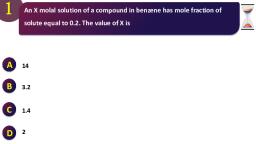
31., , $2., , 33., , 36., , 37., , 39., , 41., , Which of the following concentration term is not affected by the temperature?, , (a) Molarity {b) Normality {c) Molality (d) S%, , Which of the following is affected by the temperature?, , (a) Molarity {b) Normality (e) = % {d) All of the above, ‘The solubility of a solid in liquid does not depend upon, , {a) mature of solute and solvent (h) temperature, , {e) pressure (@) all of the above, , 1f5.85 g of NaCl is dissolved in 90 ¢ of water, then the mole-fraction of solute is, , (a) OL (hb) 0.2 fe) O.OL {d) 0.0196, , Boiling point of water in a pressure cooker is, , (a) below 100°C. {b) above 100°C fe) equal to 100°C {d) none of the above, The molarity of water is, , (a) 18 (6) 55.5 fc) 80 (d) 19.9,, , Which one of the following is a colligative property?, , (a) The half life of a radioactive element (b) The conductance of sohution, , {e) The surface tension of solution (d) The osmotic pressure of solution, , The relative lowering of vapour pressure is equal to the mole fraction of solute. The law is, , known as, , , , (a) Henry's law (6) Raoult's law, , {e) Ostwald's dilution law (dy Vane Holt law, , Isotonic solutions have the same, , (a) viscosity (6) molar concentration {ep boiling point (d) density, If 18 ¢ glucose is present in 1000 g of aSdlventythe solution will be, , (a) 1 molar (2) O12 molar : (c) 0.5 molal id) 0.1 molal, At constant temperature, the osmotioypressure of a solution is, , (a) direcily proportional to the concentration., , (6) inversely proportional to the concentration,, , {e) directly proportional to the square of the concentration,, , (@) independent of concentration,, , When a non-volatile solute is dissolved in a pure solvent, , (a) freezing point ef the solution is decreased., , (6) freezing point ofthe solution is increased., , {e) boiling point of the solution is decreased,, , (4) Both (@) and (c)., , Which one of the following is not a colligative property?, , {a) Relative lowering of vapour pressure (8) Osmotic pressure, , {e) Elevation of boiling point {d) None of these, , Osmotic pressure of a sugar solution at 24°C is 2.5 aun. The concentration of the solution in, moles/litre is, , (a) 10.25 (6) 1.025 fe) 1025 {d) 0.1025, , Elevation of boiling point was 0.52°C when 6 g of a compound X was dissolved in, 100 g of water. Molecular weight of X is (Ky = 0.52 Km™),), , {a) 120 kg/mot (6) 60 kg/mol ic) 180 kg/mol (d) 342 kg/mol, Number of moles of the solution per litre of the solution is, , (a) molality (b) molarity {e) normality (d) formality, The boiling point of a solution containing a non-volatile solute is, , (a) depressed (8) elevated fe) remain unchanged (d¢) none of these, , WWW.JEEBOOKS. IN Solutions | 31
Page 4 :
47., , 53., , 35., , 57., , 59., , 32, , An aqueous solution of methanol in water has vapour pressure, {a) equal to that of water (4) equal to that of methanol, {e) more than that of water (d) less than that of water, , 5mL N HCl, 20 mL N/2H,SO, and 30 mL g ILNO, are mixed together and the volume is made, to one litre. The normality of the resulting solution is, {a) Nid (6) N/1O {e) N/20 {d) N/40, , 500 ml. of an aqueous solution of glucose contains 6 x 10" molecules. The concentration of the, solution is, , {a) O.1M {b) 0.2M fc) 10M {d) 2.0M, , If NaCl is added to ice, then the melting point of ice will, , (a) increase (8) decrease, , {e) remains unchanged (@) first increase then decrease, , A solution is a, , (a) heterogeneous mixture (6) homogeneous mixture, , {e) colloidal sol fd) gel, , An ideal solution is the one which obeys, , {a) Raoult’s law (b) Henry's law fe) Both (a) ane (b) {d) None of these, Real solution shows deviation from Raoult's law, , {a) positive (8) negative fe} both (apamed (6) {d) none of these, If RBC is placed in 0.91% NaCl solution then it will, , (a) shrink () swell, , {e) neither shrink nor swell @ cither shrink or swell, Chlorobenzene-bromobenzene system is an example of, , (a) ideal solution (5) non-ideal solution with positive deviation, , {e) non-ideal solution with negative deviation id) none of these, , ‘The number of moles of cach @kche Billowing i in 20 g will be, , () CoM (ii) CH,ON ii) CH,COOH, (a) 0111, 0-333, 0625 (6) 0-533, 0-625, OLLL (c) O-111, 0-625, 0333 (d) 0-625, 0-333, 0-111, , Increase of temperature ofan aqueous solution will cause, , (a) decrease in motaliny (h) decrease in molarity, , {e) decrease intmole fraction fd) decrease in % (w/W), , In cold cotititries, ¢ ‘glycol is added to water in car radiators during winter. I results in, (a) lowering i in boiling point. (6) veducing the viscosity., , {e) reducing the specific heat, id) lowering in freezing point,, , ‘The concentration of a cane-sugar solution which is isotonic with 0.86% solution of urca, , (mol. wt. = 60 g/mol) is, , {a) 4.9% {b) 3% fe) 5.8% (d) 8.45, , Partial pressure of a solution component is directly proportional to its mole fraction. This, statement is known as, , {a) Henry's law (6) Raoult’s law {c) Distribution law — (¢d) Ostwald's dilution law, At high altitude, the boiling point of water is lower because, , (a) atmospheric pressure is low (b) temperature is low, , {¢) atmospheric pressure is high (d) none of these, , For an aqueous solution, freezing point is -0.186°C. Elevation of the boiling point of the same, solution is (Ky = 1.86°C mol" kg and K, = 0.512°C mol kg), {a) 0.186°C (6) 0,0512°C fc} 186°C (d) 5.1PC, , Chemistry-Xi: Term-1 WWWAJEEBOOKS.IN
Page 5 :
67., , 70., , 7k., , 72., , In a mixture of A and B, components show negative deviation when, , (a) A-B interaction is stronger than A-A and B-B interaction, , ()) A-B interaction is weaker than A-A and B-B interaction, , (2) AVunix >, ASuin > 0, , {d) AV in = 0. AS nig > 0, , 25m of a solution of barium hydroxide on titration with a 0.1 molar solution of hydrochloric, , acid gave a titre value of 35ml, The molarity of barium hydroxide solution will be, , (a) 0.07 {b) O14 (c} 0.28 (d) 0.85, , If liquids A and B form an ideal solution, the, , (a) enthalpy of mixing is zero, , (@) entropy of mi is zero, , {e) free energy of mixing is zero, , (@) free energy as well as the entropy of mixing is zero,, , Which one of the following statements is false?, , {a) Raoult's law states that the vapour pressure of a component over a solution is proportional to, its mole fraction,, , (6) The osmotic pressure (x) of a solution is given by the equationgs = MRI, where M is the, molarity of the solution., , te) The correct order of osmotic pressure for 0.0L M aqueous solution of each compound is, BaCl, > KC] > CH,COOH > sucrose., , (@) Iwo sucrose solutions of same molality prepared in different solvents will have the same, freezing point depression., , Equimolar solutions in the same solvent will have,, , (a) different boiling and different freezing points., , (4) same boiling and same freezing points, , {e) same freezing point but different boiling point., , {@) same boiling point but different freezing point,, , The glucose solution to be injected into the blood stream and the blood itself should have the, , same., , (a) viseocity {S) vapour pressure —(c) molarity {d) osmotic pressure, , ‘The most commonily, used artificial semi-permeable membrane is chemically, , (@) potassiuun fer recy anide (b) copper sulphate, , {e) copper fervicyanide (d) copper ferrocyanide, , A mixture of ethyl alcohol and propyl alcohol has a vapour pressure of 290 mm Hg at 300 K., , ‘The vapéur pressure of propyl alcohol ix 200 mm Hg. If the mole fraction of ethyl alcohol ix, , 0.6, it vapour pressure (in mm Hg) at the same temperature will be, , {a) S60 (b) 350 fe) 500 {d) 700, , At 80° C, the vapour pressure of pure liquid A ix 520 mm Hg and that of pure liquid B ix 1000, , mm Hy. Ifa mixture solution of A and B boils at 80° C and | atm pressure, the amount of A in, , the mixture is, , (a) 52 mol percent (6) 34 mol percent {c) 48 mol percent {d) 50 mol percent, , The vapour pressure of water at 20°C is [7.5mm Hg. If 18 g of glucose (CyH,,O,) is added to, , 178.2 g of water at 20°C, the vapour pressure of the resulting solution will be, , (a) 0.175 mm Hg (6) 17.525 mm Hg (c) 0.157 mm Hg (@) 16.83 mm Hg, , A 5.2 molal aqueous solution of methyl alcohol, CH,OH, is supplied. The mole fraction of, , methyl alcohol in the solution will be, , {a} 0,100 (8) 0,190 fe) 0.086 {d) 0.050, , , , , , , , , , WWW.JEEBOOKS. IN Solutions | 33