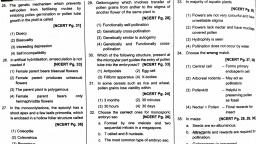
Page 1 :
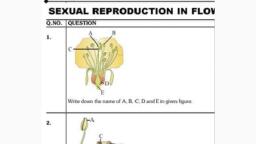
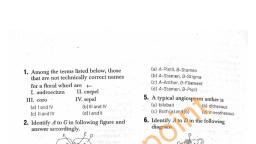
Multiple Choice Questions, 1. Among the terms listed below, those, that are not technically correct names, for a floral whorl are (NCERT Exemplar), II. carpel, IV. sepal, (a) A-Pistil, B-Stamen, (b) A-Stamen, B-Stigma, (c) A-Anther, B-Filament, (d) A-Stamen, B-Pistil, 5. A typical angiosperm anther is, (a) bilobed, (c) Both (a) and (b), 6. Identify A to D in the following, diagram., I. androecium, III. corolla, (b) IIl and IV, (d)I and II, (b) dithecous, (d) monothecous, (a) land IV, (c) Il and IV, 2. Identify A to G in following figure and, answer accordingly., D., G-, -B, (a) A-Ovary. B-Filament, C-Sepal. D-Petal,, E-Style. F-Stigma, G-Anther, (b) A-Sepal, B-0vary, C-Petal, D-Filament., E-Anther, F-Stigma, G-Style, (c) A-Ovary, B-Sepal, C-Filament. D-Petal,, E-Anther, F-Stigma. G-Style, (d) A-Petal. B-Anther, C-Stigma. D-Style., E-Filament. F-Sepal, G-Ovary, (a) A-Filament (stalk). B-Pollen sac,, C-Pollen grain, D-Line of dehiscence, (b) A-Filament (stalk), B-Pollen sac., C-Line of dehiscence, D-Pollen grain, (c) A-Line of dehiscence, B-Filament (stalk)., C-Pollen sac.D-Pollen grains, (d) A-Filament (stalk), B-Line of dehiscence., C-Pollen sac, D-Pollen grains, 3. Proximal end of the filament of stamen, is attached to the, (a) anther, (b) connective, (d) thalamus or petal, 7. The lengthwise running groove on, anther which separate theca is called, (a) rupture line, (c) suture of anther, (c) placenta, 4. Identify A and Bin the diagram given, below., (b) line of dehiscence, (d) None of these, 8. The outermost and innermost wall, layers of microsporangium in an anther, are respectively., (a) Endothecium and tapetum, (b) Epidermis and endodermis, (c) Epidermis and middle layer, (d) Epidermis and tapetum, (NCERT Exemplar)
Page 2 :
9. Pollen grains of different plants differ in, 14. Which of the following perform, microsporogenesis?, (a) Microspore mother cell, (b) Pollen mother cell, (a) size and shape, (b) colour and design, (c) size, shape and design, (d) size, shape. colour and design, (c) Both(a)and (b), (d) None of the above, 10. Microsporogenesis is the, la) development of megaspore, (b) development of pollen grain, (c) development of male gametophyte, (d) development of female gametophyte, 15. Tapetal cells are characterised by the, presence of dense cytoplasm and one, nuclei., (a) True, (b) False, 11. During microsporogenesis, meiosis, (c)Cannot say, (d)Partially true or false, occurs in, (NCERT Exemplar), (a) endothecium, 16. The pollen grain is, (a) an immature male gametophyte, (b) a mature male gametophyte, (c) partially developed male gametophyte, (d) last stage of male gametophyte, (b) microspore mother cells, (c) microspore tetrads, (d) pollen grains, 12. Microspore tetrad (pollen grains) is the, result of, 17. Pollens have two prominant walls, which are ..A... and ...B... . Here, A, and B refers to, (a) mitotic cell division, (b) meiotic cell division, (c) Both(a) and (b), (al A-intine, B-protein coat, (b) A-exine, B-intine, (d) None of the above, 13. The following is the diagram of TS of, anther. Identify the parts labelled A, B, and C., (c) A-sporopollenin. B-intine, (d) A-sporopollenin, B-exine, 18. Which of the following statements, about sporopollenin are true?, L. Exine is made up of sporopollenin., II. Sporopollenin is one of the most., resistant organic materials., III. Sporopollenin can withstand high, temperatures and strong acids., IV. So far no enzyme is known to degrade, sporopollenin., (a) A-Connective tissue. B-Endothecium., C-Pollen grain, (b) A-Endothecium. B-Connective tissue., C-Pollen grain, (c) A-Pollen grain, B-Connective tissue., C-Endothecium, Codes, (a) I and II, (c) I and II, (b) III and IV, (d) All of these, 19. Intine is made, of, (d) A-Endothecium, B-Pollen grain., C-Connective tissue, (a) cellulose, (c) Both (a)and (b), up, (b) pectin, (d) protein
Page 3 :
26. Identify the various parts A to Cin the, given diagram of an ovule., 20. The functions of germ pore is/are, (a) emergence of radicle, (b) absorption of water for seed germination, (c) initiation of pollen tube, (d) All of the above, 21. Male gametophyte in angiosperms, produces, (a) single sperm and two vegetative cells, (b) three sperms, (c) two sperms and a vegetative cell, (d) single sperm and a vegetative cell, 22. 60% of the angiosperms shed their, pollens at the, (a) 2-celled stage, (b) 3-celled stage, (c) 4-celled stage, (d) 1-celled stage, (a) A-Embryo sac. B-Inner integuments,, C-Outer integuments, (b) A-Inner integuments, B-Nucellus., C-Chalazal, (c) A-Hilum, B-Funicle. C-Embryo sac, (d) A-Micropylar end, B-Hilum, C-Inner, integuments, 27. Match the items in Column I with those, in Column II and choose the correct, 23. Viability of pollen grains depends on, (a) temperature, (b) humidity, (c) Both(a)and (b), (d) pressure, answer., Column I, Column II, A., Funicle, 1., Stalk of ovule, B., Integuments 2., Protective, 24. Pollen tablets are available in the, envelopes of ovule, 3. Junction part of, ovule and funicle, C., Chalaza, market for, (a) in vitro fertilisation, D., Hilum, 4., Basal part of the, (b) breeding programmes, (c) supplementing food, (d) ex situ conservation, ovule, Codes, 25. Identify the type of pistil in the, diagram., (a) 1, (b) 1, (c) 2, (d) 2, Stigma, 28. A micropyle is a, (a) small pore through which water enters, (b) small aperture where no integuments are, present, (c) small pore needed for seed existence, (d) All of the above, 29. An ovule is a, (a) Multicarpellary, apocarpous, (b) Multicarpellary, syncarpous, (c) Multicarpellary, pistillate, (d) Monocarpellary, apocarpous, (a) differentiated megasporangium, (b) dedifferentiated megasporangium, (c) integumented megasporangium, (d) redifferentiated megasporangium, O3441, C42T3, B2334
Page 4 :
30. Starting from the innermost part, the, correct sequence of parts in an ovule is, (NCERT Exemplar), (a) egg, nucellus, embryo sac. integument, (b) egg, embryo sac, nucellus, integument, (c) embryo sac, nucellus, integument, egg, (d) egg, integument, embryo sac, nucellus, 35. Which is the most common type of, embryo sac in angiosperms?, (a) Tetrasporic with one mitotic stage of, divisions, (b) Monosporic with three sequential mitotic, divisions, (c) Monosporic with two sequential mitotic, divisions, 31. What is A, B and Cin the given figure, of an embryo sac?, (d) Bisporic with two sequential mitotic, divisions, 36. Function of filiform apparatus is to, (a) recognise the suitable poilen at stigma, (b) stimulate division of generative cell, (c) produce nectar, (d) guide the entry of pollen tube, 37. Identify the type of cell division A to D, in the following flowchart., (a) A-Antipodals. B-Polar nuclei, C-Synergids, (b) A-Antipodals, B-Central cells, C-Egg cells, (c) A-Synergids, B-Polar nuclei, C-Egg cells, (d) A-Synergids, B-Egg cells, C-Filiform, apparatus, Megaspore, mother cell, Megaspore, dyad, D., Functional, megaspore, CMegaspore, tetrad, 32. In majority of angiosperms, (a) egg has a filiform apparatus, (b) there are numerous antipodal cells, (c) reduction division accurs in the megaspore, mother cells, 8-celled, stage, (a) A-Meiosis-I, B-Mitosis, C-Mitosis., D-Meiosis, (d) a small central cell is present in the embryo, (b) A-Meiosis-l. B-Meiosis-II, C-No division,, D-Mitosis, sac, (c) A-Mitosis, B-No division, C-Melosis-II,, D-Meiosis-l, mother, 33. In a flower, if the, cell forms megaspores without, undergoing meiosis and if one of the, megaspores develops into an embryo, sac, its nuclei would be, (a) haploid, (b) diploid, (c) a few haploid and a few diploid, (d) with varying ploidy, megaspore, (d) A-Mitosis, B-Mitosis, C-Meiosis-l,, D-Meiosis-l, 38. From the statements given below choose, the option that are true for a typical, female gametophyte. (NCERT Exemplar), I. It is 8-nucleate and 7-celled at maturity., II. It is free-nuclear during the, development., III. It is situated inside the integument, but, outside the nucellus., (NCERT Exemplar), 34. In angiosperm functional megaspore, develops into, (a) embryo sac, (b) ovule, IV. It has an egg apparatus situated at the, chalazal end., (b)l and III, (d) l and IV, (a) Tand IV, (c) endosperm, (d) pollen sac, (c) land II
Page 5 :
Choose the correct option., (a) Statements I, II, IV are correct and II is, incorrect, 39. Autogamy stands for, (a) self-pollination in same flower, (b) pollination in two flowers, (c) self-pollination in different flower, (d) pollination by only one type of organism, (b) Statement Il is correct and I, II, IV are, incorrect, (c) Statements I and Il are correct and II, IV are, incorrect, (d) All statements are correct, 40. Match the entries in Column I with, those of Column II and choose the, correct option from the codes given, below., 43. Transfer of pollen grains from the, anther to the stigma of another flower, of same plant is called, (a) geitonogamy, (c)xenogamy, Column I, Column II, (b) chasmogamy, (d) cleistogamy, A. Cleistogamy, 1., Pollination in, open flower, 44. Transfer of pollen grains from the, anther to stigma of another flower of, different plant is called, B. Geitonogamy, 2., bisexual flower, which remain, closed, Pollination in, (b) xenogamy, (d) cleistogamy, (a) geitonogamy, (c) chasmogamy, 45. Cross-pollination is preferred over self-, pollination because it results in a better, offspring., C. Chasmogamy, 3., Pollination, between flowers, in the same plant, D. Xenogamy, 4., Cross-, pollination, Codes, (a) True, (b) False, (c) Cannot say, (d) Partially true or false, A, (a) 3, (b) 1, (c) 2, (d) 1, 46. Match the following columns., 41. The main advantage of cleistogamy is, that it ensures, Column I, (Agents of, pollination), Column II, (Technical, terms), (a) cross-pollination, (b) seed setting even in the absence of, pollinators, A., Wind, 1., Anemophily, В., Water, 2., Hydrophily, (c) protandry in flowers, (d) geitonogamy instead of autogamy, C., Insects, 3., Entomophily, 42. Which of the following statements are, true about self-pollination?, I. It is most economic method as wastage, of pollen grain is minimum., II. Genetic stability can be maintained in, the progeny through self-pollination., III. Undesirable characters can be, eliminated through self- pollination., IV. Continued self-pollination may result, in weaker progeny., D., Birds, Ornithophily, 4., Codes, (a) 1, (b) 1, (c) 4, (d) 2, 4., 47. Autogamy can occur in a, chasmogamons flower if both pollen, and ovules mature simultaneously., 7440109, CM23, B232 3, D2342, C4213, B1434