Page 1 :
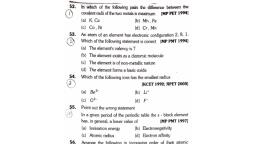
v, =~, , we, z, , x, , Which has the smallest size (MP PET 1999), , (a) Na’ (b) Mg”, , (c) Al* (d) P**, , A sodium cation has different number of electrons from, , (a) O* (b) Fo, , (c) Li (d) Al*, , Which of the following statement concerning lanthanides, elements is false (CBSE PMT 1994), , (a) Lanthanides are separated from one another by ion, exchange method, , (b) lonic radii of trivalent lanthanides steadily increases, with increase in the atomic number, , (c) All lanthanides are highly dense metals, , (d) More characteristic oxidation state of lanthanide, elements is +3, , Which one of the ions in the table below would have the, , largest value of enthalpy of hydration [Kerala PMT 2008] , Ionic radius in nm Charge of ion, , (a) 0.0065 +2, , (b) 0.095 +1, , (c) 0.135 +2, , (d) 0.169 +1, , (e) 0.181 -1, , Elements of which group form anions most readily, [CBSE PMT 1992], , (a) Oxygen family (b) Nitrogen group, , (c) Halogens (d) Alkali metals, , The following is the correct increasing order of the ionic radii, [AMU (Med.) 2012), , (a) Lit <Mg** < K* < Al®* (b) Al®* < Lit < Mg” <K*, (c) Al®* <Mg** <K* <Li* (d) K* <Al** <Mg* <Li, The atomic radii in periodic table among elements from, right to left [MP PET 1995], (a) Decreases, , (b) Increases, , (c) Remain constant, , (d) First decreases and then increases
Page 2 :
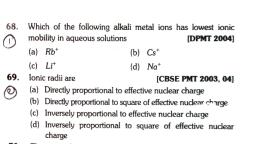
Oz, , f, , @Qx, , @s, , #0., $, , ty, , Of the following the ion with the smallest lone rads bs, , (MP PET 1996), fa) K* (b) Ca”, fe) 7 (4) 7, Which of the folowing does not represent the correct order, of the property indicated {CBSE PMT 1997), , (a) Sc* >Cr® > Fe® > Mn® : ionic radii, , (b) Se < Ti< Cr < Mn : Density, , (c) Mn* > Ni® <Co” < Fe® : ionic radii, , (d) FeO<CaO > MnO > CuO : Basic nature, , The order of magnitude of ionic radi of lons, Na’, Mg**,Al™* and Si** is [MP PMT 1996), fa) No* <Mg* <Al™ <si*, , (b) Mg** >Na* > Al > Si**, , (c)_ Al"* > Na* > Si** > Mg”, , (d) Na* > Mg** > Al®* > Si**, , Identify the correct order of the size of the following, , [CBSE PMT 2007; CBSE PMT (Pre.) 2010; WB JEE 2012), (a) Ca <K* <Ar<S® <Cr, , (b} Ca® <K* <Ar<Cl <S®, , (c) Ar<Ca” <K* <Ct <S*, , (d) Co® <Ar< Kk’ <Cl <S*, , Which statement is correct, , (a) For potassium, the atomic radius < onc radius; but for, bromine, the atomic radius > ionic radius, , {b) For potassium and bromine both, the atomic radii >, ionic radii, , (c) For potassium and bromine both, the atomic radi <, jonic radit, , (d) For potassium, the atomic radius > ionic radtus but for, bromine, the atomic radius < ionic radius, , Which of the following ion is the smallest ion (AIIMS 2001), , (a) O; (b) Oj, (ce) O, (a) 0;, The correct order of radii is {IT JEE 2000), (a) N<Be<B (b) F-<O* <N*, fc) No<Li<K (d) Fe <Fe® <Fe*, Which one of the following should be most stable, , [MP PET 2000}, (a) Hy fb) H”, () H (d) H”, Which of the following is the comect order of ionic radii, , (BHU 2002), , (a) F>Li>Na>K (b) F>K>No>Li, , (ce) No>K>F>bi (d) Li>Na>K>F
Page 3 :
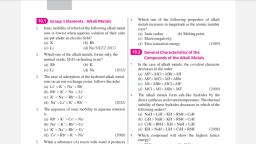
8, , @t, , 47., , 49., , 8, , (%), , Smallest among these species is (KCET 2002), , (a) Lithium jon (b) Hydrogen, , (ec) Lithium (d) Helturn, , Which of the following ionic radius would be maximum, IMP PET 1997}, , (a) c* (b) N°, , () 0? (a) Mg”, , Which Is helpful in the formation of lonic bond, , (a) Only smaill cation, , (b) Only small anion, , (c) Small cation and small anion both, , (d) Low positive charge, large cation and small anion, , The ionic conductance of following cation in a given, concentration are in the order [Odisha JEE 2004), (a) Li <No* >K'<Rb* (b) Lit > Ne’ > K* > Rb*, {c) Li’ <Na*>K* >Rb* (d) Li’ = Ne’ <K* <Rb*, Point out the wrong statement, , On moving horizontally from left to right across a period in, the periodic table, , (a) Metallic character decreases, , (b) Blectronegativity increases, , (c}_ Gram atomic volume first decreases and then increases, (d) Size of the ators increases for normal elements, , Which of the following statements is correct (MP PET 1997), , \ (a) X° jon is larger in size than X atom, , (b) X* jon ts larger in size than X atom, , (c) X° jon is larger in size than X~ ion, , (d) X* and X™ lons are equal in sie, , The atomic radius of elements of which of the following, series would be nearly the same (MP PET 1997), (a) Na K Rb Cs (b) Li Be BC, , (cl) Fe CoN Cu (d) FCI Br!, , The decreasing order of size of isoelectronic series, K*.Ca®*,CI and S* is [Roorkee 1995), la) K* >Ca* >S* >cr, , (b) K* >Co” >Cr >?, , () Ca” >K* >Cr >s?, , (d) S? >Cl >K* >Ca®, , Which of the following sets of elements have the strongest, , tendency to form anions [MP PET 1993), (a) NO.F b>) P.S,CI, {c) As, Se, Br (d) So, Tet, Radius of the isoelectronic species IMP PET 1994), , (a) Increases with the increase of nuclear charge, (b) Decreases with the increase of nuclear charge, (c) Is the same for all, , (qd) First increases and then decreases