Page 1 :
DIIGeS, ION ALLEY, SUP GET UE verewne seme—~, , Objective Questions, , Itiple Choice Questions, , 1. Which one of the following process, , involve chemical reactions?, , (a} Storing of oxygen gas under pressure inagas, cylinder, , (b) Liquefaction of air, , {c) Keeping petrol in a China dish in the open, , {d) Heating copper wire in the presence of airat, high temperature, , 2. The number of atoms of each element is, , conserved in any chemical reaction., (a) True, , (b) False, , (c)Can't say, , (d) Partially true/false, , 13. Complete the missing variables given as ‘, , x and ‘y’ in the following reaction:, Pb(NO, ), (ag) + 2KI(ag) —> PDI, (x), , 2 UNDY fa), , 04. Identify x and y in the following, , reaction, Cu+sHNO, —>Cu(NO, ), +yNO,, + 2H,0, (a)4and 2 (b)3and§, {ch2 and 3 {d)4and 4, , 05. The following reaction is an example of, , CaO\s) +H,0{!} —> Ca(OH), (aq), I. Displacement reaction, 11. Combination reaction, III. Decomposition reaction, IV Exothermic reaction, (a) Only (il) (p){)) and (HI), {e)(Il)and (IV) (d) Only (1), , 06. Ferrous sulphate crystals lose water, , when heated. How many molecules of, water are lost?, , (a)5 (b)7, , dota tAVA
Page 2 :
" (a) photochemical decomposition reaction, on {b) thermal decomposition reaction, (c)oxidation reaction, , (d) displacement reaction, , 10. Electrolysis of water is a, decomposition reaction. The mole, ratio of hydrogen and o, liberated during electro!, fa)il (b)2:1, {c)4:1 (d)t:2, , 11. Which of the following can be, decomposed by the action of sunlight?, (a) KBr, (b) AgBr, , (c)MgO, {d) NaCl, , 12. What will happen, when silver, chloride is placed in sunlight for, sometime?, , (a) White silver chloride changes into grey, coloured compound, , (b) Decomposition takes place, , (c) Both(a) and (b) takes place, , (d) Nothing will happen, adn X", , gases, is of water is, , 13. The he ¢ ., aerate, from the following, =, (a) Lead oxide, (b) Oxygen *], , Nitrogendioxide, , ee, , 44, The carbonate of metal lead is a white, solid. It decomposes when heated to, form carbon dioxide and a yellow solid, oxide ‘X’. What is X?, (a) Zinc oxide (b) Lead oxide, (c)Silver oxide (d) Magnesium oxide, , 15. Which of the following is exothermic, reaction?, (a) Dissolution of sodium hydroxide in water, (b) Evaporation of water, (c) Sublimation of silver chloride, (d) Dissolution of salt in water, , 16. Identify the endothermic process from, the following:, (ajH,0(1) —> H,0(9), (b)Ca0(s)+ H,0(/) > CalOH), (aq), (c) Combustion of methane, (d) Addition of conc. HCI to water., , 17. When zinc granules are reacted with, dilute sulphuric acid, then which of the, following gas is evolved?, , (a) Oxygen gas, , (b) Sulphur dioxide gas, (c) Hydrogen gas, , (d) Hydrogen sulphide gas, , 18. Which of the following gives, reddish-brown precipitate on mixing?, , {a)FeCl, + NH,OH (b)NaCi+ H,0, (c) AgNO, + NH,QH (d)CuSO, + H,S, 19. The following reaction is an example of, Fe,0, + 2Al —*—> 2Fe + Al,O,, (a) thermal decomposition reaction, (b) displacement reaction, , {c)double displacement reaction, (d) neutralisation reaction, , 20. Which of the following is incorrect, statement?, -{a)Mq is more reactive than H, (b)Fe is less reactive than Zn, (c)Cuis more reactive than Al, (d) Ag is less reactive than Cu
Page 3 :
21. What happens when copper rod is, dipped in iron sulphate solution?, I. Copper displaces iron., II. Blue colour of copper sulphate, solution is obtained., IIT. Reaction is exothermic., IV. No reaction takes place., , (a)(Jand (il) (opt), (and (Ii!), (c) Only (!) (d) Only (IV), , 22. What happens, when chlorine water is, added to KI solution?, (a), (ag) is formed, (b) 10; ions of white coloured are praduced, (c) KOH is formed, (d) HCI(g)is evolved., , 23. Match chemical compound given in the, Column I with its colour given in, Column II and select the correct, answer using the options given below:, , Column I Column II, (Chemical (Colour of their, compounds) compound), A. Barium sulphate 1. Colourless, B. Ferrous sulphate 2. Blue vo, C. Copper sulphate 3. Green (light), D. Zinc sulphate 4. White, Codes, Ree iero, (0) a: Seuieet 2, WIA Zliele, (aoe ek 2, mag ee, , 24. Complete the following reaction:, NaCl (aq) + AgNO, (ag) +002 Fee, (a) Na AgiNO, ICI {b) NaNO,, AgOCI, (c) NaNO,, AgC!, (d) NaNO,, AgC!, , 25. The reaction in which two compounds, exchange their ions to form two new, compounds is, (a) precipitation reaction, , (b) double displacement reaction, (c) decomposition reaction, (d) neutralisation reaction, , 26. In the double displacement reaction, between aqueous potassium iodide and, aqueous lead nitrate, a yellow, precipitate of lead iodide is formed., While performing the activity if lead, nitrate is not available, which of the, following can be used in place of lead, nitrate? (NCERT Exemplar), (a) Lead sulphate (insoluble), , (b) Lead acetate, (c} Ammonium nitrate, (d) Potassium sulphate, , 27. In a double displacement reaction such, as the reaction between sodium, sulphate solution and barium chloride, solution:, , I. Exchange of atoms takes place., Il. Exchange of ions takes place., III. A precipitate is produced., IV. An insoluble salt is produced., , The correct option is (CBSE 2020), (a) (Mand (IV) (b) (and (IN), (c} Only (it) (d) (ill)and (IV), , 28. The process of respiration is ...... :, (a) oxidation and exothermic, (b) reduction and endothermic, (c) oxidation and endothermic, (d) reduction and exothermic, , 29. When magnesium ribbon is burnt,, which of the following statements is, observed?, , (a) Magnesium burns with white flame and, changes into white powder, , (b) Magnesium burns with white flame and, changes into black powder, , [c) Magnesium burns with yellow flame and, changes into yellow powder, , (d) Magnesium burns with yellow flame and, changes into white powder
Page 4 :
osphorus and, product. This reaction is, a., , , , , , reaction., (b) precipitation, (choxid {d) reduction, 32. The reaction is an example of, which type of reaction:, 2KCI0, (s) —*—+ 2KCI(s) + 30, (9), (a) Reduction reaction, {b) Oxidation reaction, , (c) Displacement reaction, (d) Exothermic reaction, , 33. Which of the following statements, about the given reaction are correct?, 2Fels) +4H,O(!) — Fe,0, (s)+4H,(g), , L Iron metal is getting oxidised., II, Water is getting reduced., IIL. Water is acting as reducing agent., IV. Water is acting as oxidising agent., , , , , , , , , , , , , , , , , , , , , , , , , , , , , , , , , , , , , , , (a). (tipand (iH) (NCERT Exemplar), {b) (ii)and (IV), (c) (Wand (IV), (a) (i) and(Iv), 34. Identify the oxidising agent in the, following:, MnO, + 4HCl —> MnCl, +Cl,+ 2H,0, {alMn0, (b)Mncl,, (c)HCt (d) H,0, 35. In the equation,, Pb,O, +8HCl —> 3PbCI,+Cl, +4H,0,, the substance, Pb,O, acts as, {a)anoxidisingagentt, (b)anacid ot rtgenne >, (elareducingagent, (d) adehydratingagent., , gradually added to the beaker, , solution. The of, , Which of the following is the correct, , explanation for the observation?, , (a) KMn0, is an oxidising agent, it oxidises, FeSO,, , {b) FeSO, acts as an oxidising agent and, oxidises KMnO,, , (c) The colour disappears due to dilution, no, reaction is involved, , (d) KMnO, is an unstable compound and, decomposes in the presence of FeSO, toa, colourless compound, , 97. Identify the reducing agent in the, following reaction:, HO + F, — HF + HOF, (a)H,0 (b)F,, (c) HF (d) HOF, , , , , , , 38. The following reaction is a type of, reaction., PbO+H, —> Pb+H,0, (a) oxidation (b) reduction, (c) redox (d) decomposition, , 39. Match chemical reactions given in the, Column I with the type of chemical, reactions given in the Column II and, select the correct answer using the, , , , options given below:, Column I Column I, (Chemical (Types of chemical, ___ Factions) __ Feactions), A. FormationofNH, 1. Dec ith, from N, and H, omposition, B. Calcnation of zinc 2. Double, carbonate displacement, C. Rusting of iron as, , , , 3. Combination, 4. Redox, , a a Tl alae ntnemenneeso, Dd. of aqueous, solution with, =
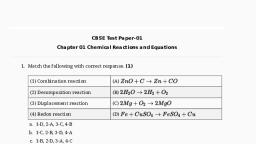
Page 5 :
{(d) Partially true/faise, , 41. The iron rod is covered with, reddish-brown layer which damages, the surface of Which of the, following method can be used to, prevent its damage?, , (a) By covered it with layer of base, , {b) By covered it with thin layer of zinc, (c) By covered it with layer of dilute acid, (d) By covered its with layer of copper, , (d) None of the above, 43. Food items made up of oils and fats, are flushed with nitrogen gas, L. to protect them from being rancid., Il. to protect their taste., IIL to maintain the weight of food., IV. to enhance their flavour., statements are