Page 1 :
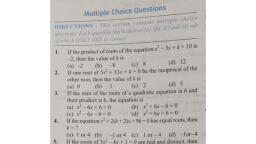
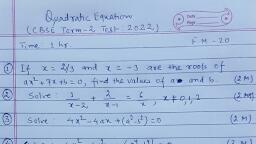
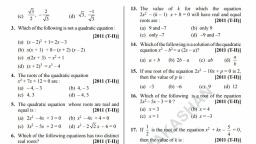
MCQs, , Mark the correct alternative in each of the following:, 1. Iftheequation x7 + 4x +k =0 has real and distinct roots, then, , (a) k<4 ) k>4 © k24 @) ks4, 2. Ifthe equation x? - ax +1 = 0 has two distinct roots, then, (a) |al =2 (b) |al<2 © {al >2 (d) None of these, 3. Ifthe equation 9x? + 6kx + 4 = 0 has equal roots, then the roots are both equal fo, (a) #2 @ +3 (©) 0 (4) #3, 4. If ax? + bx +c = 0 has equal roots, then ¢ =, « = w 2 a = as, da 2a 4a 4a, 5. If the equation ax? + 2x + a = 0 has two distinct roots, if, (a) a=+1 (b) a=0 (c) a=0,1 (a) a=-1,0, , 6. The positive value of k for which the equation x7 + kx + 64 = 0 and, x? —-8x +k =0 will both have real roots, is, , (a) 4 (b) 8 (c) 12 (d) 16, pn parr, (a) 4 (b) 3 (c) -2 (d) 3.5, 8. If 2 is a root of the equation x? + bx + 12=0 and the equation x7 + bx +q=0 has, equal roots, then q =, (a) 8 (b) -8 (c) 16 j (d) - 16, 9. If the equation (a? +b?) x? - 2 (ac + bd) x + c* +d? = 0 has equal roots, then, (a) ab = cd (b) ad = be (©) ad=Voe (a) ab = Ved, 10. If the roots of the equation (a? + #7) x? - 2b(a +c) x +(b? +c?) =0 are equal, then, (a) =ate (vb) b =ac (c) ba. (d) b=ac, ate, 11. Ifthe equation x? - bx + 1 = 0 does not possess real roots, then, (a) -3<b<3 (b) 2<b<2 (c) b>2 (a) b<-2, 1 set is acommon root of the equations ax* + ax +3 = 0 and x? +x+b-=0, then, (a) 3 (b) 3.5 () 6 (@) -3, , 13. Ifpandq are the roots of theequation x? — px +q = 0, then, (@) p=1q=-2 ) b=0g=1 (©) p=-29=0 @) p=-2,q=1, , 14. If @ and b can take values 1 Then, , 2, 3,4. num ‘, ohalevine iemmeuaiace the number of the equations of the form

Page 2 :
MATHEMATICS - X, , 8.34, 15, The number of quadratic equations having real roots and which do not change by, “ _, -— © 3. @.2 @ 4, 16. vit et2 enibenpsrd ad = = 0 has noreal roots, then, (a) ad=be (6) ab=ed (c) ac= bd (d@) ad # be, 47, Ifthe sum of the roots of the equation x* ~ x = 2(2x~1) is zero, then }, =, f 4, (a) -2 b) 2 © -3 @ 5, 18, Ifx=1isacommon root of ax* + ax +2=0 and x* +x +b =0 then, ab=, (a) 1 b) 2 (c) 4 (a) 3, 19. The value ofc for which the equation ax* + 2bx + c = 0 has equal roots is, # ar @, @) > oF OF - b, 20. If x? +k (4x +k—1)+2 = 0 has equal roots, thenk=, 2 ; 2 31 _3 1, (a) 3"! ’ (b) 377! © 53 ( 773, 21. If thesum and product of the roots of the equation ke? + 6x + 4k = 0 areequal, thenk=, 3 3 2 2 ‘, @ -3 (b) 3 (©) 3 @) ;, 22. Ifsin a andcos « are the roots of the equation ax” +bx+c=0,then?=, (a) a* - 2ac ©) a +2ac () aac oo, , 23. If2isaroot of the equation x? + ax +12 = 0 and the quadratic equation x? + ax +q=0, has equal roots, then q=, , (a) 12 (b) 8 () 20 (d) 16, , 24. If the sum of the roots of the equation x? ~ (k + 6)x +2(2k -1) = vena menianens, their product, then k =, , (a) 6 (b) 7 (c) 1 — @s, 25. Ifa and bare roots of the equation x? + ax+b=0, then a+b =, (a) 1 (b) 2 © (c) -2 (d) -1, , 26. A quadratic equation whose one root is 2. and the sum of whose roots is zero, ig *, (=) *4+4=0 -@) 2429 (©) 4x2-1=0 @) x?-2=0, , 27. Ifone root of the equation ax* + bx + ¢ = 0 is three times the other, then 5? : ac =, (a) 3:1 (b) 3:16 (©) 16:3 (@) 16:1, , 28. Ifone root of the equation 2x? + kx + 4 = 0 is2, then the other root is, (a) 6 (b) -6 (c) -1 (d@) 1
Page 3 :
QUADRATIC EQUATIONS 8.85, , 29. Ifone root of the equation 4*'4 ax'# 3 = 0 i8 1, then its other tootis, , (a3 © .73 ©.2 (@),.3, f one root of the equation 4x? — 2x + (4 - 4) = 0 be the reciprocal of the other, then 2. =, {a) 8 ; fb). ~8 ().4 (d) -4, 31. If y = 1 isacommonrootof the equations ay? +ay+3=Oandy? + y¥+b=0, thenab, equals, 3 (b) -7/2 (0) 6 (d) +3, [CBSE 2012], 32. The values of k for which the quadratic equation 16,7 + 4kx +9 = 0 has real and equal, roots are, 1 3 3, 6,-= Z = =-=, (a) 6 (b) 36,-36 {c) 6,-6 (d) 4 4, , [CBSE 2014]