Page 1 :
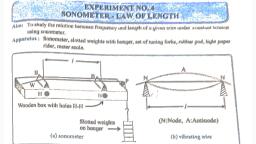
A Test on Wave Motion & Sound, , Time : | Hrs MM :; 100(+4,-1), , , , , , , , One end of two wires of the same metal and of same length (with radius, r and 2r) are, joined together. The wire is used as sonometer wire and the junction is placed in between, two bridges. The tension T is applied to the wire. If at a junction a node is formed then the, ratio of number of loops formed in the wires will be:, , (A) 1:2 (B)2:3 (C)3:4 (D)4:5, , A sonometer wire resonates with a given tuning fork forming standing waves with five, antinodes between the two bridges when a mass of 9 kg is suspended from the wire ., When this mass is replaced by a mass M, the wire resonates with the same tuning fork, forming three antinodes for the same positions of the bridges. The value of M is, , (A) 25 kg (B) 5kg (C) 12.5 kg (D) 1/25 kg, , A steel wire of length 1 m and mass 0.1 kg and having a uniform cross-sectional area of, 10° m? is rigidly fixed at both ends. The temperature of the wire is lowered by 20°C. If the, transverse waves are set up by plucking the string in the middle, the frequency of the, fundamental note of vibration is (Y,,,= 2 * 10" Nim’, a, = 1.21 * 10°/°C), , (A) 44 Hz (B) 88 Hz (C) 22 Hz (D) 11 Hz, , Astone is hung in air from a wire which is stretched over a sonometer. The bridges of the, sonometer are 40 cm apart when the wire is in unison with a tuning fork of frequency 256., When the stone is completely immersed in water, the length between the bridges is 22 cm, for re-establishing unison. The specific gravity of the material of the stone is:, , (40)? (40)?, , (A) (40)? + (22)? (8) (40)? -(22)?, , 22 40, (C) 256 2% (D) 256 x 2, , A uniform rope of length | and mass M hangs vertically from a rigid support. A block of, mass m is attached to the free end of the rope. A transverse pulse of wavelength | is, produced at the lower end of the rope. The wavelength of the pulse, when it reaches the, top of the rope, is, , (M—m ,M+m |, (A) 3 (8) *—— (C) a, , IM+m, , or,, , , , , , m, Mem
Page 2 :
10., , Amassless rod BD is suspended by two identical massless strings AB and CD of equal, lengths. A block of mass 'm’ is suspended point P such that BP is equal to ‘x’, if the, -fundamental frequency of the left wire is twice the fundamental frequency of right wire,, then the value of x is :, , A c, fundamental I harmonic, Tj, , , , , , T,, , , , , , op, , , , , , D, o weightless rod, m, , , , (A) US (B) V4 (C) 4U5 (D) 31/4, , Apulse shown here is reflected from the rigid wall A and then from free end B., , wf, , The shape of the string after these 2 reflection will be :, , wh ph @¢— a, ©% > 2) O zl, , A String of length 1m and linear mass density 0.01kgm" is stretched to a tension of 100N., When both ends of the string are fixed, the three lowest frequencies for standing wave are f,, f,, and f,. When only one end of the string is fixed, the three lowest frequencies for standing wave, are n,,n, and n3. Then, , , , , , , , (A) n, = Sn, =f, = 125 Hz (8) f, = 5f, =n, = 125 Hz, f, +f,, (C) f, =n, = 3f, = 150 Hz (O)n,= += 75 He, , Astring of length ‘I is fixed at both ends. Itis vibrating in its 3° overtone with maximum amplitude, i, , ‘a’. The amplitude at a distance > from one end is :, , a (B)0 (= (0) 5, , Ina stationary wave that forms as a result of reflection of waves from an ostacle the ratio of the, amplitude at an antinode to the amplitude at node is n. The fraction of energy reflected is :, , f 2 f \2 r4y2 f ard, ay (=) (8) (°| cc (5) (|
Page 3 :
11., , 12,, , 13., , 14., , 15., , 16., , Aloop of a string of mass per unit length m and radius R is rotated about an axis passing, through centre perpendicular to the plane with an angular velocity w. Asmall disturbance is, created in the loop having the same sense of rotation, The linear speed of the disturbance, for a stationary observer is :, , , , (A) wR (B) 2wR (C) 3wR (D) zero, , A pipe’s lower end is immersed in water such that the length of air column from the top open, end has a certain length 25 cm. The speed of sound in air is 350 m/s. The air column is found, to resonate with a tuning fork of frequency 1750 Hz. By what minimum distance should the, pipe be raised in order to make the air column resonate again with the same tuning fork?, , (A) 7.cm (B)5cm (C) 35 cm (D) 10 cm, , If, and |, are the lengths of air column for the first and second resonance when a tuning fork of, frequency n is sounded on a resonance tube, then the distance of the displacement antinode, from the top end of the resonance tube is:, , 1 |, -31, 1,-1,, (A) 2(L,-1,) (B) 5 (2, -1) (C) > (2) >, Acclosed organ pipe and an open pipe of same length produce 4 beats when they are set into, , vibrations simultaneously. If the length of each of them were twice their initial lengths, the number, of beats produced will be, , (A)2 (B) 4 (C)1 (D) 8, , In a test of subsonic Jet flies over head at an altitude of 100 m. The sound intensity on the, ground as the Jet passes overhead is 120 dB. At what altitude should the plane fly so that the, ground noise is not greater than 80 dB., , (A) above 10 km from ground (B) above 1 km from ground, , (C) above 5 km from ground (D) above 8 km from ground, , Avvibrating string of certain length | under a tension T resonates with a mode corresponding to, the first overtone (third harmonic) of an air column of length 75 cm inside a tube closed at one, end. The string also generates 4 beats per second when excited along with a tuning fork of, frequency n. Now when the tension of the string is slightly increased the number of beats, reduces to 2 per second. Assuming the velocity of sound in air to be 340 m/s, the frequency n, of the tuning fork in Hz is =, , (A) 344 (B) 336 (C) 117.3 (D) 109.3
Page 4 :
17., , 18., , 19., , In the figure shown a source of sound of frequency 510 Hz moves with constant velocity, v, = 20 m/s in the direction shown. The wind is blowing at a constant velocity v,, = 20 m/s, towards an observer who is at rest at point B. Corresponding to the sound emitted by the, source at initial position A, the frequency detected by the observer is equal to (speed of, sound relative to air = 330 m/s), , , , (A) 510 Hz (B) 500 Hz (C) 525 Hz (D) 550 Hz, , S, & S, are two coherent sources of sound having no initial phase difference. The velocity, of sound is 330 m/s. No minima will be formed on the line passing through S, and perpendicular to the line joining S, and S, , if the frequency of both the sources is :, , +t, am!, , wectdecsnns, :, , (A) 50 Hz (B) 60 Hz (C) 70 Hz (D) 80 Hz, , Earthquakes generate sound waves inside Earth. Unlike a gas, Earth can experience both, transverse (S) and longitudinal (P) sound waves. Typically, the speed of S waves is about, 4 km/s. A seismograph records P and S waves from an earthquake. The first P waves, arrive 3.0 min before the first S wave (figure). Assuming the waves travel in a straight line,, how far away does the earthquake occur ?, , (Y gonn = 12.8 * 10" pa, r,,,, = 2000 kg/m"), , , , P waves! Sveves, a | l | Leh ial Mn in, yin us mi i, , 1 2 3 4 5 6, Time (min), , , , , , , , , , Displacement of, seismograph recording pen, o, , , , , , , , , , , , , , , , , , , , (A) 1900 km (B) 1440 km (C) 1800 km (DB) 1200 km
Page 5 :
20. A triangular wave pulse is travelling on a string under tension T . The pulse is moving in, positive x-direction with speed 50 m/s . The linear mass density of the string is, , #4 = 0,080 kgm *. The transverse waveform of the pulse is shown in the following figure ., , , , , , — ; 4 oe > X, +>, 20 cm, The value of energy carried by the pulse is :, (A) 1000 J (B) 9000 J (C) 6000 J (DB) 5000 J, , Paragraph for Question Nos. 21 to 22, , Asonic source is emitting sound with natural frequency equal to 1.8 KHz . Itis maving uniformly, along a straight line ABC with speed 0.8 u , where u is the velocity of sound in air . A stationary, observer is is lying at a distance of 250 m from the straight line ABC ., , , , A * 0.8u B C, Source i, |= 250m, ° Observer, , 21. The frequency observed by the observer when the source is closest to him is :, (A) 2.0 kHz (B) 3.6 kHz (C) 5.0 kHz (D) 3.2 kHz, , 22. Distance between the souce and observer when the frequency received by the observer is, equal to the natural frequency of emitted sound is nearly equal to :, , (A) 200 m (B) 180 m (C) 160 m (D) 320m