Page 1 :
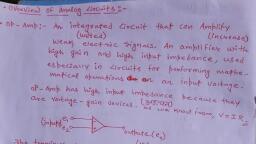
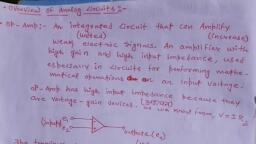
Q1. A voltage follower ………., 1. has a voltage gain of 1, 2. is noninverting, 3. has no feedback resistor, 4. has all of these, , 2. Op-Amp has _______ gain., 1.high, 2.low, 3.zero, 4.medium, , 3. Op-Amp has ______ input type configuration., 1.2, 2.3, 3.4, 4. all, , 4. Op-Amp with positive input type configuration +V or V is called _______., 1. Non-inverting type input, 2. Inverting type input, 3. Non-inverting type output, 4. Inverting type output, , 5. Op-amp output is represented as _______., , 1.Vin, , 2.Vout, 3.V+, 4.V-
Page 2 :
6. CMRR parameter in an instrumentation amplifier stands for ________., 1.Common mode rejection ratio, 2.Common medium rejection ratio, 3.Common mode ratio of reference, 4.none, , 7. . A feedback free instrumentation type amplifier has _____ input impedance., , 1.high, 2..low, 3.0, 4.medium, , 8. What is the another name for a unity gain amplifier?, 1. differential amplifier, 2.comparator, 3.single ended, 4.voltage follower, , 9. OPAMP is a/an:, 1. differential amplifier, 2oscillator, 3.rectifier, 4.none, , 10. Slew rate is defined as the:, 1. Maximum rate of change of output voltage with time, 2. Minimum rate of change of output voltage with time, 3. Moderate rate of change of output voltage with time, 4.None of the above, 11. OPAMP stands, 1. Operand amplitude, 2.Operational Amplifier, 3.Operational amplitude, 4. none
Page 3 :
12. Op-Amp was invented by ................ in 1967., 1 Henry, 2.David, 3. Richard, 4.Karl D. Swartzel Jr., 13. A voltage follower ………., 1. has a voltage gain of 1, 2. is noninverting, 3. has no feedback resistor, 4. has all of these, 14. The Op-amp can amplify, 1. a.c. signals only, 2. d.c. signals only, 3. both a.c. and d.c. signals, 4. neither d.c. nor a.c. signals, 15.The input offset current equals the ………., 1. difference between two base currents, 2. average of two base currents, 3. collector current divided by current gain, 4. none of these, 16.A common-mode signal is applied to ………., 1. the noninverting input, 2. the inverting input, 3. both iputs, 4. top of the tail resistor, 17. Current cannot flow to ground through ……., 1. a mechanical ground, 2. an a.c. ground, 3. a virtual ground, 4. an ordinary ground, , 18. what is the output
Page 4 :
1 8v, 2.7v, 3.4v, 4.5v, 19. what is the value of slew rate, 1.infinity, 2.zero, 3. both, 4.none, 20. what is the input bias current, 1. zero, 2. infinity, 3. both, 4. none