MCQ Test of Akash, Chemistry Aakash Term 2 Exam - Study Material
Page 1 :
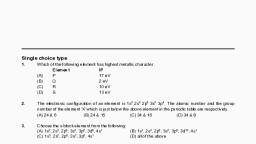
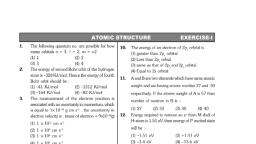
5., , Term Test-2 Chemistry, SECTION-A, ection A has 1 ions. A\ 1, , The ratio between the neutrons present in carbon and silicon with respect to atomic masses, 12 and 28 is, , (1) 3:7 (2) 7:3 (3) 3:4 (4) 6:28, The energy of photon that corresponds to a wave number of 3.3310 cm", (1) 2.5x10™erg (2) §.1x10 erg (3) §.0x10erg (4) 6.62«10"' erg, , The work function of a metal is 4 ev. To emit a photo electron of zero velocity from the surface, of a metal the wavelength of the incident light should be, , (1) 2700 A® (2) 1700 A° (3) 5900 A° (4) 3100 A°, , The binding energy of the electron in the lowest orbit of the hydrogen atom is 13.6 ev. The, energies required in ev to remove an electron from three lowest orbits of the hydrogen atom, are, , (1) 13.6, 6.8, 3.4 ev (2) 13.6, 10.2, 3.4ev, , (3) 13.6, 27.2, 40.8 ev (4) 13.6, 3.4, 1.5 ev, , For which species Bohr's theory does not apply, , (1)H (2) He" (3) (4) Be”, , 6. The maximum number of lines are possible in the emission spectrum of hydrogen by all possible, , 10., , 11., , 12., , 13., , 14., , transitions among the five levels of lowest energy within the atom, , (1)5 (2) 10 (3) 15 (4) 20, , The wavelength of light is 7000 4”. The number of photons required to produce 20J of energy, is approximately, , (1) 4.5610" (2) 5.0210" (3) 7*10" (4) 4*10", , A cricket ball having mass 200 g maving with velocity 30 m/sec has the de Broglie wavelength, approximately equal to, , (1) 10cm (2) 10™cm (3) 10cm (4) 10cm, if uncertainty in position of electron is zero, the uncertainty it its momentum would be, (1) zero (2) hi2x (3) hi4x (4) infinity, Which one represents an impossible arrangement?, n | m s, (1) 3 2 -2 1/2, (2) «4 0 a %, (3) 3 2 +3 4/2, (4) 5 3 0 -1/2, An orbital with n = 3, &2,m=0, ws, (1) 4 (2) %» (3) ®: (4), The energy of electron in the n"" Bohr orbit of H-atom is, (1) 13.6 / n?] ev (2) [-13.6 /n] eV, (3) [-13.6 / n4] Ev (4) [-13.6/n5] eV, The correct set of four quantum numbers for the outermost electron of sodium (Z = 11) is, 1 1 1 1, 3,1,0,— 3445 32,15 3,0,0,—, (1) 2 (2 2 (3) 2 (4) 2, , Enthalpy of vaporization for water is 186.5 kJ mol”. The entropy change during vaporization, is kJ K~* mol, (1) 0.5 {2) 1.0 (3) 1.5 (4) 2.0, , , , Aakash Educational Services Limited - Regd Office: Aakash Tower, 6, Pusa Road, New Dethi-? 10005 [Page 1)
Page 2 :
15., , 16., , 17., , 18., , 19., , 21., , 24,, , The heats of neutralization of four acids A, B, C, D are - 13.7, - 9.4, - 11.2 and - 12.4 k cal, respectively when they are neutralized by a common base. The acidic character obeys the, order, , (1) A>B>C>D (2) A>D>C >B, , (3) D>C>BeA (4) D>B>CoA, , When 1 mole of gas is heated at constant volume temperature is raised from 298 to 308 K., Heat supplied to the gas is 500 J. Then which statement is correct?, , (1) q=-w=500J. AU=0 (2) q= AU =500J,w=0, , (3) q=w=500J,AU=0 (4) AU=0,q=-500J, , Which is equal to maximum useful work done, , (1) 46 (2) 4H (3) AS (4) none, , A process in which pressure remains constant is called, , (1) isochoric process (2) isothermal process, , (3) adiabatic process (4) isobaric process, SECTION-B, , Section B has 18 questions. Attempt any 15 questions., , The enthalpy of formation for©°2. CO and 4:09) are -393.5, -110.5 and -241.8 kJ mol", respectively. The standard enthalpy changes in KJ for the reaction, , CO, (g) +H,(g)—>COlg} + 4,09) jg, (1) 524.1 (2) 41.2 (3) -262.5 (4) 41.2, , The enthalpy and entropy change for a chemical reaction are -25=10~ cal and 7.4 cal deg”, respectively. Predict whether the nature of reaction at 298 K is, , (1) spontaneous (2) reversible, , (3) irreversible (4) non spontaneous, , Heat produced in calories by the combustion of one gram of carbon is called, (1) Heat of combustion of carbon, , (2) Heat of formation of carbon, , (3) Calorific value of carbon, , (4) Heat of production of carbon, , The first law of thermodynamics is only, , (1) The law of conservation of energy, , (2) The law of conservation of mass, , (3) The law of conservation of momentum, , (4) Both (1) and (2), , in a reversible isothermal process, the change in internal energy is, , (1) Zera (2) Positive (3) Negative (4) None of these, For the reaction,, , CH,(g) + 50,(g)_ » 3CO,(g) + 4H,0(1), at constant temperature, ‘H-AE is, , (1)-RT (2)+RT (3)- 3RT (4) + 3RT, , The entropy values (in JK“'mol"') of Hajc) = 130.6, Clajg) = 223.0 and HCl) = 186.7 at 298 K, and 1 atm pressure. Then entropy change for the reaction Mas * bia > AChe ig, , (1) + 540.3 (2) +727.3 (3) - 166.9 (4) +19.8, , Which of the following is zero for an isochoric process, , (1) oP (2) ov (3) 47 (4) dE, , , , Aakash Educational Services Limited - Regd Office: Aakash Tower, 6, Pusa Road, New Dethi-? 10005 [Page 2)
Page 3 :
27. Heat require to raise the temperature of 1 mol of a substance by 1°C is called, (1) Specific heat (2) Molar heat capacity, (3) Water equivalent (4) Specific gravity, , , , Aakash Educational Services Limited - Regd Ofice: Aakash Tower, 8, Puss Road, New Delhi-! 10005 [Page 3)
Page 4 :
28. Match list | with list Il and select the correct answer using the codes given below the lists, , , , List! List Il, , , , 1 Heavy water (a) Bicarbonates of Mg and Ca in water, , , , 2) Temporary hard water __| (b) No foreign ions in water, , , , 3 Soft water () 2.0, , , , 4 Permanent hard water ({d) Sulphates and chlorides of Mg and Ca in water, , , , , , , , Codes, (1) 1-¢, 2-d, 3-b, 4-a (2) 1-b, 2-a, 3-c, 4-d, (3) 1-b, 2-d, 3-c, 4-a (4) 1-c, 2-a, 3-b, 4-d, , 29. Permutitis technical name given to, (1) Aluminates of calcium and sodium, (2) Silicates of calcium and sodium, (3) Hydrated silicates of aluminium and sodium, (4) Silicates of calcium and magnesium, , 30. 20 volume 40: solution has a strength of about, , (1) 30% (2) 6% (3) 3% (4) 10%, 31. Water softening by Clark's process uses, , (1) Caco, (2) NaHco, (3) Na,CO, (4) C2004), 5, 32. Washing soda is, , (1) Na,CO, (2) NazCO,.H,0, , (3) Na,CO,.7H,0 (4) Na,CO,.10H,0, 33, Which metal does not impart colour to the flame on heating?, , (1) Be (2) Ca (3) Sr (4) Ba, 34. Which of the following hydroxides is amphoteric in nature?, , (1) Be(OH), (2) Ca(OH.) (3) S*(OH), (4) 82(0H),, 35. Which of the following is the strongest reducing agent in aqueaus solution?, , (1) Li (2) Na (3)K {4) Rb, 36. e/m ratio is not constant for, , (1) cathode rays (2) protons, , (3) alpha rays (4) anode rays, , SECTION-C, , Section C has 9 questions. Attempt any 5 questions, , 37. Which of the follawing mainly form metal oxide on heating in air, , (1) Na (2)K, (3) Cs (4) Li, 38. Lithium shows diagonal relationship with, (1) Mg {2) Be, (3) Al (4) B, 39. Hydrogen is, (1) Electropositive, , (2) Electronegative, (3) Both electropositive as well as electronegative, (4) Neither electropositive nor electronegative, 40. Hydrogen acts as a reducing agent and thus resembles, (1) Halogen (2) Noble gas, , , , Aakash Educational Services Limited - Regd Office: Aakash Tower, 6, Pusa Road, New Dethi-? 10005 [Page 4)
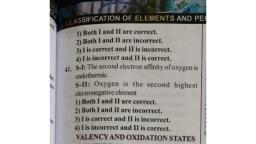
Page 5 :
41,, , 42., , (3) Radioactive elements, , (4) Alkali metals, , Electrolysis of fused sodium hydride liberate hydrogen at the, , (1) Anode (2) Cathode, , (3) Cathode and anade both, , (4) None of these, , Hydrogen has three isotopes, the number of possible diatomic molecules will be, (1)2 (2) 6, , (3)9 (4) 12, , in which of the compounds does hydrogen have an oxidation state of -1, (1) CHa (2) NH3, , (3) HCI (4) CaH2, , Pure hydrogen is obtained by carrying electrolysis of, , (1) Water containing H2SOs«, , (2) Water containing NaOH, , (3) solution Ba(OH)2 (4)KOH solution, , Tritium undergoes radioactive decay giving, , (1) a-particles (2) B-particles, , (3) Neutrons (4) y-rays, , , , Aakash Educational Services Limited - Regd Ofice: Aakash Tower, 8, Puss Road, New Delhi-! 10005 [Page 5)



 Learn better on this topic