Page 1 :
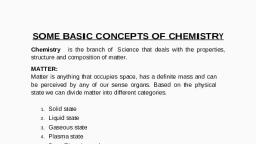
SOME BASIC CONCEPTS OF CHEMISTRY, Chemistry is the branch of Science that deals with the properties, structure and composition of matter., MATTER:, Matter is anything that occupies space, has a definite mass and can be perceived by any of our sense organs. Based on the physical state we can divide matter into different categories., Solid state, Liquid state, Gaseous state, Plasma state, Bose-Einstein condensate, Fermionic condensate, Properties of matter:, Physical properties: Physical properties can be measured or observed without changing the identity or the composition of the substance.Eg: colour, odour, melting point, boiling point, density, etc.,, Chemical properties: The measurement or observation of chemical properties requires a chemical change to occur. Eg: composition, combustibility., Classification of matter, Matter can be classified into PURE SUBSTANCES and MIXTURES, Pure substances contain only one type of particles. E.g. sodium (Na), Potassium (K), Hydrogen (H), Oxygen (O), Helium (He), Carbon dioxide (CO2), water (H2O), ammonia (NH3), cane sugar (C12H22O11) etc. These are further divided into two – elements and compounds., Elements are pure substances which contain only one type of particles. These particles may be atoms or molecules. Now there are about 117 elements. Some elements exist as monoatomic and some others are polyatomic. E.g. Hydrogen, Nitrogen, Oxygen (diatomic), Sodium, Potassium, Lithium, Calcium (monoatomic), Phosphorus, Sulphur (polyatomic) etc., Compounds are pure substances which contain more than one type of atoms. E.g. CO2, H2O, NH3, H2SO4 etc., Mixtures contain more than one type of particles. E.g. all types of solutions, gold ornaments, sea water, muddy water, air etc., There are two types of mixtures – homogeneous and heterogeneous mixtures. Mixtures having uniform composition throughout are called homogeneous mixtures. E.g. alcohol and water, air etc., Mixtures having different compositions at different parts are called heterogeneous mixtures. E.g. sea water, soil etc, The international system of units( SI units), The international system of units have seven basic units. These units are related to the seven fundamental scientific quantities. The other physical quantities such as volume, speed ,density etc can be derived from this quantities., Mass and Weight, Mass is the amount of matter present in a body. It is a constant quantity. Its SI unit is kilogram (kg). Weight is the gravitational force acting on a body. It is a variable quantity. i.e. it changes with place. Its SI unit is newton (N)., 1m3 = 106 cm3, 1cm3= 1ml, 1 L = 103 cm3 (mL), 1 dm3 = 103 cm3, Density (d), It is the amount of mass per unit volume., density = mass/volume. Its SI unit is kg/m3. But it is commonly expressed in g/cm3., Volume (V), It is the space occupied by a body. Its SI unit is m3. Other units are cm3, mL, L etc., Temperature (T), It is the degree of hotness or coldness of a body. It is commonly expressed in degree Celsius (0C). Other units are degree Fahrenheit (0F), Kelvin (K) etc. its SI unit is Kelvin (K)., Degree Celsius and degree Fahrenheit are related as:, 0F = 9/5(0C) + 32 ( convert 0C into 0F), Degree Celsius and Kelvin are related as:, K = 0C + 273.15 ( convert 0C into K), Other relations:, °C = K – 273.15 ( convert K into 0C), °C = 5/9 (°F – 32) (convert 0F into 0C), PROBLEMS, Convert 250C into Kelvin scale and Fahrenheit scale., 0F = 9/5(0C) + 32 K = 0C + 273.15, =9/5 × (25) + 32 = 25 + 273.15, =770F =298.15K, Find the temperature equal to 2100F in Celsius scale., °C = 5/9 (°F – 32), =5/9 (210 -32), =5/9 × 178, =890/9, =98.8°C, Convert 273.15K into °C., °C = K – 273.15, =273.15 – 273.15, =0°C, Scientific notation:, Exponential notation in which any number can be represented in the form of, N × 10n , where n is the exponential having positive or negative values. N is a number( called digit term) which varies between 1.000…………. and 9.999…., For eg: 232.508 as 2.32508× 10² in scientific notation., 0.00016 can be written as 1.6 × 10⁻⁴, PROBLEMS:, Express the following in the scientific notation., 0.0015 = 1.5× 10 -3, 214000 = 2.14× 10⁵, 1008 = 1.008 × 10³, 400.0 = 4.000× 10², 6.0012= 6.0012× 100, Multiplication, (5.6 × 10⁵ ) × (6.9 ×10⁸ ), Division, 2.7 × 10-3 = (2.7÷5.5)(-3-4) =0.4909 × 10—7, 5.5 ×104 =4.909 × 10⁻⁸, Addition and subtraction, first the numbers are written in such a way that they have the same exponent. After that, the coefficients (digit terms) are added or subtracted, Addition: 6.65 × 10⁴ +8.95 × 10³, = (6.65 × 10⁴ ) + (0.895 × 10⁴ ), = (6.65 + 0.895 )× 104, = 7.545 × 10⁴, Subtraction: (2.5 × 10⁻² ) – (4.8 × 10⁻³ ), = (2.5 × 10⁻² ) – (0.48 × 10⁻² ), =(2.5 – 0.48) × 10-2, = 2.02 × 10⁻², Precision and Accuracy, Precision refers to the closeness of various measurements for the same quantity. But, accuracy is the agreement of a particular value to the true value of the result, Significant figures, The uncertainty in the experimental or the calculated values is indicated by mentioning the number of significant figures. Significant figures are meaningful digits which are known with certainty plus one which is uncertain., For eg: if we write a measured value as 11.2 ml , 11 is the certain and 2 is the uncertain., There are certain rules for determining the number of significant figures. These are stated below:, RULE NO 1: All non-zero digits are significant., For example in 285 cm, there are three significant figures and in 0.25 mL, there are two significant figures., RULE NO 2: Zeros between two non-zero digits are significant., For eg: 2.005 has four significant figures., RULE NO 3: Zeros preceding to first non-zero digit are not significant. Such zero indicates the position of decimal point., For eg:0.03 has one significant figure and 0.0052 has two significant figures., RULE NO 4:, A)Zeros at the end or right of a number are significant, provided they are on the right side of the decimal point., For example, 0.200 g has three significant figures., (B)if otherwise, the terminal zeros are not significant if there is no decimal point., For example, 100 has only one significant figure, but 100. has three significant figures and 100.0 has four significant figures, RULE NO:5, Counting the numbers of object, for example, 2 balls or 20 eggs, have infinite significant figures as these are exact numbers and can be represented by writing infinite number of zeros after placing a decimal., 2 = 2.000000 or 20 = 20.000000., NOTE:, We can express the number 100 as 1×10² for one significant figure, 1.0×10² for two significant figures and 1.00×10² for three significant figures., RULES FOR ROUNDING OFF NUMBERS, RULE NO 1:, If the rightmost digit to be removed is more than 5, the preceding number is increased by one., For example, 1.386. If we have to remove 6, we have to round it to 1.39, RULE NO 2:, If the rightmost digit to be removed is less than 5, the preceding number is not changed., For example, 4.334 if 4 is to be removed, then the result is rounded upto 4.33, RULE NO 3:If the rightmost digit to be removed is 5, then the preceding number is not changed if it is an even number but it is increased by one if it is an odd number., For example, if 6.35 is to be rounded by removing 5, we have to increase 3 to 4 giving 6.4 as the result. However, if 6.25 is to be rounded off it is rounded off to 6.2., ADDITION AND SUBSTRACTION OF SIGNIFICANT FIGURES, In this case the result cannot have more digits to the right of the decimal point than either of the original numbers., For eg: 12.11 + 18.0 +1.012 +31.122 = 31.122, 18.0 has only one digit after the decimal point and the result should be reported only up to one digit after the decimal point, which is 31.1., MULTIPLICATION AND DIVISION, In these operations, the result must be reported with no more significant figures as in the measurement with the few significant figures. 2.5×1.25 = 3.125 Since 2.5 has two significant figures, the result should not have more than two significant figures, thus, it is 3.1., LAW OF CHEMICAL COMBINATION, The combination of elements to form compounds is governed by five basic laws., a. Law of conservation of mass, d. Law of definite proportion, c. Law of multiple proportions, d. Gay Lussac’s Law of Gaseous Volumes, e. Avogadro’s Law, LAW OF CONSERVATION OF MASS/(Law of indestructibility of matter): – by Antoine Lavoisier, This law was proposed by Antoine Lavoisier., It states that matter can neither be created nor destroyed. We can only convert one form of matter into another form. Or, in a chemical reaction, the total mass of reactants is equal to the total mass of products. Chemical equations are balanced according to this law because only balanced chemical equations obey law of conservation of mass. It is not applicable in the case of nuclear reactions., Illustration, Consider the reaction 2H2 + O2 → 2H2O. Here 32g of hydrogen combines with 32g of oxygen to form 36g of water., Total mass of reactants : 4 + 32= 36g., Total mass of products : 36g, Law of Definite Proportions (Law of definite composition):, This law was proposed by Joseph Proust. It states that a given compound always contains exactly the same proportion of elements by weight. Or, the same compound always contains the same elements combined in a fixed ratio by mass., Illustration: CO2 contain only two elements Carbon and Oxygen combined in a mass ratio 3:8., Ratio = 12:32, = 3:8, Law of Multiple Proportions:, This law was proposed by John Dalton. It states that if two elements can combine to form more than one compound, the different masses of one of the elements that combine with a fixed mass of the other element, are in small whole number ratio., Illustration:, Hydrogen combines with oxygen to form two compounds, namely, water and hydrogen peroxide., Hydrogen + Oxygen → Water, 2g 16g 18g, Hydrogen + Oxygen → Hydrogen Peroxide, 2g 32g 34g, Here, the masses of oxygen (i.e., 16 g and 32 g), which combine with a fixed mass of hydrogen (2g) bear a simple ratio, i.e., 16:32 or 1: 2, Gay Lussac’s Law of Gaseous Volumes:, This law was proposed by Gay Lussac. It states that when gases combine to form gaseous products, their volumes are in simple whole number ratio at constant temperature and pressure., Illustration: H2 combines with O2 to form water vapour according to the equation 2H2(g) + O2(g) → 2H2O(g). If 100 mL of hydrogen combine with 50 mL of oxygen, we get 100 mL of water vapour. Thus, the volumes of hydrogen and oxygen which combine together (i.e. 100 mL and 50 mL) bear a simple ratio of 2:1., Avogadro’s Law: This law was proposed by Amedeo Avogadro. It states that equal volumes of all gases at the same temperature and pressure should contain equal number of moles or molecules., Illustration: If we take 10L each of NH3, N2, O2 and CO2 at the same temperature and pressure, all of them contain the same number of moles and molecules, DALTON’S ATOMIC THEORY, The term atom was first used by John Dalton from the Greek word a-tomio (means indivisible). He proposed the first atomic theory. The important postulates of this theory are:, Matter is made up of minute and indivisible particles called atoms., Atoms can neither be created nor be destroyed., Atoms of same element are identical in their properties and mass. While atoms of different elements have different properties and mass., Atoms combined to form compound atoms called molecules., When atoms combine, they do so in a fixed ratio by mass. Dalton’s theory could explain the explain the laws of chemical combination., PROBLEMS, 1., Total mass of reactants is 4g + 16×2 = 36g, Total mass of products is 2( 2×1 + 16 ) = 36g, That is total mass of reactants is equal to total mass of products, Total mass of reactants is 2g + 16g = 18g, Total mass of products is 2(2 + 16) =36g, That is total mass of reactants is not equal to total mass of products, ( c) Total mass of reactants is 2g + 32g = 34g, Total mass of products is 2(2 + 16) =36g, That is total mass of reactants is not equal to total mass of products, So correct answer is option D., 2. NO and NO2 are two oxides of nitrogen., i) Which law of chemical combination is illustrated by these compounds?, (ii) State the law., Ans: a) i) Law of multiple proportions, ii) It states that if two elements combine to form more than one compound, the different masses of one of the elements that combine with a fixed mass of the other element, are in small whole number ratio, 3.a) When nitrogen and hydrogen combines to form ammonia, the ratio between the volumes of gaseous reactants and products is 1: 3: 2. Name the law of chemical combination illustrated here, Gay – Lussac’s law of Gaseous volumes, 4.A given compound always contains exactly the same proportion of elements by weight.’, (i) Name the above law., (ii) Write the name of the Scientist who proposed this law, ANS(i) Law of definite (constant) proportions, (ii) Joseph Proust, 5. Hydrogen combines with oxygen to form two different compounds, namely water (H2O) and hydrogen peroxide (H2O2)., a) Which law is obeyed by this combination?, (b) State the law., ANS-a) Law of Multiple proportions, (b) It states that if two elements combine to form more than one compound, the different masses of one of the elements that combine with a fixed mass of the other element, are in small whole number ratio., 6. The combination of elements to form compounds is governed by the laws of chemical combination. Hydrogen combines with oxygen to form compounds, namely water and hydrogen peroxide. State and illustrate the related law of chemical combination., ANS: a) Law of multiple proportions, b) It states that if two elements combine to form more than one compound, the different masses of one of the elements that combine with a fixed mass of the other element, are in small whole number ratio., 7.The laws of chemical combination are the basis of the atomic theory., a) Name the law of chemical combination illustrated by the pair of compounds, CO and CO2., ANS:a) Law of multiple proportions, 8. The following data are obtained when dinitrogen and dioxygen react together to form different compounds:, Mass of dinitrogen Mass of dioxygen, (i) 14 g 16 g, (ii) 14 g 32 g, (iii) 28 g 32 g, (iv) 28 g 80 g, (a) Which law of chemical combination is obeyed by the above experimental data? Give its statement, Law of multiple proportion. The law states that if two elements combine to form more than one compound, the different masses of one of the elements that combine with a fixed mass of the other element, are in small whole number ratio., ATOMIC MASS, Atomic mass of an element is a number that expresses how many times the mass of an atom of the element is greater than 1/12th the mass of a C12 atom., For e.g. atomic mass of Nitrogen is 14, which means that mass of one N atom is 14 times greater than 1/12th the mass of a C12 atom., Atomic mass unit (amu): 1/12th the mass of a C12 atom is called atomic mass unit (amu)., i.e. 1 amu = 1/12 x mass of a C12 atom, = 1.66 x 10⁻²⁴ g, = 1.66 x 10⁻²⁷ kg, Today, ‘amu’ has been replaced by ‘u’ which is known as unified mass., Average atomic mass:, All most all the elements have isotopes. So we can calculate an average atomic mass of an element by considering the atomic mass of the isotopes and their relative abundance. For e.g. chlorine has two isotopes Cl35 and Cl37 in the ratio 3:1. So the average atomic mass Cl =(3x35 + 1x37)/4 =35.5, Molecular mass:, Molecular mass is the sum of atomic masses of the elements present in a molecule. It is obtained by multiplying the atomic mass of each element by the number of its atoms and adding them together., For e.g. molecular mass of H2SO4 is calculated as:, 2 x 1 + 32 + 4 x 16 = 98 u, FORMULA MASS:, In the case of ionic compounds (like NaCl), there is no discrete (separate) molecules. Here the positive ions and the negative ions are arranged in a three-dimensional structure. So we can calculate only formula mass by taking molecular formula of the compound., PROBLEMS, 1.FIND OUT THE FORMULA UNIT MASS OF, CaF2, Na2SO4, Al2(SO4) 3, KClO 3, 2.FIND OUT THE MOLECULAR MASS OF, C2H4, C2H6, CH3OH, Cl2, MOLE CONCEPT, Mole is the unit of amount of substance. It is defined as the amount of substance that contains as many particles as there are atoms in exactly 12 g C12 isotope., 1 mole of any substance contains 6.022 x 10²³ atoms. This number is known as Avogadro number or Avogadro constant (NA or N0)., 1 mol of hydrogen atoms = 6.022×10²³ atoms, 1 mol of water molecules = 6.022×10²³ water molecules, 1 mol of sodium chloride = 6.022 × 10²³ formula units of sodium chloride, Molar volume: It is the volume of 1 mole of any substance. At standard temperature and pressure (STP), molar volume of any gas = 22.4 L (or, 22400 mL). i.e. 22.4 L of any gas at STP contains 1 mole of the gas or 6.022 x 10²³ molecules of the gas and its mass = molar mass., For e.g. 22.4 L of hydrogen gas = 1 mole of H2 = 6.022x10²³ molecules of hydrogen = 2 g of H2, NO OF MOLES= GIVEN MASS/ATOMIC MASS, NO OF MOLES= GIVEN MASS/MOLECULAR MASS, NO OF MOLE = GIVEN NO OF PARTICLES/NA, NO OF MOLE= GIVEN VOLUME/22.4L, Molar mass: The mass of one mole of a substance in gram is called its molar mass (gram molecular mass). The molar mass in grams is numerically equal to molecular mass in u., Molar mass of oxygen = 32g, Molar mass of hydrogen = 2g etc., PROBLEM, Calculate the molar mass of the following:, (i) H2O2 (ii) CO2 (iii) CH4, Percentage composition, It is the percentage of each elements present in 100g of a substance., i.e. percentage composition (mass percent) of an element = Mass of that element in the compound x 100, Molar mass of the compound, It is helpful in checking the purity of a given sample. Also by knowing the percentage composition, we can calculate the empirical and molecular formula of a compound, PROBLEM:, What is the percentage of carbon, hydrogen and oxygen in ethanol?, Molecular formula of ethanol is: C2H5OH, Empirical and Molecular formulae, Empirical formula is the simplest formula which gives only the ratio of different elements present in the compound. But molecular formula is the actual formula that gives the exact number of different elements present in the sample. For e.g. the empirical formula of glucose is CH2O but its molecular formula is C6H12O6. By knowing the percentage composition, we can calculate the empirical and molecular formula of a compound., n = Molar mass÷ Empirical formula mass, Molecular formula = n × empirical formula, FOR EXAMPLE: A compound contains 4.07% hydrogen, 24.27% carbon and 71.65% chlorine. Its molar mass is 98.96 g. What are its empirical and molecular formulas?, EMPIRICAL FORMULA=C1H2Cl1, Empirical formula mass = 12.01 + (2 × 1.008) + 35.453 = 49.48 g, n = Molar mass/Empirical formula mass, = 98.86g 49.48g, =2 = n, Therefore molecular formula = n × empirical formula, =2×C1H2Cl2, = C2H4Cl2, Stoichiometry and Stoichiometric calculations, Stoichiometry deals with the calculations involving the masses or the volumes of reactants and the products., Chemical Equation, It is the representation of a chemical reaction by symbols and formulae. Here the reactants are written in the left hand side and the products, on the right hand side., The substances which participate in a chemical reaction are called reactants, The substances which are formed as a result of a reaction are called products, A chemical equation should be balanced and the physical states of reactants and products are written in brackets., The following informations are obtained from a chemical equation., An idea about the reactants and products and their physical states., An idea about the masses of reactants and products., An idea about the number moles and molecules of reactants and products., An idea about the volumes of reactants and products at STP, For example:, CH4 (g) + 2O2 (g) → CO2 (g) + 2 H2O (g) Here, methane and dioxygen are called reactants and carbon dioxide and water are called products., The coefficients 2 for O2 and H2O are called stoichiometric coefficients. Similarly the coefficient for CH4 and CO2 is one in each case. They represent the number of molecules or mole taking part in the reaction or formed in the reaction., • One mole of CH4 (g) reacts with two moles of O2 (g) to give one mole of CO2 (g) and two moles of H2O(g), • One molecule of CH4 (g) reacts with 2 molecules of O2 (g) to give one molecule of CO2 (g) and 2 molecules of H2O(g), • 22.7 L of CH4 (g) reacts with 45.4 L of O2 (g) to give 22.7 L of CO2 (g) and 45.4 L of H2O(g), • 16 g of CH4 (g) reacts with 2×32 g of O2 (g) to give 44 g of CO2 (g) and 2×18 g of H2O (g), Limiting reagent (Limiting reactant):, The reagent which limits a reaction or the reagent which is completely consumed in a chemical reaction is called limiting reagent or limiting reactant., For e.g. In the reaction, 2SO2(g) + O2(g 2 SO3(g), 2 moles of SO2 reacts completely with 1 mole of O2 to form 2 moles of SO3. If we take 10 moles each of SO2 and O2, we get only 10 moles of SO3 because 10 moles of SO2 requires only 5 moles of O2 for the complete reaction. So here SO2 is the limiting reagent and 5 moles of O2 remains unreacted., The concentration of a solution, Concentration of a solution or the amount of substance present in its given volume can be expressed in any of the following ways., 1. Mass per cent or weight per cent (w/w %), 2. Mole fraction, 3. Molarity, 4. Molality, Mass percent (w/w or m/m): It is defined as the number of parts solute present in 100 parts by mass of solution., i.e. Mass % of a component = Mass of solute × 100, Mass of solution, Mole fraction: It is defined as the ratio of the number of moles of a particular component to the total number of moles of solution., i.e. Mole fraction of a component =, Number of moles of the component, Total number of moles of all the components, For example, in a binary solution, if the number of moles of A and B are nA and nB respectively,, then the mole fraction of A ( xA) = nA/(nA + nB) and that of the component B, XB = nB / (nA + nB), xA + xB = 1, i.e the sum of the mole fractions of all the components in a solution is always equal to 1., Molarity (M): It is defined as the number of moles of solute dissolved per litre of solution., i.e. Molarity (M) = Number of moles of solute, volume of solution in liter(v), 1 M NaOH solution means 1 mole of NaOH is present in 1 L of solution., Molality (m): It is defined as the number of moles of the solute present per kilogram (kg) of the solvent., i.e. Molality (m) = Number of moles of solute, Mass of solvent in kg, Among the above concentration terms, molarity depends on temperature because it is related to volume, which changes with temperature. All the others are temperature independent