Page 1 :
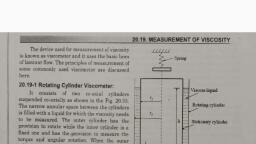
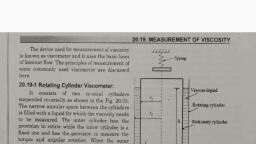
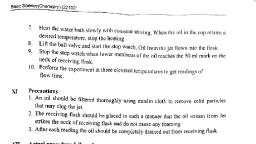
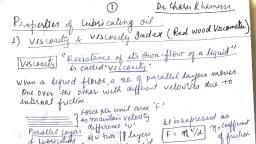
EXPERIMENT: -1, AIM: -Determination of viscosity of lubricant by Red Wood Viscometer (No. 1 & No. 2), CHEMICALS USED: -Given sample of lubricant, suitable organic solvent like CCl4, ether, petroleum spirit or benzene., APPARATUS REQUIRED: -Red Wood viscometer no. 1 & no. 2, stop watch, Kohlrausch flask, thermometer, filter paper, PRINCIPLE: -Viscosityis the property of a fluid that determines its resistance to flow. It is an indicator of flow ability of a lubricating oil; the lowest the viscosity, greater the flow ability. It is mainly due to the forces of cohesion between the molecules of lubricating oil., Absolute Viscosity may be defined as “the tangential force per unit area which is required to maintain a unit velocity gradient between two parallel layers. It is denoted by (eta). Its Unit in CGS system is poise and its dimensions are ML-1T-1.Viscosity Index: Viscosity generally decreases with increase in temperature. The maintenance of viscosity over the range of temperature is called the viscosity Index (V.I)A relatively small change/no change in viscosity with temperature is indicated by high viscosity index whereas low viscosity index shows relatively large change in viscosity with temperatureNote:There is a direct correlation between molecular structure of lubricating oil with its viscosity and viscosity index. A high viscosity index is exhibited by those lubricating oils which have linear or rod like shape molecules with high molecular weight. This is due to the greater intermolecular forces of attractionEffect of temperature on viscosityViscosity of lubricating oil is inversely proportional to the temperature i.e. with increase of temperature, viscosity decreases. This is due to the decrease in intermolecular attractionAt higher temperature, oil must have sufficient viscosity to carry loads. Hence heavier oils are used at higher temperature. Similarly, light oils are used at low ambient temperatureEffect of pressure on viscosityLubricating oils are subjected to extreme pressure at the interphase between gears and rolling element. At such higher pressure, viscosity of lubricating oil increases considerably., Vicosity helps in selecting good lubricating oilLight oilsHeavy OilsHaving low densityHigh densityEasy flow abilityLow flowabilityUsed for; High speed, low pressure Used for; Low speed, Viscosity is the property of lubricating oil that determines it ability to lubricate and through its film strength, viscosity values are usedIn evaluating load carrying capacityIn denoting the effect of temperature changes and for determining the presence of contaminants in used oil during service.Absolute viscosity values are required for use in all bearing design calculations and other lubrication engineering technical design problems.Measurement of viscosity of lubricating oil, The instrument used for measuring the viscosity are known as viscometersDifferent types of viscometers areSaybolt ViscometerAngler’s ViscometerOstwald ViscometerKinematic ViscometerRedwood ViscometerRedwood ViscometerItis of two types a)Redwood viscometer No.1-, Universal b)Redwood viscometer No.2-Abmiralty Both the above viscometers are identical in principle, shape and mode of testing. The essential differences between the two areDescription of the Redwood viscometerIt is divided in to three parts, 1.Oil Cup; Material-Silver plated brassHeight-90mmDiamtere-46.5mmIt holds the test sample of lubricating oil. The bottom of the cup is fitted with polished-agate discharge tube containing an orifice of specified dimension, 2.Water BathOil cup is surrounded by water bath for adjusting the temperature, 3.Kohlrausch FlaskIt receives the oil from polished-agate discharge tube, PROCEDURE: -1.Select the appropriate viscometer, either Redwood viscometer No.1 or 2 depending up on the nature of lubricating oil2.Clean the viscometer cup properly with the help of suitable solvent e.g. CCl4, ether, petroleum spirit or benzene and dryit to remove any tracesof solvent.3.Level the viscometer with the help of leveling screws.4.Fill the outer bath with water for determining the viscosity at 80oc and below.5.Place the ball valve on the jet to close it and pour the test oil into the cup up to the tipof indicator.6.Place a clean dry Kohlrausch flask immediately below and directly in line with discharging jet.7.Insert a clean thermometer and a stirrer in the cup and cover it with a lid.8.Heat the water filled in the bath slowly with constant stirring. When the oil in the cup attains a desired temperature,stop the heating.9.Lift the ball valve and start the stop watch. Oil from the jet flows into the flask.10.Stop the stop watch when lower meniscus of the oil reaches the 50 ml mark on the neck of receiving flask.11.Record the time taken for 50 ml of the oil to collect in the flask.12.Repeat the experiment to get more readings., OBSERVATION TABLE, RESULT: -The viscosity of given oil sample usingRedwood viscometer no. --------at___ oC is ____ Red Wood seconds., PRECAUTIONS: -1.The oil should be filtered thoroughlya muslin cloth to remove solid particles that may clog the jet., 2. The receiving flask should be placed in such a manner that the oil stream from jet strikes the neck of receiving flask and do not cause any foaming., 3. After each readingthe oil should be completely drained out of receiving flask., QUESTION BANK: 1.What is viscosity? Define Absolute viscosity, 2.How does the viscosity of liquid vary with