Page 1 :
9, Science, Quarter 3 – EARTH & SPACE, Module 1: Different Types, of Volcanoes, , CO_Q3_Science 9_ Module 1
Page 2 : Science – Grade 9, Alternative Delivery Mode, Quarter 3 – Earth and Space, Module 1: Different Types of Volcanoes, First Edition, 2020, Republic Act 8293, section 176 states that: No copyright shall subsist in any work of, the Government of the Philippines. However, prior approval of the government agency or office, wherein the work is created shall be necessary for exploitation of such work for profit. Such, agency or office may, among other things, impose as a condition the payment of royalties., Borrowed materials (i.e., songs, stories, poems, pictures, photos, brand names,, trademarks, etc.) included in this module are owned by their respective copyright holders., Every effort has been exerted to locate and seek permission to use these materials from their, respective copyright owners. The publisher and authors do not represent nor claim ownership, over them., Published by the Department of Education, Secretary: Leonor Magtolis Briones, Undersecretary: Diosdado M. San Antonio, Development Team of the Module, Writer: Ellissa Christie Kaye L. Murillo, Editors: Loreta E. Santos, Anthony D. Angeles, Reviewers: Anacoreta R. Trogo, Marilou G. Duque, Toribio G. Cruz Jr., Illustrators: Ellissa Christie Kaye L. Murillo, Neil Edward Diaz, Layout Artist: Anthony D. Angeles, Neil Edward Diaz, Management Team:, Malcolm S. Garma, Genia V. Santos, Dennis M. Mendoza, Micah S. Pacheco, Josefina M. Pablo, Manolo C. Davantes Jr., Dalisay E. Esguerra, Hilda C. Valencia, , Printed in the Philippines by ________________________, Department of Education – National Capital Region, Office Address:, Telefax:, E-mail Address:, , Misamis St. Bago Bantay, Quezon City, (632)8929-0153,
[email protected]
Page 3 :
9, Science, Quarter 3 – EARTH & SPACE, Module 1: Different Types, of Volcanoes
Page 4 :
Introductory Message, This Self-Learning Module (SLM) is prepared so that you, our dear learners,, can continue your studies and learn while at home. Activities, questions, directions,, exercises, and discussions are carefully stated for you to understand each lesson., Each SLM is composed of different parts. Each part shall guide you step-bystep as you discover and understand the lesson prepared for you., Pre-tests are provided to measure your prior knowledge on lessons in each, SLM. This will tell you if you need to proceed on completing this module or if you, need to ask your facilitator or your teacher’s assistance for better understanding of, the lesson. At the end of each module, you need to answer the post-test to self-check, your learning. Answer keys are provided for each activity and test. We trust that you, will be honest in using these., In addition to the material in the main text, Notes to the Teacher are also, provided to our facilitators and parents for strategies and reminders on how they can, best help you on your home-based learning., Please use this module with care. Do not put unnecessary marks on any part, of this SLM. Use a separate sheet of paper in answering the exercises and tests. And, read the instructions carefully before performing each task., If you have any questions in using this SLM or any difficulty in answering the, tasks in this module, do not hesitate to consult your teacher or facilitator., Thank you.
Page 5 :
What I Need to Know, , This module was designed and written with you in mind. It is here to help you, master the different types of volcanoes. The scope of this module permits it to be, used in many different learning situations. The language used recognizes the diverse, vocabulary level of students. The lessons are arranged to follow the standard, sequence of the course. But the order in which you read them can be changed to, correspond with the textbook you are now using., The module focuses on achieving this learning competency:, Describe the different types of volcanoes and volcanic eruption. (S9ESIIIb-26), After going through this module, you are expected to:, 1. describe the structure of a volcano;, 2. describe the different types of volcano based on structure, and activity;, 3. give examples of the types volcanoes which are found in the Philippines;, 4. describe the different types of volcanic eruption; and,, 5. create an advocacy material or activity that will help raise awareness, about the signs of an impending volcanic eruption., , 1, , CO_Q3_Science 9_ Module 1
Page 6 :
What I Know, Directions: Choose the letter of the best answer. Write the chosen letter on a, separate sheet of paper., 1. Which of the following BEST describes a volcano?, A. It is a place within the mantle where rocks melt to generate magma., B. It is a long tube in the ground that connects the magma chamber to Earth’s, surface., C. It is an opening in the Earth's mantle through which lava, volcanic ash,, and gases escape., D. It is an opening on the surface of the Earth that allows material warmer, than its surroundings to escape from its interior., 2. Which of the following statements about volcanoes is TRUE?, A. Volcanic eruptions can be predicted., B. Volcanic eruptions are always violent., C. Volcanoes cannot be found in bodies of water., D. Volcanoes give us information about inner Earth, For questions 3-5, refer to Figure 1 (Parts of a volcano), , Figure 1. Parts of a Volcano, Illustrated by: Ms. Ellissa Christie Kaye L. Murillo, , 3. Which part represents the magma chamber?, A. 1, B. 2, C. 3, D. 7, 4. What part of the volcano is represented by Part 1?, A. crater, B. magma, C. main vent, D. magma chamber, , 2, , CO_Q3_Science 9_ Module 1
Page 7 :
5. Which of the following statements correctly describes Part 8 in Figure 1?, A. It is cloud of ash formed by volcanic explosion, B. It is a fast-moving current of hot gas and rock that is moving away from a, volcano., C. It is a basin, circular in form, which can be large in radius and sometimes, great in depth., D. It is a silicate rock that is hot enough to be in liquid form, expelled from a, volcano and reached the Earth’s surface during an eruption., 6. What type of volcanoes are formed from wide thin layers of lava?, A. lava domes, B. cinder cones, C. shield volcanoes, D. composite volcanoes, 7. What type of volcano is Mayon Volcano which is formed from alternating layers, of lava flow, undissolved stone and ash?, A. lava domes, B. cinder cones, C. shield volcanoes, D. composite volcanoes, 8. Which of the following CORRECTLY describes the composition and formation, of composite volcanoes?, A. It has a highly viscous or thick, slow moving lava., B. It has a loose and fluid lava that flows over each other., C. It is composed of boulders and formed by the collision of oceanic plates., D. It is composed of loose fragments from basaltic lava and considered as, the simplest type of volcano., 9. Volcanoes are classified as active or inactive. Which of the following is used to, determine volcanic activity?, A. materials they emit, B. age of the volcanoes, C. place where they are located, D. historical record of eruption or volcanic activity, 10. Mt. Akir-Akir, located in Province of North Cotabato, has no record of activity for, the last 10,000 years. Which of the following statements is CORRECT?, A. It is an active volcano., B. It is an inactive volcano., C. It is a potentially active volcano., D. It is a destructive volcano., 11. Bicol region is highly volcanic in origin and part of the Pacific Ring of Fire. Which, of the following volcano located in Bicol region is considered the most active having, the most number of historical eruptions?, A. Iriga, B. Isarog, C. Mayon, D. Bulusan, , 3, , CO_Q3_Science 9_ Module 1
Page 8 :
12. Which of these statements is INCORRECT?, A. Vulcanian eruption is a silent eruption due to oozing lava., B. Strombolian eruption is an eruption characterized by fountain lava., C. Phreatic eruption is a short lived-eruption and maybe an onset of a large, eruption., D. Phreatomagmatic eruption is an eruption resulted to sideway emission of, pyroclastic materials., 13. Taal volcano in Batangas exhibits phreatic or hydrothermal eruption. Which of, the following statements describes a phreatic eruption?, A. It is a violent eruption due to the contact between water and magma., B. It is an excessively explosive type of eruption of gas and pyroclastic., C. It is a periodic weak violent eruption characterized by fountain of lava., D. It is characterized by tall eruption columns that reach up to 20 km high, with pyroclastic flow and ash fall tephra., 14. Which of the following is a sign of an impending volcanic eruption?, A. Volcanic tremors, B. Increase level of water, C. Presence of hot spring, D. Occurrence of thunderstorm, 15. Which of these is NOT a sign of impending volcanic eruption?, A. Crater glow due to presence of magma at or near the crater., B. Decrease in the temperature of hot springs, wells, or crater lake near the, volcano, C. Increase in the frequency of volcanic quakes with rumbling sounds;, occurrence of volcanic tremors, D. Increase steaming activity; change in color of steam emission from white to, gray due to entrained ash., , 4, , CO_Q3_Science 9_ Module 1
Page 9 :
Lesson, , 1, , Earth and Space:, Different Types of Volcanoes, , In this module, you will be dealing with the volcanic structure and the different, types of volcanoes based on structure and activity, and types of volcanic eruptions., You will also explore the different examples of volcanoes found in the Philippines as, well as the signs of impending volcanic eruption. You are expected to create materials, that can provide awareness on signs of a forthcoming volcanic eruption especially to, people or community living near an active volcano., Here are some key questions for you to ponder as you go over this module:, 1., 2., 3., 4., 5., , What is the structure of a volcano?, How are volcanoes classified?, What are the examples of volcanoes found in the Philippines?, What are the different types of volcanic eruption?, What advocacy material can be created to raise awareness on the signs of, impending volcanic eruption?, , What’s In, Write four (4) words that you can associate with the word “volcano” by completing, the graphic organizer. Write your answer on a separate sheet of paper., , 5, , CO_Q3_Science 9_ Module 1
Page 11 :
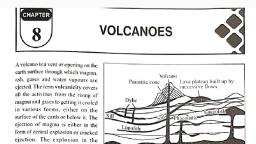
What Is It, Structure of a Volcano, The term “volcano” refers to mountain or hill, typically conical, having a crater, or vent in which lava, rock fragments, hot vapor, and gas are or have been erupted, from the earth's crust. The lava and other volcanic materials originated from molten, materials called magma found beneath the surface of the Earth. Magma and other, volcanic materials are finding its way to the surface where they are expelled through, openings like cracks and holes. Any activity that includes the movement of magma, towards or onto the surface is called volcanism., ., , ., , Figure 3. The Structure of volcano, Illustrated by: Ellissa Christie Kaye L. Murillo, , The Parts of a Volcano are:, ⮚ Summit is the highest point or the apex of the volcano. At the summit,, you have an opening called vent., ⮚ Slopes are the sides or flanks of a volcano that radiate from the main or, central vent., ⮚ Base is lower outer part of the volcano., Other Geologic features of a volcano:, Magma Chamber is a region beneath the vent of a volcano where molten, rock or magma is deposited or stored before eruption., , 7, , CO_Q3_Science 9_ Module 1
Page 12 :
Main Vent is the main opening or outlet on the surface of a volcano that, emits lava, gases, ash or other volcanic materials., Conduit is an underground central tube-like or pipe-like structure of a, volcano that connects the magma chamber to the crater through which, the magma travels., Side Vent is a smaller outlet through which magma escapes., Crater is the mouth of the volcano which is a funnel-shaped or bowlshaped hollow at the top of the vent from where magma, ash and gas, comes out., Lava is a molten rock which is given off onto the surface of the Earth, when a volcano erupts., Ash and Gas Cloud is a of mixtures of rock, minerals, glass particles and, gases expelled or pushed out of the volcano during volcanic eruption., , Classification of Volcanoes, There are several ways by which volcanoes can be classified. They can be, classified based on structure and activity., Types of Volcanoes Based on Structure, One way to classify different types of volcanoes is through the structure, characterized by their shape, parts and formation., Cinder Cone Volcano, , Figure 4 Cinder Cone Volcano, Zzyzx, Volcanic Cinder Cone, November 16, 2003,, https://commons.wikimedia.org/wiki/File:Volcanic_Cin, der_Cone_-_panoramio.jpg, , Cinder cone volcanoes are the simplest, type of volcano. They are built from particles and, blobs of solidified lava ejected from a single vent., Lava is thrown into the air, which breaks into, small fragments that solidify and fall as cinders, around the vent to form a circular or oval cone., Most cinder cones have a steep slope, wide, crater and are the most abundant of the three, major volcano types. An example of this type in, the Philippines are Taal Volcano in Batangas,, Smith Volcano found in Babuyan Group of, Islands, Mount Mayabobo found in Quezon, Province, and Mount Musuan in Bukidnon. An, example of this outside of the Philippines is the, Paricutin volcano in Mexico., , Figure 4.1 Mount Babuyan, , Figure 4.2 Taal Volcano, , Bing Ramos, “Smith Volcano”, April 4, 2006,, https://commons.wikimedia.org/wiki/File:Smith_Volca, no_1.jpg, , therealbrute, “ Binintiang Malaki volcanic cone of Taal volcano in the, Philippines”,, May, 15,, 2010,, https://commons.wikimedia.org/wiki/File:Volcanic_Cone_in_Taal_Lake_in_t, he_Philippines_-_2010-05-15.jpg, , 8, , CO_Q3_Science 9_ Module 1
Page 14 :
Figure 5.4. Mount Rainier, , Figure 5.5. Mount Fuji, , Stan, Shebs,, “Mount, Rainier”,, July, 2005,, https://commons.wikimedia.org/wiki/File:Mount_Raini, er_from_west.jpg, , 名古屋太郎( Nagoya Taro), “Mount Fuji”, January 3, 2008,, https://commons.wikimedia.org/wiki/File:080103_hakkai, _fuji.jpg, , Shield Volcano, , Figure 6. Shield Volcano, Illustrated by: Ellissa Christie Kaye L. Murillo, , Shield volcanoes are large, broad volcanoes, that look similar to shields from above – hence, the name. These volcanoes are built almost, entirely of fluid lava flow thus these volcanoes, are not steep. They can be easily identified, because they are tall and broad, with flat,, rounded shapes. The lava is not accompanied, by pyroclastic materials, which makes shield, volcanoes relatively safe. Eruptions at shield, volcanoes are only explosive if water somehow, gets into the vent. Mauna Loa is one of the, largest shield volcanoes., , Figure 6.1 Mount Mauna Loa, Nula 666, “ Mount Mauna Loa”, September 13, 2010,, https://commons.wikimedia.org/wiki/File:Mauna_Kea_, from_Mauna_Loa_Observatory,_Hawaii_-_20100913.jpg, , Types of Volcanoes Based on Activity, Another way of classifying volcanoes according to the Philippine Institute of, Volcanology and Seismology (PHIVOLCS) is based on their activity as indicated by, their behavior and historical records., , , Active volcanoes are those volcanoes that have had at least one eruption, during the past 10,000 years. They are those that erupted recently and still, showing regular activity like emission of gases, lava and ash flows., , Inactive volcanoes, on the other hand, are those that have not erupted for, the last 10,000 years and is not expected to erupt again in a comparable time, scale of the future. There are no signs of volcanic activity for a long period of, time because magma supply is cut off. Also the physical form of the volcano, has signs of intensive weathering and erosion, 10, , CO_Q3_Science 9_ Module 1
Page 18 :
Signs of an Impending Volcanic Eruption, Philippine Institute of Volcanology and Seismology (PHIVOLCS) is the, government agency tasked with monitoring earthquakes and volcanoes in the, country. Based on their findings, here are the commonly observed signs when a, volcano is about to erupt., , Kevin Sebold, “Strombolian eruption”, March 30, 2013, https://commons.wikimedia.org/wiki/File:Fuego_Eruption.jpg, , What’s More, ACTIVITY 1: NAME MY PARTS, Label the parts of a volcano using the words inside the box and fill out the given table, with their correct descriptions. Write your answers on a separate sheet of paper., Magma Chamber, , magma, , Crater, , Main Vent, , Secondary Vent, , Lava, , Ash and Gas Cloud, , layers of lava and ash, , 14, , CO_Q3_Science 9_ Module 1
Page 19 :
Figure 9. Parts of a Volcano, Illustrated by: Ellissa Christie Kaye L. Murillo, , No., , Parts, , Description, , 1, 2, 3, 4, 5, 6, 7, 8, , ACTIVITY 2: WRITE MY TYPE, Identify the type of volcano (CINDER CONE, SHIELD VOLCANO, COMPOSITE, VOLCANO) as described by the following statements. Write your answers on a, separate sheet of paper., 1., 2., 3., 4., 5., 6., 7., 8., 9., 10., , It is the most abundant and the simplest type of volcano., It is built almost entirely of fluid lava flows., It is slightly domed structure that resembles a warrior’s shield., Mayon Volcano is an example of this type of volcano., It has a steep slope and wide crater., It is built from ejected lava fragments., It has a nearly perfect sloped structure., An example of this type of volcano is the Taal Volcano in Batangas., It is formed from alternate solidification of both lava and pyroclastic deposits., It can easily be identified because of its structure which is tall and broad with, flat rounded shape., 15, , CO_Q3_Science 9_ Module 1
Page 20 :
ACTIVITY 3: ACTIVE OR INACTIVE?, Refer to the given map below to identify the following volcanoes in the Philippines, whether ACTIVE or INACTIVE. Explain your answer and write them on a separate, sheet of paper., , Figure 10. Active and Inactive Volcanoes in the Philippines, Earth, shaker,, “Active, and, Inactive, Volcanoes, in, the, Philippines”,, January, 20,, 2020,, https://web.facebook.com/earthshakerph/posts/volcanoes-in-the-philippinesas-a-geologically-active-archipelago-that-islocated/2673344532719667/?_rdc=1&_rdr, , 16, , CO_Q3_Science 9_ Module 1
Page 21 :
1. Smith Volcano, also known as Mount Babuyan, is a cinder cone on Babuyan, Island, the northern most of the Babuyan group of islands on Luzon Strait,, north of the main island of Luzon in the Philippines., Answer. ___________________, 2. Mount Matutum can be found in Acmonan, Tupi South Cotabato,, Philippines. Matutum and its foothills are predominantly inhibited by, indigenous Blaan families., Answer. ____________________, 3. Mount Makaturing is a stratovolcano on Mindanao Island in the Philippines., It is found in the province of Lanao del Sur in the Bangsamoro autonomous, region in Muslim Mindanao., Answer. ____________________, 4. Mount Kalatungan is a volcanic mountain located in the province of, Bukidnon in the Southern Philippines., Answer. ____________________, 5. Mount Alu is located on the eastern tip of island town in Lugus in the province, of Sulu in the Southernmost Philippines., Answer. ____________________, , ACTIVITY 4: THE GREAT IMPACT, Write TRUE on the space provided if the statement is correct and FALSE if incorrect., On the last column, write a short explanation if your answer false. Write your, answers on a separate sheet of paper., TRUE, or, FALSE, , STATEMENTS, , EXPLANATION, , 1. Inactive volcanoes are those volcanoes that has, had at least one eruption during the past 10,000, years., 2. Mount Mayon is an example of a shield volcano., 3. Magma is a molten rock which give off onto the, surface of the Earth when a volcano erupts., 4. The term volcano refers to a mountain or hill., 5. Cinder cone volcanoes are a large, typically steepsided volcano., 6. Slope is the highest point of the apex of the, volcano., 7. Plinian eruption is a periodic, weak to violent, eruption characterized by fountain lava., 8. Cinder cone volcanoes are the simplest type of, volcanoes., 9. Base is the lower part of volcano., 10. Mauna Loa is the largest shield volcano., 17, , CO_Q3_Science 9_ Module 1
Page 22 :
What I Have Learned, Write the word/s that correctly complete the statement. Write your answer on a, separate sheet of paper., , 1. __________ is a natural opening in the surface of the Earth where molten rocks,, hot gases, smoke, and ash are ejected, , 2. Major parts of volcanoes are: __________, the highest point; __________ the side;, and __________ the lower part of the volcano., , 3. Volcanoes are classified as _________ or __________ based on their records of, eruption., , 4. According to structure of volcanoes are classified as __________, __________,, and __________., , 5. __________ are those volcanoes that has had at least one eruption during the, , last 10,000 years and _____________ are volcanoes that have not erupted for, the last 10,000 years and is not expected to erupt again in a comparable time, scale of the future., , 6. Volcanoes that are large, broad and look like shield from the above are called, __________, those with steep slope and wide are called ________ and those, typically steep-sided and symmetrical cones of large dimension are called, __________., 7. Mayon Volcano, Taal Volcano, Mount Kanlaon, Bulusan Volcano and Mount, Pinatubo are examples of _______ volcanoes because they erupted just recently, and more frequently than others., , 8. Examples of inactive volcanoes in the Philippine are __________ and ______., 9. The following are the types of volcanic eruption: __________, __________,, __________, __________, and __________., , 10. There, , are, observable, signs, of, impending, volcanic, eruption., ______________________, _______________________ and ______________________, are examples of these signs., , 18, , CO_Q3_Science 9_ Module 1
Page 23 :
What I Can Do, Create an advocacy material or activity (flyer, jingle, poem composition, advocacy, video, etc.) on raising awareness about the signs of an impending volcanic eruption., Your work/performance will be rated using the given rubric., Criteria, Accuracy of, the content, Originality, and creativity, Clarity of the, message, , 4, All, information, presented are, complete and, reliable., It shows, originality and, creativity., The message, conveyed is, very clear., , Description, 3, 2, Most of the, Some, information, information, presented are, presented are, complete and, complete and, reliable., reliable., It shows, It shows, originality and creativeness., no creativity., The message, The message, conveyed is, is conveyed is, clear., not clear., , 1, Only few of, the, information is, correct., No originality, and no, creativity., No message, conveyed., , Assessment, Directions: Choose the letter of the best answer. Write the chosen letter on a, separate sheet of paper., 1., , Which statement is INCORRECT?, A. Volcanoes give information about inner Earth., B. Volcanoes can be found on land and ocean floor., C. Volcanoes show precursory signs before eruption., D. Volcanoes that do not produce lava is not dangerous., , 2., , Which of the following CORRECTLY describes the main vent of the volcano?, A. It is the part where magma is stored., B. It is the central tube-like structure of the volcano., C. It is the smaller outlet through which magma is ejected., D. It is the channel through which magma travels to the surface of the, Earth., , 19, , CO_Q3_Science 9_ Module 1
Page 24 :
For questions 3-5, refer to Figure 1.1 (Parts of a volcano), , Illustrated by: Ellissa Christie Kaye L. Murillo, , 3., , Which of these is CORRECTLY matched?, A. 1: magma flow, B. 2: magma chamber, C. 3: slope, D. 4: lava, , 4. What part of the volcano serves as the region under the surface of the Earth where, hot molten magma is collected?, A. lava flow, B. main vent, C. secondary vent, D. magma chamber, 5. What is the term used to represent the opening of the volcano where magma, comes out?, A. chamber, B. crater, C. summit, D. vent, 6. What type of volcanoes are formed from viscous or sticky lava that does not flow, easily?, A. cinder cones, B. composite volcanoes, C. lava domes, D. shield volcanoes, 7., , Which of the following is TRUE about cinder cone?, A. It is built from particles and blobs of solidified lava ejected from a single, vent., B. Lava coming out from this volcano is not accompanied by pyroclastic, materials., C. Lava blown out from this volcano breaks into small fragments solidify and, fell as cinder around the vent., D. It is formed from viscous magma being erupted effusively onto the surface, and then piling up around the vent., , 20, , CO_Q3_Science 9_ Module 1
Page 25 :
8. Which type of volcanoes have broad bases and steep slopes and are formed by, alternating layers of lava flows, volcanic ash, cinders, blocks and pyroclastic, materials?, A. cinder cones, B. composite volcanoes, C. lava domes, D. shield volcanoes, 9. What is the basis of classifying volcanoes as active or inactive?, A. size of the base, B. shape of the cone, C. age of the volcano, D. records of eruption, 10. Which of the following statements is CORRECT?, A. Active volcanoes do not have magma supply while inactive volcanoes, have magma supply., B. Active volcanoes exhibit volcanic activity within the last 10 000 years, while inactive volcanoes have no record of eruption., C. Inactive volcanoes are those that erupted recently and showing regular, activity while active volcanoes exhibit no sign of volcanic activity., D. Inactive volcanoes exhibit sign of emissions of molten materials and gases, while active volcanoes show no sign of emission, 11. Which are considered active volcanoes in the Philippines?, I. Mayon Albay, III. Kanlaon in Negros Island, II. Calayan in Cagayan, IV. Hibok-hibok in Camiguin, A. I and II only, B. I, II, and III only, C. I, II, and IV only, D. I, III, and IV only, 12. The eruption of Mount Pinatubo in the Philippines on June 15, 1991, was the, second largest of the 20th century. Its eruption was characterized as an, excessively explosive type of eruption of gas and pyroclastic. Which type of the, eruption is this?, A. Phreatic, B. Phreatomagmatic, C. Plinian, D. Strombolian, 13. Which of these is TRUE for a Phreatomagmatic eruption?, A. It is a silent eruption due to oozing lava, B. Its eruption is characterized by fountain lava., C. Its eruption has resulted to sideway emission of pyroclastic., D. It is a short-lived eruption and maybe an onset of a major eruption., 14. What is the most important sign of an impending volcanic eruption which is also, referred as seismic activity?, A. crater glow, B. ground swell, C. volcanic tremor, D. dried vegetation, 15. Which of these is NOT a sign of a forthcoming volcanic eruption?, A. crater glow, B. volcanic tremors, C. drying up of vegetation, D. increased amount of rainfall, 21, , CO_Q3_Science 9_ Module 1
Page 26 :
Additional Activities, CONCEPT MAPPING, Construct a concept map about volcano using the term/phrases found inside the, box. Write your answer on a separate sheet of paper., cinder cone, , active, , composite, , inactive, , shield, , volcano, , crater glow, , volcanic tremor, , drying up vegetation, , increased steaming activity, , ground swelling, , 22, , CO_Q3_Science 9_ Module 1
Page 27 :
23, 1., 2., 3., 4., 5., , Active, Active, Active, Inactive, Inactive, , 1. Cinder cone, 2. Shield, volcano, 3. Shield, volcano, 4. Composite, volcano, 5. Cinder cone, 6. Cinder cone, 7. Composite, volcano, 8. Cinder cone, 9. Composite, volcano, 10. Shield, volcano, , Activity 2, , Activity 3, , Activity 4, , 1. D, 2. D, 3. B, 4. C, 5. D, 6. C, 7. D, 8. D, 9. D, 10. B, 11. D, 12. A, 13. A, 14. A, B, , What I Know, , What’s In, Answer may vary, Activity 1, , Answer Key
Page 28 :
1., 2., 3., 4., 5., 6., 7., 8., 9., 10., 11., 12., 13., 14., 15., , 24, Additional Activities, Answers may vary., , D, D, B, D, B, B, A, B, D, B, D, C, C, C, D, , 1. Volcano, 2. summit, slope, base, 3. active , inactive, 4. cinder cone, composite volcano,, shield volcano, 5. active, inactive, 6. shield volcano, cinder cone, composite volcano, 7. active, 8. Arayat, Apo (answer may vary), 9. Phreatic, Phreatomagmatic, Strombian, Vulcanian,Plinian, 10. Crater glow, volcanic tremors, ground, swell (answer may vary), Assessment, What I Can do, Answers may vary., , What I Have Learned